

EV vs Gas: The Real Cost Comparison Over 5 Years
Compare charging, fuel, maintenance, and ownership costs over five years so you can see whether an EV or gas car fits your real driving pattern.
I manage 80 vehicles — here’s what I actually know about EV costs
I run logistics for a regional distribution company. Eighty vehicles across the fleet — box trucks, cargo vans, sedans for the sales team. Over the past three years, we’ve phased in 22 electric vehicles alongside the existing gas fleet, and I can tell you that the real-world numbers look nothing like the brochure numbers. They’re not worse, necessarily. They’re just different in ways nobody warned us about.
On weekends I’m under the hood of a ‘72 Chevelle, so trust me when I say I have zero tribal loyalty in the combustion-versus-electric debate. I love a carbureted V8 as much as anyone. But when the boss asks me whether the next batch of fleet replacements should be EVs or gas, I don’t answer with feelings. I answer with spreadsheets.
This article is the framework I use to do that analysis, broken down so anyone can run the same comparison for their personal vehicle. No hand-waving, no cherry-picked stats. Just the numbers you need to plug in and the calculators to crunch them.
How much does it really cost to charge an EV?
The single biggest misconception about EVs is that electricity is basically free compared to gas. It’s cheaper, yes — but how much cheaper depends entirely on how and where you charge.
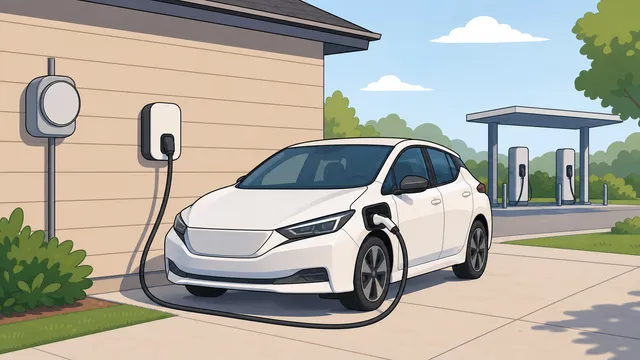
Home charging on a Level 2 setup at off-peak rates? You might pay the equivalent of $1.00–$1.50 per gallon of gas in energy costs. DC fast charging at a commercial station during peak hours? That number can climb to $3.00 or more per gallon-equivalent. I’ve seen fleet drivers rack up charging bills that made me do a double-take, all because they were exclusively using highway fast chargers instead of plugging in overnight at the depot.
The variables that matter: your local electricity rate (cents per kWh), your vehicle’s efficiency (miles per kWh), and how you split your charging between home, work, and public stations. Those three inputs change everything.
Use the EV Charging Cost Calculator to figure out what you’re actually spending — or what you would spend — on electricity per mile:
Distance unit
Petrol comparison and break-even tariff
Single charge session
Estimated charging cost
£103.89
Monthly total for 1,000 mi, with 80% charged at home and the rest at the away/public tariff.
- Annual charging cost
- £1,246.67/yr
- Cost per 100 mi
- £10.39
- Wall energy per month
- 277.78 kWh
- Blended cost per mi
- £0.104/mi
| Home charging | £62.22/mo |
| Away/public charging | £41.67/mo |
| Battery energy | 250.00 kWh/mo |
| Charging losses included | 27.78 kWh/mo |
Single charge session
Charging from 20% to 80% adds 45.00 kWh at the battery, draws 50.00 kWh from the charger, and covers about 180 mi.
- Home rate
- £14.00
- Away/public rate
- £37.50
- Blended mix
- £18.70
Tariff scenarios
All miles at home tariff
£77.78/mo
£0.280/kWh - £0.078/mi - Shows what the same mileage costs if every mile is replenished at your home rate.
Half-price off-peak tariff
£38.89/mo
£0.140/kWh - £0.039/mi - Useful for testing whether an overnight EV tariff would materially change running cost.
All miles at away/public tariff
£208.33/mo
£0.750/kWh - £0.208/mi - Shows the penalty if the same mileage is mostly rapid, workplace, or destination charging.
Run this with your real electricity rate, not the national average. Rates vary wildly by state and utility. A friend of mine in California pays $0.38/kWh on his top tier. A colleague in Tennessee pays $0.10. Same car, wildly different operating costs.
The result matters most when you translate it into your actual charging mix. An EV that gets most of its energy at home overnight can look brilliant on a spreadsheet. The same EV living on public DC fast chargers and apartment-complex pricing can lose a lot of that advantage. If your plan depends on cheap home charging, be honest about whether you actually have cheap home charging.
What gas mileage does your current car really get?
Here’s the other side of the ledger, and it’s the one where most people kid themselves. Your car’s EPA fuel economy rating is a laboratory number. Real-world mileage is almost always lower — sometimes significantly.
In our fleet, the sedans rated at 32 MPG average closer to 27 in mixed city-highway driving. The cargo vans rated at 24 MPG are pulling 19–20 when loaded. That gap between rated and actual fuel economy compounds over five years and tens of thousands of miles. If you’re basing your cost comparison on the sticker number, you’re understating the gas side of the equation.
Track your real mileage for a couple of tanks. Fill up, reset the trip odometer, drive until you need fuel again, fill up, and divide the miles driven by the gallons pumped. It’s a two-minute exercise that gives you a number you can actually trust.
The Gas Mileage Calculator does exactly this — enter your odometer readings and fuel fill-ups to get your true MPG:
Gas mileage result
25 MPG
Real-world efficiency based on 300 miles and 12 gallons. Full-tank estimate: 375 miles.
9.41 L/100km
Converted equivalent
10.63 km/L
Kilometres per litre
$42.00
Trip fuel cost
375 mi
Estimated full-tank range
Efficiency sheet
| Miles per gallon | 25 MPG |
| Litres per 100 km | 9.41 L/100km |
| Kilometres per litre | 10.63 km/L |
| Cost per mile | $0.14 |
| Cost per kilometre | $0.09 |
| Cost per 100 miles | $14.00 |
| Cost per 100 km | $8.70 |
| Estimated full-tank range | 375 mi / 603.5 km |
Benchmark trip rows
These rows keep your measured efficiency the same and scale the journey length.
| Trip | Distance | Fuel used | Trip cost |
|---|---|---|---|
| 25 mi | 25 mi | 1 gal | $3.50 |
| 100 mi | 100 mi | 4 gal | $14.00 |
| 300 mi | 300 mi | 12 gal | $42.00 |
Tank range checkpoints
Range estimates below assume the same measured mileage at different fill levels.
| Tank level | Fuel in tank | Estimated range |
|---|---|---|
| Quarter tank | 3.75 gal | 93.75 mi |
| Half tank | 7.5 gal | 187.5 mi |
| Full tank | 15 gal | 375 mi |
Once you know your real MPG, you’ve got half the gas cost equation. The other half is the price at the pump — and that’s where the next calculator comes in.
This is also where I would stop using brochure language and start using lived reality. Highway commuters, school-run traffic, winter warmups, roof boxes, bad weather, and a heavy right foot all change the number. If your real-world MPG is five miles lower than the sticker, that difference gets multiplied across every year you own the car.
What does gas really cost over five years?
Here’s the math that matters. Take your annual mileage, divide by your real-world MPG, multiply by the price per gallon, and repeat for five years. Simple in concept, but most people never do it — and the totals are sobering.
Let’s walk through an example from our fleet. A sales rep drives 18,000 miles a year. Their sedan gets 27 MPG in practice. At $3.40 per gallon, that’s 667 gallons per year, costing about $2,267 annually. Over five years, that’s $11,335 in fuel alone — and that’s assuming gas prices stay flat, which they never do.
Compare that with the EV equivalent in our fleet. Same 18,000 miles, an efficiency of 3.5 miles per kWh, charged mostly at the depot at $0.12/kWh. That works out to 5,143 kWh per year, costing about $617 annually. Over five years: $3,086.
The fuel cost difference alone is over $8,000 in this scenario. That’s real money, but it’s not the whole story — which I’ll get to in a moment.
Use the Fuel Cost Calculator to project your own gas costs based on your actual driving patterns:
Round-trip fuel cost
$11.67
100.00 mi planned · 3.33 gal used
$11.67
One round trip
$11.67
Average cost per trip
$11.67
Cost per 100 mi
3.33
gal per round trip
| Base trip distance | 100.00 mi |
| Fuel cost for one trip | $11.67 |
| Fuel used | 3.33 gal |
| Total distance | 100.00 mi |
| Trip multiplier | 2x distance |
| Cost per 100 mi | $11.67 |
| Cost per mi | $0.117 |
Fuel-price sensitivity
Small pump-price swings matter more when the same route repeats often. Use this table to budget around a cheaper or higher fill-up price.
| Scenario | Fuel price | Plan cost | Per mi |
|---|---|---|---|
| 10% cheaper fuel | $3.15 | $10.50 | $0.105 |
| Entered fuel price | $3.50 | $11.67 | $0.117 |
| 10% higher fuel price | $3.85 | $12.83 | $0.128 |
Efficiency scenario comparison
Traffic, speed, weather, and load can easily move real fuel economy by about 10%. This comparison shows how that affects fuel used and total budget.
| Scenario | MPG | Fuel used | Plan cost | Per mi |
|---|---|---|---|---|
| 10% worse economy | 27.00 | 3.70 gal | $12.96 | $0.130 |
| Entered fuel economy | 30.00 | 3.33 gal | $11.67 | $0.117 |
| 10% better economy | 33.00 | 3.03 gal | $10.61 | $0.106 |
How to read the estimate
Use the one-trip cost when you want a quick answer for a specific drive. The planned total is more useful for commute budgeting, delivery work, shared travel, or repeat school runs because it multiplies the same route across all entered trips.
The cost-per-100-mi figure makes vehicle comparisons faster than raw trip totals, especially when two routes are different lengths. If your real-world economy is usually worse than the official label, edit the efficiency input downward for MPG or upward for L/100km.
Plug in your real numbers — your actual mileage, your actual MPG from the calculator above, and a realistic fuel price. Don’t use last month’s low. Average it across the year or use a slight upward projection if you want to be conservative.
Once you have this number and the EV charging number, put them side by side before you go any further. That gap is the operating-cost advantage EV buyers love to talk about, and it is real. But it is only one line in the five-year ownership picture, not the whole argument.
What costs do these calculators not capture?
Energy costs are the easiest part to quantify, but a five-year comparison has to account for several other line items that change the picture.
Maintenance. This is where EVs pull further ahead. No oil changes, no transmission fluid, no timing belts, no exhaust system. Brake pads last dramatically longer because regenerative braking does most of the work. In our fleet, maintenance costs per mile on the EVs are running about 40% lower than the equivalent gas vehicles. Over five years, that adds up to thousands in savings.
Depreciation. This one is trickier and cuts against EVs right now. Battery technology is advancing fast enough that a three-year-old EV can feel outdated in ways that a three-year-old gas car doesn’t. Resale values on used EVs have been volatile. This is improving as the market matures, but it’s a real factor in a five-year cost analysis.
Insurance. EVs tend to cost more to insure because repair costs are higher — replacement battery packs and specialised body panels aren’t cheap. In our fleet, insurance premiums on the EVs run about 10–15% higher than comparable gas models.
The upfront price gap. Even with incentives, most EVs still cost more to purchase than their gas equivalents. That premium has been shrinking every year, but it hasn’t disappeared. Whether the fuel savings offset it over your ownership period depends entirely on your mileage and local energy prices — which is exactly why you need to run the numbers yourself instead of relying on somebody else’s averages.
I would add three more items to the grown-up version of the spreadsheet.
Home charging setup. If you need a Level 2 charger, panel work, or a long cable run, the installation cost belongs in the comparison. If you already have a convenient garage circuit, great. If you need electrical work, pretending that cost does not exist is just optimistic accounting with nicer branding.
Registration fees and incentives. Some states charge EV-specific registration fees. Incentives can help, but they are a moving target by state, utility, income level, model eligibility, and purchase date. Do not assume any federal or state credit is there until you confirm the current rules. Tax-credit law and charging-equipment incentives have changed repeatedly, and as of April 3, 2026, you should verify current IRS and state guidance before letting a credit make the deal look better than it is.
Depreciation on the exact model. EV resale is not one single market. A popular used EV with solid range and battery reputation behaves differently from an older compliance car or a model with price-cut whiplash in its history. Gas cars are not one market either. Compare the actual models you are considering, not a generic “EV” and a generic “gas car”.
So when does an EV actually win on cost?
If you drive a lot of miles, charge at home or at a depot with reasonable electricity rates, and plan to keep the vehicle for at least four years, the EV will almost certainly cost less to operate. The fuel savings are substantial and the maintenance gap is real.
If you drive fewer miles, rely heavily on public fast charging, or plan to trade in after two to three years, the math gets much tighter — and in some cases, a fuel-efficient gas car still wins on total cost of ownership.
There is also a middle case that catches a lot of buyers: you drive moderate miles, you can charge at home some of the time, and the EV still saves money on energy but not enough to erase the higher purchase price quickly. That is not a bad answer. It just means the decision may come down to how long you keep cars, whether you value quieter driving and lower maintenance hassle, and how much volatility you can tolerate in resale values.
Don’t let anyone — EV enthusiast or gas loyalist — tell you there’s a universal answer. There isn’t. The answer is in your numbers: your mileage, your electricity rate, your fuel price, your driving patterns. The three calculators above give you the foundation to build that comparison honestly.
Run them. Compare the results. Then make the call based on your situation, not someone else’s marketing deck.
This article is informational, not personalised financial or tax advice. Vehicle incentives, registration fees, tax treatment, utility tariffs, and insurance pricing vary by state and by driver. Before you sign for a vehicle because a spreadsheet says the five-year total works, check the live incentive rules, your actual insurance quote, and the charging setup you will really use.
Calculators used in this article
Transport / Electric Vehicles
EV Charging Cost Calculator
Calculate EV charging cost from monthly mileage, vehicle efficiency, home and public electricity tariffs, charger efficiency, battery charge percentage.

Transport / Fuel Efficiency
Trip Cost Calculator
Estimate trip fuel cost, road trip fuel split, gas mileage, commute cost, and US mileage reimbursement from one consolidated transport planning calculator.
Transport / Fuel Efficiency
Trip Cost Calculator
Estimate trip fuel cost, road trip fuel split, gas mileage, commute cost, and US mileage reimbursement from one consolidated transport planning calculator.