

Party Planning Checklist: Timeline, Food, and Budget Tips
Plan a party without last-minute panic by working backwards from the date, estimating food and drink properly, and sorting tips and split bills ahead of time.
I’ll be honest with you: the last birthday party I threw for my youngest nearly broke me. Not financially, although the pinata budget did get a bit silly, but mentally. I forgot to order the cake until two days before, ran out of paper plates halfway through, and somehow tipped the caterer twice because I couldn’t remember whether I’d already done it. Classic me.
Since then, I have become a full-on party planning convert. Spreadsheets, countdowns, shopping lists stuck to the fridge, the lot. And annoyingly, it works. When you are not standing in the kitchen trying to remember whether you bought enough buns for the burgers, you can actually enjoy the people you invited.
That is the real point of a good party planning checklist. It is not about turning your barbecue into a military operation. It is about making the practical bits boring enough that the fun bits can happen without you having a small internal breakdown next to the crisps.
So whether you are planning a children’s birthday, a summer barbecue, a baby shower, or a grown-up dinner party you would like to survive without muttering at your oven, here is the party planning system I keep coming back to.
How far in advance should you start planning a party?
This sounds obvious, but hear me out. The single biggest mistake I see people make, and yes, I am absolutely including myself here, is not giving themselves enough runway. You need to know exactly how many days you have between now and party day because that one number shapes everything else. Venue or home? Catered or homemade? Fancy cake or supermarket one with a few strategic berries on top? All of that depends on time.
Got six weeks? Lovely. You can shop around, compare prices, chase RSVPs, and order the cute personalised bits that make you look much more organised than you feel. Got ten days? We are no longer “planning a party”, we are triaging.
I use the Date Difference Calculator to work out exactly how many days I am dealing with. It saves me from vague optimism and from that thing where you keep saying “it’s not for ages” until suddenly it is next Saturday.
Quick examples
Load a common date-counting scenario, then adjust the dates to match your own timeline.
Include the end date
Turn this on when both dates should count as part of the span.
Result
180 days between dates
7 June 2026 to 4 December 2026, excluding the end date.
- Calendar breakdown
- 0y 5m 27d
- Business days
- 129
- Full weeks + days
- 25w 5d
- Total weeks
- 25.71
- Weekend days
- 51
- Weekday span
- Sunday to Friday
Range checkpoints
Use these quarter-span markers to plan reviews, reminders, or handoff points inside the same date range.
| Checkpoint | Date | Calendar days from start | Business days from start |
|---|---|---|---|
| 25% point | 22 July 2026 (Wednesday) | 45 | 32 |
| Halfway point | 5 September 2026 (Saturday) | 90 | 65 |
| 75% point | 20 October 2026 (Tuesday) | 135 | 96 |
Inclusive versus exclusive comparison
Compare the raw elapsed result with the version that counts both dates.
| Rule | Calendar breakdown | Total days | Weeks | Business days |
|---|---|---|---|---|
| Exclude end date | 0y 5m 27d | 180 | 25.71 | 129 |
| Include end date | 0y 5m 28d | 181 | 25.86 | 130 |
How to use this result
Use total days for plain elapsed-time questions, the calendar breakdown for anniversaries and age-style interpretations, and the business-day figure when the practical question is how many weekdays sit inside the same range.
The weeks-plus-days readout is usually the fastest way to turn the result into a project timeline, while the weekend-day total helps you see how much of the same span falls outside a standard Monday-to-Friday workweek.
Once you have your number, treat it like a proper countdown rather than a foggy feeling. If the calculator shows 42 days, that means this week is for locking in the date, the guest list, and the big decisions. If it shows 14 days, your priority is final headcount, groceries, and anything with a delivery window. If it shows 3 days, stop browsing balloon arches on the internet and buy the ice.
Here is the rough timeline I swear by now:
- 6+ weeks out: Book the venue, choose the party style, draft the guest list, send invitations.
- 4 weeks out: Plan the menu, order cakes or custom items, borrow or rent anything you do not own.
- 2 weeks out: Chase missing RSVPs, finalise numbers, buy decorations and other non-perishables.
- 1 week out: Confirm vendors, plan your cooking schedule, do the pantry and freezer shop.
- 2-3 days out: Buy fresh ingredients, prep anything that can be made ahead, tidy the house enough that nobody has to step over Lego.
- Day before: Set up decorations, lay out serving bits, chill drinks, and put tomorrow’s jobs in order.
- Day of: Fresh food prep, final tidy, ice run, music on, breathe.
My middle child’s seventh birthday ran beautifully because I followed this exact rhythm. I even made a three-layer rainbow cake from scratch. Was it perfectly straight? Not even slightly. Did she think it was magic? Yes, and that is really the standard I am aiming for.
How do you turn your guest list into a realistic party budget?
If you ask me what drives party costs more than anything else, it is not the balloons or the themed napkins or even the cake. It is headcount. Every extra guest means more food, more drinks, more chairs, more table space, more favours if you are doing them, and usually a bit more chaos. This is why the guest list is a budget decision, not just a social one.
Before I buy a single packet of bunting, I split the budget into four buckets:
- Food and drink
- Venue or setup costs
- Decorations and extras
- Buffer money for the things I forgot
For a home party, food and drink usually take the biggest share. For a venue party, the room hire may be the headline number, but food still sneaks up on you if you are not careful. The easiest way to stay sane is to choose a rough spend-per-head early. If your total budget is 300 and you have 15 guests, that gives you about 20 per person before surprises. If you suddenly invite 10 more people, the maths changes whether you like it or not.
This is where I try to be ruthlessly honest. A smaller guest list with enough food, places to sit, and room to breathe is better than a packed house where the buffet looks picked over after twenty minutes. If I need to save money, I cut complexity first, not hospitality. Fewer menu items, simpler decor, homemade traybakes instead of fancy individual desserts. Guests remember whether they felt welcome, not whether every cupcake matched the napkins.
One useful trick from years of feeding three children and a rotating cast of hungry cousins: choose one “hero” spend and let the rest be easy. Maybe it is the nice cake. Maybe it is hiring a local pizza van. Maybe it is the drinks trolley for an adult party. Not everything has to be special for the whole event to feel special.
How much food should you make for a party?
This is where my meal-prep brain wakes up properly. Food planning for parties is tricky because people eat differently when they are standing, chatting, grazing, and helping themselves than they do when they are sitting down to a plated meal. Buffet guests are optimistic people. They pile a plate like they have not eaten since Tuesday.
My default starting points look like this:
- Buffet mains: about 200 to 250g per adult, 120 to 180g per child depending on age
- Side dishes: about 100 to 120g per person, per side
- Salads: about 1 cup per person as a side
- Dessert: at least 1 portion each, and 1.25 to 1.5 if it is something people love
- Appetisers only: roughly 8 to 12 bites per person if there is no full meal coming after
- Drinks: around 1 drink per person per hour as a planning rule, then adjust for weather, age mix, and whether alcohol is being served
Those are starting points, not commandments carved into stone tablets. A daytime children’s party with squash, sandwiches, and cake will look very different from an evening barbecue with adults lingering for four hours. Competitor guides aimed at caterers make the same point over and over: buffet-style events need a buffer because self-service always nudges portions up.
My own rule is to make a little extra in the cheap, filling categories and keep tighter control on the expensive stuff. Pasta salad, rice, potatoes, bread rolls, tortilla chips, fruit skewers, and traybake cake save the day when appetites are larger than expected. Running out of steak is painful. Running out of pasta salad is almost offensive.
One trick I picked up while helping with my sister-in-law’s baby shower was to plan one extra portion for every five guests. So if I expect 20 people, I cook for about 24 portions overall. That covers seconds, one unexpected plus-one, and the fact that there is always one uncle who eats like he has just finished a marathon.
If you are serving children and adults, do not count them exactly the same. Little ones rarely eat a full adult portion, but teenagers absolutely can, and often with quite alarming dedication. I also make a point of checking whether I am planning a meal or a grazing table. The longer the party runs, the more “just one more nibble” happens.
What should you do once you know your party countdown?
The countdown number is only useful if you turn it into jobs. Otherwise it is just a mildly stressful fact.
When I have four or more weeks, I spread the work across normal life: one admin job, one shopping task, one kitchen task. That keeps the party from swallowing the entire month. When I have less time, I simplify fast. Fewer menu items. Less fussy decor. Shop once for the basics, once for the fresh bits, and stop inventing work for yourself.
This is also the moment to decide what can be outsourced. A supermarket cake can be upgraded with berries and a topper. Shop-bought hummus is not a moral failure. Frozen canapes are there for a reason. You do not get extra host points for exhaustion.
I learned this the hard way after trying to do a homemade dessert table, handmade party bags, and a full hot buffet for a school-holiday birthday. By the time guests arrived, I looked like a woman who had seen battle. Now I ask a simpler question: what has the biggest impact on the guests, and what is just creating more washing-up for me?
How do you handle tips and split bills without awkwardness?
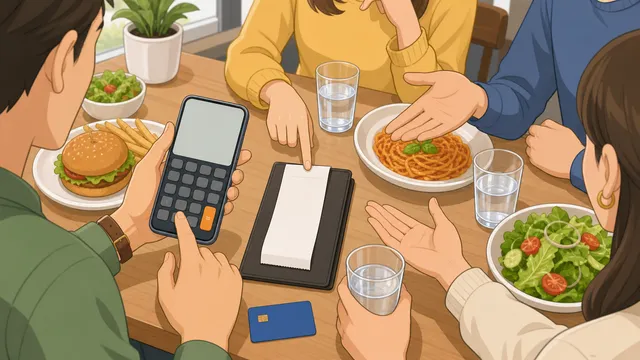
Now let us talk money in the specific, awkward, end-of-the-night sense. Nobody wants to be hunched over a phone trying to work out the tip while six other people are saying, “I think I already transferred you?” Last year, a group of us went out for a friend’s fortieth and spent a full fifteen minutes arguing about whether the tip should be calculated on the discounted bill or the original total. Reader, it was excruciating.
If you are eating out as a group, hiring catering staff, tipping a delivery driver, or paying a bartender for a party at home, sort the numbers before everyone is tired and ready to leave. I keep the Tip Calculator bookmarked because this is exactly the sort of maths I do not trust myself to do while balancing leftovers and handbags.
The general rules I tend to follow are:
- Restaurant group meal: around 15 to 20% of the final bill unless service is already included
- Catering team: often 15 to 20% of the catering total, or whatever has been agreed in the contract
- Delivery driver: a smaller percentage or flat amount, depending on distance and order size
- Bartender for a private party: either an agreed flat fee, a tip jar arrangement, or gratuity on the final bar tab
Use the Tip Calculator before the payment moment gets scrappy:
Tip basics
Work out gratuity, tax, and split totals for restaurant bills
Enter the bill, choose a tip rate, add tax if you want the full out-of-pocket total, decide whether to tip before or after tax, and split the final amount evenly across the table.
Quick bill scenarios
Tip percentage
Tip calculation base
Pre-tax is the cleaner percentage method; post-tax matches receipts or payment screens that calculate gratuity from the tax-inclusive total.
If the receipt already adds an automatic gratuity or service charge, enter it here. The calculator will show the extra tip needed to reach your target instead of double-tipping.
Round tip up to the next whole amount
Useful when you want a cleaner gratuity figure for payment or bill splitting.
Display currency
Switch the displayed bill summary currency without changing the gratuity math.
Once you have the number, make the next decision early: are you hosting, are you splitting evenly, or is everyone paying for what they ordered? Etiquette guidance for group dinners is very clear on one point: tell people upfront. If you invite everyone to celebrate and expect them to cover themselves, say so before the booking. If you are hosting, do not leave guests nervously guessing at the table. And if you are splitting, check whether the venue allows separate bills before anybody orders cocktails like they have won the lottery.
The calculator is especially handy when the result is not a neat figure. If the gratuity comes to 26.40 and six people are sharing, that is not the moment to start doing panicked mental arithmetic. Work it out, round sensibly, and tell everyone what their share includes. Tax and gratuity are the bits people forget when they say, “Oh, just send me my pasta.”
My golden rules for a stress-free party
After throwing more parties than I can count, three children will do that to a woman, I have boiled it down to a few non-negotiables:
- Never underestimate prep time. Whatever you think it will take, add at least 50%. Balloons are liars.
- Batch your shopping. One early trip for non-perishables, one later trip for fresh food, and done.
- Accept help properly. If someone asks what they can bring, give them a real job: ice, drinks, a salad, extra chairs, picking up the cake.
- Set a buffer in the budget. Even a small one stops the “one more thing” purchases from becoming ridiculous.
- Plan for how people actually behave. Buffets disappear faster than you think. Children ignore the expensive fruit platter and demolish the crisps. Adults will stand near the kitchen no matter how beautifully you style the sitting room.
- Make the easiest version of your best idea. This rule has saved me from many decorative spirals.
How do you actually enjoy the party once it starts?
The whole point of planning is so that you can be present on the day. I used to spend every party hovering in the kitchen, refilling bowls and asking people if they needed anything every three minutes like an anxious restaurant manager. Now I prep what I can the day before, set up a self-serve drinks spot, put serving spoons in everything, and let the party breathe a bit.
My oldest told me last Christmas that her favourite part of our parties is when I am “not being busy.” That one lodged straight in my chest. So yes, make the checklist. Use the calculators. Count the days properly. Work out the tip before everyone is halfway into their coats. But then put the clipboard down and go laugh with your guests. A well-planned party should feel easier, not tighter.
Calculators used in this article
Finance / Everyday Money / Tips & Bills
Tip Calculator
Use this tip calculator to compare gratuity percentages, include tax, credit automatic gratuity or service charges, round the extra tip.

Dates & Time / Date Calculations
Date Difference Calculator
Count days, weeks, months, business days, and range checkpoints between two dates with inclusive and exclusive comparisons.