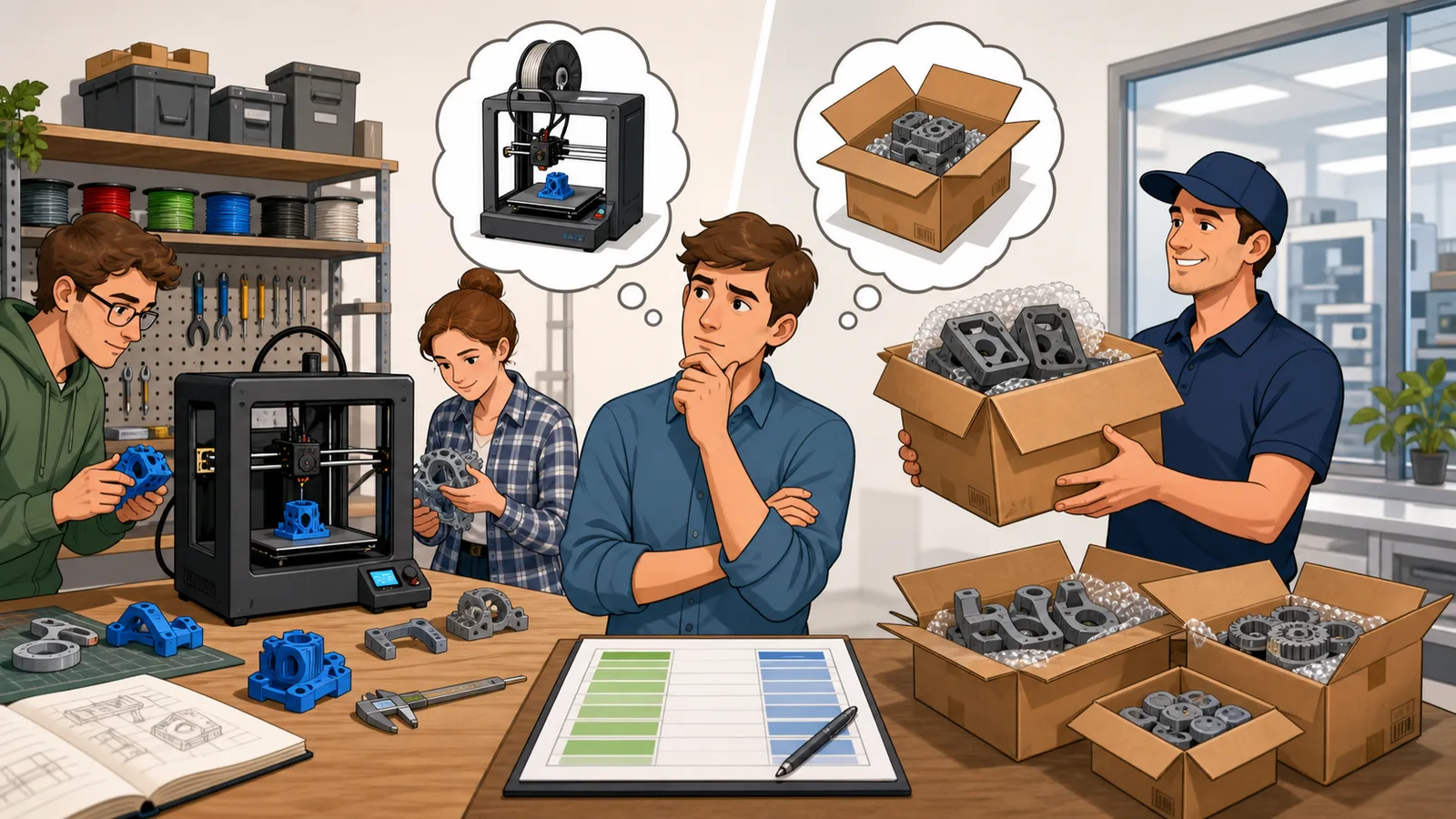
Compare buying a 3D printer with outsourcing using ownership overhead, labour, reprint allowance, shipping fees, break-even volume, payback timing.
Last updated
3D printer buy vs outsource calculator for real make-versus-buy planning Compare buying a 3D printer with outsourcing prints using the cost lines that usually decide
the answer in practice: maintenance, support overhead, operator labour, reprint allowance,
outside order fees, break-even volume, and payback timing.
Why this is stronger than a thin make-vs-buy sheet
Outsourcing often looks expensive per part but still wins at low volume because it avoids
idle machine cost, setup effort, failed-print risk, and annual support overhead. This
planner keeps those lines visible instead of pretending material cost alone decides the
buy-vs-outsource question.
Quick scenarios
Display currency
Set the reporting currency before entering or reviewing money inputs so the worksheet labels match your finance view.
Buy vs outsource
Buying is cheaper over the planning horizon
Buying saves $6,418.30 across 3
years, and the current volume of 90 prints a year is
above the modeled break-even threshold.
First-year in-house cost
$6,113.90
Ongoing annual in-house cost
$2,913.90
Effective in-house cost per print
$32.38
Annual outsource cost
$6,120.00
Break-even volume
33 / year
2.8 prints/month
Payback window
1 years
Annual run-rate gap: $3,206.10 buy advantage
Decision sheet
Annual fixed ownership cost
$1,050.00
Adjusted in-house variable cost per print
$20.71
Effective outsource cost per print
$68.00
Current volume gap per print
$35.62 buy advantage
Volume sensitivity
Use this check to see whether the make-versus-buy answer still holds if annual print demand lands below or above the current plan.
Scenario
Prints/year
Annual in-house
Annual outsource
Result
Lower demand
68
$2,458.28
$4,844.00
$2,385.72 buy advantage
Current plan
90
$2,913.90
$6,120.00
$3,206.10 buy advantage
Higher demand
113
$3,390.23
$7,454.00
$4,063.77 buy advantage
Horizon comparison sheet
Year
Cumulative buy cost
Cumulative outsource cost
Advantage
1
$6,113.90
$6,120.00
$6.10 buy advantage
2
$9,027.80
$12,240.00
$3,212.20 buy advantage
3
$11,941.70
$18,360.00
$6,418.30 buy advantage
Decision note Buying looks cheaper over 3 years. The first year where
cumulative buying becomes cheaper is year 1, so the printer only makes sense if you expect volume and utilisation to stay close to this plan.What to test next Stress the scenario by changing annual print volume, reprint allowance, and outsource order
fees. The volume sensitivity table is useful for spotting decisions that only work under unrealistically high utilisation. If the answer only flips there, outsourcing is often
the safer operations decision even when a simple materials-only sheet suggests buying.
3D printer buy vs outsource calculator for make-vs-buy planning, break-even volume, and
Use this 3D printer buy vs outsource calculator when the real question is whether to buy a machine or keep sending parts to a service bureau. It compares in-house ownership with outsourced 3D printing using printer cost, annual support overhead, operator labour, reprint allowance, shipping and order fees, break-even volume, and payback timing so you can judge when make-vs-buy actually flips.
How this 3D printer make-vs-buy calculator works
A useful buy-vs-outsource 3D printer calculator has to do more than compare printer price with outsource price per part. The in-house side includes annual maintenance, support overhead, material, setup and cleanup labour, and a waste allowance for failed or repeated prints. The outsource side includes not only the quoted part price, but also the annual friction around shipping, quote minimums, and order handling.
That is why this page separates first-year ownership cost from ongoing annual operating cost. The upfront purchase lands once, but labour, support tooling, and reprint risk keep showing up every year. If those recurring lines are ignored, buying can look cheaper on paper long before it is actually cheaper in operations.
The hidden ownership costs that usually decide the answer
Teams often underestimate the cost of owning a 3D printer because filament looks cheap compared with a bureau quote. In practice, the harder lines to ignore are operator time, safety gear, software, spare parts, failed prints, maintenance downtime, and the fact that an idle machine still has to justify its purchase. Those costs do not disappear just because the slicer says one part uses only a small amount of material.
For a low-volume workflow, those fixed and semi-fixed costs dominate. That is why buying a printer can still be the wrong answer even when the quoted outsource price per part looks high. If the printer will only run occasionally, the capital and support burden gets spread across too few jobs and outsourcing can stay cheaper for much longer than a simple material-only sheet suggests.
How to read break-even volume, cost per print, and payback
Break-even prints per year estimates the annual print volume needed for ownership to catch up with outsourcing across the selected planning horizon. If your modeled print volume is well below that threshold, outsourcing is usually the safer decision because the machine will not be used often enough to recover its fixed cost base.
Effective in-house cost per print is also important because it spreads annual fixed ownership cost across the current print volume. That makes it easier to compare a realistic cost per part against the outsourced quote. Payback then asks how many years the annual run-rate advantage needs to continue before the original printer purchase is recovered.
Why a volume sensitivity check matters more than a single answer
A make-vs-buy decision can look strong at one print volume and fragile at another. That is why the calculator now compares lower-demand, current-plan, and higher-demand cases around the same annual workflow. If buying only wins when the printer stays unusually busy, the model is telling you the decision is fragile, not robust.
This matters for prototype teams because demand rarely lands exactly on forecast. A quick sensitivity check helps separate a durable in-house case from a scenario that works only when everything goes right on utilisation.
Why low-volume prototyping often stays outsourced
A low-volume prototyping team may only need a handful of parts each month. In that case, outsourcing can win even if every part costs more, because service bureaus absorb the machine utilisation problem for you. You pay only when you order, and you avoid dedicating staff time, floor space, and maintenance effort to a capability that may sit idle most weeks.
The opposite can also be true. If you are printing fixtures, fit checks, or repeat prototype revisions every week, then buying can quickly outperform outsourcing because you eliminate repeated quote cycles, shipping delay, and per-order fees. That is the core make-vs-buy signal this page is designed to expose.
Worked example: when buying beats outsourced 3D printing
Suppose the printer costs 3,200, annual maintenance and wear parts are 450, annual ownership overhead is 600, material is 11 per print, labour is 8 per print, reprint allowance is 9%, and the team expects 90 prints per year. Suppose the outsourced quote is 58 per print plus roughly 900 a year in shipping, order handling, and minimum-fee friction across the full workflow.
The calculator turns that into an ongoing in-house cost of 2,913.90 per year and an annual outsource cost of 6,120. That makes the modeled break-even threshold about 33 prints per year, with payback around 1 year. In other words, once the workflow is active enough, buying can stop being a speculative capital expense and start behaving like an operating-cost reduction.
What this calculator does not cover
This planner does not model lead time, queueing risk, IP protection, quality assurance burden, staff training depth, tax treatment, financing, or the value of having multiple printing technologies available through a bureau. Those factors matter in procurement and operations decisions even when the cost math points clearly one way.
It also assumes the outsourced part price and internal cost structure stay broadly stable across the selected horizon. If your workflow is highly volatile, if the print mix changes materially, or if certain parts need industrial processes you would not own in-house, the result should be treated as a first-pass operating model rather than a final procurement answer.
Frequently asked questions
What is the main difference between a 3D printer buy vs outsource calculator and a normal 3D printing cost calculator?
A print-cost calculator answers, "What does one job cost?" A buy-vs-outsource calculator answers, "Should we own the capability or keep sending work out?" That second question needs fixed ownership cost, annual utilisation, and payback, not just filament and electricity.
Should operator labour really be included in a make-vs-buy 3D printing comparison?
Usually yes. Someone still slices the file, starts the machine, clears supports, checks part quality, and handles reprints. If that time is ignored, buying can look cheaper than it really is, especially in small teams where printing is not anyone's full-time role.
Why do annual outsource fees matter if I already know the per-part quote?
Because service bureaus often add shipping, minimum-order friction, quote handling, or repeat admin work that does not show up cleanly in a single unit price. Annualising those fees produces a fairer outsource cost comparison.
When does buying a 3D printer usually make more sense than outsourcing?
Buying tends to make more sense when print demand is frequent, turnaround speed matters, and the same workflow keeps consuming outsourced quotes month after month. It is especially compelling when the annual print volume is comfortably above the break-even threshold and the team can actually keep the machine busy.
Can outsourcing still be the better decision even if the printer pays back on paper?
Yes. A paper payback period does not capture every operations risk. Outsourcing may still be better if demand is uncertain, if parts require several different materials or processes, if quality assurance is critical, or if your team does not want to absorb maintenance and process ownership.
Why should I test lower and higher print volume scenarios?
Because volume risk is usually what breaks a weak buy case. If buying only beats outsourcing at one optimistic annual print count, the safer real-world decision may still be to outsource until demand is more stable.
Why include a reprint and waste allowance?
Because failed starts, support mistakes, tuning cycles, warped parts, and repeated prototypes all consume labour and material. A waste allowance does not assume everything fails; it simply stops the model from pretending every print run is perfect.
Does this calculator work only for desktop FDM printers?
The structure fits desktop FDM best, but the planning logic still applies more broadly. You can use it for other printer types if the ownership cost, labour, and outsource quote reflect that process realistically. The main limitation is that specialist industrial workflows often have more complex support equipment and post-processing than a simple worksheet can show.
How should I interpret a very high break-even volume?
A high break-even volume usually means one of two things: the machine and support burden are expensive for the planned workload, or the outsourced quote is not high enough above in-house variable cost to justify owning the capability. In both cases, outsourcing is often the safer short-term decision.
Why can buying look cheaper after the first year but still be risky?
The first-year hurdle is only part of the story. If volume drops, if the printer is underused, or if staffing and downtime costs rise, the expected annual advantage can disappear quickly. That is why the horizon comparison and quick-scenario testing matter.