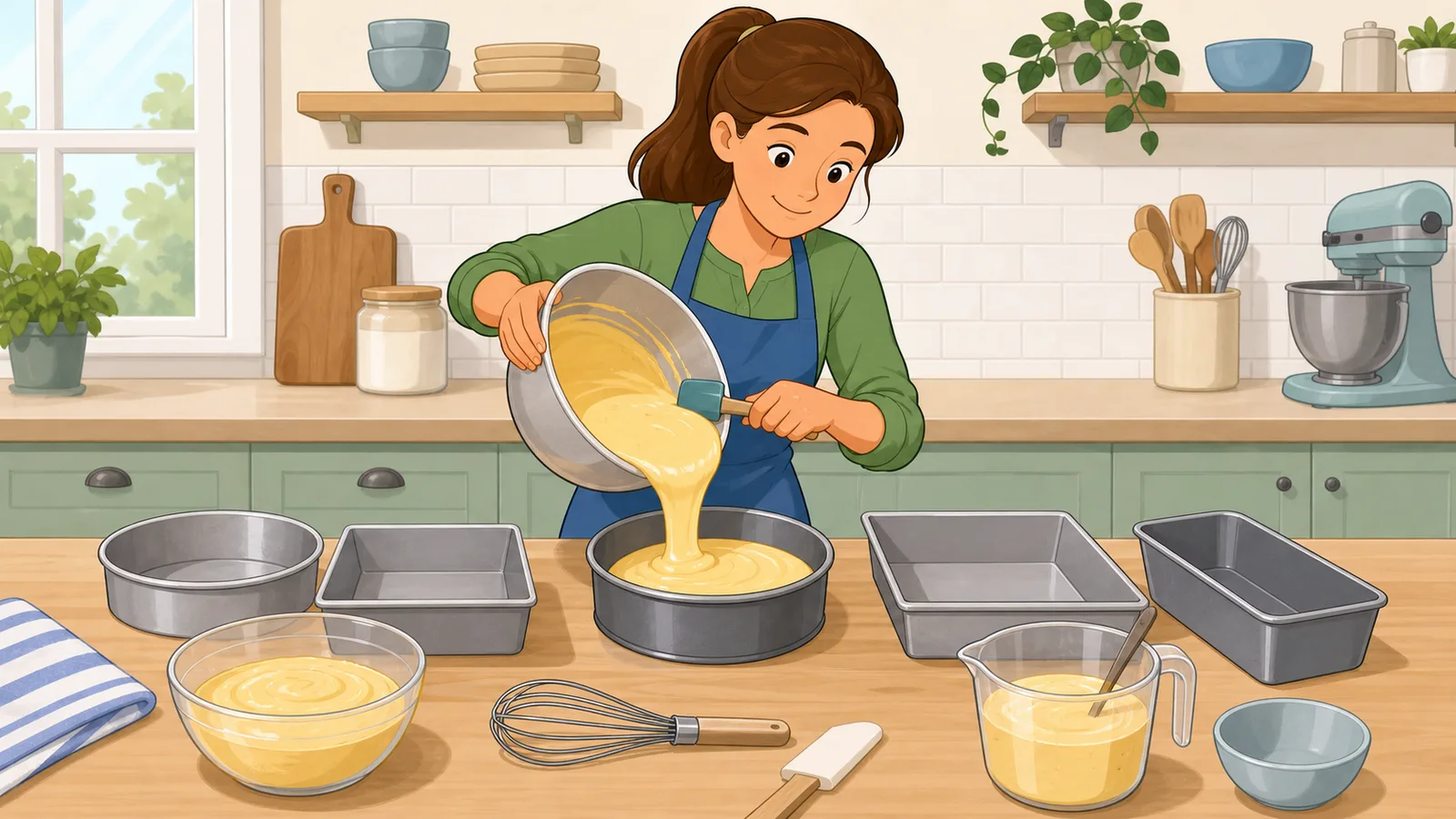
Cake pan converter for round, square, rectangular, and loaf pans, with area or full-volume scaling, safe batter-fill guidance, servings estimates.
Last updated
Cake pan converter for pan swaps and cake batter scaling Compare round, square, rectangular, and loaf pans by area or volume so you can resize cake batter, servings, and the first bake-time check before you bake.
Scaling basis
How to read the swap
Use area mode when the batter height stays close to the original. Switch to volume mode when the cake pan converter needs to account for a noticeably deeper or shallower tin, because the full capacity and safe fill level change more than the footprint alone.
Original pan
Target pan
Result
2.3276x
The target pan needs about 132.76% more batter than the original when compared by surface area.
Original area
50.2655 in²
Target area
117 in²
Percent change
+132.764%
Multiply recipe by
2.3276x
Target servings
27.9317
First bake-time check
Start checking between 33.9 and 36.1 minutes.
Example ingredient adjustment
3 cups of batter becomes about 6.98 after applying the scaling factor.
Baking note
Scaling quantity gets you close, but cake doneness still depends on pan material, batter type, oven accuracy, and how full the tin sits. Use the range as the first check, not as a guaranteed finish time.
Cake pan converter: scale cakes between round, square, rectangular, and loaf pans
A cake pan converter or cake pan size converter compares the original pan and the target pan geometrically so you can scale batter quantity before you bake.
Area scaling versus volume scaling
Area scaling is the right choice when the batter depth will stay roughly the same. That covers many swaps between standard round tins, square tins, and sheet-style cake pans where the depth is similar.
Volume scaling becomes more useful when the pan depth changes materially as well. In that case, comparing only the footprint can miss how much extra batter the taller pan can hold or how much thinner the batter will sit in a shallow pan.
Round area = pi x (Diameter / 2)^2
Used for round cake tins and springform-style pans.
Rectangular area = Width x Length
Used for rectangular trays, sheet pans, and loaf-style pans.
Scaling factor = Target area or volume / Original area or volume
The multiplier applied to the original batter quantity or to any example ingredient amount.
Full pan volume = Footprint area x Batter depth
Used when the cake pan converter needs to account for a noticeably deeper or shallower tin.
Worked example: 8-inch round to 9-by-13-inch pan
If you move from an 8-inch round pan to a 9-by-13-inch rectangular pan at the same batter depth, the target pan has about 2.33 times as much surface area. That means the new pan needs a little over twice as much batter as the original.
If the original recipe served 12, the same factor points to about 28 servings in the larger pan before you account for slice style or cake height. The example ingredient field helps you test one batter amount before you rewrite the whole recipe.
Why bake time still needs judgment
Scaling batter quantity is not the same thing as predicting exact bake time. Pan material, oven accuracy, batter composition, and depth all change how quickly the centre sets and how fast the edges brown.
That is why the calculator gives a first check window rather than a guaranteed finish time. Use the adjusted time as an early doneness check, then rely on your normal visual and probe tests.
A cake pan size calculator is most useful when you are swapping between familiar tin shapes. A round cake pan often scales cleanly to another round pan of a different diameter, while a rectangular pan swap can change both the footprint and the slice pattern. Loaf pans are narrower and deeper, so volume usually matters more than a simple footprint comparison.
When a recipe says it serves a certain number of people, treat that figure as approximate rather than exact. Slice thickness, layer height, and cake style all change the final serving count. A larger cake pan converter result might mean the same cake recipe now serves more people, but the portions can still be cut differently depending on the occasion.
Batter capacity and safe fill level
Many cake pan conversion charts talk in cups of batter because home bakers often need to know whether the scaled batter will physically fit in the target tin. In volume mode, this converter estimates a safe fill amount in US cups from the pan volume and the fill percentage you choose.
A two-thirds fill level is a common starting point for standard cake batters because it leaves room for rise. High-rising sponge, chiffon, angel food, and very foamy batters may need more headroom, while denser loaf cakes or brownies can sometimes tolerate a slightly fuller pan. If the scaled recipe exceeds the safe fill amount, bake the extra batter separately rather than forcing it into the tin.
How to check a cake pan swap in practice
Start by measuring the usable inside dimensions of each tin, not the label on the pan box. Then compare area when the batter height stays similar, or compare full volume when the deeper tin changes the cake height materially. That is the cleanest way to turn a cake pan converter result into a recipe scaling calculator decision you can actually use in the kitchen.
If the new pan is much wider, the batter will sit thinner and may bake sooner. If it is taller, the centre may need a longer first check window even when the scaling factor looks right. In both cases, the calculator helps you resize the batter first and then decide when to test for doneness.
Frequently asked questions
When should I use area mode instead of different-depth mode?
Use area mode when the batter will sit at about the same depth in both pans. Use different-depth mode when the pan depth changes enough to affect capacity materially.
Does a 2x scaling factor mean the bake time doubles?
No. Bake time is driven more by batter depth and heat transfer than by ingredient quantity alone. The calculator gives a first-check window, not a direct time multiplier.
Can I use this for loaf pans as well as round and rectangular pans?
Yes. The converter supports round, square, rectangular, and loaf shapes so you can compare common cake-pan substitutions with one tool.
Why does the calculator ask for an example ingredient amount?
It helps you sense-check the scaling factor with one familiar quantity, such as cups of batter or frosting, before you rewrite the full ingredient list.
Is this a cake pan size calculator or a recipe scaling calculator?
It is both: the calculator compares pan size geometrically and then turns that result into a recipe scaling factor for batter, frosting, or filling.
How do I convert an 8-inch round cake pan to a 9x13 pan?
Use the target pan dimensions and let the calculator compare the round pan area with the rectangular pan area. In many cases the 9x13 pan needs a little more than twice as much batter as an 8-inch round pan at the same depth.
Does a loaf pan need area scaling or volume scaling?
Loaf pans often need volume scaling when the depth changes materially, because they are longer and deeper than many round or square tins. If the batter depth stays similar, area can still be a useful first pass.
Should I change the serving count when the pan changes?
Yes, but only as a guide. The calculator gives an estimated target serving count from the same scaling factor, yet the true number depends on slice size and cake style.
How full should I fill a cake pan after converting a recipe?
A two-thirds fill level is a useful starting point for many standard cake batters because it leaves room for rise. Use volume mode and the safe fill level field when pan depth changes, and bake any extra batter separately if the scaled amount would overfill the target pan.
Why do some cake pan conversion charts list batter in cups?
Cup estimates help you check physical pan capacity before baking. They are not a perfect replacement for recipe scaling, but they are useful when you need to know whether a batter batch will fit in a 9x13 pan, loaf pan, Bundt pan, or deeper round tin.