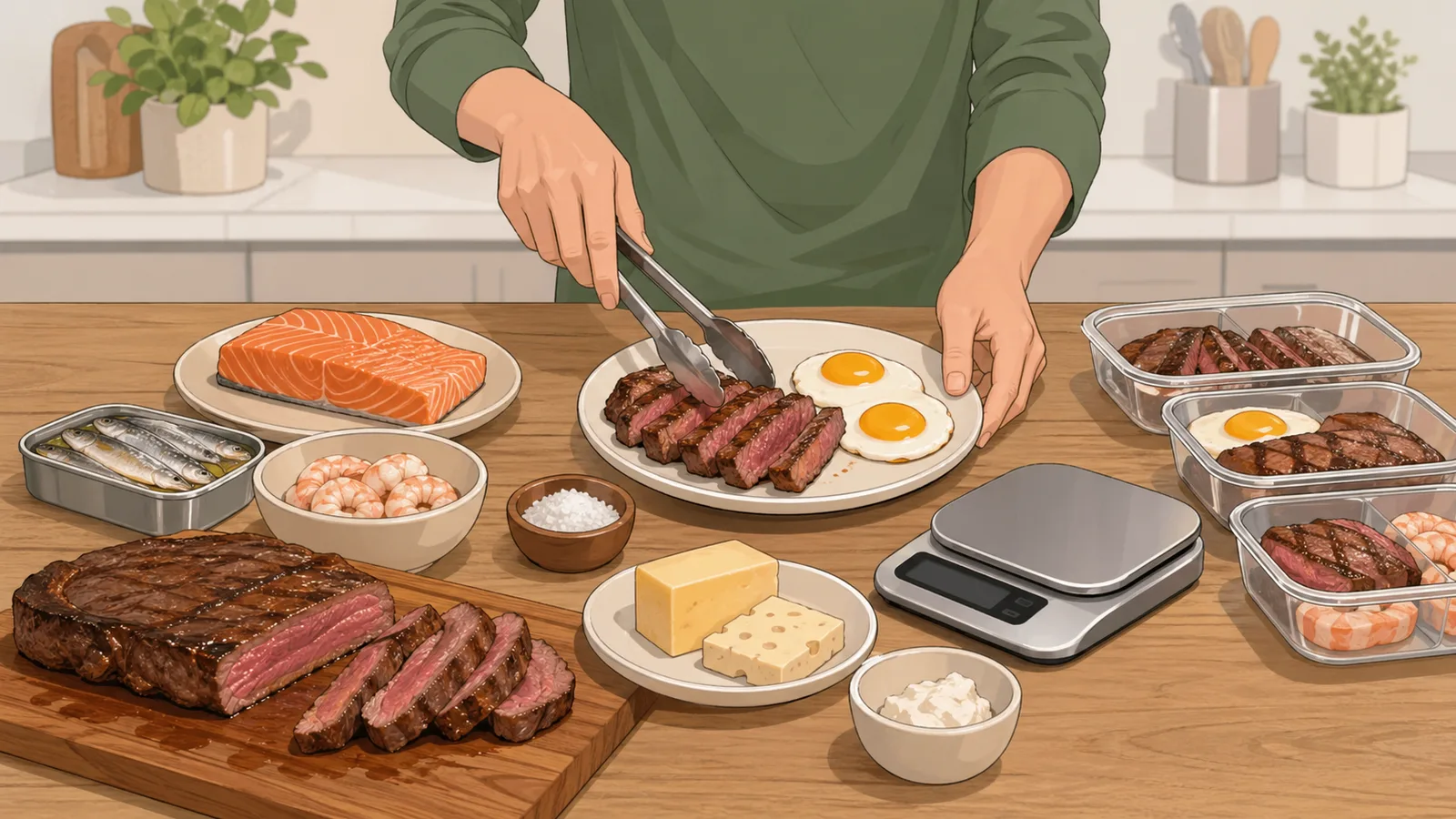
Use this carnivore diet calculator to set calories, protein, and fat from body size and goal
This carnivore diet calculator turns body size, activity, goal, and diet style into a practical carnivore macro calculator. It compares strict carnivore, keto carnivore, and animal-based macro assumptions, shows per-meal splits, and explains where very narrow carnivore setups can miss calories, electrolytes, and nutrient coverage.
Medical caution A strict carnivore diet is a restrictive pattern, not a neutral default. If you have kidney disease, gout, diabetes, pregnancy, high LDL cholesterol, or a history of disordered eating, treat this as planning information only and review the diet with a qualified clinician before using it long term.
Units
Sex
Carnivore style
Models a near-zero-carb meat, fish, egg, and animal-fat setup where fat supplies almost all non-protein calories.
Daily target
2,759 kcal
Maintenance strict carnivore target: 2,759 kcal/day, 152 g protein, 239 g fat, and 0 g carbs.
Protein target
152 g
22% of calories · range 128–176 g
Fat target
239 g
78% of calories · 2,151 kcal
Carb allowance
0 g
Strict carnivore · 0% of calories
Estimated BMR
1,780
kcal/day
Estimated TDEE
2,759
Moderately active (3–5 days/week)
How to read this result
Protein stays near 152 g/day, with a practical range of 128–176 g, so fat can absorb most goal-specific changes.
The maintenance target lands at 2,759 kcal/day on the strict carnivore setting, which keeps calories and carb assumptions visible instead of assuming meat-only eating makes them irrelevant.
Lean cuts make lower-calorie plans easier to hit, while fattier cuts, eggs, seafood, and dairy make the target easier to cover without drifting off plan.
Planning note
Protein is held steady across the goal options to protect lean mass, while fat changes the most as calories move down for fat loss or up for muscle gain. If food choices are very lean, you may hit protein early while still undershooting total calories and fat. Models a near-zero-carb meat, fish, egg, and animal-fat setup where fat supplies almost all non-protein calories.
Goal comparison
Goal
Calories
Protein
Fat
Fat Loss
2,259 kcal
152 g
183 g
Maintenance Current
2,759 kcal
152 g
239 g
Muscle Gain
3,009 kcal
152 g
267 g
Strict, keto carnivore, and animal-based comparison
Style
Carbs
Protein
Fat
Assumption
Strict carnivore Current
0 g
152 g
239 g
Models a near-zero-carb meat, fish, egg, and animal-fat setup where fat supplies almost all non-protein calories.
Keto carnivore
5 g
152 g
237 g
Allows a small trace-carb buffer for eggs, dairy, shellfish, or seasonings while still keeping the plan very low carb.
Animal-based
30 g
152 g
226 g
Adds a modest carb allowance for a looser animal-based setup, so fat grams fall compared with strict carnivore at the same calorie target.
Per-meal planning
2 meals per day
1,380 kcal
76 g protein · 119.5 g fat per meal
3 meals per day
920 kcal
50.7 g protein · 79.7 g fat per meal
4 meals per day
690 kcal
38 g protein · 59.8 g fat per meal
Food setup tradeoffs
Leaner meat setup
Best fit: Higher-protein cuts when you want satiety and easier calorie control.
Watch for: Calories climb quickly, so portion control still matters on a fat-loss phase.
Dairy-inclusive setup
Best fit: People who tolerate dairy and need an easier route to calories and calcium.
Practical foods: Greek yogurt, hard cheese, cottage cheese, kefir, butter or cream if tolerated.
Watch for: Dairy can make the plan less strict, may not suit all digestive patterns, and can make calorie intake drift upward fast.
Electrolyte planning
Sodium
Carbohydrate restriction often shifts fluid balance and can increase sodium loss early on.
Carnivore-friendly options: Salt food to taste, salted broth, cured fish or meat when sodium tolerance allows.
Caution: Do not force aggressive sodium intake if you have hypertension, heart failure, or kidney disease without clinician guidance.
Potassium
Potassium can be harder to cover when food variety becomes very narrow.
Carnivore-friendly options: Fish, shellfish, beef, dairy if included, and a broader rotation of animal foods.
Caution: Avoid high-dose potassium supplementation without medical review, especially with kidney disease or blood-pressure medication use.
Magnesium
Restrictive diets often leave magnesium marginal even when calories look adequate.
Carnivore-friendly options: Shellfish, oily fish, some mineral waters, and supplements when a clinician agrees they are appropriate.
Caution: Persistent cramps, poor sleep, or constipation are reasons to review the plan rather than assuming adaptation alone explains the problem.
Nutrients to monitor
Nutrient
Why it comes up
Food choices to review
Vitamin C
Plain muscle meat contains very little, so strict meat-only patterns may leave intake low unless food variety is broader.
Liver, kidney, roe, oysters, and some fish provide more than plain muscle meat alone.
Fibre
A strict carnivore diet removes fibre completely, which changes bowel habit and removes a food component linked with broader cardiometabolic and gut-health benefits.
There is no animal-food fibre source, so bowel tolerance and long-term suitability need active review.
Calcium
Calcium can be low when dairy, bones, or fish with bones are excluded.
Yogurt, cheese, canned fish with bones, or clinician-guided alternatives if the plan stays dairy-free.
Magnesium
Magnesium intake is often less predictable on narrow animal-only food lists.
Shellfish, oily fish, broader seafood rotation, or supplementation when medically appropriate.
Carnivore diet calculator guide: calories, protein, fat, and common nutrient gaps
This carnivore diet calculator estimates daily calories, protein grams, and fat grams from body size, activity, and goal. It works like a carnivore macro calculator for people who want to compare strict carnivore, keto carnivore, and more flexible animal-based setups while keeping the calorie tradeoff visible.
What this carnivore diet calculator is doing
Use the calculator when you want a practical answer to how much to eat on a carnivore diet instead of a vague ratio. It starts from body size and activity, then translates the result into calories, protein grams, and fat grams so you can compare food choices in a way that is easier to follow day to day.
The page is useful for anyone comparing a strict carnivore plan, a carnivore macro calculator, or a looser animal-based approach. The key idea is that the calorie question never disappears: lean meats, fatty cuts, eggs, dairy, and seafood all change how easy the plan is to sustain.
The calculator accepts metric or imperial body measurements, then converts internally to the same Mifflin-St Jeor and body-weight protein basis. That keeps pounds-and-inches users from having to translate their inputs elsewhere before comparing strict carnivore macros, keto carnivore macros, and animal-based diet macros.
BMR = Mifflin-St Jeor equation
The calculator uses the Mifflin-St Jeor equation to estimate resting energy needs from body size, height, age, and sex.
TDEE = BMR x activity multiplier
An activity multiplier converts resting energy needs into an estimated total daily energy expenditure.
Protein grams = body weight x 1.9
Protein is anchored near the middle of a common muscle-preservation range so fat can change more than protein as goals shift.
Carb calories = selected style carb grams x 4
Strict carnivore is modeled as zero carbs, keto carnivore allows a trace-carb buffer, and animal-based mode adds a modest carb allowance.
After protein and the selected carb allowance are set, the remaining calorie budget is assigned to fat.
How the calculator sets carnivore calories and macros
Because carbohydrates are essentially zero, calories come almost entirely from protein and fat. This calculator estimates basal metabolic rate with the Mifflin-St Jeor equation, scales it for activity to estimate TDEE, then adjusts calories for fat loss, maintenance, or muscle gain. Protein is set near the middle of the common muscle-preservation range and fat supplies the remaining energy.
The style selector makes the carb assumption explicit instead of hiding it. Strict carnivore keeps carbs at zero, keto carnivore allows a small trace-carb buffer for foods such as eggs, dairy, shellfish, or seasonings, and animal-based mode models a looser setup where a modest carb allowance lowers the fat grams required at the same calorie target.
That structure matters because many carnivore diet discussions online skip the calorie question and jump straight to food rules. In practice, carnivore macros still decide whether the pattern functions as a cut, a maintenance diet, or a surplus. If calories are too low, recovery suffers. If protein is high but fat is too low for the chosen calorie target, the diet can become unnecessarily hard to sustain.
A useful carnivore diet calculator should therefore read like a planning tool, not a permission slip to eat only meat and ignore total energy. The most practical interpretation is usually: set protein first, let fat fill the remaining calories, and then check whether the resulting food pattern is realistic for your appetite, budget, and schedule.
What the macro targets look like in real food
A carnivore macro target only becomes useful when it translates into food choices. Leaner cuts such as chicken breast, turkey, venison, tuna, or very lean beef drive protein up quickly but often leave fat too low unless extra fat is added elsewhere. Fatty beef mince, ribeye, salmon, eggs, cheese, and butter shift the plan toward a higher-fat intake much more easily.
That is why two users can both say they are doing carnivore while eating very different macro splits. One person may land on a relatively high-protein, lower-fat version built around lean meat. Another may be closer to a keto-style carnivore diet with fattier cuts and higher total fat. The calculator gives the gram targets first so those food choices can be made deliberately instead of by guesswork.
If you are wondering how much to eat on a carnivore diet, the calculator’s calorie number is the best starting point because hunger often becomes the signal that the food list is too lean or the target is too low.
Worked example
Take an 80 kg, 180 cm, 30-year-old moderately active man aiming for maintenance. Using Mifflin-St Jeor, resting energy expenditure comes out to about 1,780 kcal/day. After applying a moderate activity multiplier of 1.55, estimated TDEE is about 2,759 kcal/day.
At the calculator's default protein setting of 1.9 g/kg, protein lands at about 152 g/day. That uses about 608 kcal. On strict carnivore, the calculator assigns the rest to fat, leaving roughly 2,151 kcal to be covered by fat, which works out to about 239 g/day. Split across three meals, that is about 51 g protein and 80 g fat per meal as a planning starting point rather than a rigid prescription.
If the same person switched the goal to fat loss, the calculator would reduce the target by 500 kcal to about 2,259 kcal/day while keeping protein broadly steady. That mostly lowers the fat allowance rather than the protein target, which is why food choice and satiety become the practical challenge on a fat-loss version of a carnivore plan.
If that user switched from strict carnivore to animal-based mode, the daily calorie target would stay the same but the calculator would reserve a small carb allowance before calculating fat. That makes the fat target lower and shows why strict carnivore macros, keto carnivore macros, and animal-based macros should not be treated as the same plan.
A lighter or less active user would see the same pattern: protein stays relatively stable, but the fat grams move first. That is the main reason the tool is more helpful than a single blanket ratio for everyone.
Strict carnivore, keto carnivore, and animal-based are not the same thing
Strict carnivore usually means only animal foods. Some people include only meat and water, while others include eggs, fish, dairy, coffee, and seasonings. Animal-based diets are looser and usually add fruit, honey, or selected plant foods. Keto carnivore is a useful shorthand for versions that deliberately keep protein moderate enough and fat high enough to stay more reliably ketogenic.
Those differences explain why search terms like carnivore diet macros, carnivore fat ratio, and is carnivore keto often lead to conflicting advice. They are not all describing the same diet. The stricter the food list becomes, the more important it is to think about calories, electrolytes, calcium, magnesium, and long-term adequacy rather than assuming the label alone tells you whether the plan is well constructed.
The calculator's comparison row is designed for that exact ambiguity. It keeps the same body stats and goal, then shows how strict carnivore, keto carnivore, and animal-based assumptions change carbs and fat while protein stays anchored. That makes the tradeoff easier to see than a single fat-to-protein ratio.
If you are comparing carnivore vs keto, the biggest difference is usually the food list and the practical nutrient tradeoffs, not the fact that both patterns can be very low in carbohydrate.
Why hunger, satiety, and bulking change the result
A lot of people search for a carnivore diet calculator because they want to know why they are hungry on carnivore, or because they are trying to bulk on carnivore without guessing at portions. In practice, hunger usually means calories are too low, protein is adequate but fat is too lean, or the food list is so narrow that the plan becomes hard to repeat.
If the goal is muscle gain, the calculator's surplus option gives a better starting point than trying to eyeball extra steaks. If the goal is fat loss, the smaller fat allowance is deliberate: the plan can still feel satisfying, but it should not quietly turn into unlimited eating just because the food list is animal-only.
This is also why a strict meat-only approach can feel very different from a more flexible animal-based version. Small changes in fat choice, dairy inclusion, or meal frequency can make the same calorie target feel either easy or overly restrictive.
Nutrients and health markers to monitor
Vitamin C is one of the most discussed concerns because plain muscle meat contains very little. Fibre is effectively absent, which can change bowel habit and removes a food component associated with cardiometabolic and gut-health benefits in broader diet research. Calcium depends heavily on whether dairy, bones, or specialised foods are included. Magnesium and potassium can also be harder to cover consistently on a very narrow meat-only pattern.
Electrolytes matter in the early adaptation phase as carbohydrate intake falls and fluid balance shifts. Sodium intake often rises, while potassium and magnesium can become the limiting minerals if food variety is very narrow. Beyond nutrients, the health markers worth monitoring are usually LDL cholesterol or apoB, renal function in people with kidney risk, uric acid if gout is a concern, bowel tolerance, and the overall sustainability of the diet rather than one isolated short-term symptom change.
The practical takeaway is simple: a carnivore diet calculator can estimate calories and macros, but it cannot tell you whether your long-term nutrient coverage is actually adequate.
Vitamin C is often the first nutrient people ask about on a strict carnivore diet.
Fibre disappears completely when plant foods are excluded, so bowel changes and long-term tolerance matter.
Calcium and magnesium are easier to miss if dairy, bones, and seafood are limited.
LDL cholesterol or apoB should be reviewed if you use the diet long term or have cardiovascular risk.
What current evidence can and cannot say
The carnivore diet does not have the long-term randomized controlled trial base available for Mediterranean, DASH, or other broadly studied dietary patterns. Most of the enthusiasm online comes from case reports, surveys, and personal experience. That can be enough to justify an experiment for some users, but it is not strong evidence of long-term safety or superiority.
Short-term symptom relief also does not prove that a strict carnivore diet is the best explanation. Some people may improve because the diet removes highly processed foods, simplifies eating, reduces total calories, or removes a specific trigger food. At the same time, high saturated fat intake, low fibre intake, and the absence of several plant-food micronutrient sources are credible reasons to monitor the pattern carefully rather than treating it as automatically healthy because it feels simple.
The current literature is enough to support careful self-experimentation and measured follow-up, not an automatic claim that the diet is the best choice for every user.
Frequently asked questions
Is a carnivore diet calculator the same thing as a carnivore macro calculator?
Not exactly. A carnivore macro calculator usually focuses on protein and fat ratios, while a carnivore diet calculator should also keep calories visible so you can judge whether the plan works for fat loss, maintenance, or gain.
Is a carnivore diet the same thing as a keto diet?
Not necessarily. A strict carnivore diet is usually very low in carbohydrate, so many people do produce ketones, but a higher-protein, lower-fat version may not behave the same way as a deliberately formulated ketogenic diet. Carnivore describes the food list; keto describes the metabolic and macro profile more directly.
How much fat should I eat?
Fat provides the remaining calories after protein needs are met. On a deficit, fat intake will be lower than on maintenance or a surplus. In practice, if your food choices are too lean, you may hit protein easily but still undershoot calories and find the diet hard to sustain.
Do eggs and dairy still count as carnivore?
Many people include them and still use the carnivore label, but others use a stricter meat-only interpretation. The more relevant question is whether those foods improve calorie adequacy, calcium intake, digestibility, and long-term adherence for you. Two plans can both be called carnivore while working very differently in practice.
Why do some people feel hungry on carnivore?
Hunger usually means the plan is too lean, too low in calories, or too repetitive to be satisfying. If you keep protein steady but add some fat, more calorie-dense cuts, or a more realistic meal frequency, the same target can feel very different.
Can I bulk on carnivore diet with this calculator?
Yes. Use the muscle-gain goal, then compare the higher-fat options in the food rows. A carnivore bulk still needs enough calories, and the surplus should come from a plan you can actually repeat instead of forcing extra food that feels unsustainable.
Why does animal-based mode show carbs on a carnivore calculator?
Animal-based eating is usually looser than strict carnivore and may include fruit, honey, or other selected plant foods. The calculator includes that mode because many users compare strict carnivore, keto carnivore, and animal-based macros before choosing a food list.
Should I choose strict carnivore or keto carnivore?
Choose strict carnivore if you want the calculator to model a near-zero-carb animal-food setup. Choose keto carnivore if your real food list includes small trace-carb sources such as eggs, dairy, shellfish, or seasonings but you still want a very low-carb plan. Neither choice is medical advice; it is a planning assumption.
What are the main risks to monitor on a strict carnivore diet?
The main concerns usually raised are low fibre intake, uncertain vitamin C adequacy on a very narrow food list, calcium and magnesium shortfalls if dairy or seafood are limited, and changes in LDL cholesterol or other lipids in some people. Anyone using the diet for a medical reason or over the long term should treat lab monitoring and clinician input as part of the plan, not as an optional extra.
Can I use pounds and inches in the carnivore diet calculator?
Yes. Use the unit buttons to switch between metric and imperial inputs. The calculator converts pounds and inches into the same internal weight and height basis before estimating BMR, TDEE, protein, fat, and carb allowance, so the macro comparison stays consistent across both unit systems.