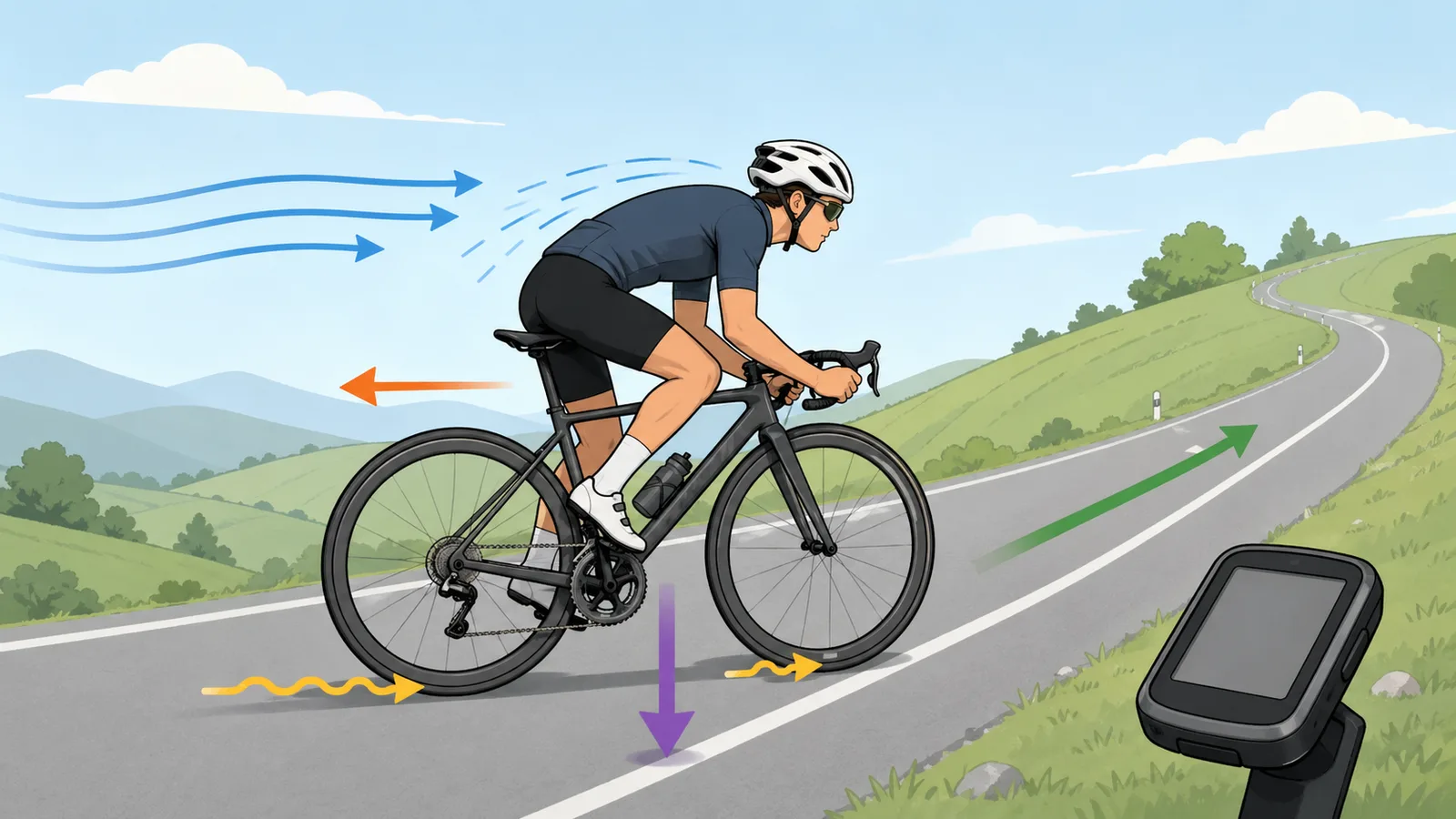
Use this cycling power to speed calculator to convert watts to km/h or estimate the watts needed for a target cycling speed using CdA, gradient, wind.
Last updated
Cycling power to speed calculator Convert cycling watts to speed or solve the watts needed for a target cycling speed. The model accounts for rider-plus-bike weight, riding position, CdA, rolling resistance, gradient, headwind or tailwind, altitude, and drivetrain loss.
Ride presets
Tyre and surface presets
Riding position
General road-bike position; kept for backwards compatibility with earlier page data.
Estimated speed
32.8 km/h (20.4 mph)
220 W at 80 kg total mass, 0 % grade, and 0 km/h wind.
Aero drag
191 W
Rolling resistance
29 W
Gradient force
0 W
Calories per hour
789
Wheel power
213 W
Drivetrain loss
7 W
Dominant limiter: aerodynamic drag for this scenario.
Sensitivity: reducing CdA by 5% is worth about 0.5 km/h at the same power. Adding 1 km/h would need about 19 more watts.
Assumptions: CdA 0.4, Crr 0, air density 1.23 kg/m³, drivetrain efficiency 97%.
How to read it: use W/kg first for climb comparisons, but use CdA, wind, and tyre/surface assumptions first when the result is aero-dominated on flatter roads.
Cycling watts to speed chart
Estimated bike speed by power output and terrain for an 80 kg rider + bike in road position, no wind, sea-level air density, and Crr 0.004.
Power (W)
Flat (km/h)
Flat (mph)
3% (km/h)
7% (km/h)
100 W
24.3
15.1
11.9
6
150 W
28.4
17.7
16.5
8.8
200 W
31.6
19.7
20.3
11.6
250 W
34.3
21.3
23.5
14.1
300 W
36.7
22.8
26.3
16.6
350 W
38.8
24.1
28.8
18.9
400 W
40.6
25.3
31.1
21.1
Model limitation Speed and power estimates assume steady-state riding. Real speeds vary with gusts, road texture, drafting, tire pressure, pacing surges, equipment setup, and actual measured CdA.
Cycling power to speed calculator: watts, km/h, CdA, wind, and climbing context
A cycling power to speed calculator is only useful if it answers the question riders actually have. This page also explains the main assumptions behind the cycling power to speed calculator result, highlights the supporting figures shown by the calculator, and helps the reader use the estimate without overstating what a quick online tool can prove.
What this cycling power to speed calculator is doing
The live calculator models steady-state cycling power as the sum of the three main resistive loads: aerodynamic drag, rolling resistance, and gravity on a gradient. It then either solves for speed from a chosen wattage or solves for required watts from a target cycling speed. That makes it more useful than a one-direction watts-to-km/h estimate because real planning often starts with a target pace, race split, or climb speed rather than a known power number.
That distinction matters because cyclists search for several adjacent intents at once: cycling watts to speed, speed to watts cycling, how many watts for 35 km/h, how many watts do I need for a climb, and what difference does aero position make at the same power. A calculator that only gives one bare answer without the surrounding force breakdown is weaker than the better competitor tools.
The cycling power model behind the result
The page uses the standard steady-state relationship between pedal power and the forces resisting forward motion. Aerodynamic drag rises with the square of apparent wind speed, so above roughly 25 km/h it usually dominates flat-road riding. Rolling resistance rises more gently with speed but still matters, especially on rougher tyres or slower rides. Gradient force scales directly with total mass and grade, which is why watts per kilogram becomes so important uphill.
The result block therefore separates aerodynamic, rolling, and climbing watts instead of hiding them inside one total. This is not just cosmetic. It helps answer the practical follow-up question: is the limiter for this scenario aerodynamics, weight on a climb, or tyre and surface losses?
Pwheel = Paero + Prolling + Pgrade
Wheel power is the sum of aerodynamic, rolling-resistance, and climbing power at the chosen speed.
Paero = 0.5 × rho × CdA × (v + w)^2 × v
Aerodynamic power depends on apparent wind speed, which is why even a moderate headwind can add many watts.
Prolling = Crr × m × g × cos(theta) × v
Rolling resistance depends on total mass, surface and tyre quality through Crr, and speed.
Pgrade = m × g × sin(theta) × v
Climbing power scales directly with total weight, speed, and road gradient.
Why CdA matters more on the flat than riders expect
Competitor pages consistently surface the same lesson: once speed is reasonably high, small aerodynamic improvements can be worth more than the same effort spent elsewhere. That is why the upgraded calculator includes several position presets and a speed-gain estimate from a modest CdA reduction. On flat roads, reducing CdA by 5% can be more meaningful than dropping a small amount of weight.
This does not mean climbing weight is irrelevant. It means the dominant force changes with context. A rider searching for watts to speed on a fast solo effort usually needs aero guidance. A rider searching for cycling power for a 7% climb usually needs weight-and-grade context first.
Flat and fast usually means aerodynamics dominate.
Steeper climbing usually shifts the limiting force toward gravity and watts per kilogram.
Wind can change the answer more than many riders expect because drag depends on apparent wind, not just ground speed.
Rolling resistance matters more at lower speeds, rougher surfaces, and with slower tyres.
Worked examples: what the calculator helps you compare
Example 1: a rider-plus-bike system around 80 kg holding roughly 220 watts on flat roads in a standard road position lands in the low-30s km/h under calm conditions. Add a moderate headwind and the same power may no longer hold the same speed because aerodynamic watts rise quickly with apparent wind.
Example 2: that same rider targeting 35 km/h solo on flat roads may need a meaningfully different power depending on whether they ride on relaxed hoods, a lower aero-road position, or a full TT setup. That is why the page now supports speed-to-watts planning rather than asking you to manually guess and check power inputs.
Example 3: on a 7% climb, the same rider may only need modest speed to produce a high watts-per-kilogram demand because climbing power rises directly with grade and total mass. The output makes that tradeoff visible with W/kg, force breakdown, and the dominant-limiter note.
How to use a cycling watts to speed result well
Use the page as a scenario planner, not as a promise. Enter a realistic rider weight, bike-and-kit weight, road gradient, wind direction, rolling-resistance assumption, and altitude. Then compare one variable at a time. If you change weight, position, tyres, wind, and grade all at once, you lose the ability to see which assumption is actually driving the answer.
The most useful workflow is usually to start with the scenario you care about most. If you are planning a time-trial effort or solo segment, use speed-to-watts mode and compare positions. If you are checking a climb, use a realistic grade and total system mass. If you are translating trainer or power-meter data into expected road speed, keep wind and terrain conservative because real-world variability is what most often breaks overly optimistic estimates.
Further reading
Watts Calculator — Competitor calculator with explicit drag, rolling-resistance, and drivetrain-loss breakdown.
Tyres, drivetrain loss, and why small assumptions move the answer
Competitor calculators that feel useful do not force the rider to know every laboratory value before getting started. The upgraded page now gives practical Crr presets for fast road tyres, everyday training tyres, rough road surfaces, and gravel-style conditions, while still leaving the exact rolling-resistance input editable for riders who have a measured value.
Drivetrain efficiency is also visible because pedal power and wheel power are not always the same thing. A clean road drivetrain may lose only a small slice of the rider's power before it reaches the rear wheel, while poor lubrication, worn parts, cross-chaining, or off-road contamination can widen that gap. Showing wheel power and drivetrain loss makes the watts-to-speed result easier to compare with power meters, smart trainers, and real road tests.
For practical use, treat Crr and drivetrain efficiency as scenario assumptions. If the estimated speed looks too optimistic, first check whether the tyre preset, surface, wind, and position are realistic before assuming your power meter or the physics model is wrong.
Further reading
Bicycle Rolling Resistance — Independent rolling-resistance testing resource that helps riders understand why tyre choice and surface assumptions can change Crr.
When this model is useful and when it is not
A cycling watts-to-speed model is most useful for steady or near-steady conditions: solo pacing, time-trial planning, long climbs with reasonably consistent gradient, and broad scenario comparison. It becomes less reliable when speed and power vary second to second due to drafting, stop-start riding, repeated accelerations, rough traffic patterns, or gusty winds.
That does not make the calculator weak. It just defines the right scope. The page is strongest when used for pacing, training interpretation, and decision support. It is not a substitute for an actual power meter, on-course testing, or a full course simulator that models changing wind angle and terrain over time.
Frequently asked questions
How many watts do you need to ride at 35 km/h?
There is no single answer because the required power depends on rider-plus-bike weight, CdA or riding position, wind, road gradient, tyre rolling resistance, and altitude. On flat roads in calm air, many solo riders need somewhere in the low-to-mid-200-watt range to hold 35 km/h in a standard road position, but a headwind or less-aero posture can push the required watts meaningfully higher.
What matters more for cycling speed: watts or watts per kilogram?
On climbs, watts per kilogram usually matters more because gravity scales directly with body-plus-bike mass. On flat roads, absolute watts and especially aerodynamics matter more because drag dominates at higher speeds. That is why this page shows both raw power and W/kg but also includes CdA-driven interpretation.
Why does a headwind change the power requirement so much?
Aerodynamic drag depends on apparent wind speed, not just your ground speed. If you ride at 30 km/h into a 15 km/h headwind, the air sees you at roughly 45 km/h. Because drag rises with the square of air speed, the watt penalty grows quickly.
Can this calculator convert speed to watts as well as watts to speed?
Yes. The upgraded page now works in both directions. Use watts-to-speed when you know your power and want an estimated cycling speed, or switch to speed-to-watts when you have a target pace or race split and want to estimate the power requirement.
What is CdA in cycling?
CdA is drag coefficient multiplied by frontal area, measured in square metres. It is one of the biggest determinants of cycling speed on flat terrain. Lower CdA means less aerodynamic resistance, so the same watts can produce a faster speed.
What Crr should I use for a road bike?
A common smooth-road assumption for good road tyres is around 0.003 to 0.005. Faster tyres on clean tarmac can sit near the low end, while rough roads, slower tyres, lower pressures, or mixed surfaces can push Crr higher.
Does altitude make cycling speed faster at the same watts?
Higher altitude lowers air density, which reduces aerodynamic drag. That can make flat-road speed slightly higher at the same power, although the rider's physiology may also be affected by altitude. The calculator reflects the mechanical air-density effect only, not the biological performance cost of altitude.
Is this calculator accurate for group rides or drafting?
Not really. Drafting changes aerodynamic drag dramatically and unpredictably depending on rider spacing, pack structure, yaw angle, and road context. This page is better for solo riding or for scenario comparisons where drafting is not the main feature.
Why does the page include bike weight separately from rider weight?
Climbing and rolling-resistance forces depend on total system mass, not rider mass alone. Splitting rider weight from bike-and-kit weight makes the assumptions easier to audit and compare across setups.
Should I use tyre presets or enter a custom Crr value?
Use the tyre and surface presets when you want a fast planning estimate. They keep the calculator usable without forcing you to research rolling-resistance coefficients before every ride. Enter a custom Crr value when you have a measured tyre-and-pressure value, when you are comparing specific tyres, or when road texture is the main uncertainty in the scenario.
Should I enter pedal power or wheel power?
Most riders should enter the pedal or crank power they see from a power meter or smart trainer and leave drivetrain efficiency near the default. The calculator then estimates the smaller wheel-power amount after drivetrain loss. If your measurement is already wheel-based, set drivetrain efficiency close to 100% so the model does not subtract the same loss twice.