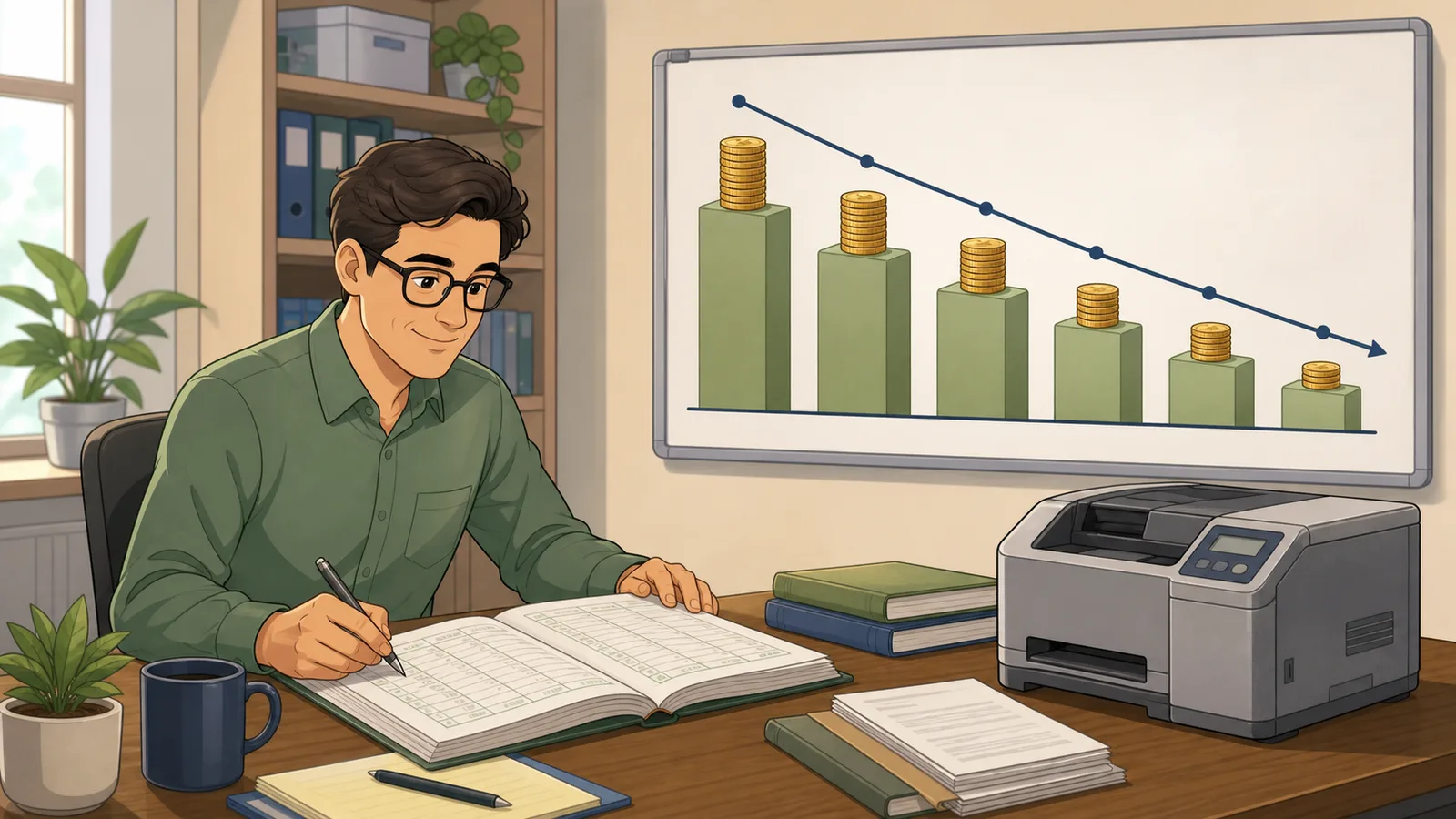
Build a year-by-year depreciation schedule from asset cost, salvage value, useful life, and method, then compare straight-line, declining-balance.
Last updated
Build a depreciation schedule before choosing a method Enter cost, salvage value, useful life, and a method to compare annual depreciation expense, accumulated depreciation, ending book value, and how front-loaded each method is.
Display currency
Choose the currency label before entering money amounts. The depreciation formula stays the same.
Scenario presets
Method
Assumptions
This schedule uses a simple annual convention, keeps salvage value fixed, and shows educational straight-line, declining-balance, and sum-of-years'-digits depreciation. It is not a substitute for asset-class tax rules or your accounting policy.
Result
$6,000.00 first-year depreciation
Straight-line on a $35,000.00 asset with $5,000.00 salvage value over 5 years.
Depreciable base
$30,000.00
Average annual depreciation
$6,000.00
Total depreciation
$30,000.00
Ending book value
$5,000.00
Largest annual expense
$6,000.00
First-year share
20%
Even annual expense Straight-line depreciation spreads the depreciable base evenly across the full useful life.
Method comparison on the same inputs
Straight-line
Selected schedule
First year: $6,000.00
Peak year: $6,000.00
Ending book: $5,000.00
Front-load: 20% of total in year 1
150% declining balance
Alternative timing
First year: $10,500.00
Peak year: $10,500.00
Ending book: $5,000.00
Front-load: 35% of total in year 1
200% declining balance
Alternative timing
First year: $14,000.00
Peak year: $14,000.00
Ending book: $5,000.00
Front-load: 46.67% of total in year 1
Sum-of-years' digits
Alternative timing
First year: $10,000.00
Peak year: $10,000.00
Ending book: $5,000.00
Front-load: 33.33% of total in year 1
Annual schedule
Year
Method
Opening book value
Depreciation
Accumulated
Closing book value
1
Straight-line
$35,000.00
$6,000.00
$6,000.00
$29,000.00
2
Straight-line
$29,000.00
$6,000.00
$12,000.00
$23,000.00
3
Straight-line
$23,000.00
$6,000.00
$18,000.00
$17,000.00
4
Straight-line
$17,000.00
$6,000.00
$24,000.00
$11,000.00
5
Straight-line
$11,000.00
$6,000.00
$30,000.00
$5,000.00
Planning note
Straight-line is easier for forecasting steady expense. Declining-balance and sum-of-years'-digits schedules front-load depreciation into earlier years, but they do so with different expense curves. The best method depends on the accounting policy, reporting objective, and asset-class rules that apply to the business.
A depreciation calculator turns an asset's cost, salvage value, useful life, and chosen method into a year-by-year expense schedule. It helps you compare evenly spread straight-line depreciation with front-loaded declining-balance and sum-of-years'-digits schedules, then see how each depreciation method changes first-year expense, accumulated depreciation, and ending book value.
What depreciation is doing
Depreciation allocates the recoverable cost of a business or income-producing asset across the periods that benefit from using it. Instead of expensing the full asset cost immediately, the cost is spread over time according to the method chosen and the useful-life assumption used for the schedule.
That is why depreciation is both an accounting concept and a planning concept. The same asset can produce different year-by-year expense patterns depending on whether you use straight-line or a declining-balance method, even though the total depreciable base recovered over the schedule is the same once salvage value is respected.
Straight-line versus declining-balance
Straight-line depreciation spreads the depreciable base evenly across the useful life. Each year carries the same depreciation expense, which makes the method easy to forecast and explain.
Declining-balance methods apply a higher percentage to the asset's opening book value in earlier years, which produces larger early deductions and smaller later ones. Many schedules switch to straight-line once the remaining straight-line amount becomes larger than the declining-balance amount, because that finishes the depreciable base more efficiently while still respecting the salvage-value floor.
Depreciable base = Asset cost - Salvage value
This is the total amount of cost to be recovered through depreciation across the schedule.
Straight-line annual depreciation = Depreciable base / Useful life
Straight-line spreads the recoverable cost evenly over the full useful life.
Declining-balance depreciation = Opening book value x Rate
The declining-balance rate is commonly based on 150% or 200% of the straight-line rate, subject to the salvage-value floor and any switch to straight-line.
Where sum-of-years'-digits fits
Sum-of-years'-digits depreciation is another accelerated method. Instead of applying a fixed declining-balance rate to opening book value, it weights each year by the remaining useful life. In a five-year schedule, the first year receives five parts out of a total of fifteen, the second year receives four parts, and the pattern continues until the salvage floor is reached.
That makes a sum-of-years'-digits depreciation calculator useful when you want an accelerated expense curve but also want the annual amounts to decline in a more transparent arithmetic pattern. It can sit between the simplicity of straight-line depreciation and the sharper early-year effect of a double-declining-balance schedule.
The method-comparison cards in the calculator use the same asset cost, salvage value, and useful life across all methods. That gives you a cleaner view of timing: the total depreciable base is the same, but first-year depreciation, peak annual expense, accumulated depreciation, and book value can vary significantly.
Years digits sum = Useful life x (Useful life + 1) / 2
This is the denominator used to weight each year in a sum-of-years'-digits schedule.
SYD depreciation = Depreciable base x Remaining life / Years digits sum
Earlier years receive a larger share of the depreciable base because more useful life remains.
Worked example: comparing the same asset under different methods
Suppose an asset costs 35,000, has a salvage value of 5,000, and a useful life of 5 years. Straight-line depreciation produces a steady 6,000 of annual expense. A 200% declining-balance schedule produces a much larger first-year expense, then smaller later-year amounts as the book value falls.
On the same inputs, sum-of-years'-digits depreciation starts at 10,000 in year one because five of the fifteen useful-life digits are assigned to the first year. A 200% declining-balance method starts even higher on these assumptions, while straight-line stays flat. The calculator shows these alternatives side by side so the timing choice is visible before you rely on the schedule.
The calculator shows both the headline first-year expense and the full annual schedule. That helps you compare whether you want a steadier planning view or a more front-loaded depreciation pattern for the same depreciable base.
How to choose a method for planning
For many planning questions, the best depreciation method is the one that matches the decision you are trying to explain. Straight-line depreciation is often easiest for budgeting because the annual amount stays level. Declining-balance and sum-of-years'-digits schedules are better when you want to see how accelerated depreciation changes early-year expense and book value.
The scenario presets are intentionally neutral examples rather than tax elections. Use the equipment schedule to inspect a common five-year asset, the furniture schedule to see a longer steady-life pattern, and the technology schedule to compare faster front-loaded depreciation. You can then overwrite the cost, salvage value, useful life, and method to match your own asset.
Because this is a universal planning calculator, it does not assume a country-specific recovery class, MACRS life, bonus depreciation rule, Section 179 election, or local tax convention. Use it for schedule comparison and internal forecasting, then check the governing rules before using any result for filing or audited reporting.
Use straight-line when a level annual depreciation expense is the main planning need.
Use 150% or 200% declining balance when you need to model a front-loaded book expense curve.
Use sum-of-years'-digits when you want accelerated depreciation with a clear annual weighting formula.
Use the method-comparison view to separate total depreciation from the timing of that depreciation.
How to use the schedule
Use the schedule to understand how quickly book value falls, how much depreciation is recognized each year, and when a declining-balance schedule begins to resemble straight-line. It is useful for budgeting, internal planning, and explaining the effect of different methods to stakeholders.
The annual schedule also works as a quick depreciation table. Each row shows opening book value, depreciation expense, accumulated depreciation, and closing book value, so you can trace the asset from original cost down to its salvage value.
This tool is intentionally simplified. It does not attempt to reproduce every jurisdiction-specific tax convention, recovery class, or mid-period rule. For actual filings or audited statements, compare the result with the tax or accounting rules that govern the asset.
Frequently asked questions
What is the difference between straight-line and declining-balance depreciation?
Straight-line spreads depreciation evenly over the useful life, while declining-balance methods recognize more depreciation in earlier years and less in later years because they apply a fixed rate to the remaining book value.
Why does salvage value matter?
Salvage value is the floor the schedule should not depreciate below. Depreciation only recovers the asset cost above that expected ending value.
Why might a declining-balance schedule switch to straight-line?
As the book value falls, the declining-balance amount can become smaller than the remaining straight-line amount. Switching to straight-line at that point can finish the schedule more efficiently while still respecting the salvage-value floor.
Does this calculator match every tax-depreciation rule?
No. It is a simplified planning tool for straight-line and declining-balance schedules. Actual tax treatment can depend on asset class, recovery system, convention rules, and jurisdiction-specific guidance.
What is sum-of-years'-digits depreciation?
Sum-of-years'-digits depreciation is an accelerated method that assigns more depreciation to earlier years by weighting each year according to the remaining useful life. For a five-year asset, the years add to 15, so year one receives 5/15 of the depreciable base, year two receives 4/15, and so on.
Is double declining balance the same as 200% declining balance?
Yes in this simplified schedule. A 200% declining-balance method applies twice the straight-line rate to opening book value, subject to the salvage-value floor and the calculator's straight-line switch when that produces a better remaining schedule.
Can I use this as a MACRS depreciation calculator?
No. This page compares universal book-planning schedules. MACRS depreciation uses US tax recovery classes, conventions, and elections that are not interchangeable with a general straight-line, declining-balance, or sum-of-years'-digits schedule.
Why is book value different from resale value?
Book value is an accounting carrying amount based on cost less accumulated depreciation. Resale value depends on market demand, condition, age, location, and negotiation. Salvage value is only the modeled floor used in this depreciation schedule; it is not a live market quote.
What inputs do I need for a depreciation schedule?
You need the asset cost, expected salvage value, useful life in years, and depreciation method. Those inputs determine the depreciable base, the annual expense pattern, the accumulated depreciation row by row, and the ending book value.
Should I choose straight-line or an accelerated method?
Use straight-line when you want stable annual expense and easier forecasting. Use an accelerated method such as declining balance or sum-of-years'-digits when the asset provides more economic benefit earlier or when you need to inspect a front-loaded expense pattern. For tax or audited reporting, the allowed method may be set by the applicable rules rather than personal preference.