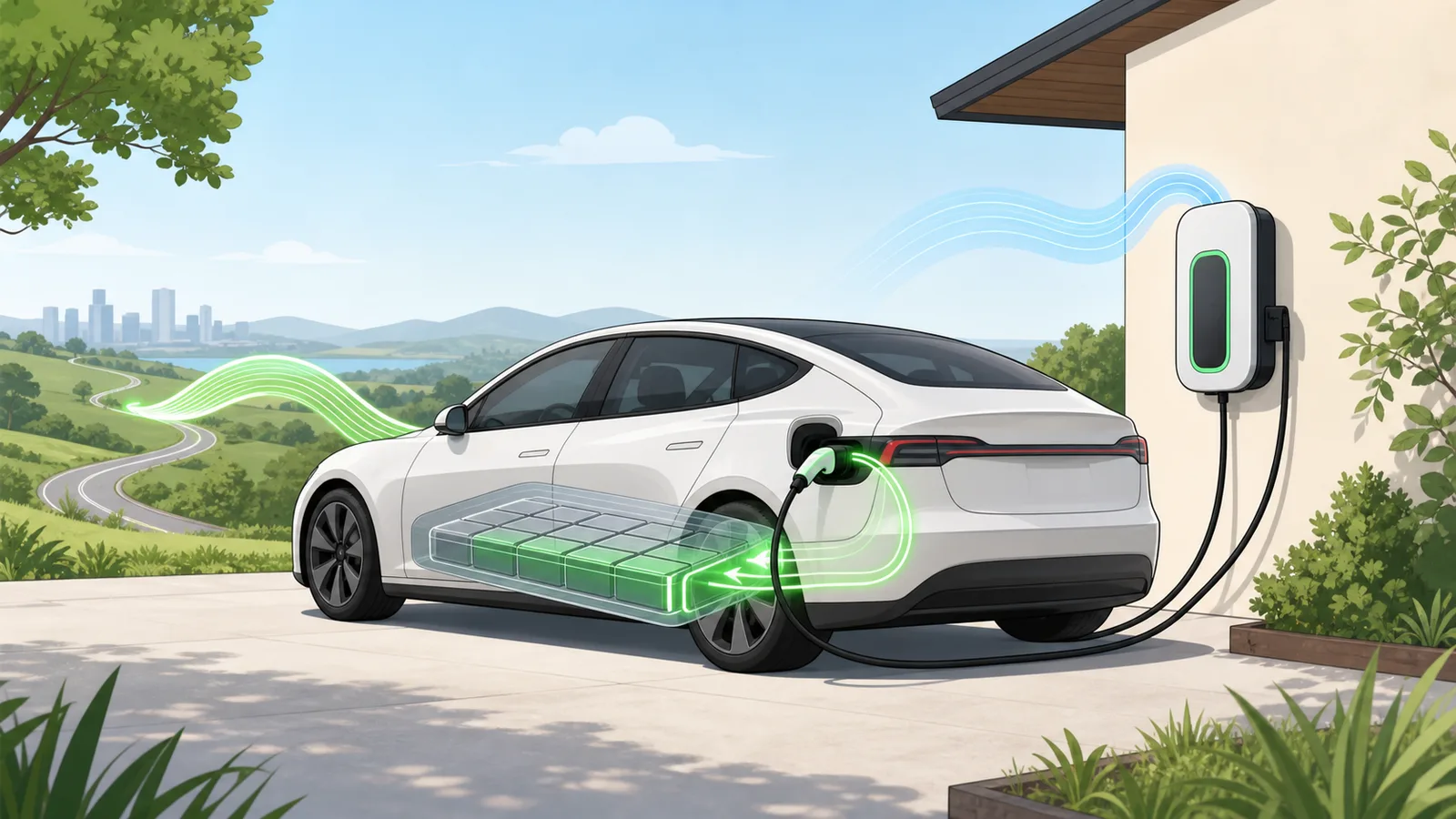
Estimate usable EV battery energy, EV range, charge-window energy, wall energy billed, charging time, and charging cost from battery size, efficiency.
Last updated
EV battery energy helper Estimate usable battery energy, nominal range, charge-window energy, charging time, and cost-per-charge from a battery size and real-world efficiency assumption.
Battery presets
Efficiency presets
Real-world condition presets
Important limits
This helper estimates nominal range from an efficiency assumption and usable battery share. Real range changes with temperature, speed, terrain, weather, battery conditioning, and charging taper, especially above 80% state of charge.
Enter battery details Provide a battery size and efficiency assumption to estimate nominal EV range, charge-window energy, charging time, and charge cost.
EV battery helper: usable battery, range, charging time, and charge cost explained
An EV battery helper turns a battery-size figure into practical planning outputs such as usable battery energy, nominal range, charging-window energy, charging time at common charger powers, and the electricity cost of a full or partial charge.
Why battery size alone does not equal road range
An EV battery pack may be described by its gross capacity, but the amount available for driving is usually smaller because the battery management system keeps part of the pack in reserve. That is why the helper starts by applying a usable-battery percentage rather than assuming the full nominal pack size is available on the road.
Range then depends on efficiency. A vehicle that uses fewer kilowatt-hours per 100 kilometres will travel farther on the same usable battery than a heavier or less aerodynamic vehicle. The calculator converts the entered efficiency into a common basis so it can estimate nominal range consistently.
Usable battery = Gross battery × Usable share
Applies the entered usable-battery percentage to the pack capacity.
Nominal range (km) = Usable battery / (kWh per 100 km) × 100
Transforms energy available into distance under the selected efficiency assumption.
Charge cost = Energy added × Rate per kWh
Estimates the electricity cost of the selected charge window.
Wall energy billed = Battery energy added / Charger efficiency
Accounts for charging losses so the cost estimate follows the kWh recorded by a wall meter or public charging session.
Battery health, weather, speed, and charger losses
A useful EV battery calculator should not treat a new battery, a cold motorway trip, and a gentle city commute as the same scenario. Battery health reduces the usable kWh available from an older pack, while cold weather, high speed, wet roads, roof loads, and cabin heating can raise energy use per kilometre or mile. The helper models those effects as transparent multipliers so you can see how much range changes before you rely on the number.
Charging cost also depends on where the kWh are measured. The car stores battery-side energy, but your electricity bill or charging receipt usually reflects wall-side energy. A charger-efficiency assumption bridges that gap. This is why the result now reports both charge-window energy and wall energy billed, then uses the wall-side kWh for charge cost and the effective charging power for charging-time estimates.
Charging time is calculated from the energy added across the selected state-of-charge window and the charger power you enter or compare against. This gives a simple constant-power estimate that is useful for ballpark planning.
Real EV charging is rarely constant. AC charging can be close to the rated power for long periods, but DC fast charging usually tapers as the battery fills, which means the final part of the session can take longer than a simple division suggests.
Worked example: 75 kWh battery from 10% to 80%
Suppose an EV has a 75 kWh gross pack, a 95% usable share, 90% battery health, and an efficiency assumption of 17.5 kWh/100km. The usable energy is 75 × 0.95 × 0.90, or 64.1 kWh. Under label-style conditions that supports about 366 km of usable-battery range before considering a reserve strategy.
If you model cold or wet conditions as 20% higher energy use, the adjusted efficiency becomes 21.0 kWh/100km and the estimated full usable-battery range falls to about 305 km. A 10% to 80% charge window adds about 44.9 battery-side kWh. With 90% charger efficiency, the wall energy billed is about 49.9 kWh, which is the more appropriate figure for charging cost.
How to use the result responsibly
Use the nominal range and charge-window outputs for comparison, budgeting, and back-of-the-envelope trip planning. They are especially useful when comparing two battery sizes, two efficiency assumptions, or the effect of changing from a home charger to a faster charger.
Do not treat the result as guaranteed road range. Temperature, speed, tyres, elevation, HVAC use, payload, battery preconditioning, and charging taper can all shift both range and session length materially.
Why does the calculator ask for usable battery percentage?
Because the full gross battery capacity is not always available for driving. Many EVs keep part of the pack in reserve to protect battery life and preserve consistent performance.
Is the charging-time result exact?
No. It is a constant-power estimate. Real charging sessions can be slower because charging power often tapers as state of charge rises, especially on DC fast chargers.
What efficiency unit should I use?
Use whichever unit your source provides. The helper accepts common EV formats such as kWh/100km, Wh/km, Wh/mi, and mi/kWh, then converts them into one consistent range estimate basis.
Why can real range differ so much from nominal range?
Real range changes with temperature, speed, terrain, wind, accessory use, tyre choice, and driving style. The helper is designed for planning and comparison, not for certifying exact trip outcomes.
Should I enter gross battery capacity or usable battery capacity?
If you know the usable capacity, enter that number and set usable battery share to 100%. If you only know the advertised gross pack size, enter the gross kWh and use the usable-share field to model the buffer kept by the battery management system.
How should I use the battery health field?
Leave battery health at 100% for a new or unknown pack. If the car reports reduced usable capacity, or an inspection suggests meaningful degradation, enter that percentage so the EV range estimate reflects the smaller effective battery.
What does the energy-use adjustment do?
The adjustment changes the entered efficiency before range is calculated. A positive value models harder conditions such as cold weather, motorway speed, wind, hills, roof boxes, or heavy HVAC use. A negative value models easier-than-label conditions such as gentle city driving.
Why is wall energy billed higher than charge-window energy?
Charge-window energy is the battery-side energy you are trying to add. Wall energy billed accounts for losses in the cable, charger, onboard electronics, and battery conditioning. It is usually the better basis for estimating charging cost from an electricity tariff.
Can this replace a route planner?
No. It can help you sanity-check battery size, EV efficiency, charge-window energy, and charging cost, but it does not know charger availability, route elevation, traffic, wind, live temperature, preconditioning, or the exact charging curve for a specific vehicle.