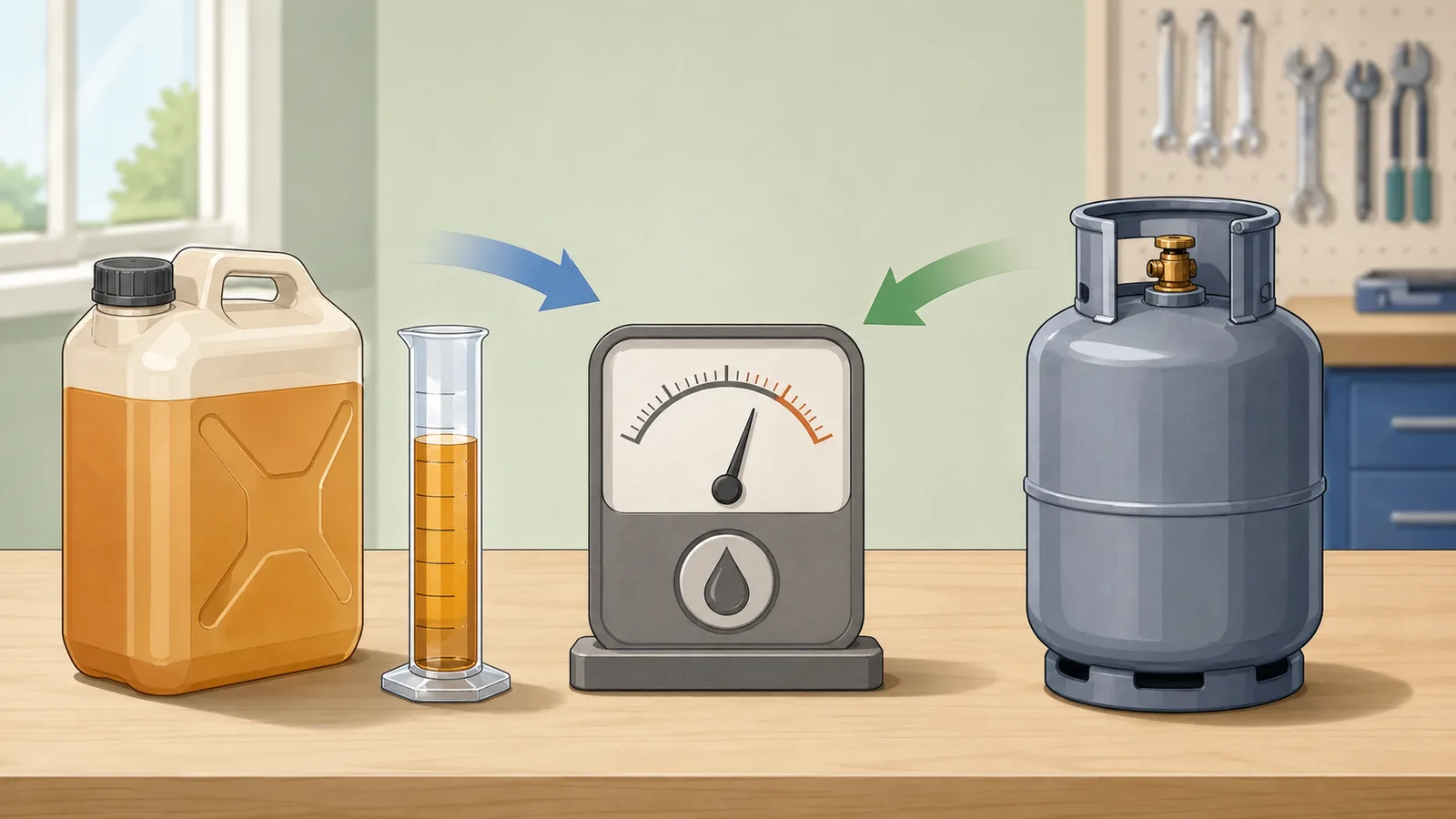
Convert fuel energy density by volume between MJ/L, MJ/m3, kWh/L, BTU/ft3, and BTU/US gal, with common liquid and gas fuel presets.
Last updated
Fuel efficiency by volume converter Convert volumetric fuel-energy values across MJ/L, kWh/L, MJ/m3, BTU/L, and BTU/US gal so liquid and bulk-fuel references stay on one unit basis.
Common fuels
What this converter measures
These units describe energy content per unit volume. They are useful when liquid fuels are quoted by litre or gallon and gaseous fuels are quoted by cubic metre.
Keep the same heating-value basis
Lower heating value and higher heating value sources can differ even before unit conversion. This tool changes units only, so compare sources on the same LHV or HHV basis before drawing fuel-performance conclusions.
Gas pressure and blend notes
Gas values on a cubic-metre basis can vary with pressure, temperature, and composition. Use supplier or standards-body documentation when a specification needs certified volumetric energy content.
Result
34.2 MJ/L
34.2 MJ/L equals 9.5 kWh/L, 34,200 MJ/m3, 917,900 BTU/ft3, and 122,705 BTU/US gal on the same volume basis.
Megajoules per litre
34.2 MJ/L
Kilowatt-hours per litre
9.5 kWh/L
Megajoules per cubic metre
34,200 MJ/m3
BTU per cubic foot
917,900 BTU/ft3
BTU per US gallon
122,705 BTU/US gal
Interpretation
This is in the common liquid-fuel range, where MJ/L, kWh/L, and BTU/US gal are usually the most useful side-by-side readings.
Fuel energy density converter: MJ/L, MJ/m3, kWh/L, BTU/ft3, and BTU/US gal explained
A fuel energy density converter compares how much energy is associated with each litre, cubic metre, cubic foot, or US gallon of fuel. In engineering references this is a volumetric heating value, calorific value, or volumetric energy density question rather than a vehicle fuel-economy question. The calculator converts J/m3, kJ/m3, MJ/m3, J/L, kJ/L, MJ/L, Wh/L, kWh/L, kcal/L, BTU/L, BTU/ft3, and BTU/US gal on one shared basis.
What volumetric fuel energy means
Volumetric fuel energy describes how much energy is associated with each unit of fuel volume. It is useful when fuels are purchased, stored, metered, or specified by litre, gallon, or cubic metre rather than by mass.
That makes the volume basis especially relevant for liquid fuels such as gasoline, diesel, and jet fuel, and for gaseous fuels that may be quoted on a cubic-metre basis. The calculator keeps the same volumetric property while translating it across SI, electrical-equivalent, and imperial unit systems.
1 kWh/L = 3.6 MJ/L
Electrical-equivalent and SI energy units convert directly through the kilowatt-hour relationship.
1 MJ/m3 = 0.001 MJ/L
Converts a cubic-metre basis into the corresponding litre basis.
1 BTU/L ≈ 0.001055 MJ/L
Shows the BTU-to-MJ relationship on a litre basis.
Why liquid and gas references should not be mixed casually
A litre-based value is usually intuitive for liquids because the physical volume is compact and easy to picture. A cubic-metre basis is more common for gases because the same energy content would look very small if expressed per litre.
The calculator handles both bases cleanly, but the interpretation still depends on the fuel state and the underlying measurement convention. For gases, temperature, pressure, and composition can materially change the volumetric figure published by a source.
Keep lower and higher heating values separate
Published fuel values can differ even before unit conversion because some sources use lower heating value and others use higher heating value. That choice changes whether the latent heat of condensation is counted as recoverable energy.
The converter does not pick one convention for you. It only changes units. To compare fuels fairly, keep the same LHV or HHV basis throughout the source material you are using.
Further reading
NIST Guide to the SI — Official NIST reference for SI usage and unit-conversion conventions used in scientific and engineering work.
Common fuel-energy-density searches this converter answers
Many people arrive with a pair conversion in mind, such as MJ/L to kWh/L, MJ/m3 to BTU/ft3, BTU/US gal to MJ/L, or BTU/ft3 to MJ/m3. The result table keeps those pair checks visible at the same time instead of forcing a separate one-to-one conversion for each unit.
That broader table is especially useful when one source describes gasoline, diesel, ethanol, or liquid propane by litre, while another describes natural gas by cubic metre or cubic foot. The units look unrelated at first glance, but they can all be compared through the same volumetric energy-density base.
The default gasoline-style example gives an immediate reference point, and the presets let you jump to common liquid and gas values before replacing them with the exact value from a supplier sheet, laboratory report, or engineering reference.
1 Wh/L = 0.0036 MJ/L
Links electrical-equivalent litre values with the SI megajoule scale.
1 BTU/ft3 ≈ 0.03726 MJ/m3
Connects common natural-gas notation with a cubic-metre heating-value basis.
1 BTU/US gal ≈ 0.0002787 MJ/L
Shows how a US-gallon imperial fuel value maps back to the litre basis.
How to interpret litres, cubic metres, cubic feet, and gallons
For compact liquid fuels, MJ/L and kWh/L are usually the easiest headline values because they describe the energy contained in one litre of fuel. BTU/US gal is still common in US-facing fuel references, so the calculator keeps that value beside the SI rows.
For gases, a litre basis can make the number look artificially small. Cubic metres and cubic feet are more practical because metering and heating-value references often use those volumes. That is why the calculator shows MJ/m3 and BTU/ft3 as first-class outputs instead of treating them as obscure edge units.
The volume basis is still only as reliable as the source value. If a fuel expands, is compressed, or is reported at a different reference condition, a pure unit conversion cannot make those physical conditions equivalent.
Worked example: convert gasoline from MJ/L to BTU/US gal
Suppose a gasoline reference is stated as 34.2 MJ/L. Because one US gallon is 3.785411784 litres, the same litre-based energy value corresponds to about 129.5 MJ per US gallon before converting megajoules to BTU.
Using the BTU relationship, that is about 122,700 BTU/US gal. The calculator also shows the same value as 9.5 kWh/L and 34,200 MJ/m3, which makes the gasoline reference comparable with electrical-equivalent and bulk-volume tables.
The important step is not the exact preset value; it is keeping the convention consistent. If your source uses a different blend, temperature basis, or lower-versus-higher heating-value convention, enter that source value and compare only against references that use the same convention.
Where this converter should not be stretched
This is not a vehicle fuel economy calculator. A car's miles per gallon, litres per 100 kilometres, or range per tank depends on drivetrain efficiency, driving cycle, load, tyres, weather, and many other variables beyond fuel energy per unit volume.
It is also not a density converter. If a source gives energy per mass, such as MJ/kg or BTU/lb, use a mass-based fuel specific-energy converter unless you also have a valid fuel density to bridge mass and volume.
For procurement, emissions modelling, or process design, use the exact source specification. This page is strongest as a fuel energy density converter and heating value unit converter, not as a substitute for certified fuel-property data.
Frequently asked questions
Is this the same thing as vehicle fuel economy?
No. This tool converts energy content per unit volume. Vehicle fuel economy is distance travelled per unit of fuel consumed. The two ideas are related but not interchangeable.
Why would I compare MJ/L with MJ/m3?
MJ/L is common for liquids, while MJ/m3 is common for gases. Seeing both helps when one source quotes liquid fuels by litre and another quotes gas by cubic metre.
Why can the same fuel have slightly different published values?
Fuel blend, purity, temperature, pressure, and whether the source uses lower or higher heating value can all shift the reported number.
Does this converter estimate usable engine or boiler efficiency?
No. It converts the underlying fuel-energy quantity only. Real system efficiency depends on the engine, burner, process, and operating conditions.
How do I convert MJ/L to kWh/L?
Divide the MJ/L value by 3.6. For example, 36 MJ/L equals 10 kWh/L because one kilowatt-hour is exactly 3.6 megajoules. The calculator keeps both rows visible so you can compare thermal and electrical-equivalent notation without doing the division manually.
How do I convert BTU/ft3 to MJ/m3?
Multiply BTU per cubic foot by about 0.03726 to get MJ per cubic metre. This conversion is especially useful for natural gas references, where US sources often use BTU/ft3 while SI-oriented sources often use MJ/m3.
Can I use this as a calorific value converter?
Yes, when the calorific value is stated per unit volume and you keep the same lower or higher heating value basis. If the source gives calorific value per mass, use a mass-based specific-energy converter instead of forcing the number into a volume unit.
Why does natural gas look so small in MJ/L?
A gas occupies much more volume than a liquid at ordinary reference conditions, so its energy per litre is small compared with liquid fuels. MJ/m3 or BTU/ft3 is usually the clearer notation for gas because those units match how gas heating values are commonly reported.
What is the difference between volumetric energy density and fuel efficiency?
Volumetric energy density is the fuel energy associated with a unit of volume. Fuel efficiency usually describes how effectively a vehicle, engine, heater, or process turns that fuel energy into useful output. This page converts the fuel property, not the device performance.
Can I compare gasoline, diesel, ethanol, propane, and natural gas directly?
You can compare their stated volumetric energy values after converting units, but direct interpretation still needs care. Fuels can be liquid or gaseous, may use different reference conditions, and may be reported on lower or higher heating value bases. The table is a unit bridge, not a complete fuel-selection model.
Does pressure affect BTU/ft3 or MJ/m3 values?
Yes. Gas volume changes with pressure and temperature, so a gas heating value per cubic foot or cubic metre must be tied to the source's reference conditions. A unit converter can translate the stated value, but it cannot infer the missing pressure, temperature, or composition assumptions.