Skip to content
Calcipedia
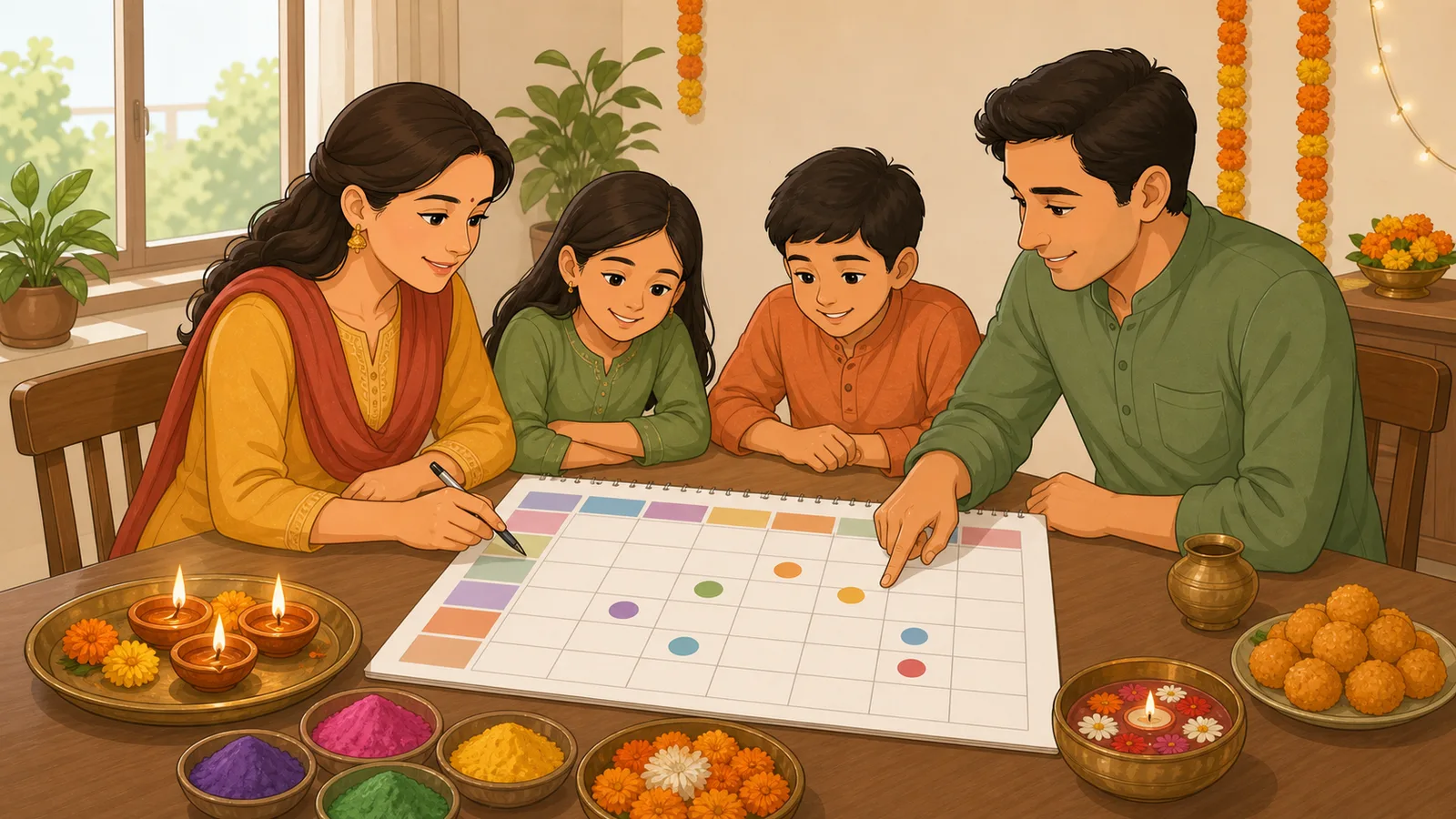
Hindu Festival Calculator instructional illustration

Hindu Festival Calculator

Use this Hindu festival calculator to estimate Diwali, Holi, Navratri, Dussehra, Janmashtami, Ganesh Chaturthi, and other major Hindu festival dates by year.

Last updated

Hindu festival calendar worksheet Enter a Gregorian year to map major Hindu festival dates, then use the planning notes to see which observances deserve a local temple or community-calendar double-check.

Quick jump

Scope and assumptions

  • The worksheet follows the North Indian (Purnimant) naming convention for the selected festivals.
  • Recent supported years use curated reference dates; other supported years use a simplified lunisolar approximation.
  • Some observances, especially Holi, Janmashtami, and Diwali, can split by a day because local panchangs apply different evening or midnight rules.
Treat this as a planning calendar, not a final religious authority If an exact observance date matters for puja, temple attendance, school scheduling, or travel, confirm it with the local panchang, temple, or community organisation you follow.

Festival planning sheet

Hindu festival dates for 2026

This year uses curated reference dates for the named observances.

First major festival
Holi
Tuesday, 3 March 2026
Autumn headline
Sunday, 8 November 2026
Diwali
Data basis
Reference dates
Recent-year planning sheet
Always double-check
Janmashtami + Diwali
Midnight and evening rules can change the civil date you should use locally.

Major planning anchors

The dates most people need first

Holi होली
Tuesday, 3 March 2026
Colour day linked to Phalguna Purnima, usually after Holika Dahan on the previous evening.
For travel or school planning, allow for both Holika Dahan and the main colour-play day instead of treating Holi as a single isolated moment.
Janmashtami जन्माष्टमी
Friday, 4 September 2026
Krishna Ashtami of Bhadrapada, often with Smarta and Vaishnava or ISKCON observances on adjacent dates.
When the exact midnight observance matters, treat the page as a shortlist and confirm whether your community follows Smarta, Vaishnava, or ISKCON timing.
Ganesh Chaturthi गणेश चतुर्थी
Monday, 14 September 2026
Bhadrapada Shukla Chaturthi, the fourth bright-half lunar day after the new moon.
Useful for planning the start of the Ganesh festival period, especially when immersion or community programming continues for several days after installation.
Navratri (start) नवरात्रि
Sunday, 11 October 2026
Ashwin Shukla Pratipada, the bright-half opening of the autumn Navratri cycle.
This is the best autumn-planning anchor if you need the whole festival run rather than only Dussehra.
Dussehra (Vijayadashami) दशहरा (विजयादशमी)
Tuesday, 20 October 2026
Ashwin Shukla Dashami, the tenth day of the autumn Navratri sequence.
Strong for event planning because it anchors the close of Navratri and many public-procession calendars.
Diwali दीवाली
Sunday, 8 November 2026
Kartik Amavasya / Lakshmi Puja night, tied to the new moon and evening observance window.
Treat this as the autumn headline date, then allow extra room for Dhanteras, Kali Chaudas, Govardhan Puja, and Bhai Dooj around it.

Seasonal planning windows

How the year clusters in practice

Spring sequence

Sunday, 15 February 2026 to Wednesday, 1 April 2026

Useful for spring break, school programming, and temple-visit planning because several observances cluster within six to eight weeks.

Includes Maha Shivaratri, Holi, Ram Navami, Hanuman Jayanti.

Late-summer family dates

Thursday, 27 August 2026 to Monday, 14 September 2026

Helpful when the practical question is which August or September weekends may already be spoken for by family or community events.

Includes Raksha Bandhan, Janmashtami, Ganesh Chaturthi.

Autumn festival run

Sunday, 11 October 2026 to Tuesday, 10 November 2026

The strongest planning cluster for travel, retail, editorial calendars, and school or workplace observances.

Includes Navratri (start), Dussehra (Vijayadashami), Diwali, Bhai Dooj.

Full festival calendar

Why each date moves and what to confirm locally

FestivalDateTiming basisTypical windowLocal note
Makar Sankranti मकर संक्रांति
Wednesday, 14 January 2026Solar ingress into Makara (Capricorn), usually a fixed mid-January date.14 or 15 JanuaryBecause this is a solar festival, the date moves much less than the lunar observances, though some almanacs shift it by a day.
Maha Shivaratri महा शिवरात्रि
Sunday, 15 February 2026Krishna Chaturdashi of Magha or Phalguna, observed on the night vigil before Amavasya.February to early MarchMonth naming can differ between regional calendars, but the practical civil date is usually the same.
Holi होली
Tuesday, 3 March 2026Colour day linked to Phalguna Purnima, usually after Holika Dahan on the previous evening.Late February to late MarchSome calendars emphasise Holika Dahan, others the next day’s colour celebration, and diaspora communities may shift by a day.
Ram Navami राम नवमी
Thursday, 26 March 2026Chaitra Shukla Navami, nine lunar days after the new moon beginning Chaitra.Late March to mid-AprilTemple timetables and fasting observance windows can differ even when the civil date matches.
Hanuman Jayanti हनुमान जयंती
Wednesday, 1 April 2026Often kept on Chaitra Purnima in North Indian calendars.March to AprilRegional traditions vary more here than for the pan-Indian headline festivals, so local temple calendars deserve priority.
Raksha Bandhan रक्षा बंधन
Thursday, 27 August 2026Shravana Purnima full-moon observance.AugustAuspicious-thread timing can be narrowed by local muhurat rules even when the civil date is widely shared.
Janmashtami जन्माष्टमी
Friday, 4 September 2026Krishna Ashtami of Bhadrapada, often with Smarta and Vaishnava or ISKCON observances on adjacent dates.August to early SeptemberThis is one of the most common one-day split festivals because midnight and Rohini-nakshatra rules are applied differently.
Ganesh Chaturthi गणेश चतुर्थी
Monday, 14 September 2026Bhadrapada Shukla Chaturthi, the fourth bright-half lunar day after the new moon.August to SeptemberPublic celebrations are especially prominent in Maharashtra, and local immersion schedules can matter more than the opening date alone.
Navratri (start) नवरात्रि
Sunday, 11 October 2026Ashwin Shukla Pratipada, the bright-half opening of the autumn Navratri cycle.September to OctoberGarba, Durga Puja, and regional Navratri practice can emphasise different days inside the same nine-night window.
Dussehra (Vijayadashami) दशहरा (विजयादशमी)
Tuesday, 20 October 2026Ashwin Shukla Dashami, the tenth day of the autumn Navratri sequence.OctoberRamlila, Durga immersion, and Vijayadashami customs vary a lot by region even when the civil date is shared.
Diwali दीवाली
Sunday, 8 November 2026Kartik Amavasya / Lakshmi Puja night, tied to the new moon and evening observance window.Late October to mid-NovemberDiwali is one of the most likely festivals to show one-day regional variation because sunset, pradosh, and local panchang rules matter.
Bhai Dooj भाई दूज
Tuesday, 10 November 2026Kartik Shukla Dwitiya, shortly after the Diwali new moon sequence.October to NovemberExact spacing around the Diwali cluster can look different in public calendars because related observances are grouped differently.

How to use this result

Start with the headline festivals you actually need, then read the timing-basis and local-note columns before committing a travel plan, school event, or publishing schedule.

If the selected year is outside the curated lookup range, use the sheet to narrow the likely week or weekend first, then confirm the exact date against the local panchang you trust.

← All Religious Holidays calculators

Dates & Time

Hindu festival calculator for Diwali, Holi, Navratri, and Janmashtami dates

Use this Hindu festival calculator to estimate major Hindu festival dates by year, including Diwali, Holi, Navratri, Dussehra, Janmashtami, Ganesh Chaturthi, and Raksha Bandhan.

What this Hindu festival calculator actually helps you do

Many people are not looking for a full daily panchang. They are trying to answer a more practical question: in a given Gregorian year, when do the main Hindu festivals likely land, and which ones need extra local confirmation before they go into a school calendar, family trip, editorial plan, or temple event sheet? That is the job this page is designed to do.

The result therefore starts with the festivals most people search for first, such as Holi, Janmashtami, Navratri, Dussehra, and Diwali, and then widens into the surrounding sequence. That makes the page useful both as a Hindu festival calculator and as a compact Hindu holiday calendar for planning the whole year around the strongest spring, late-summer, and autumn clusters.

How the calculator estimates Hindu festival dates

Hindu festival dates are not driven by the Gregorian calendar alone. They are determined from the lunisolar panchang, which tracks lunar months, lunar days or tithis, solar transitions, and other astronomical markers. In practice, that is why Diwali can move between late October and mid-November, why Holi shifts across late February and March, and why Navratri, Dussehra, Janmashtami, and Ganesh Chaturthi never stay on one fixed western date.

This page uses curated reference dates for recent supported years and a simplified lunisolar fallback outside that span. The method is good for yearly planning, comparison, and education, but it is intentionally honest about its limits. The page is not trying to replace a local temple or a region-specific panchang. It is trying to give you a strong first-pass Hindu festival dates by year sheet that is still transparent about uncertainty.

Further reading

Why local calendars can disagree even when the festival name is the same

Regional and tradition-level differences are normal, not a bug. North Indian and South Indian month naming can differ because some calendars count months from the full moon while others count from the new moon. Diaspora communities also convert tithi-based observances into local civil dates using local sunrise, sunset, or midnight rules, so a festival that appears stable in one country can shift by a day somewhere else.

The biggest practical split risks on this page usually involve festivals such as Holi, Janmashtami, and Diwali. Holi can mean Holika Dahan on one evening and colour play on the following day. Janmashtami may separate Smarta and Vaishnava or ISKCON observance. Diwali can depend on the evening Lakshmi Puja window and how a local panchang applies sunset or pradosh rules. That is why the calculator shows local-variation guidance instead of pretending that one date always settles every community.

Further reading

  • Britannica - Diwali — Reference overview of Diwali, its timing in the Hindu calendar, and its regional religious significance.
  • Britannica - Holi — Reference overview of Holi, its Phalguna full-moon timing, regional practices, and Gregorian-date movement.

Worked example: reading the 2026 Hindu festival calendar

Suppose you are planning around 2026. The page shows Holi in early March, a spring sequence that runs through Ram Navami and Hanuman Jayanti, then a late-summer run built around Raksha Bandhan, Janmashtami, and Ganesh Chaturthi, and finally the autumn festival block from Navratri to Dussehra and Diwali. That is already more useful than a flat date list because it tells you where the year is dense with observances rather than leaving every festival isolated.

The stronger use case is decision-making. If you are trying to publish a community calendar, organise travel, or avoid scheduling conflicts, the planning sheet helps you identify which dates are probably safe to lock in and which ones deserve local confirmation. A fixed solar anchor like Makar Sankranti is usually lower risk. A date such as Janmashtami or Diwali should be treated as high-value but locally confirmable, especially when your event depends on evening or midnight observance.

When to trust the calculator and when to go beyond it

Use the calculator when the question is broad planning: when is Diwali this year, which month does Ganesh Chaturthi fall in, how far is Navratri from Dussehra, or which part of the year is most crowded with major Hindu festivals? Those are exactly the kinds of questions a calculator-style Hindu festival calendar can answer quickly and well.

Go beyond the calculator when the exact observance is binding for worship, temple logistics, fasting discipline, travel tied to one temple's calendar, or a school or employer policy that needs the final civil date for a specific community. In those cases, this page should be the shortlist, not the final authority. The calculator is strongest when it narrows the answer intelligently and shows you where local confirmation still matters.

Frequently asked questions

Why do Hindu festival dates change every year?

Most major Hindu festivals are determined from the lunisolar panchang rather than the fixed Gregorian calendar. That means the date depends on the relevant tithi, lunar month, solar transition, or observance window, so the civil date moves from year to year.

Is this a Hindu festival calendar or a Hindu festival calculator?

It functions as both. It calculates a practical yearly festival sheet for a chosen Gregorian year, then presents the output as a planning calendar that highlights the biggest festival clusters and the observances most likely to need local confirmation.

Why might my temple give a different date for Janmashtami or Diwali?

Those festivals are especially sensitive to local observance rules. Janmashtami can separate Smarta and Vaishnava or ISKCON practice, while Diwali depends on the evening Lakshmi Puja window and local panchang rules. A temple calendar may therefore differ by a day even when the broader yearly calendar is still useful.

Does the page follow the same convention everywhere in the world?

No. The page uses a North Indian naming convention and then warns where one-day regional or diaspora variation is common. It is designed for honest planning, not for declaring one universal final authority over every local Hindu calendar.

What is the best keyword intent this page answers?

The page is strongest for searchers looking for a Hindu festival calculator, Hindu festival calendar by year, or direct date questions such as when Diwali, Holi, Navratri, Dussehra, Janmashtami, or Ganesh Chaturthi falls in a selected year.

Also in Religious Holidays

Related

More from nearby categories

These related calculators come from the same leaf category, nearby sibling categories, or the same top-level topic.