Convert lumens, lux, foot-candles, candela, and watts with the required lighting context: area, distance, beam angle, and luminous efficacy.
Last updated
Lighting unit converter Convert lumens, lux, candela, and watts in one worksheet with the missing context kept visible: area for lux and lumens, distance for candela and lux, beam angle for candela and lumens, and luminous efficacy for watts. Watts are electrical power, not brightness, so every watts-to-lumens, lumens-to-watts, watts-to-lux, or lux-to-watts result depends on the lm/W assumption.
Conversion intent
Efficacy presets
Luminous flux
5,000 lm
500 lux across 10 m² is 5,000 lumens.
Active intent
Lux to lumens
Formula used
lumens = lux × area
Solid angle
Not used
Efficacy
100 lm/W
Foot-candles
46.45 fc
Interpretation note Assumes the entered illuminance is reasonably uniform across the whole selected area.
Lighting unit converter: lumens, lux, candela, watts, beam angle, and luminous efficacy
Use this lighting unit converter to move between lumens, lux, candela, and watts without hiding the assumptions. This page also explains the main assumptions behind the lighting unit converter result, highlights the supporting figures shown by the calculator, and helps the reader use the estimate without overstating what a quick online tool can prove.
What this lighting unit converter covers
This page is designed for the search intent behind lighting unit converter, lux to lumens calculator, candela to lux calculator, lumens to watts calculator, watts to lux calculator, and related lighting conversion questions. Instead of treating those as unrelated tools, it keeps the shared photometric relationships in one place so the required context stays visible.
The calculator handles area-based lux and lumen conversions, distance-based candela and lux conversions, beam-angle lumens and candela conversions, and efficacy-based watts and lumens conversions. That matters for SEO and for correctness: a one-step answer without area, distance, beam angle, or lm/W can look precise while using an unstated assumption.
Lumens measure luminous flux: the total visible light output from a source. Lux measures illuminance: lumens per square metre on a surface. Candela measures luminous intensity in a direction. Watts measure electrical power consumed by the lamp or fixture, not the visible light output itself.
That is why the same lamp can have one lumen rating, many possible lux readings, and a candela value that changes with beam concentration. A broad floodlight and a narrow spotlight can emit similar lumens but produce very different candela and lux values at a target distance.
The most common mistake is trying to convert watts directly to brightness. A 10 W LED, a 10 W halogen lamp, and a 10 W incandescent lamp can produce very different lumens because their luminous efficacy values are different.
Lux to lumens and lumens to lux need area
Lux and lumens are connected by illuminated area. To convert lux to lumens, multiply the lux level by the area in square metres. To convert lumens to lux, divide lumens by the area. This is the core reason a lux to lumens calculator asks for area instead of using a fixed conversion factor.
For example, 500 lux across 10 m² is 5,000 lumens under a uniform-coverage worksheet assumption. The same 500 lux across 1 m² is only 500 lumens. The lux value is identical, but the total luminous flux is not.
The calculator now accepts illuminated area in either square metres or square feet and normalises the formula internally to square metres. That keeps the SI definition visible while making the same lux to lumens calculator practical for users working from floor plans, shop drawings, or room sizes listed in square feet.
Lumens = lux × area
Use when you know the illuminance target and the surface area.
Lux = lumens ÷ area
Use when you know total luminous flux and want average illuminance.
Foot-candles, square feet, and US lighting worksheets
Foot-candles are the US customary illuminance unit used in many architectural, retail, workplace, and lighting-product references. One foot-candle means one lumen per square foot, so it is closely related to lux but not identical: one foot-candle is about 10.7639 lux.
Calcipedia keeps the main lighting formulas in SI units, then shows the lux result as foot-candles when a lux value is available. This makes lumens to lux, watts to lux, and candela to lux results easier to compare with US lighting schedules without turning the page into a separate country-specific calculator.
Foot-candles = lux ÷ 10.7639
Use this display conversion when a lux result needs to be compared with foot-candle guidance.
Area in m² = area in ft² × 0.09290304
The calculator uses this normalisation before applying lux and lumen formulas to square-foot inputs.
Candela to lux and lux to candela need distance
Candela and lux are connected by distance when the light source can be treated as directional and the target surface faces the beam. The simplified point-source relationship is lux equals candela divided by distance squared. Rearranged, candela equals lux multiplied by distance squared.
For example, 100 cd at 2 m gives 25 lux because the distance term is 2². This inverse-square behavior is why small distance changes can make a large difference in measured illuminance.
Distance can be entered in metres or feet. The inverse-square calculation still runs from metres, so a feet-based candela to lux worksheet remains consistent with the standard photometric relationship while matching common fixture throw-distance notes.
Lux = candela ÷ distance²
Use for directional intensity reaching a target surface at a known distance.
Candela = lux × distance²
Use when a target lux level and throw distance imply a required intensity.
Lumens to candela and candela to lumens need beam angle
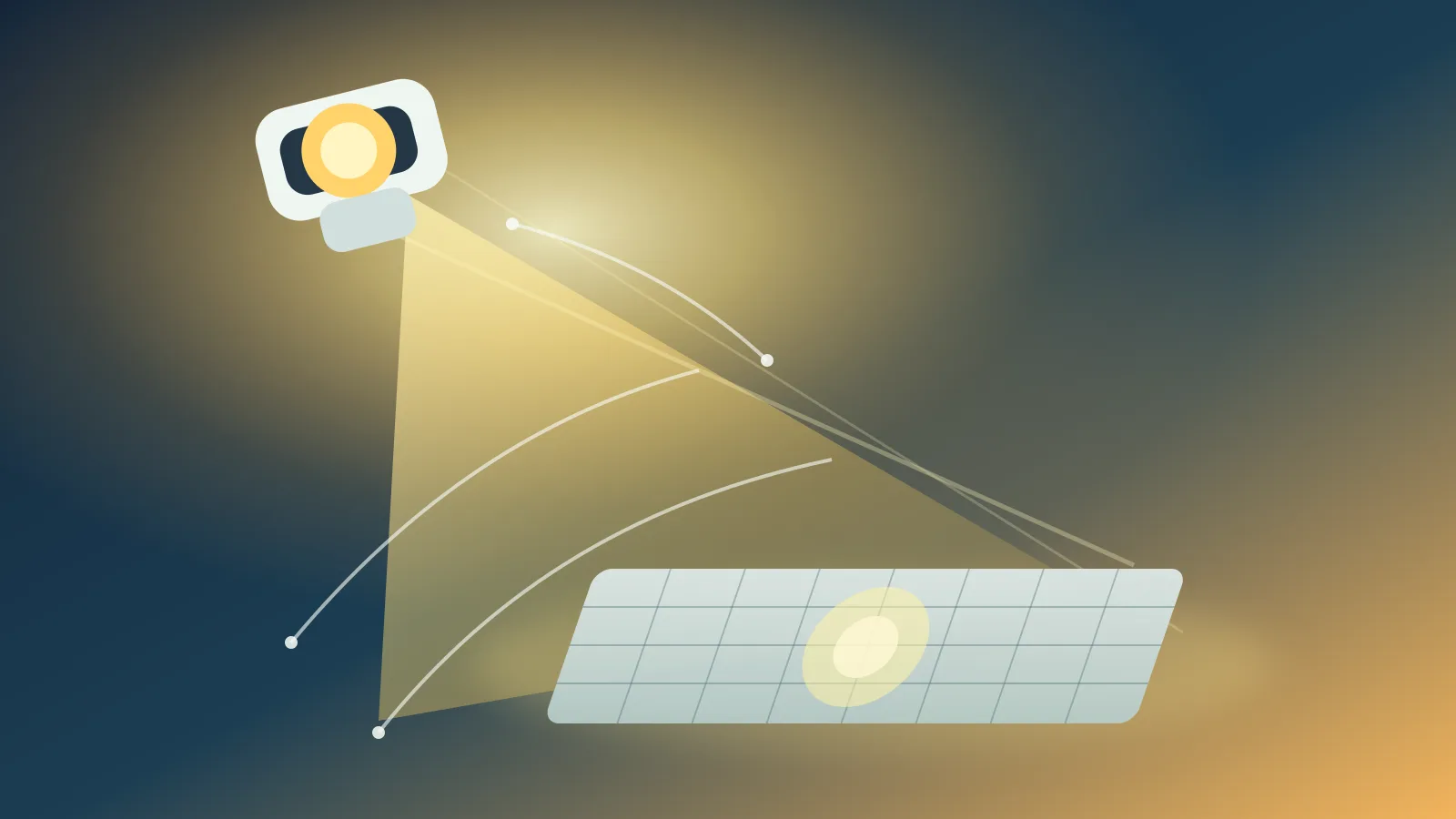
Lumens and candela are connected through solid angle. A beam angle describes how concentrated the light is. For a cone-shaped beam, the solid angle can be estimated from the full beam angle, then lumens equal candela multiplied by solid angle.
A narrower beam concentrates the same lumens into more candela. A wider beam spreads the same lumens across more steradians and lowers the candela estimate. That is why lumens to candela and candela to lumens calculators must ask for beam angle.
Solid angle = 2π × (1 − cos(beam angle ÷ 2))
Estimates steradians for a circular cone using the full beam angle.
Lumens = candela × solid angle
Connects luminous intensity and luminous flux for an assumed beam shape.
Watts to lumens and lumens to watts need luminous efficacy
Luminous efficacy is measured in lumens per watt. It is the bridge between electrical power and visible light output. Use watts to lumens when you know power and an efficacy assumption. Use lumens to watts when you know the target lumen output and a realistic efficacy for the source type.
Common planning presets are useful, but they are still assumptions. LEDs often produce far more lumens per watt than incandescent or halogen lamps, and fixtures can lose light through optics, diffusers, heat, driver performance, and placement.
Lumens = watts × luminous efficacy
Forward estimate from electrical power to visible light output.
Watts = lumens ÷ luminous efficacy
Reverse estimate from lumen target to electrical power.
Watts to lux and lux to watts combine the same assumptions
A watts to lux calculator first estimates lumens from watts and luminous efficacy, then divides by illuminated area. A lux to watts calculator reverses that chain: lux multiplied by area gives lumens, then lumens divided by efficacy gives watts.
These conversions are useful for rough planning, but they are not a replacement for measured photometric data. Real fixtures may not deliver all emitted lumens to the target surface, and uneven beams can make an average lux estimate misleading.
When to use a lighting worksheet versus measured photometric data
This calculator is best for transparent unit conversion, early planning, estimating lamp equivalence, and checking whether a result is in the right order of magnitude. It keeps the assumptions visible so you can compare LED, CFL, halogen, and incandescent efficacy scenarios without pretending watts alone define brightness.
For architectural lighting design, regulatory compliance, road lighting, workplace safety, or product procurement, use manufacturer photometric files, measured fixture data, and project-specific geometry. A single worksheet cannot model reflectance, mounting height, beam distribution, glare, maintenance factors, or room-surface interactions.
NIST — Photometric Calibrations — NIST reference for photometric quantities including candela, illuminance, lumen, luminous flux, and lux.
Frequently asked questions
What is the best lighting unit converter for lumens, lux, candela, and watts?
Use a converter that asks for the missing context instead of forcing a fixed factor. Lumens and lux need area, candela and lux need distance, lumens and candela need beam angle, and watts need luminous efficacy.
Can you convert lux to lumens directly?
No. You need illuminated area. Lumens equal lux multiplied by area in square metres, so the same lux value can represent very different lumen totals depending on the surface size.
How do you convert lumens to lux?
Divide lumens by illuminated area in square metres. The result is an average illuminance estimate in lux for a uniform lighting worksheet.
Can I use square feet instead of square metres?
Yes. Choose square feet for the area input and the calculator will convert the entered surface area to square metres before applying the lux and lumen formulas. The result still reports lux, and when a lux result is available it also shows the equivalent foot-candles.
How do lux and foot-candles compare?
Lux and foot-candles both measure illuminance. Lux is lumens per square metre, while foot-candles are lumens per square foot. One foot-candle is about 10.7639 lux, so a 500 lux result is about 46.45 foot-candles.
How do you convert candela to lux?
Use lux equals candela divided by distance squared, assuming a directional source and a target surface facing the beam. The calculation is defined with distance in metres; if you enter feet, the calculator normalises the distance to metres first.
Can I enter candela distance in feet?
Yes. Select feet for the distance input and the calculator will normalise the throw distance to metres before applying the inverse-square candela to lux or lux to candela formula. This helps when a fixture datasheet or site measurement is written in feet.
How do you convert lux to candela?
Multiply lux by distance squared. This estimates the candela needed to produce a target lux level at a given throw distance under the simplified point-source assumption.
How do you convert lumens to candela?
Estimate the beam solid angle from the full beam angle, then divide lumens by that solid angle. Narrow beams produce higher candela from the same lumens.
How do you convert candela to lumens?
Multiply candela by the beam solid angle. The result depends on beam angle because candela is directional intensity and lumens are total visible output across the beam.
Can watts be converted to lumens?
Yes, but only with a luminous efficacy assumption in lumens per watt. Watts measure electrical power, so a watts-to-lumens calculator is really applying an efficiency estimate.
Why are LED watts different from incandescent watts?
LEDs usually produce more lumens per watt than incandescent lamps. That means two bulbs with the same wattage can have very different brightness, and two bulbs with the same lumens can use very different power.
How do you convert watts to lux?
Multiply watts by luminous efficacy to estimate lumens, then divide by illuminated area. The formula is lux equals watts times lm/W divided by area.
How do you convert lux to watts?
Multiply lux by area to estimate lumens, then divide by luminous efficacy. This gives a rough power estimate for the selected source efficiency.
Is this a replacement for lighting design software?
No. It is a transparent unit-conversion worksheet. Use measured photometric data and proper design tools for compliance, procurement, glare control, mounting-height studies, or critical lighting layouts.