Skip to content
Calcipedia
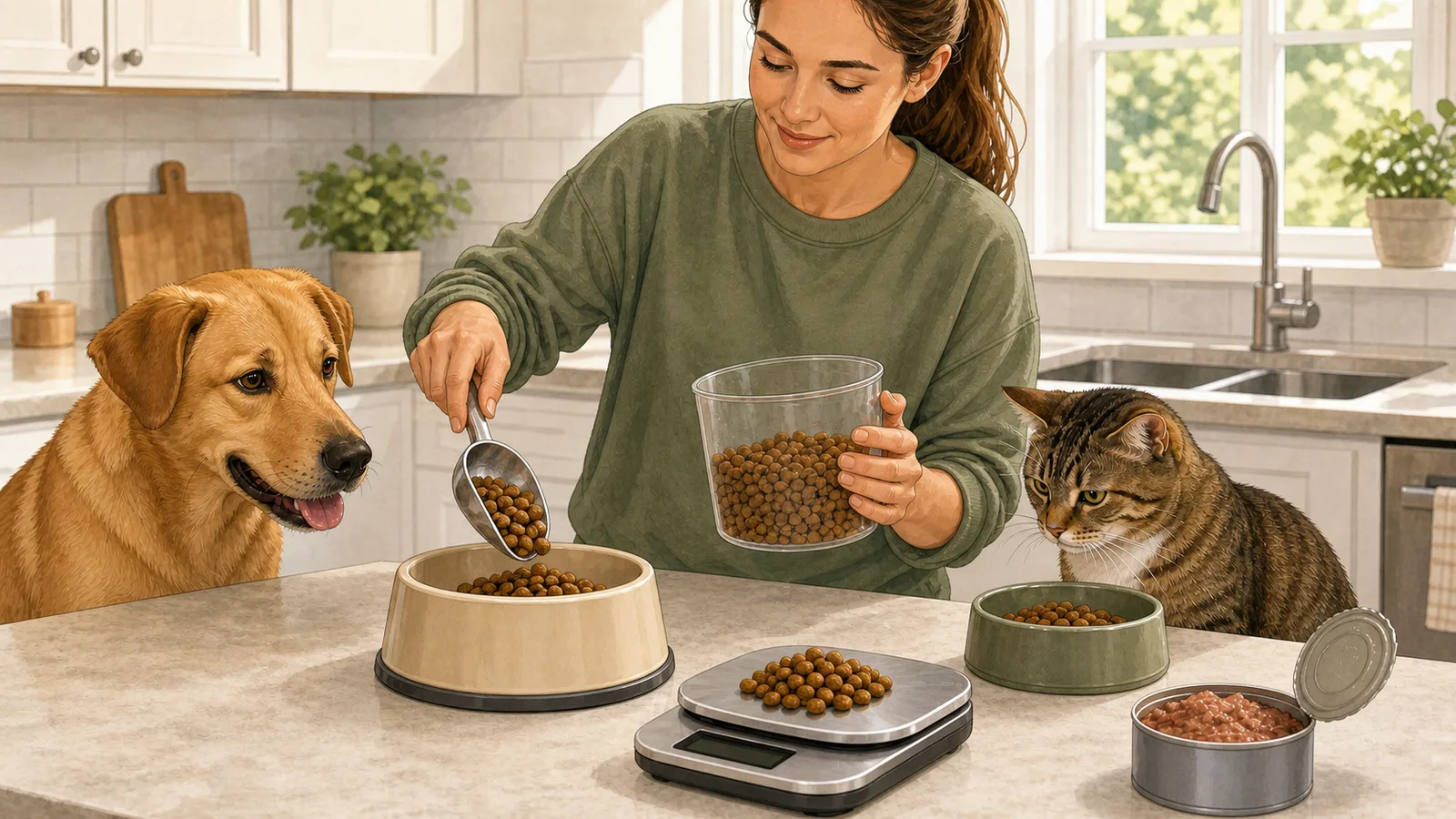
Pet Food Calculator instructional illustration

Pet Food Calculator

Estimate dog and cat food portions from weight, age, calorie density, lifestyle, activity, treats, and feeding goal, with cups, grams, cans, per-meal portions.

Last updated

Pet food calculator at a glance

Use this pet food calculator to estimate daily calories, cups, grams, cans, meal portions, and monthly food needs for cats and dogs from weight, age, food-label calorie density, and the key lifestyle factors that change portions.

It is a measured starting point for stable pets, not a treatment plan for obesity, weight loss, pregnancy, growth problems, or disease-related feeding needs.

Quick dog profiles

Label and measuring assumptions

Use the calorie statement from the bag or manufacturer page in kcal per cup. If you also know how many grams fit in one measured cup, add that value to cross-check scoop portions against a kitchen scale.

Daily portion

1.6 cups

Starting point for a adult dog using about 629 kcal/day.

Resting energy
393 kcal
Meals per day
2
Per meal
0.8 cups per meal
Monthly food
47.2 cups per month
Food calories
566 kcal
Treat allowance
63 kcal

What shifts the number

Medium breed • Neutered or spayed • Typical adult routine

Maintain current condition

Adult dog estimates start from resting energy requirement, then apply a maintenance factor based on routine activity level. Maintain current condition is applied after the life-stage and activity estimate. Around 63 kcal/day is reserved for treats, chews, or training rewards so they stay inside the same budget.

Typical adult routine is the usual neutral baseline. Working, sport, and very sedentary dogs can fall well outside a bag’s generic feeding chart.

Meal split planner

Current split

0.8 cups per meal

This matches the current meal-count setting.

3 meals per day

0.5 cups per meal

Useful if your household schedule needs a different meal rhythm.

← All Pets & Animals calculators

Pet Care

Pet food calculator for dog food, cat food, calories, cups, and grams

This pet food calculator estimates daily calories, cups, grams, meal portions, and monthly food needs for dogs and cats. It consolidates the dog food calculator and cat food calculator workflows while preserving dog activity, breed-size growth stage, adult status, treat-budget logic, cat lifestyle, and food-label calorie density.

How the pet food calculator estimates portions

The calculator starts with resting energy requirement, often shortened to RER. RER estimates the calories a dog or cat would need at rest from body weight in kilograms. The calculator then applies a species-specific life-stage and lifestyle adjustment so the final daily calorie target better reflects puppies, kittens, adult pets, senior pets, activity, neuter status, and feeding goal.

The last step converts calories into a practical portion from the calorie density on the food label. If the label gives kcal per cup, the result appears in cups and cups per meal. If the label gives kcal per 100 g, the result appears in grams and kilograms per month. If the label gives kcal per can or tray, the result appears in cans per day, cans per meal, and cans per month. That makes the result easier to compare with real food instead of stopping at a calorie number.

RER = 70 x body weight in kg^0.75

Resting energy requirement, used as the calorie baseline before life-stage and lifestyle adjustments.

Daily portion = daily food calories / food calorie density

Converts the calorie target into cups or grams from the food label.

Dog food estimates preserve activity, breed size, and treats

The dog food calculator mode keeps the important controls from the standalone dog page: breed size, activity level, adult status, feeding goal, treat budget, age unit, weight unit, and calorie-density unit. The dog quick profiles and meal-split planner also remain available so a user can test a family dog, toy adult, large puppy, or senior trim plan without rebuilding every input from scratch.

Treat calories are separated from main-food calories because chews, toppers, table scraps, and training rewards can silently push a ration above plan. If the treat budget is high, the calculator warns that treats can crowd out balanced food and should be handled carefully.

Cat food estimates preserve lifestyle and label checks

The cat food calculator mode keeps the cat-specific lifestyle control because indoor-calm, indoor-typical, mixed indoor/outdoor, and outdoor-active cats can need different starting points. The output includes daily portion, per-meal portion, monthly food quantity, resting energy, meals per day, and the adjustment note that explains why the estimate can move.

For cats, small calorie differences can matter because body weight is lower and indoor obesity risk is common. The page therefore frames the result as a starting estimate to compare with body condition, appetite, weight trend, and veterinary advice rather than a fixed prescription.

Wet-food cans, trays, and pouch planning

Many dog food calculator and cat food calculator pages stop at calories or cups, but wet food often needs a different check. If the label gives calories per can, tray, or pouch, switching the calculator to kcal per can lets you work in the packaging unit you actually buy. That is useful for senior cats on wet food, mixed wet-and-dry feeding, or dog foods sold in tubs or trays rather than scoopable kibble.

This also helps with buying decisions. A result like 1.8 cans per day is easier to turn into a weekly or monthly shopping list than a generic calorie target. If the food is not a standard can size, use the calories for the exact container the pet eats from rather than guessing from ounces or volume.

Why grams per cup matters for dry food and mixed feeding

A cup is a volume measure, not a weight measure. Two kibbles can both say kcal per cup while one fills a measuring cup at a very different weight. If the bag or manufacturer also lists grams per cup, entering that value lets the calculator show a weighed daily portion and grams per meal alongside the scoop-based estimate.

That weighed cross-check is useful when several people feed the same pet, when a pet gains weight on a loosely filled scoop, or when you are trying to match a dry-food ration with a wet-food top-up. The daily calories do not change just because meals are split differently, but meal count changes how much should go into each bowl.

Worked example: converting calories to cups

Suppose a medium adult dog has a daily calorie target near 700 kcal and the food label says 360 kcal per cup. If 10% of calories are reserved for treats, the main food budget is about 630 kcal. Dividing 630 by 360 gives about 1.75 cups per day before rounding for a practical scoop or weighed portion.

The same logic works for cat food. If an adult cat target is about 270 kcal and the food is 380 kcal per cup, the daily portion is about 0.7 cups. If the label gives kcal per 100 g instead, switching the unit makes the calculator return grams rather than cups.

When a generic pet feeding calculator is not enough

A pet feeding calculator cannot see body-condition score, muscle condition, pregnancy, lactation, disease, medication, food allergies, growth abnormalities, appetite change, vomiting, diarrhoea, or the exact calories in every treat. It also cannot decide whether a weight-loss goal is medically appropriate.

Use the result as a measured starting point for stable pets. If a pet is growing poorly, losing weight unexpectedly, gaining weight quickly, dealing with chronic disease, or needing therapeutic food, a veterinarian-set feeding plan should override a generic calculator.

Further reading

Frequently asked questions

How much food should I feed my pet?

Start with body weight, age, species, lifestyle, and the calorie density on the food label. The calculator estimates daily calories, then converts that number into cups or grams. Treat the result as a starting point and adjust with body-condition trend and veterinary guidance.

Is this a dog food calculator and a cat food calculator?

Yes. Choose dog or cat first. Dog mode includes breed size, activity, adult status, feeding goal, treat budget, quick profiles, and meal-split rows. Cat mode includes lifestyle and the same calorie-density conversion to cups or grams.

What is RER in a pet food calculator?

RER means resting energy requirement. It is a body-weight-based calorie baseline calculated as 70 times body weight in kilograms to the 0.75 power. The calculator then applies life-stage and lifestyle adjustments before converting calories into a food portion.

Should I use cups or grams for pet food?

Use whichever matches the food label and your feeding method. Cups are convenient when the label gives kcal per cup, but grams are often more repeatable because scoops can vary. If your label gives kcal per 100 g, switch the calculator to grams.

How do I calculate wet dog food or wet cat food cans per day?

Use the calories for one full can, tray, or pouch from the label and switch the unit to kcal per can. The calculator will return cans per day, cans per meal, and cans per month so the result matches the packaging unit you actually buy.

Why does grams per cup matter in a pet feeding calculator?

Calories per cup tell you the energy in one measured cup, but grams per cup tells you how heavy that cup is on a kitchen scale. Adding grams per cup helps cross-check scoop portions against a weighed ration, which is often more consistent for weight management or multi-person feeding.

Do treats count in daily pet calories?

Yes. Treats, toppers, chews, and table scraps should come from the same daily calorie budget. The calculator reserves a treat percentage and subtracts that from main-food calories so extras do not quietly sit on top of the ration for dogs or cats.

How many meals per day should I feed my dog or cat?

Meal count changes portion size per bowl, not the full-day calorie target. Adult dogs and adult cats often start at two meals per day, while puppies and kittens may need more frequent meals. Use the calculator's meal split as a starting structure, then follow veterinary advice for growth, disease, or appetite issues.

Can I use this for a puppy or kitten?

The calculator includes puppy and kitten life-stage adjustments, but growth is a higher-stakes feeding period. If growth looks too fast, too slow, or uneven, use food-label puppy or kitten guidance and veterinary advice rather than relying only on a generic estimate.

Can this calculator create a weight-loss plan?

It can show a cautious starting estimate for a dog weight-management goal, but it is not a medical weight-loss plan. Weight reduction should be based on body-condition scoring, regular weigh-ins, and veterinary guidance, especially for cats, puppies, kittens, senior pets, and pets with disease.

Also in Pets & Animals

Related

More from nearby categories

These related calculators come from the same leaf category, nearby sibling categories, or the same top-level topic.