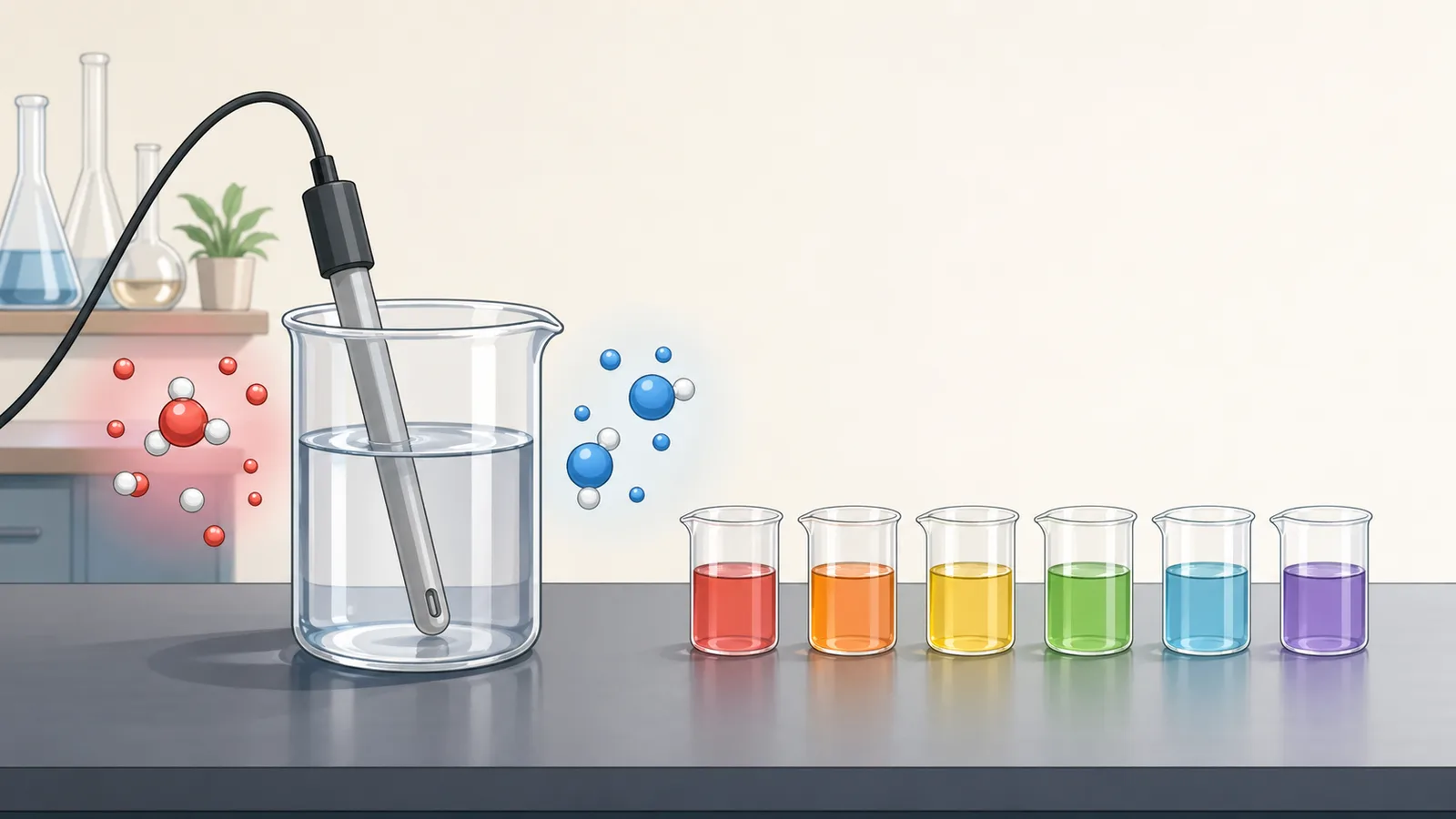
Calculate pH, pOH, hydronium or hydrogen ion concentration, and hydroxide concentration from one known value, with a 25 °C default and optional custom pKw.
Last updated
Known value
Convert pH, pOH, [H+], and [OH-] from one known value Use the standard pH + pOH = 14 teaching convention, or switch to a custom pKw when a temperature-specific
water-ion relation is supplied by your lab manual or class problem.
Quick presets
Assumptions
The default assumes aqueous conditions at 25 °C, where pH + pOH = 14 and the ion product of water is
1.0 × 10^-14. Custom pKw changes the neutral point but still treats concentrations as ideal.
Result
pH 7
Neutral. Hydronium and hydroxide are equal at the selected neutral point of pH 7.
This is neutral at the selected pKw because pH equals pOH at 7.
pOH
7
Acid-base band
Neutral
[H+]
1.000 × 10^-7 M
[OH−]
1.000 × 10^-7 M
Calculation path
pOH = pKw - pH = 14 - pH, then [H+] = 10^-pH and [OH-] = 10^-pOH.
Selected pKw
14
Kw = 1.000 × 10^-14 for the pH + pOH relation used here.
Neutral point
pH 7
Neutral means hydronium and hydroxide are equal under the selected water-ion model.
Hydronium level
1.000 × 10^-7
Each 1 pH unit lower means 10 times more hydronium concentration.
Hydroxide level
1.000 × 10^-7
Each 1 pOH unit lower means 10 times more hydroxide concentration.
Reference solution
Typical pH
Context
Lemon juice
2
strongly acidic food range
Vinegar
2.4–3.4
acidic household example
Pure water at 25 °C
7
neutral when pKw is 14
Blood
7.35–7.45
slightly basic biological range
Baking soda solution
~8.3
mildly basic
Household ammonia
11–12
basic cleaning-solution range
Interpretation limits This calculator assumes aqueous conditions at 25 °C by default, where pH + pOH = 14 and Kw = 1.0 × 10^-14.
A pH calculator converts between pH, pOH, hydronium concentration, hydrogen ion concentration, and hydroxide concentration. Use it as a pOH calculator, a pH to H+ concentration calculator, or a concentration to pH calculator under the standard aqueous 25 °C convention, with an optional custom pKw when your problem supplies a different water-ion relation.
What pH actually measures
pH is a logarithmic way to describe the effective hydronium-ion level in an aqueous solution. Lower pH values indicate more acidic conditions, while higher values indicate more basic conditions.
Because the scale is logarithmic, a one-unit pH change represents a tenfold change in hydronium concentration. That is why small pH differences can correspond to large chemical differences in the solution itself.
The 25 °C acid-base relations used here
For introductory aqueous chemistry at 25 °C, the standard relations are pH = -log10[H+], pOH = -log10[OH−], and pH + pOH = 14. Those relations come from the water-ion product Kw = 1.0 × 10^-14 under the same temperature assumption.
This calculator uses those relations consistently to derive the full four-value profile from whichever one value you already know.
pH = -log10([H+])
Converts hydronium concentration in mol/L into the pH scale.
pOH = -log10([OH−])
Converts hydroxide concentration in mol/L into the pOH scale.
pH + pOH = 14
Applies the standard 25 °C water-ion relation used in general chemistry.
Worked example
Suppose the measured pH is 3.20. The calculator converts that pH into a hydronium concentration of about 6.31 × 10^-4 M, then uses Kw to derive the hydroxide concentration and the matching pOH.
That makes the page useful whether you start with a meter reading, a worksheet value, or a concentration given in molarity notation.
Why pKw and temperature matter
Many pH calculator pages hard-code pH + pOH = 14. That is the familiar 25 °C teaching convention, but the more general relationship is pH + pOH = pKw. When pKw changes, the neutral point is pKw ÷ 2 rather than always 7.
The custom pKw control is useful for chemistry problems that already provide a temperature-specific pKw. It should not be read as a full temperature model by itself, because real analytical pH work can also involve activity coefficients, calibration standards, ionic strength, and the measurement procedure.
pH + pOH = pKw
General water-ion relation. At 25 °C, pKw is commonly rounded to 14.00.
neutral pH = pKw / 2
Neutral means [H+] and [OH−] are equal under the selected water-ion model.
How to use the result without over-reading it
For a classroom or quick lab-prep check, enter whichever value is known: pH, pOH, [H+], or [OH−]. The result shows the complementary concentration, the acid-base band, the neutral point for the selected pKw, and a short explanation of whether hydronium or hydroxide is dominant.
For strong acid or strong base concentration problems, first decide whether the entered concentration really equals [H+] or [OH−]. A monoprotic strong acid such as HCl is often treated as [H+] = C in introductory problems, while a base with more than one hydroxide per formula unit may require a stoichiometric factor before using the pH converter.
When this calculator is not enough
This page is intentionally a pH, pOH, and ion-concentration converter. It does not solve weak acid equilibrium, weak base equilibrium, buffer pH, titration curves, polyprotic acid systems, or activity-corrected analytical pH.
If your problem gives Ka, Kb, pKa, pKb, buffer components, or a titration volume, you need an acid-base equilibrium setup before the pH number can be trusted. Use this page after that equilibrium step has produced the actual hydronium or hydroxide concentration.
Frequently asked questions
Why does a one-unit pH change matter so much?
Because the pH scale is logarithmic. Moving from pH 7 to pH 6 means the hydronium concentration increases by a factor of ten, not by a small linear amount.
Can pH ever be below 0 or above 14?
Yes. The classroom range of 0 to 14 is a common teaching simplification for many dilute aqueous solutions, but concentrated systems can fall outside that range. This calculator still uses the standard 25 °C Kw convention when it derives the related values.
Does this page work for buffers and non-aqueous systems?
Only as a simplified reference. It does not model ionic strength, activity corrections, non-aqueous solvents, or buffer equilibria. For formal analytical work, rely on calibrated measurement methods and the relevant laboratory procedure.
Why does pH use a logarithmic scale?
The logarithmic scale compresses very large concentration ranges into numbers that are easier to read and compare. Because each one-unit change reflects a tenfold change in hydronium concentration, pH is much easier to scan than a raw molarity value across acidic and basic solutions.
What is the difference between pH and pOH?
pH describes hydronium concentration and pOH describes hydroxide concentration. At 25 °C they add to 14, so knowing one lets you calculate the other under the standard aqueous assumption used by this calculator.
How do I calculate pH from H+ concentration?
Use pH = -log10([H+]) with [H+] in mol/L. For example, [H+] = 1 × 10^-4 M gives pH 4. The calculator accepts M, mM, μM, and nM inputs and converts them to mol/L before applying the logarithm.
How do I convert pH to hydrogen ion concentration?
Use the inverse relationship [H+] = 10^-pH. A pH of 5 corresponds to [H+] = 1 × 10^-5 M, while a pH of 6 corresponds to 1 × 10^-6 M, so the lower pH has ten times more hydronium concentration.
What does pKw mean in a pH calculator?
pKw is the negative logarithm of Kw, the water-ion product. In the simplified relationship used here, pH + pOH = pKw. The standard classroom value is pKw = 14.00 at 25 °C, but some problems provide another pKw for a different temperature.
Is pH 7 always neutral?
pH 7 is neutral under the 25 °C convention where pKw is 14. If a problem uses a different pKw, the neutral point becomes pKw ÷ 2 because neutral means [H+] and [OH−] are equal.
Can this calculate the pH of a weak acid or weak base?
Not directly. Weak acid and weak base problems require an equilibrium calculation using Ka, Kb, pKa, or pKb before [H+] or [OH−] is known. Once that concentration is known, this page can convert it into pH, pOH, and the complementary ion concentration.