Skip to content
Calcipedia
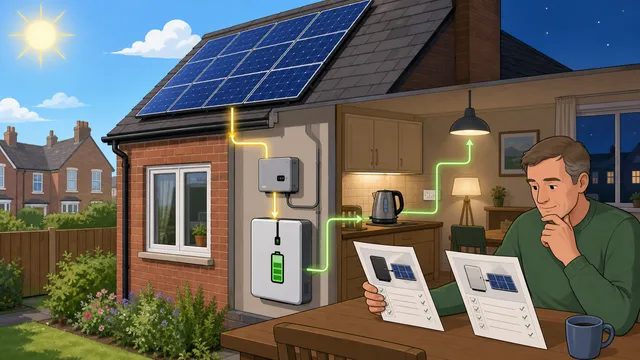
Plug-In Solar Savings Calculator instructional illustration

Plug-In Solar Savings Calculator

Estimate balcony-solar bill savings, export-credit value, simple payback, and the impact of higher self-consumption from your own plug-in solar assumptions.

Last updated

Estimate balcony-solar savings without pretending to know your roof This plug-in solar savings calculator uses your own daily generation estimate, electricity rate, export-credit assumption, and self-consumption rate to model annual bill savings, simple payback, and how much extra value better daytime load matching could unlock.

Fast scenario presets

Start with a cautious 400 W kit, an 800 W balcony solar payback case, or a higher self-consumption case, then replace the assumptions with your own quote or generation estimate.

Display currency

Change the money display without changing your generation or tariff assumptions.

What self-consumption means here

Self-consumption is the share of your generated kWh that directly offsets your own demand. Any remaining kWh are valued at the export credit you enter, or treated as spill when the export credit is zero.

Formula reference

Annual generation = average daily generation x days used per year.

Annual value = self-consumed kWh x electricity rate + spill or export kWh x export credit.

Simple payback = system cost ÷ annual value.

Enter generation and cost assumptions Add system cost, wattage, average daily generation, electricity rate, export credit, self-consumption, and days used per year to estimate annual plug-in solar savings.
← All Home Energy calculators

Home Energy

Plug-in solar savings calculator: balcony-solar bill savings, payback

A plug-in solar savings calculator estimates how much a small balcony-solar or plug-and-play panel setup could shave off your electricity bill before you buy it.

What this plug-in solar savings calculator is measuring

This calculator focuses on the compact end of solar: plug-in kits, balcony solar, and other small systems that offset a slice of household demand rather than replacing a full rooftop array. That makes it closer to a balcony solar savings calculator than a full home-solar proposal tool. The question it answers is simple: if your system produces a certain number of kWh per day, how much of that energy becomes real bill savings over a year?

The answer depends less on nameplate wattage alone than on self-consumption. A small plug-in solar system can only save money on the kWh you actually use in real time unless you are paid for exports. That is why this page separates annual generation from self-consumed energy, shows spill or export kWh separately, lets you enter an export-credit rate when one genuinely applies, and compares the baseline case with a higher self-consumption scenario.

Further reading

The plug-in solar savings formula

The core bill-savings formula is annual bill savings = average daily generation x days used x self-consumption x electricity rate. This is why the calculator asks for your own daily kWh estimate rather than pretending to know your roof, orientation, or irradiance. If you already have a believable generation estimate from the seller, from PVWatts, or from a local planning tool, the arithmetic becomes transparent.

The calculator now also lets you enter an export credit for the kWh that are not self-consumed. If exports are not paid, blocked, unknown, or administratively unrealistic for the product you are considering, leave export credit at zero. If a supplier or utility genuinely pays for excess plug-in solar generation, the annual value becomes self-consumed bill savings plus export credit, and simple payback becomes system cost divided by that total annual value.

Annual generation = average daily generation x days used per year

Scales a realistic day-level generation assumption into a yearly kWh figure.

Annual bill savings = annual generation x self-consumption x electricity rate

Only the kWh that directly offset your own demand are counted as bill savings in this worksheet.

Annual export credit = spill or export kWh x export credit rate

Optional row for places where excess generation is measured and compensated.

Simple payback = system cost / annual value

Shows how long it takes bill savings plus any entered export credit to recover the upfront cost.

Choosing credible generation, self-consumption, and export inputs

The strongest competing balcony solar calculators usually ask for location, orientation, tilt, and sometimes a city-level irradiance dataset. This page takes a lighter approach, but the same discipline still matters. A daily generation estimate for a south-facing, unshaded 800 W kit is not interchangeable with a shaded west-facing balcony, and a summer seller screenshot should not be treated as a year-round average.

Use the preset buttons as starting points, not as promises. A cautious 400 W case is useful when you are testing a smaller renter-friendly setup or a less-than-perfect balcony. The 800 W balcony case reflects the common small-system search intent, while the high-daytime-use preset shows why load matching can matter more than chasing a little more wattage. Replace each preset with your actual quote, tariff, and local production estimate before making a purchase decision.

Export credit is deliberately separate from self-consumption because regulations, meters, supplier terms, and product standards differ by country and utility. For example, UK policy work on plug-in solar has focused on low-cost panels for balconies and outdoor spaces while also noting that distribution-code and wiring-regulation changes are part of the rollout. In any country, do not assume a plug-and-play system can legally export or earn credit just because a full rooftop system can.

Further reading

Why self-consumption matters more than brochure wattage

Two plug-in solar kits with the same wattage can save very different amounts because savings depend on when your household uses electricity. If the generated power lines up with base daytime demand such as refrigeration, internet equipment, standby devices, and background loads, more of the kWh are self-consumed and more of the generation becomes real savings. If you are away during the day and have little always-on demand, the same kit may still generate energy but convert less of it into avoided imports.

That is the main reason this calculator includes a comparison scenario with higher self-consumption. It helps answer a common user question: how much more is the system worth if I shift appliance use into the middle of the day? Even a modest increase in self-consumption can shorten payback more effectively than chasing a slightly bigger panel count.

Worked example: 800 W kit, 2.4 kWh/day, 70% self-consumption

Suppose a plug-in solar kit costs 900 in your local currency, has 800 W of rated power, and you expect it to generate 2.4 kWh on an average active day. If you use it for 365 days and self-consume 70% of the generated energy at an electricity rate of 0.30 per kWh, annual generation is 876 kWh and self-consumed energy is 613.2 kWh.

That produces annual bill savings of 183.96 and a simple payback of about 4.9 years when export credit is zero. If the remaining 262.8 kWh receives an export credit of 0.08 per kWh, total annual value rises to about 204.98 and payback shortens to about 4.4 years. If better daytime load matching lifts self-consumption to 85%, annual value rises again because more energy is offsetting the higher import rate rather than earning the lower export credit. The example shows why a plug-and-play solar calculator should treat usage timing and export assumptions as first-class inputs instead of burying them in hidden defaults.

How this differs from a full rooftop solar proposal

A rooftop-solar quote usually models site-specific irradiance, tilt, azimuth, inverter losses, export terms, incentives, and long-horizon economics. A plug-in solar savings calculator does not need all of that to be useful. Small balcony systems are often bought as lightweight demand-offset tools, especially by renters or households testing solar before considering a larger installation.

That said, the simplification cuts both ways. This page does not tell you whether a plug-in system is legal in your area, whether exports are allowed or paid, how a landlord or HOA might treat it, or how safe the installation arrangement is for your specific wiring and mounting setup. It handles the savings arithmetic, not the permitting, electrical, or product-compliance side.

Further reading

What this calculator does not include

This worksheet does not model battery storage, tariff inflation, time-of-use pricing, maintenance, equipment degradation, circuit protection, product certification, or seasonal generation swings. It also does not convert wattage into generation for you. The daily kWh estimate still needs to come from a credible source or from your own measured data, and the export-credit input should be used only when you have a real, applicable compensation rate.

That is deliberate. Thin pages often hide optimistic assumptions inside the savings figure, which makes the result harder to trust. This calculator is more useful when it stays explicit: if the generation estimate is aggressive or the self-consumption percentage is unrealistic, the output will look better than reality. Pressure-test those two inputs before you trust the payback.

Frequently asked questions

How do you calculate plug-in solar savings?

Multiply average daily generation by the number of active days in the year to get annual generation, then multiply that by the share you self-consume and by your electricity rate. That gives annual bill savings. Divide system cost by annual bill savings to get simple payback.

How much can a balcony solar system save?

It depends on generation, electricity price, and self-consumption. Competitor guides often describe 400-800 W systems as meaningful but limited bill shavers rather than full-bill replacements. The closer your output matches always-on daytime demand, the stronger the savings.

What self-consumption percentage should I use?

Use the share of generated kWh you expect to consume directly in real time. Homes with steady daytime demand can justify a higher assumption, while homes that sit mostly idle during daylight may need a lower one. A conservative input is usually better than assuming nearly every kWh offsets the bill.

Does this calculator include export payments?

Yes, but only if you enter an export credit. Leave export credit at zero when exports are unpaid, not allowed, not metered, or too uncertain for the plug-in product you are considering. Enter a non-zero export rate only when your utility, supplier, or local rules clearly compensate excess generation from this type of system.

Why does the calculator ask for daily generation instead of location?

Because the attached spec is designed as a simpler savings planner, not a full irradiance model. If you already have a believable generation estimate from a seller, a local planning tool, or measured output, the savings arithmetic becomes clearer and easier to audit.

Can a higher self-consumption rate really change payback that much?

Yes. Small systems are especially sensitive to how much of their output you use yourself. Running more daytime loads while the system is generating can sometimes shorten payback more than adding a little more wattage, especially when your import electricity rate is much higher than any export credit.

Is plug-in solar the same as full rooftop solar?

No. Plug-in solar usually refers to compact systems that offset a slice of demand with simpler setup and lower output. Rooftop solar proposals usually involve larger systems, site-specific design, utility rules, and a broader financial model.

Should renters use a plug-in solar savings calculator?

Often yes, because plug-in systems appeal to renters and households without a suitable roof. But the financial model is only one part of the decision. You still need to check whether the product, mounting method, and local rules fit your building and occupancy situation.

What is a realistic 400 W or 800 W balcony solar scenario?

A realistic scenario starts with a credible daily kWh estimate, not just panel wattage. A smaller 400 W kit may be useful for cautious testing, shaded locations, or lower budgets, while an 800 W balcony solar setup is often closer to the common plug-in solar search intent. Use the presets to understand the mechanics, then replace the generation, cost, tariff, and self-consumption inputs with values that match your own location and product.

Should I use a balcony solar calculator or a full solar panel output calculator?

Use this page when the decision is a compact plug-in or balcony system and you already have a daily generation estimate. Use a solar panel output calculator when you need to estimate production from panel wattage, panel count, peak sun hours, and efficiency. Use a full rooftop-solar proposal or PVWatts-style tool when roof orientation, shading, inverter losses, and site-specific irradiance are central to the decision.

Do I need to check rules before installing plug-in solar?

Yes. The savings arithmetic does not answer the safety, landlord, HOA, utility, circuit-protection, product-certification, or export-permission questions. Check the rules that apply to your building and jurisdiction before buying or plugging in a system, and treat any seller estimate as incomplete until those checks are clear.


Also in Home Energy

You may also need

Related

More from nearby categories

These related calculators come from the same leaf category, nearby sibling categories, or the same top-level topic.