Ring size converter for US, UK, EU, Japan, diameter, and circumference charts
A ring size converter turns an inside diameter, inside circumference, or familiar regional label into the nearest standard ring size across US, UK, EU, and Japan charts. It is most useful when you already have a millimetre measurement from a jeweler, a ring mandrel, or an existing ring that fits well, and you need a practical ring size chart before ordering jewellery online.
What the converter is doing
Ring sizing systems all describe the same physical dimension in different ways. The most universal reference point is the inside size of the ring itself. This calculator uses your inside diameter or inside circumference in millimetres, converts that measurement to the nearest standard size, and then shows the equivalent labels in the US, UK, EU, and Japan systems.
Because ring sizes are manufactured in standard increments, the result is always the closest commonly sold size rather than an infinitely precise custom measurement. That is why the nearest-size gap matters: if your measurement sits close to the midpoint between two sizes, the better final choice can depend on band width, knuckle size, temperature, and how snug you like a ring to feel.
The converter now keeps the neighbouring chart rows visible instead of returning only a single label. That makes it easier to compare the closest match against the next smaller and next larger sizes before you decide whether to round up, stay with the chart match, or ask a jeweler to check the fit.
circumference = diameter × π
Used to translate an inside diameter measurement into the inside circumference shown in millimetres.
diameter = circumference ÷ π
Used when the user starts with a paper-strip or tape measurement around the finger.
1 in = 25.4 mm
Used to convert inch measurements from calipers or older ring charts into millimetres before chart lookup.
How US, UK, EU, and Japan ring sizing systems differ
A US ring size uses a numeric scale with quarter, half, and whole-size steps. UK ring sizes use letters and half letters, then extend beyond Z for larger sizes. EU ring sizes are commonly tied to the inside circumference in millimetres, which is why an EU 54 ring is close to a 54 mm inside circumference. Japanese sizes also use numbers, but the numbering does not match the US scale.
This is why a US to UK ring size conversion can look inconsistent when different charts round at different points. Two charts can both be reasonable if one lists half sizes only and another lists quarter-size steps. The calculator treats millimetres as the anchor, then reports the closest chart row rather than claiming that every regional label has a perfect one-to-one equivalent.
For online orders, the most reliable workflow is to start from a physical measurement whenever possible. Use a known US, UK, EU, or Japan label when that is all you have, but confirm against diameter or circumference if the ring is expensive, custom, vintage, or hard to resize.
The inside measurement is only one part of ring fit. Wider bands usually feel tighter than thin bands of the same nominal size because they create more surface contact with the finger. Fingers also swell and shrink during the day, in hot weather, after exercise, and when travelling.
That is why jewelers still use metal sizers and ring mandrels during final fitting. Use the converter to compare systems and narrow the likely range, then confirm the final fit if the ring is expensive, difficult to resize, or uses a wide or full-eternity band.
The wide-band check in the calculator is a planning aid, not a rule. It shows the common next-size-up comparison so you can see what a comfort adjustment would look like in US, UK, EU, and Japan terms before discussing the final size with the seller.
Worked example: converting a 54.4 mm ring circumference
Suppose a ring that fits well has an inside circumference of 54.4 mm. Dividing by π gives an inside diameter of about 17.3 mm. On the chart used here, that lands on US 7, UK N 1/2, EU 54, and Japan 14.
If the ring is a narrow band, the closest chart match is usually the right starting point. If it is a wide wedding band or stacked bridal set, the wide-band planning row lets you compare a larger comfort check before ordering. That does not automatically mean you should buy the larger size; it means the converter has shown the tradeoff that a jeweler would normally test with physical sizers.
If your measurement had been 54.0 mm instead, the calculator would still show the closest standard row and the adjacent smaller and larger rows. That nearby-size table is useful because a difference of a few tenths of a millimetre can be normal measurement noise when you are using paper, string, or a printed sizing guide.
How to measure ring size in mm without misleading yourself
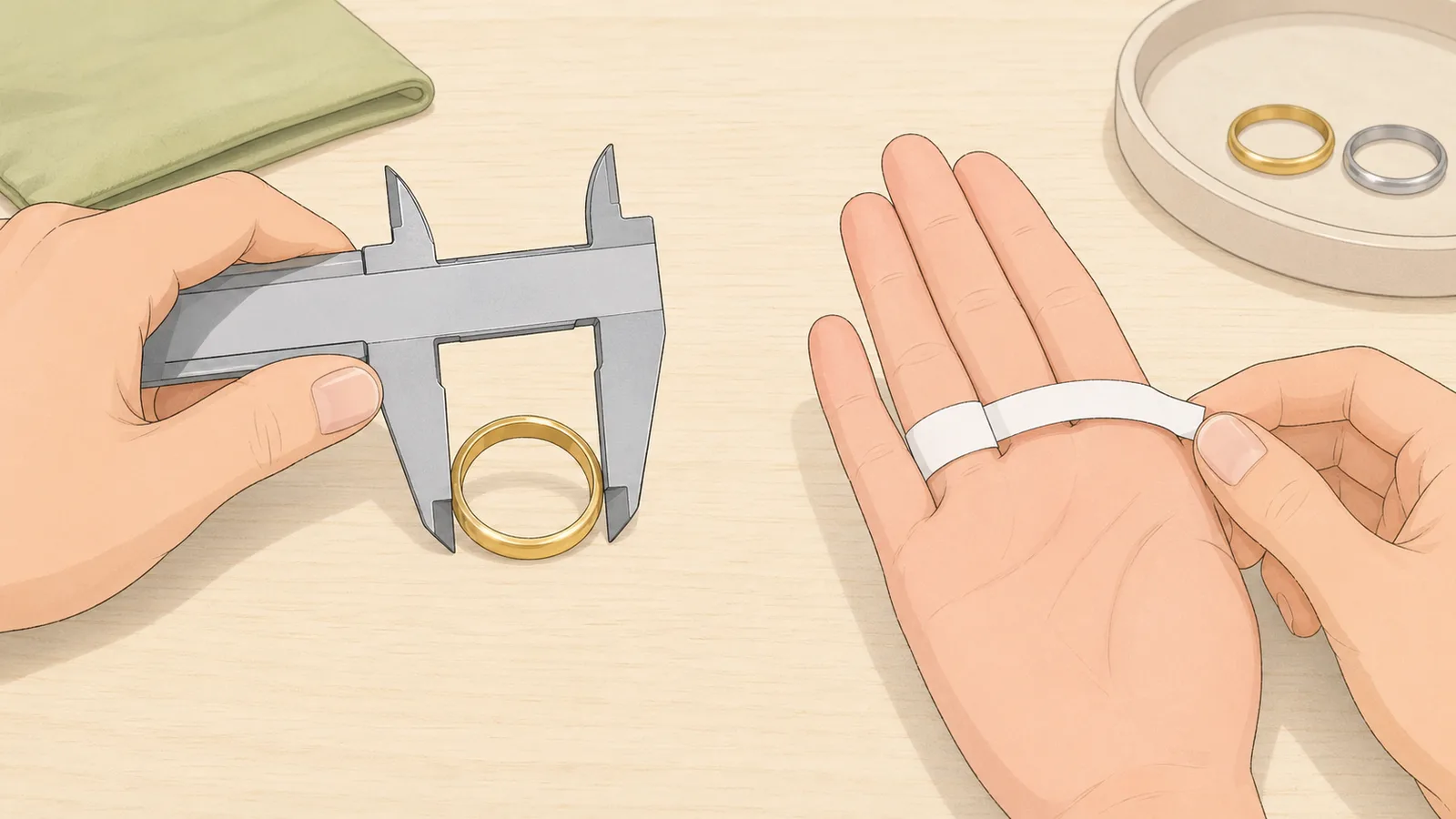
The best home measurement is usually the inside diameter of a ring that already fits the intended finger. Use calipers if you have them, measure the widest internal opening, and avoid including the metal wall of the ring. A ruler can work for a first estimate, but small alignment errors matter because ring sizes are separated by fractions of a millimetre.
If you measure the finger directly, use a narrow non-stretch paper strip rather than thick string, mark the overlap, and measure the length in millimetres. Repeat the measurement more than once and avoid taking it when the finger is unusually cold, hot, swollen, or compressed.
Printable ring size charts can be convenient, but they are only as accurate as the printer scaling and the calibration check. If the page prints at 94%, 97%, or any setting other than actual size, the circles and strips will be wrong. Treat printable tools as a first pass and confirm important purchases with a jeweler.
Further reading
GIA ring size guide — Gemological Institute of America guidance on measuring ring size, using finger gauges, and interpreting international ring charts.
What this ring size chart does not cover
No ring size converter can guarantee final comfort. Finger shape, knuckle size, ring profile, band width, metal thickness, temperature, humidity, and the maker's own manufacturing tolerances can all affect fit. The calculator shows a chart match and a planning range, not a promise that a finished ring will feel perfect.
This converter also does not model special sizing systems used by some brands, smart-ring fit kits, hinged shanks, sizing beads, arthritic shanks, or the resize limits of full-eternity and patterned rings. If the ring cannot be resized easily, treat the result as a shortlist and get a physical fitting before committing.
For gifts, avoid guessing from shoe size, height, age, or body type. Those clues do not convert into ring size reliably. A borrowed ring from the correct finger, a jeweler's measurement, or a properly calibrated sizing kit is much more useful than demographic guesswork.
Choose US as the input method, enter the known US size, and read the closest UK letter in the result. The converter also shows EU, Japan, diameter, circumference, and neighbouring chart rows, which is useful because US quarter sizes and UK half letters do not always line up identically across every published chart.
What is ring size in mm?
Ring size in mm usually refers to the inside diameter or inside circumference of the ring. EU sizing is commonly close to the inside circumference in millimetres, while many international charts also list inside diameter. The converter accepts either diameter or circumference and translates it into the nearest chart row.
Should I size up for a wide ring band?
Often yes. Wider bands can feel tighter than narrow bands, so jewelers commonly check whether a half-size adjustment is more comfortable. The converter gives the nearest standard size and a wide-band planning comparison, but a physical wide-band fitting check is still worth doing before purchase.
Is inside diameter or inside circumference better?
Either can work if the measurement is accurate. Inside circumference is often easier to match against international size charts, while inside diameter is easier to take from an existing ring with calipers. The converter handles both by translating them to the same internal size reference.
Why does the result say nearest standard size?
Manufactured rings come in standard increments, not arbitrary decimal measurements. If your millimetre measurement falls between two production sizes, the converter rounds to the closest standard option and shows the adjacent rows so you can see how close the next smaller or larger size would be.
Are printable ring size charts accurate?
They can be useful for a first estimate, but printer scaling can make them wrong. Always print at actual size, check the calibration mark, and avoid relying on a printed chart for an expensive, custom, or hard-to-resize ring. A metal finger gauge or jeweler measurement is more reliable.
What if my knuckle is larger than the base of my finger?
Choose a size that can pass the knuckle without forcing but still sits securely at the base of the finger. That may require testing the closest chart size and the next larger size. Comfort-fit profiles, sizing beads, or adjustable shank designs can sometimes help, but those choices need jeweler guidance.
Do ring sizes vary by country?
Yes. US and Canada commonly use numbers, the UK and Australia use letters, EU charts often follow circumference in millimetres, and Japan uses its own numeric system. A ring size converter is useful because the same physical ring can have different labels in each system.
Can a ring be resized after I convert the size?
Many plain metal rings can be resized, but the practical range depends on the metal, design, stone setting, engraving, and whether stones go all the way around the band. Full-eternity bands, patterned shanks, and some alternative metals are more limited. Ask a jeweler before assuming a future resize will be simple.
Can I guess ring size from another body measurement?
No reliable conversion exists from shoe size, height, age, or body type to ring size. Use an existing ring from the same finger, a measured inside diameter, a measured circumference, a sizing kit, or a jeweler's gauge instead.