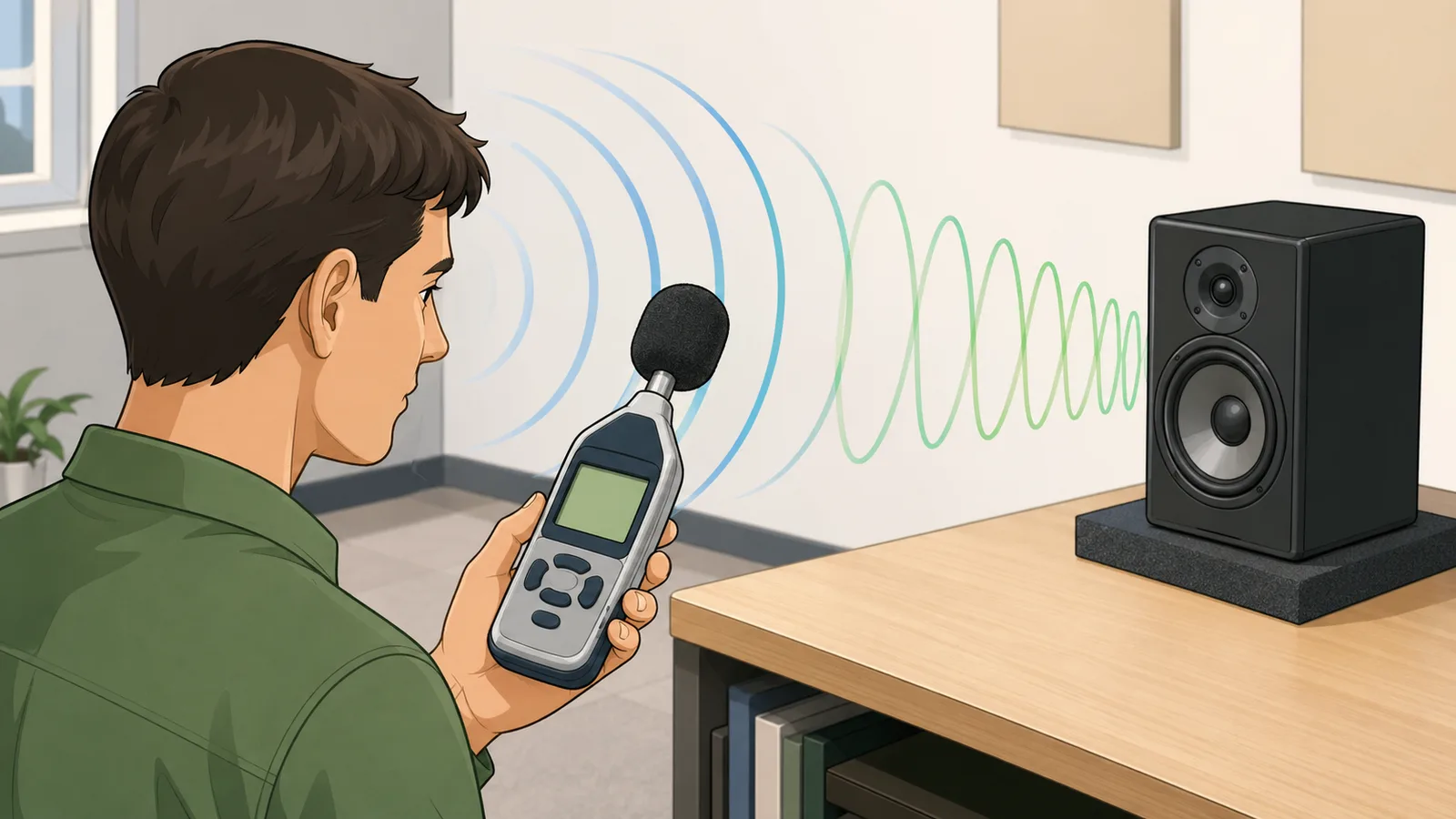
Convert dB SPL to pascals, micropascals, W/m², bels, and pressure nepers, compare dB changes, and keep dB(A) limitations visible.
Last updated
Acoustic level
Convert dB SPL, dB(A), sound pressure, and sound intensity with reference context
Compare logarithmic and physical sound measures without losing the reference-band meaning behind the reading.
Quick presets
Weighting caution dB(A) is frequency-weighted for hearing relevance. This page keeps dB(A) numerically aligned with SPL as a
reference shorthand, not as a full spectral weighting model.
Enter values Provide a sound level, pressure, or intensity reading to compare the supported acoustic reference forms.
Sound level converter: dB SPL, dB(A), pascals, and intensity explained
A sound level converter helps when a noise reading needs to be understood both as a logarithmic decibel value and as a physical sound-pressure or sound-intensity quantity.
Why decibels need reference values
Decibels are logarithmic ratios, not standalone physical quantities. In acoustics, dB SPL uses a reference sound pressure of 20 micropascals, which is often treated as the threshold of human hearing near 1 kHz under standard conditions.
Once the reference is fixed, a pressure reading can be converted into dB SPL, and the same pressure can be expressed as sound intensity. This page keeps those linked values visible together so the physical meaning of the decibel number is easier to interpret.
That is also why searchers often look for phrases such as dB SPL to Pa, 94 dB to pascal, or sound intensity from decibels. They are usually trying to bridge a gap between an instrument reading and the underlying physical quantity, not merely swap one label for another.
Lp = 20 log10(p / p0)
Standard sound-pressure-level relation using the reference pressure p0 = 20 µPa.
LI = 10 log10(I / I0)
Standard intensity-level relation using the reference intensity I0 = 10^-12 W/m².
I ≈ p² / (ρc)
Links sound pressure to plane-wave intensity using the characteristic impedance of air.
Why dB(A) is only a shorthand here
A-weighting adjusts sound levels to better match human hearing sensitivity across frequency bands. That means a true dB(A) conversion needs spectral information, not just one raw amplitude number.
This page therefore keeps dB(A) numerically aligned with the entered level as a reference shorthand, while making the limitation explicit. It is useful for quick comparison, but it is not a substitute for full weighted-noise analysis.
That distinction matters because many quick online tools imply that dB SPL and dBA are interchangeable. They are not. A sound level meter can display both kinds of reading, but the A-weighted result depends on how much acoustic energy sits in each frequency band before the weighting curve is applied.
Worked conversion checkpoints users commonly need
A practical checkpoint is that 0 dB SPL corresponds to a sound pressure of 20 µPa, while 94 dB SPL is approximately 1 Pa. Those anchors are useful because many calibration and acoustics references use the 94 dB ≈ 1 Pa relationship as a quick sanity check.
The page also helps explain why +20 dB is not a small change. A twenty-decibel increase means ten times the sound pressure and one hundred times the sound intensity. A +10 dB change means ten times the intensity, while a +3 dB change is roughly a doubling of intensity. That is why 'small' decibel deltas can still be operationally important.
Suppose a reading is 60 dB SPL. Converting from the reference equations gives a sound pressure around 0.02 Pa and an intensity around 10^-6 W/m². Raising that level to 80 dB SPL does not merely add a bit more energy. It multiplies pressure by ten and intensity by one hundred, which is exactly the kind of relationship that a good sound level converter should make visible.
When bels, nepers, and micropascals are useful
Most everyday noise work uses decibels, but some competitors and technical references also expose bels, nepers, or micropascals. A bel is simply ten decibels on the same logarithmic ratio scale, so 9.4 B SPL is the same acoustic level as 94 dB SPL.
A pressure neper uses the natural logarithm of the pressure ratio rather than base-10 logarithms. It is less common in practical noise work, but it can appear in theoretical acoustics, transmission, and signal references. Showing it beside dB SPL helps users recognize that it is another way to describe the same pressure ratio against the same reference.
Micropascals are useful when a pressure is close to the hearing-threshold reference. Writing 20 µPa is often clearer than writing 0.00002 Pa, and it makes the 0 dB SPL anchor easier to check.
B SPL = dB SPL / 10
Bels use the same base-10 ratio scale as decibels, with one bel equal to ten decibels.
Np = ln(p / p0)
Pressure nepers use the natural logarithm of the pressure ratio relative to the same reference pressure.
1 Np = 20 log10(e) dB ≈ 8.686 dB
Conversion between pressure nepers and decibels for the same amplitude ratio.
Why comparing two dB levels is often more useful than one conversion
Many users are not only asking what one sound level equals in pascals. They are asking whether a new reading is meaningfully louder, whether a machine is much noisier than a baseline, or why a modest-looking decibel increase matters. That is why the calculator now lets you compare the entered reading against another dB SPL level and shows the pressure and intensity multiplier directly.
This is different from adding multiple sound sources. A comparison answers, 'How much larger is this one level than that one?' A source-addition calculator answers, 'What is the combined level when several sources are present together?' Keeping those questions separate prevents the common mistake of treating decibel differences, source sums, and unit conversions as the same operation.
For example, a reading that is +20 dB above a comparison level is ten times the pressure amplitude and one hundred times the intensity ratio. A reading that is -20 dB below the comparison level is one tenth the pressure amplitude and one hundredth the intensity ratio. The direction matters just as much as the number.
How to interpret the reference bands
The descriptive band attached to the result is there to anchor the number in a real-world range such as quiet room, conversation, or hazardous exposure. That contextual step is often more useful than the raw conversion alone.
Remember that exposure risk depends on both level and duration. Two readings with the same dB value can imply very different practical risk depending on how long the exposure lasts and whether hearing protection is used.
This is also where many users confuse conversion with compliance. A sound level converter can tell you what 85 dB, 1 Pa, or 10^-4 W/m² mean in equivalent reference terms. It cannot tell you, by itself, whether a workplace, venue, or device setup is compliant without the correct weighting, averaging method, duration model, and measurement procedure.
Common misconceptions this page does not solve away
One misconception is that negative decibel values are impossible. They are possible whenever the measured quantity is below the chosen reference. A negative dB SPL value does not mean 'negative sound'; it means the measured pressure is below the 20 µPa air reference used for the scale.
Another misconception is that decibel values add arithmetically. They do not. Combining two equal sound levels increases the total by about 3 dB, not by doubling the displayed decibel number. That matters when users try to reason from several sources or from repeated exposure events.
Finally, this page assumes the standard air-reference context used for SPL work. It is not a water-acoustics calculator, a room-acoustics simulator, or a compliance meter. If the measurement context changes, the reference assumptions and the right interpretation can change with it.
Frequently asked questions
What is the difference between dB SPL and dB(A)?
dB SPL is an unweighted sound-pressure level referenced to 20 µPa in air. dB(A) applies an A-weighting curve that emphasizes frequencies the ear is more sensitive to and de-emphasizes very low and very high frequencies. That means two sounds with the same raw SPL can have different dB(A) values if their spectra differ. This page keeps dB(A) as a reference shorthand so users can compare labels, but a true SPL-to-dB(A) conversion requires frequency-band information from a meter, analyzer, or measured spectrum.
Why does a small change in dB matter so much?
Because decibels are logarithmic. A +10 dB change means ten times the sound intensity, while a +20 dB change means ten times the sound pressure and one hundred times the intensity. Even a +3 dB change is already about a doubling of intensity. So when a reading moves from 60 dB to 80 dB, the physical acoustic change is far larger than the twenty-number difference might imply at first glance.
Does this page tell me whether a noise exposure is safe?
Not by itself. It gives level equivalences and context bands, but real hearing-risk assessment also depends on exposure time, weighting choice, measurement method, peak versus averaged behaviour, and whether hearing protection is used. For example, an occupational limit may be stated in dBA over an 8-hour time-weighted average, which is a more specific question than simply converting one number into pascals or intensity.
Can I use this page for formal acoustic compliance work?
No. It is a reference converter, not a substitute for calibrated measurements, spectral weighting analysis, or regulatory exposure assessment. Use it to sanity-check formulas, translate a known SPL into pressure or intensity, and understand the meaning of a reading. For formal compliance, hearing-conservation work, environmental acoustics, or device certification, rely on the governing standard and properly calibrated instrumentation.
Why does the converter include bels and pressure nepers?
Decibels are the practical acoustic unit, but bels and nepers are related logarithmic ratio units that appear in some technical references and competing sound-unit tools. A bel is ten decibels. A pressure neper uses the natural logarithm of the pressure ratio, with 1 Np equal to about 8.686 dB for the same amplitude ratio. Including them helps users translate less common labels without losing the standard dB SPL, pascal, and W/m² context.
What does the comparison level field tell me?
It compares the entered sound level with another dB SPL baseline and converts the difference into pressure and intensity multipliers. For example, a +20 dB difference means 10× pressure amplitude and 100× intensity. This is useful for interpreting a change from one reading to another, but it is not the same as adding two simultaneous sound sources.