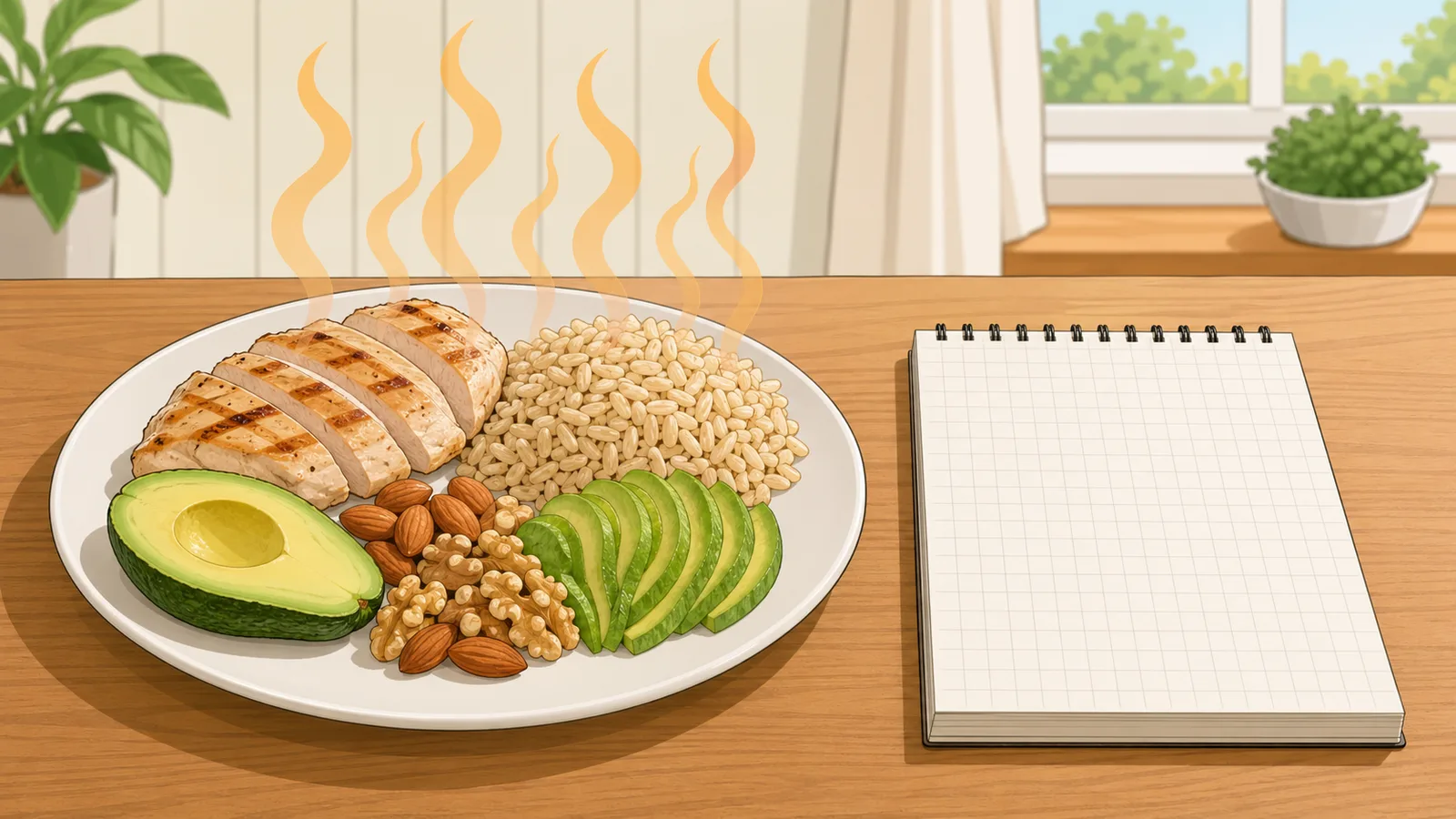
How to read the TEF result Use this TEF calculator to estimate the thermic effect of food from your meal macros and compare midpoint digestion cost with a published range. The midpoint is a planning estimate; the range shows how much the result can move when a meal is more protein-heavy or fat-heavy.
Meal scenarios
Result
Thermic effect of food
50 kcal
11.0% of total meal calories
Range: 34.0–60.0 kcal (7.5–13.2%)
Meal total
455 kcal
Midpoint net digestible
405 kcal
TEF range
34.0–60.0 kcal
Net meal range
394.9–421.0 kcal
Why the range matters Protein has the biggest digestion cost, carbohydrate sits in the middle, and fat is lowest. That means two meals with the same label calories can have different net digestible calories if one is more protein-heavy or one is more fat-heavy.
Thermic effect of food calculator guide: protein vs carbs vs fat and net meal calories
The thermic effect of food, also called dietary-induced thermogenesis, is the energy your body uses to digest, absorb, and metabolise a meal. People usually search this topic when they want to know how many calories are burned digesting food, whether protein burns more calories than carbs or fat, what a meal’s net digestible calories might look like after TEF is accounted for, or simply when they search for a TEF calculator.
What the thermic effect of food actually measures
TEF is the temporary rise in energy expenditure that happens after eating. It is one part of total daily energy expenditure, alongside resting metabolism, activity, and non-exercise movement. The key point is that TEF is not an extra magic bonus layered on top of metabolism from nowhere; it is already part of how total energy use works across the day.
That distinction matters because people often search for net calories after digestion and assume TEF creates a huge discount on food calories. In reality, TEF is real but modest. It changes the effective energy cost of meals somewhat, especially when protein is high, but it does not turn ordinary foods into negative-calorie foods.
Why protein has the highest thermic effect
Protein has the highest thermic effect at roughly 20 to 30 percent of the calories it provides, carbohydrates sit more around 5 to 10 percent, and fat is usually lowest at around 0 to 3 percent. That is why high-protein meals usually produce a larger TEF than higher-fat meals with the same label calories.
This page uses midpoint planning values of 25 percent for protein, 8 percent for carbohydrate, and 3 percent for fat. Those are useful educational estimates, not fixed laws. Food form, meal size, fibre, processing, and the person eating the meal can all move the real value around those central rates.
What TEF can and cannot do for fat loss
TEF can help explain why higher-protein diets modestly improve satiety and may slightly increase daily energy expenditure, but it should stay in perspective. For most people, the day-to-day difference is meaningful enough to be worth understanding and not large enough to outweigh total calorie intake, food quality, or adherence.
That is why thermic effect of food calculators are best used as comparison tools rather than weight-loss promises. They can show why a protein-rich meal has a higher metabolic cost than a high-fat meal, but they should not imply that TEF alone will drive visible fat loss if the broader diet is not in line.
How to use a TEF calculator without double-counting calories
The practical use of this page is to compare meals or macro splits, not to keep subtracting TEF from every food log and then also use a TDEE estimate that already assumes normal digestion costs. If you are using calorie targets based on standard maintenance or TDEE calculators, average TEF is already baked into the energy-expenditure side of the equation.
Where this page is genuinely useful is in showing why two meals with the same label calories can have a different thermic profile. A protein-forward meal may leave you with slightly lower net energy and often greater fullness, while a high-fat meal usually has a lower digestion cost. That helps frame trade-offs without overstating them.
Meal macros versus daily macro percentages
Some TEF calculators ask for a full day of calories and macro percentages. This page focuses on grams of protein, carbohydrate, and fat for a meal because that is often the data people already have from a food label, recipe, meal plan, or tracking app. It also makes the output easier to interpret as net meal calories rather than a vague daily average.
The preset meal scenarios are there to make comparison fast. A balanced meal, a high-protein meal, a higher-fat meal, and a carb-led meal can all be tested without rebuilding the inputs from scratch. That turns the thermic effect calculator into a practical comparison tool for meal composition rather than only a static formula.
Use grams when you want a meal-level answer from known macros.
Use daily percentage calculators when you only know your whole-day macro split.
Compare presets when the real question is whether a protein-heavy meal meaningfully changes net calories.
How to read the midpoint and the range
The calculator’s midpoint estimate uses practical planning values of 25% for protein, 8% for carbohydrate, and 3% for fat. Those are useful for day-to-day meal planning because they keep the estimate simple enough to understand and compare.
The range shown on the result sheet is there because thermic effect of food is not a single fixed number. Protein generally sits higher, carbohydrate sits in the middle, and fat is lowest. A more protein-heavy meal usually pushes the digestion cost toward the upper end of the range, while a more fat-heavy meal pushes it toward the lower end.
Think of the range as a sensitivity check rather than a second opinion. If the midpoint and the range lead to the same practical decision, the exact decimal is less important than the pattern: protein raises TEF more than carbs, and carbs raise TEF more than fat.
Use the midpoint for quick meal planning.
Use the range to understand how much the same meal can shift if the macro mix changes.
Do not treat the range as a promise that the meal will always land at one exact value.
Why the same calories can leave different net meal calories
Two meals can both label as 700 kcal and still leave different net digestible calories once TEF is considered. A protein-heavy meal usually burns more of its own calories during digestion than a meal with the same label calories that is mostly fat. That difference is modest, but it is real.
This is one reason the page shows both the thermic effect midpoint and the net meal range. The label calories tell you what was eaten. The net calories show the approximate amount left after digestion cost is applied. For planning, that is more useful than pretending every meal behaves exactly the same.
Protein-dense meals usually have the largest digestion cost.
Carbohydrate sits between protein and fat for TEF.
Fat usually has the smallest digestion cost, so high-fat meals keep more of their label calories net.
When TEF is useful and when it should stay in the background
TEF is useful when you want to compare meal composition, understand why protein-rich meals often feel more filling, or sanity-check whether a macro split is likely to produce the same net energy as a different split. It is less useful if you are already working from a maintenance estimate that implicitly assumes normal digestion costs.
That is why the safest workflow is usually to keep TEF in the background unless the question is specifically about meal composition. If you are tracking calories for weight change, the bigger drivers are still total intake, activity, adherence, and the consistency of your plan over time.
Frequently asked questions
Is protein really the macronutrient with the highest thermic effect?
Yes. Protein consistently shows the highest thermic effect in human feeding studies, which is why high-protein meals usually burn more calories during digestion than carb- or fat-heavy meals with the same energy content. The exact percentage varies, but protein is the clear leader.
Should I add TEF on top of my TDEE or maintenance calories?
Usually no. Standard maintenance and TDEE estimates already assume normal digestion costs inside total daily expenditure. A TEF calculator is more useful for comparing meals or understanding macronutrient differences than for adding a separate calorie bonus on top of your target.
Does eating more often increase total thermic effect of food?
Not much if total calories and macronutrients stay the same. Spreading the same intake over more meals does not create a large extra TEF advantage by itself. Total intake and macro composition matter more than meal count.
Is TEF the same for everyone?
No. Individual variation exists. Insulin sensitivity, metabolic rate, meal size, food processing, and the wider meal composition can all influence TEF. The rates used here are practical population averages rather than personal laboratory measurements.
Can a high-protein diet materially raise total daily calorie burn through TEF alone?
It can raise total daily energy expenditure somewhat, but usually not enough to override total calorie intake, adherence, and food quality. TEF is one reason higher-protein diets can be useful, yet the effect is still modest compared with the bigger drivers of body-weight change.
What is diet-induced thermogenesis?
Diet-induced thermogenesis is the increase in energy expenditure that happens after eating because the body has to digest, absorb, transport, and metabolize food. It is another name for thermic effect of food or TEF.
Why does the calculator show a TEF range instead of one exact number?
Because thermic effect is not a single fixed number in real life. Protein, carbohydrate, and fat all sit in published ranges, and the exact digestion cost changes with food composition, meal size, processing, and the person eating the meal. The range is there to show that sensitivity.
Should I subtract TEF twice if I already use TDEE?
No. Standard TDEE estimates already include normal digestion costs inside total daily energy expenditure. TEF is best used to compare meals or macro splits, not as an extra discount on top of an already complete maintenance estimate.
Why does this TEF calculator use grams instead of macro percentages?
Grams are usually more useful for a single meal because they match food labels, recipe nutrition, and most tracking apps. Macro percentages are helpful for whole-day diet patterns, but meal-level grams make it clearer how much energy came from protein, carbohydrate, and fat, how much TEF each macro contributes, and what the net meal calorie range looks like.
Can two meals with the same calories have different net calories after digestion?
Yes. A protein-heavy meal and a fat-heavy meal can both label as the same calories but still leave different net calories after TEF is considered. Protein usually has the highest digestion cost, so the net meal calories can be slightly lower than a higher-fat meal with the same label calories.
Does cooking or food processing change thermic effect of food?
It can. Highly processed foods are often easier to chew and digest, and some preparation methods can change how much energy is required to process a meal. The calculator uses central planning values, so it does not try to model every processing detail.
Is a high-protein meal always lower in net calories?
Not automatically, but it usually has a higher digestion cost than a fat-heavy meal with the same label calories. The exact difference depends on the whole meal composition, so protein can raise TEF without creating a dramatic calorie gap every time.