

How to Add, Subtract, and Simplify Fractions Without Getting Confused
A step-by-step guide to fraction operations — from finding common denominators to simplifying results — with interactive calculators to check your work.
Fractions aren’t the enemy — they just need a proper introduction
I’ve lost count of the number of students who have sat down across from me and said, almost apologetically, “I just don’t get fractions.” And every single time, within about twenty minutes, they’re solving problems and wondering what all the fuss was about. Fractions aren’t inherently difficult — they’re just taught in a way that sometimes skips the why and jumps straight to the rules. So let’s fix that.
Here’s the thing: you already understand fractions intuitively. If you’ve ever split a pizza, shared a bag of sweets, or measured out half a cup of flour, you’ve worked with fractions. A fraction is simply a way of describing a part of something. The top number (the numerator) tells you how many parts you have, and the bottom number (the denominator) tells you how many equal parts make up the whole. That’s the entire concept. Everything else — adding, subtracting, simplifying — is just learning the rules for working with those two numbers.
The trick is taking it one step at a time. So let’s start where most people get stuck: adding and subtracting fractions.
Why you need a common denominator
Adding fractions like 1/4 + 1/4 is straightforward — you have one quarter plus another quarter, which gives you two quarters (2/4, or simplified, 1/2). The denominators are the same, so you just add the numerators and keep the denominator.
But what about 1/3 + 1/4? This is where students start to panic, and honestly, I understand why. You can’t just add the tops and add the bottoms — that would give you 2/7, which is completely wrong. The reason? Thirds and quarters are different-sized pieces. You can’t combine pieces of different sizes any more than you can add three apples and four oranges and call them seven appleoranges.
The solution is to convert both fractions so they have the same denominator — a common denominator. For 1/3 and 1/4, the smallest number that both 3 and 4 divide into evenly is 12. That’s the least common denominator (LCD).
- 1/3 becomes 4/12 (multiply both top and bottom by 4)
- 1/4 becomes 3/12 (multiply both top and bottom by 3)
Now you can add them: 4/12 + 3/12 = 7/12. The pieces are the same size, so combining them makes sense.
Try this: think of two fractions from your own life. Maybe you ate 1/3 of a cake yesterday and 1/4 today. How much have you eaten in total? Use the Adding Fractions Calculator to check your answer:
What to enter
Use numerators and denominators for each fraction you want to add.
If you start with a mixed number, convert it to an improper fraction first or use the mixed-number calculator elsewhere on the site.
Result
5/6
Sum of 2 fractions as a simplified fraction, with the mixed-number form shown below when useful.
0.83
Decimal value
6
LCD used
5/6
Mixed number
2
Fractions added
| Step | Working |
|---|---|
| Original fractions | 1/2 + 1/3 |
| Find the LCD | LCD(2, 3) = 6 |
| Convert to equivalent fractions | 3/6 + 2/6 |
| Add the numerators | (3 + 2)/6 = 5/6 |
Common denominator
Fractions can only be added directly once their parts are equal-sized. The least common denominator makes those parts line up with the smallest shared denominator.
Simplify the sum
After adding the numerators, the calculator reduces the answer to lowest terms and shows the mixed-number form when the result is greater than one.
Use it for homework
This is useful for checking fraction addition with like or unlike denominators and for confirming the working step-by-step before you submit an answer.
If you got 7/12, well done. That’s genuinely the hardest conceptual leap in all of fraction arithmetic — understanding why you need equal-sized pieces before you can combine them. Everything from here builds on that one idea.
Do you always need the least common denominator?
Strictly speaking, no. You just need a common denominator. If you are adding 1/3 and 1/4, you could convert them into twelfths, or twenty-fourths, or thirty-sixths if you felt strangely enthusiastic about making your life harder. The maths would still work.
But the least common denominator is usually the smartest choice because it keeps the numbers smaller and the simplifying easier at the end. Students often understand the idea of equivalent fractions perfectly well, then get buried under large numerators because they chose a denominator that was technically valid but unnecessarily awkward.
So here is the teacher shortcut: use the smallest common denominator you can find, not because the bigger one is wrong, but because smaller numbers make errors easier to spot. If you get to the end of a problem and your answer looks clunky, ask yourself whether a smaller common denominator would have made the whole thing cleaner.
Subtracting fractions: the same idea in reverse
Good news: if you can add fractions, you can subtract them. The process is identical — find a common denominator, convert both fractions, then subtract the numerators instead of adding them.
Let’s say you have 3/4 of a tank of petrol and you use 1/3 of a tank on a trip. How much is left?
- 3/4 becomes 9/12 (multiply top and bottom by 3)
- 1/3 becomes 4/12 (multiply top and bottom by 4)
- 9/12 - 4/12 = 5/12
You’ve got 5/12 of a tank remaining. The denominator stays the same because you’re still working with twelfths — you’re just taking some away instead of combining them.
One common mistake to watch for: sometimes the subtraction gives you a numerator of zero. That’s not an error — it just means the answer is zero. And if you get a negative numerator, that simply means you’re subtracting a larger fraction from a smaller one, which is perfectly valid in many real-world situations (like when you owe more than you have).
Multiplying and dividing: surprisingly easier than adding
Here’s something that surprises most students: multiplying fractions is actually simpler than adding them. You don’t need a common denominator at all. Just multiply the numerators together and multiply the denominators together.
For example: 2/3 times 3/5 = 6/15, which simplifies to 2/5. That’s it. No finding common denominators, no converting. Multiplication is the one fraction operation where you can just go straight across.
Dividing fractions has one extra step: flip the second fraction upside down (find its reciprocal) and then multiply. So 2/3 divided by 3/5 becomes 2/3 times 5/3 = 10/9, which is 1 and 1/9 as a mixed number.
The reason this works is beautifully logical — dividing by a fraction is the same as asking “how many of these pieces fit into that amount?” Flipping and multiplying is just the shortcut for answering that question.
Try this: use the Fraction Calculator below to practice all four operations. Start with simple numbers to build confidence, then try larger ones. Notice how multiplication often gives you a fraction you need to simplify afterwards:
Fraction workflows
Choose the fraction problem first
Use one fraction calculator for adding fractions, subtracting fractions, multiplying fractions, dividing fractions, simplifying fractions, comparing fractions, finding equivalent fractions, least common denominator work, fraction-to-decimal, fraction-to-percent, fraction-to-ratio, mixed-number conversion, improper-fraction conversion, and unknown-fraction proportions.
Active workflow
Add, subtract, multiply, divide
Use two fractions with the four core operations and show simplified, mixed-number, and decimal results.
1 1/4
Simplified result
1.25
Decimal value
| Improper fraction | 5/4 |
| Operation | Add |
| Mixed number | 1 1/4 |
| Step | Working | Why |
|---|---|---|
| Normalize inputs | 1/2 and 3/4 | Signs are kept in the numerator and denominators are made positive before calculating. |
| Use a common denominator | (1 x 4 + 3 x 2) / (2 x 4) = 10/8 | Addition needs equal-sized parts before the numerators can be combined. |
| Simplify by 2 | 5/4 | Divide numerator and denominator by their greatest common divisor. |
Fraction workflow guide
| Workflow | Use it for | Watch for |
|---|---|---|
| Core arithmetic | Adding, subtracting, multiplying, or dividing two fractions | Addition and subtraction need a common denominator; multiplication and division do not. |
| Simplifying and equivalent fractions | Reducing to lowest terms, checking equivalent fractions, and building matching denominators | Equivalent fractions look different but reduce to the same value. |
| Fraction conversions | Changing a fraction into a decimal, percentage, ratio, mixed number, or improper fraction | Repeating decimals are rounded for display but the fraction remains exact. |
| Unknown fraction solving | Solving proportions such as a/b = c/d when one value is missing | Exactly one field should be blank, and no denominator can be zero. |
If you’ve been following along and trying examples, you’re already doing better than you think. Seriously — the fact that you’re here, working through this, means you’re building real understanding rather than just memorising steps.
One more useful habit: estimate before you trust your final answer. If 5/8 is a bit more than one half and 3/8 is a bit less than one half, their sum should be a little bigger than 1, not something tiny like 8/16 or something huge like 8/3. A rough estimate will not give you the exact answer, but it will often tell you when you have made a denominator mistake before you ever reach for a calculator.
Simplifying fractions: making your answer as clean as possible
After any fraction calculation, you’ll often end up with a result like 6/8 or 15/25. These are correct answers, but they’re not in their simplest form. Simplifying (also called reducing) a fraction means dividing both the numerator and denominator by their greatest common factor (GCF) until they can’t be divided any further.
Take 6/8. What’s the largest number that divides evenly into both 6 and 8? That’s 2. Divide both by 2, and you get 3/4. That’s the simplified form.
For 15/25, the GCF is 5. Divide both by 5, and you get 3/5.
Here’s a quick method for finding the GCF when it’s not obvious: list the factors of each number and find the largest one they share.
- Factors of 18: 1, 2, 3, 6, 9, 18
- Factors of 24: 1, 2, 3, 4, 6, 8, 12, 24
- GCF: 6
So 18/24 simplifies to 3/4.
Some students ask me, “Why bother simplifying? The answer is still correct either way.” Fair question. The reason is clarity — 3/4 is much easier to visualise and work with than 18/24. It’s also the form teachers and exams expect, and it makes comparing fractions far simpler. If someone asks you whether 18/24 or 15/20 is larger, that’s a head-scratcher. But simplify both to 3/4 and you can see instantly that they’re equal.
Use the Fraction Simplifier to check your work or handle larger numbers where finding the GCF by hand gets tedious:
Mixed numbers and improper fractions: two sides of the same coin
You’ll sometimes end up with a fraction where the numerator is larger than the denominator, like 7/4. This is called an improper fraction, and it’s perfectly valid — it just means you have more than one whole. To convert it to a mixed number, divide 7 by 4: you get 1 with a remainder of 3, so 7/4 = 1 and 3/4.
Going the other way is just as easy. To convert 2 and 1/3 to an improper fraction, multiply the whole number by the denominator and add the numerator: 2 times 3 + 1 = 7, so it becomes 7/3.
Why does this matter? Because when you’re adding or subtracting mixed numbers, it’s often easier to convert them to improper fractions first, do the calculation, and then convert back. It saves you from juggling whole numbers and fractions separately, which is where most errors creep in.
Common mistakes and how to avoid them
After years of tutoring, I’ve seen the same errors come up again and again. Here are the ones to watch for:
- Adding denominators when adding fractions. Remember: 1/3 + 1/4 is NOT 2/7. You need a common denominator first.
- Forgetting to simplify. Always check whether your answer can be reduced. Divide the numerator and denominator by their greatest common factor.
- Multiplying the denominator when finding equivalents. When converting to a common denominator, whatever you do to the bottom, you must also do to the top. If you multiply the denominator by 3, multiply the numerator by 3 as well.
- Confusing multiplication and addition rules. For multiplication, go straight across (no common denominator needed). For addition, you must find a common denominator first. Mixing these up is the single most common error I see.
- Panicking with large numbers. A fraction like 144/360 looks intimidating, but the process is the same as with small numbers. Find the GCF (36 in this case), divide both parts, and you get 4/10, which simplifies further to 2/5.
Practical tips for building fraction confidence
Here are the strategies I share with every student — the ones that actually stick:
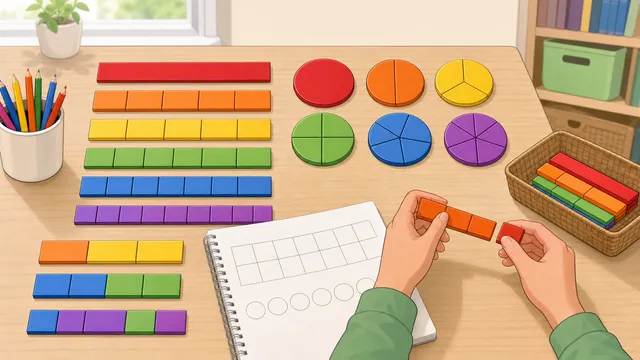
- Use real objects. Cut a piece of paper into equal parts. Physically see what 3/8 looks like compared to 1/2. Once you can visualise fractions, the arithmetic follows naturally.
- Estimate first. Before calculating 5/8 + 3/4, notice that 5/8 is a bit more than half and 3/4 is close to a whole. So your answer should be somewhere around 1 and 3/8. If your calculation gives you something wildly different, you know to double-check.
- Simplify as you go. When multiplying fractions, you can cross-cancel common factors before multiplying. For 4/9 times 3/8, notice that 4 and 8 share a factor of 4, and 3 and 9 share a factor of 3. Cancel those first and you’re left with 1/3 times 1/2 = 1/6. Much easier than multiplying 12/72 and simplifying afterwards.
- Practice with cooking. Recipes are full of fractions. If a recipe calls for 3/4 cup of flour and you want to make one and a half batches, you need 3/4 times 3/2 = 9/8 = 1 and 1/8 cups. Real-world practice beats worksheets every time.
You’ve already come further than you think
If you’ve read through this and tried even a couple of calculations along the way, you’ve covered the core of fraction arithmetic — adding, subtracting, multiplying, dividing, and simplifying. That’s not a small thing. These are the operations that trip up students at every level, from primary school through to university entrance exams, and you just worked through all of them.
The key from here is repetition with real numbers. Next time you’re splitting a bill, halving a recipe, or working through a homework problem, do the fraction work by hand first, then check with one of the calculators above. Each time you do that, the process becomes more automatic and less intimidating.
And if you do get stuck on a problem? That’s not failure — that’s learning. Go back to the basics, find your common denominator, and take it one step at a time. You’ve got this.
Calculators used in this article
Math / Number Systems / Fractions
Fraction Calculator
Add, subtract, multiply, divide, simplify, compare, convert, and solve fractions with one fraction calculator covering mixed numbers, improper fractions.
Math / Number Systems / Fractions
Fraction Calculator
Add, subtract, multiply, divide, simplify, compare, convert, and solve fractions with one fraction calculator covering mixed numbers, improper fractions.
Math / Number Systems / Fractions
Fraction Calculator
Add, subtract, multiply, divide, simplify, compare, convert, and solve fractions with one fraction calculator covering mixed numbers, improper fractions.