

Landscaping on a Budget: Calculating Mulch, Gravel, and Ground Cover
Work out exactly how much mulch, gravel, or ground cover you need — so you order once, spread once, and don't waste money on excess material.
The landscaping trap nobody warns you about
When I tackled the front yard of my bungalow a few years back, I made the classic mistake. I drove to the garden centre, pointed at a pile of bark mulch, and said “give me ten bags.” I had no idea how much ground I was covering. I ran out halfway across the front beds, went back for another ten bags, and still ended up with bare patches along the fence line. Three trips to the garden centre for one job. That’s not a renovation — that’s a shuttle service.
Landscaping materials are sold by volume, and most people have no intuition for how far a cubic yard of mulch actually spreads. The maths isn’t complicated, but you have to do it before you load up the truck. This guide walks through the three ground-cover materials I use most — mulch, gravel, and general area coverage — and gives you the calculators to nail the quantities on the first pass.
Know your square footage first
Before you can figure out how much mulch or gravel to buy, you need to know the area you’re covering. This sounds obvious, but it trips people up more than you’d expect. Garden beds are rarely neat rectangles. They curve around trees, taper along pathways, and wrap around the house in irregular shapes.
Here’s how I handle it: break the area into rough rectangles and triangles. Measure each section separately, calculate the square footage of each one, and add them together. For curved beds, I use the closest rectangular approximation and add about 5% to account for the shape.
A few things people forget to measure:
- The strip between the driveway and the fence — it’s usually narrow but long, and those square feet add up fast.
- Tree rings — if you’re mulching around the base of trees, each one is a circle. Measure the diameter you want and work out the area.
- Slopes — a sloped bed has more surface area than its flat footprint suggests. If the slope is significant, add 10-15% to your area calculation.
The Square Footage Calculator handles the arithmetic for standard shapes. Plug in your measurements and it’ll give you the total area:
Common square-footage scenarios
Use the result the way pros usually check it
For L-shaped rooms: measure the outer rectangle, subtract the cut-out, then compare the order quantity against the raw floor area before buying material.
For repeated rooms: use the identical sections input when the dimensions genuinely match. Bedrooms that differ by even a small alcove should be measured separately.
For homes and listings: use this as a geometry planner, not as a substitute for ANSI or local listing rules that define what finished square footage counts.
Material order
184.8 ft²
Rectangle area totals 168 ft² before applying 10% waste.
- One section
- 168 ft²
- Measured total
- 168 ft²
- Order with waste
- 184.8 ft²
- Waste amount
- 16.8 ft²
- Square feet
- 168 ft²
- Square metres
- 15.61 m²
- Square yards
- 18.67 yd²
- Perimeter
- 52 ft
Shape check
Use rectangle mode for standard bedrooms, living rooms, garages, lots, and any space with one clear length and width.
Interpretation
Rectangles are the fastest square footage check for rooms, garages, and simple floor plans. This answer shows the measured total with 10% overage available for ordering.
Large-area conversions
0 acres and 0 hectares for site-planning or lot-size comparisons.
| Planning row | Value |
|---|---|
| Measured formula | 12.00 × 14.00 = 168.00 ft² |
| Identical sections | 1 |
| Waste allowance | 10% |
| Flooring order benchmark | 184.8 ft² at 10%, 193.2 ft² at 15% |
Write that number down. You’ll use it for everything that follows.
Mulch: how deep is deep enough?
Mulch does three jobs in your yard. It suppresses weeds, retains moisture in the soil, and insulates plant roots from temperature swings. But it only does those jobs if you spread it at the right depth.
Too thin (under 2 inches) and weeds push straight through within weeks. Too thick (over 4 inches) and you risk suffocating plant roots and creating a moisture trap that breeds fungus. The sweet spot for most bark and wood chip mulch is 2 to 3 inches. I go with 3 inches on beds that get full sun, because the top layer breaks down faster in direct heat, and 2 inches in shaded areas where decomposition is slower.
Here’s where people lose money: mulch is typically sold in bags (usually 2 cubic feet each) or in bulk by the cubic yard. Bags are convenient for small jobs, but they’re almost always more expensive per unit of volume. If you’re covering anything larger than about 100 square feet, bulk delivery will save you a significant amount. One cubic yard of mulch covers roughly 108 square feet at 3 inches deep — that’s about 13 to 14 bags’ worth.
Use the Mulch Calculator to work out exactly how much you need. Enter your area and desired depth, and it’ll give you the volume in cubic yards and the number of bags:
Depth guidance
Typical finished depth: 2 to 3 inches.
A 2 to 3 inch layer is usually enough for weed suppression without burying crowns or stems.
Common bag sizes
Most retail mulch bags are 1.5, 2, or 3 cubic feet. Coverage falls quickly as depth increases.
Mulch order
1.22 cu yd
Order volume after adding 10% extra on top of 1.11 raw cubic yards.
- Area measured
- 120 sq ft
- Raw cubic feet
- 30
- Extra added
- 3 cu ft
- Bags needed
- 17
- Bag coverage
- 8 sq ft
- 1 yard covers
- 108 sq ft
Order sheet
Bulk, bag, and coverage summary
| Project type | Flower and shrub beds |
| Target depth | 3 in |
| Raw volume | 1.11 cu yd / 30 cu ft |
| Waste allowance | 10% adds 0.11 cu yd |
| Bag size and density guide | 2 cu ft bags | about 733.33 lb total installed mulch |
| Coverage cheat sheet | Each bag covers about 8 sq ft and each cubic yard covers about 108 sq ft at this depth. |
| Cost comparison | Bulk — | Bags — | Add both prices to compare bulk versus bagged mulch. |
| Bags per cubic yard | About 13.5 bags make one cubic yard at this bag size. |
Ordering tip: add 5-10% to whatever the calculator tells you. Mulch settles after you spread it, and you’ll always have edges and corners that eat more material than the flat sections. I’d rather have a small pile left over than make another trip.
Gravel: driveways, paths, and drainage beds
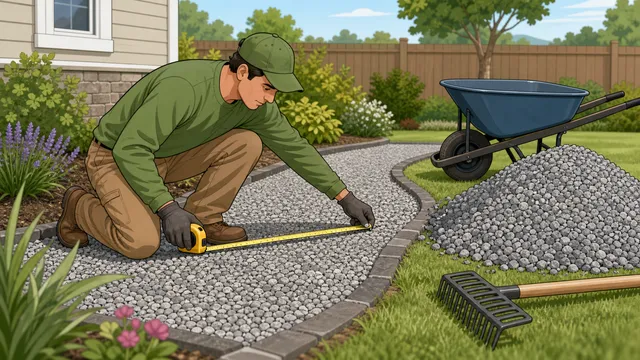
Gravel is a different beast from mulch. It doesn’t decompose, it doesn’t float away in the rain (mostly), and it compacts over time into a firm surface. I use it for pathways, the strip alongside my garage, and a drainage bed at the back of the property where water used to pool after every storm.
Depth requirements vary by use:
- Decorative ground cover (around plants or along a fence line): 2 inches is enough.
- Walkways and garden paths: 3 to 4 inches gives a stable surface that doesn’t shift underfoot.
- Driveways and parking areas: you’re looking at 4 to 6 inches minimum, often with a compacted base layer underneath.
- Drainage beds: 4 to 6 inches, sometimes deeper depending on the volume of water you need to manage.
Gravel is heavier than mulch, which means delivery is essentially mandatory for anything beyond a small path. A cubic yard of gravel weighs roughly 1.2 to 1.5 tonnes depending on the type — you’re not hauling that in the back of a hatchback.
The type of gravel also affects coverage. Pea gravel (those small, rounded stones) packs tighter than angular crushed stone. Larger decorative river rock leaves more air gaps and covers less area per cubic yard at the same depth. If you’re using anything larger than 20mm stone, bump up your volume estimate by 10%.
The Gravel Calculator takes the guesswork out. Enter your dimensions and depth, and it gives you the volume and approximate weight:
Unit setup
Quick examples
Area shape
Pea gravel
Typical depth: 2 to 3 in. Best for: decorative beds, walkways, play areas, and light foot traffic.
Use supplier density when available. Moisture, fines, compaction, and local stone grading can move tons and delivery cost even when the cubic-yard volume is correct.
Supplier order target
1.00 tons
Rounded from 0.86 tons after 8.0% allowance. Exact order volume is 0.64 yd³ (0.49 m³).
- Cubic yards
- 0.64 yd³
- Cubic meters
- 0.49 m³
- 50 lb bags
- 35
- 20 kg bags
- 40
- Project area
- 96.00 ft²
- Weight
- 0.78 t
- Truckloads
- 0.10 loads
- Material cost
- 45 units
Planning sheet
| Scenario | Cubic yards | Tons | Metric tonnes | Bags |
|---|---|---|---|---|
| Measured volume | 0.59 yd³ | 0.80 tons | 0.73 t | 32 |
| With allowance | 0.64 yd³ | 0.86 tons | 0.78 t | 35 |
| Rounded supplier target | 0.74 yd³ | 1.00 tons | 0.91 t | 40 |
Interpret the result
The base geometry is 0.59 yd³ before allowance. The order volume is 0.64 yd³, and the rounded supplier target is 1.00 tons at 2,700 lb per cubic yard.
Increase the allowance when the area has uneven edges, compaction loss, settlement, trimming, or future top-up needs. Keep a smaller allowance when the supplier can deliver exact loose cubic yards and the bed is easy to shape.
Landscape fabric under gravel is non-negotiable. Lay a proper woven geotextile under any gravel area. Without it, the gravel slowly sinks into the soil and weeds push up from below. I’ve seen people skip the fabric to save a few dollars, and within two years they’re pulling the gravel out, laying fabric, and starting over. Do it once, do it right.
Putting together your materials list
Once you’ve got your area measured and your mulch and gravel volumes calculated, build a proper materials list before you place any orders. Here’s my standard checklist for a landscaping project:
- Square footage of each zone (beds, paths, driveway strips)
- Mulch volume in cubic yards, with the 5-10% buffer
- Gravel volume in cubic yards, including the weight estimate for delivery planning
- Landscape fabric — measure the same square footage as your gravel areas, plus 6 inches of overlap at every seam
- Edging material — metal, plastic, or stone edging to keep mulch and gravel from migrating into the lawn
- Fabric staples — one every 2 feet along seams and edges
Price everything out from at least two suppliers. Bulk landscape materials can vary wildly in cost between garden centres and dedicated aggregate yards. In my experience, the aggregate yard is usually 20-30% cheaper on gravel and roughly comparable on mulch.
Timing and delivery
Order your bulk materials mid-week if you can. Weekends are peak delivery time for every landscaping supplier, and you’ll often wait longer or pay a premium for Saturday delivery. Most suppliers will dump the material on your driveway or at the kerb — make sure you have a wheelbarrow, a good rake, and a few hours blocked out for spreading.
For mulch, early spring and late autumn are the best times to lay it down. Spring mulching locks in soil moisture before summer heat arrives. Autumn mulching insulates roots heading into winter. Avoid mulching in the middle of a hot, dry spell — the fresh layer acts like insulation and can actually trap heat against the soil surface.
Gravel is less timing-sensitive, but avoid laying it on saturated ground. If the base is soggy, the gravel will sink unevenly and you’ll spend the next year trying to level it out.
The key takeaway from every landscaping job I’ve done — from my bungalow’s front beds to a full backyard drainage overhaul — is the same lesson that applies to every renovation project: measure twice, calculate once, and order with a small buffer. It’s always cheaper to return a leftover bag of mulch than to make an emergency run for more.
Calculators used in this article
Construction / Landscaping
Mulch Calculator
Use this mulch calculator to estimate cubic yards, bag count, mulch coverage, and waste-adjusted order quantity for flower beds, tree rings.
Construction / Landscaping
Gravel Calculator
Estimate how much gravel you need in cubic yards, cubic metres, tons, metric tonnes, bags, truckloads, and material cost for paths, beds, tree rings.
Home & DIY / Measurement / Area
Square Footage Calculator
Calculate square footage for rooms and spaces with rectangle, L-shaped room, circle, triangle, and trapezoid formulas, plus repeated-room totals, custom waste.