Estimate how much gravel you need in cubic yards, cubic metres, tons, metric tonnes, bags, truckloads, and material cost for paths, beds, tree rings.
Last updated
Gravel coverage, tons, yards, bags, and cost Estimate how much gravel you need for paths, beds, tree rings, patio bases, drainage fill, and small landscape areas. The calculator shows cubic yards, tons, metric tonnes, bag counts, supplier rounding, truckload context, and optional material cost.
Unit setup
Quick examples
Area shape
Pea gravel
Typical depth: 2 to 3 in. Best for: decorative beds, walkways, play areas, and light foot traffic.
Use supplier density when available. Moisture, fines, compaction, and local stone grading can move tons and delivery cost even when the cubic-yard volume is correct.
Supplier order target
1.00 tons
Rounded from 0.86 tons after 8.0% allowance. Exact order volume is 0.64 yd³ (0.49 m³).
Cubic yards
0.64 yd³
Cubic meters
0.49 m³
50 lb bags
35
20 kg bags
40
Project area
96.00 ft²
Weight
0.78 t
Truckloads
0.10 loads
Material cost
45 units
Planning sheet
Scenario
Cubic yards
Tons
Metric tonnes
Bags
Measured volume
0.59 yd³
0.80 tons
0.73 t
32
With allowance
0.64 yd³
0.86 tons
0.78 t
35
Rounded supplier target
0.74 yd³
1.00 tons
0.91 t
40
Quote in the supplier's unit Use cubic yards when the yard sells by volume, tons when it sells by weight, and the rounded supplier target when orders must be rounded to a quarter-ton, half-ton, full ton, or truckload.
Interpret the result
The base geometry is 0.59 yd³ before allowance. The order volume is 0.64 yd³, and the rounded supplier target is 1.00 tons at 2,700 lb per cubic yard.
Increase the allowance when the area has uneven edges, compaction loss, settlement, trimming, or future top-up needs. Keep a smaller allowance when the supplier can deliver exact loose cubic yards and the bed is easy to shape.
Gravel calculator for cubic yards, tons, bags, depth, and cost
A gravel calculator helps answer the practical ordering question: how much gravel do I need for a path, landscape bed, tree ring, drainage area, patio base, or small fill project. This calculator converts project shape, dimensions, gravel depth, material density, waste allowance, and supplier rounding into cubic yards, cubic metres, tons, metric tonnes, bag counts, truckload context, and optional material cost.
What this gravel calculator is estimating
Most gravel projects start with area and depth, but the order usually has to be discussed in cubic yards, cubic metres, tons, bags, or truckloads. A useful gravel calculator therefore needs to show both volume and weight, not just one bare number.
This page is built for paths, decorative beds, circular tree rings, triangular corners, patio bases, small drainage fill areas, and other landscape aggregate jobs. It supports rectangle, circle, and triangle shapes, imperial or metric inputs, common gravel density presets, waste and compaction allowance, supplier rounding, 50 lb bag estimates, 20 kg bag estimates, truck capacity context, and a material-only cost estimate when you enter a price per ton.
Core gravel formulas
The calculator first finds the footprint area, converts the entered depth into a volume, applies the allowance you choose, and then converts that order volume into weight using the selected gravel density. It keeps the geometric volume, practical order volume, and supplier-rounded target visible so you can see where the final number came from.
Density is the bridge between a cubic-yard gravel calculator and a gravel tons calculator. Two projects with the same length, width, and depth can have different tonnage if one uses pea gravel and the other uses denser crushed limestone or road base.
Rectangle area = Length x Width
Use this for paths, beds, trenches, pads, and most rectangular coverage areas.
Circle area = pi x Radius^2
Use this for tree rings, round fire-pit surrounds, and circular landscape beds.
Triangle area = Base x Height / 2
Use this for triangular corners, tapered beds, and wedge-shaped sections.
Base volume = Area x Gravel depth
Depth is converted into feet or metres before the raw gravel volume is calculated.
Order volume = Base volume x (1 + Allowance%)
The allowance covers waste, uneven edges, compaction, settlement, and trimming.
Tons = Order cubic feet x Density lb/ft3 / 2,000
Weight depends on the material density assumption, so supplier density should replace defaults when available.
How to choose gravel depth
The depth input has the biggest effect after area because doubling depth doubles the order quantity. Decorative stone beds and light paths often use a shallower layer, while patio bases, drainage fill, and vehicle surfaces need a deeper or more structured build-up.
Use the quick examples as starting points, then adjust depth for the actual job. A 2 inch decorative layer is very different from a 4 inch base, and a drainage trench can require far more material if it is filled close to grade. If the project has mixed depths, calculate each section separately and add the supplier order quantities.
Cubic yards, tons, metric tonnes, and bags
Use cubic yards or cubic metres when the supplier quotes loose volume. Use tons or metric tonnes when the yard quotes by weight. Because gravel density changes by stone type, moisture, fines content, and compaction state, both units should stay visible until you confirm the supplier's actual basis.
Bag counts are most useful for small jobs and store pickup comparisons. Once a project needs dozens of 50 lb bags or many 20 kg bags, a bulk order may be easier to handle and cheaper per unit, but delivery fees and supplier minimums can still change the decision.
Material density and gravel type
The preset material choices cover common planning assumptions for crushed stone, pea gravel, river rock, limestone, decomposed granite, sand, and custom supplier density. They are not a promise that every local yard uses the same conversion.
Angular crushed stone and limestone are often selected for compactable base or drainage work. Pea gravel and river rock are common for decorative beds, tree rings, and walkways where appearance matters more than structural interlock. Road-base blends, crusher run, and dense graded aggregate can be heavier because fines fill the voids between larger particles.
Allowance, supplier rounding, and truckload planning
The geometric result is the minimum if the area were perfectly shaped and perfectly placed. Real gravel jobs have spillage, edge trimming, settlement, compaction, and uneven ground, so the allowance controls how much extra is added before rounding.
The supplier rounding control turns an exact tonnage into a more realistic order target. A yard may quote by quarter-ton, half-ton, full ton, cubic yard, or truckload, so the rounded supplier target is designed to make the result easier to compare with a dispatch quote. Truckload context is illustrative only because vehicle capacity, legal haul limits, and delivery minimums vary by supplier.
Worked example: garden path gravel
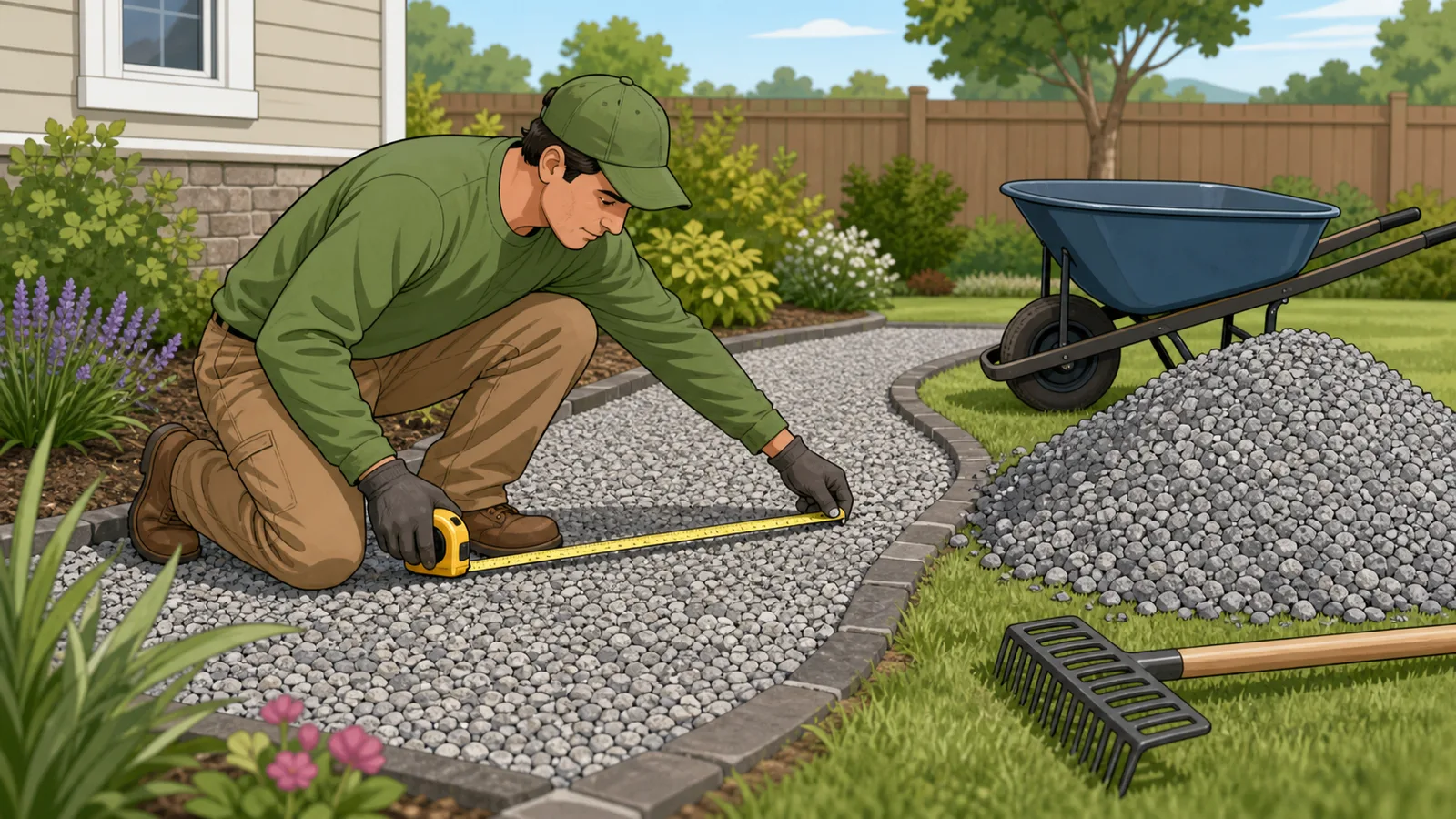
Suppose a garden path is 24 ft long, 4 ft wide, and 2 inches deep. The footprint is 96 square feet. The base volume is 16 cubic feet, which is about 0.59 cubic yards before allowance.
With an 8% allowance and a 100 lb/ft3 crushed-stone density assumption, the practical order is about 0.64 cubic yards and about 0.86 tons before supplier rounding. If the supplier rounds up to the nearest quarter-ton, the order target becomes 1.00 ton. That rounded figure is more useful for a quote than the exact geometric number alone.
What this result does not cover
This calculator estimates aggregate quantity. It does not design a structural driveway, choose geotextile, specify drainage slope, account for excavation bulking, model water content, or decide whether a compacted base layer is adequate for your soil and traffic.
Use it as a gravel-order planning tool, then confirm gravel type, supplier density, sold unit, delivery minimum, bag size, and compaction expectations before final purchase. For a dedicated driveway build-up with multiple layers, use the gravel driveway calculator and estimate each layer separately.
Frequently asked questions
How much gravel do I need?
Measure the project area, choose the depth, select a realistic gravel density, and add a waste or compaction allowance. This calculator turns those inputs into cubic yards, cubic metres, tons, metric tonnes, bag counts, and a rounded supplier order target.
How do I calculate gravel in cubic yards?
For a rectangle, multiply length by width, multiply by depth converted into feet, and divide cubic feet by 27. For round or triangular areas, calculate the area first, then multiply by depth and convert the same way.
How many tons of gravel do I need?
Tons depend on volume and density. After the calculator finds the waste-adjusted cubic feet, it multiplies by the selected lb/ft3 density and divides by 2,000. Use the supplier's density or tons-per-yard figure when you have it.
How many cubic yards are in a ton of gravel?
There is no single fixed conversion because gravel density varies. A rough planning range is often around two-thirds to three-quarters of a cubic yard per short ton, but crushed stone, river rock, limestone, moisture, and fines can move the conversion.
How deep should gravel be for a path or landscape bed?
Decorative beds and light paths are often planned at a few inches of depth, while bases, drains, and vehicle surfaces may need a deeper section. The calculator estimates quantity from the depth you enter; it does not decide the structural depth for you.
Should I add extra gravel for waste or compaction?
Usually yes. A small allowance helps cover uneven edges, settling, compaction loss, spreading loss, and small measurement errors. Increase the allowance for irregular borders, compactable material, rough subgrade, or a job where a second delivery would be expensive.
Is it better to buy gravel by the bag, ton, or cubic yard?
Small touch-up projects can be practical by bag. Larger areas are usually easier to order by bulk cubic yard or ton. The calculator shows all three views so you can compare a store pickup against a supplier quote and delivery minimum.
What gravel type should I choose in the calculator?
Choose the preset closest to the material you plan to buy, such as crushed stone, pea gravel, river rock, limestone, decomposed granite, or sand. If the supplier gives a specific density or tons-per-yard conversion, use the custom option.
Does the calculator work for circular tree rings?
Yes. Select the circle shape, enter the radius, choose depth, and select a gravel type. The calculator converts the circular area into volume, weight, bag count, and a supplier order target.
Why does the rounded supplier target exceed the exact tonnage?
Supplier orders often need to be rounded to practical increments such as a quarter-ton, half-ton, full ton, or truckload. Rounding up helps avoid ordering slightly short when the exact number cannot be delivered.
Guides
Featured in articles
Step-by-step guides that use this calculator to solve real problems.