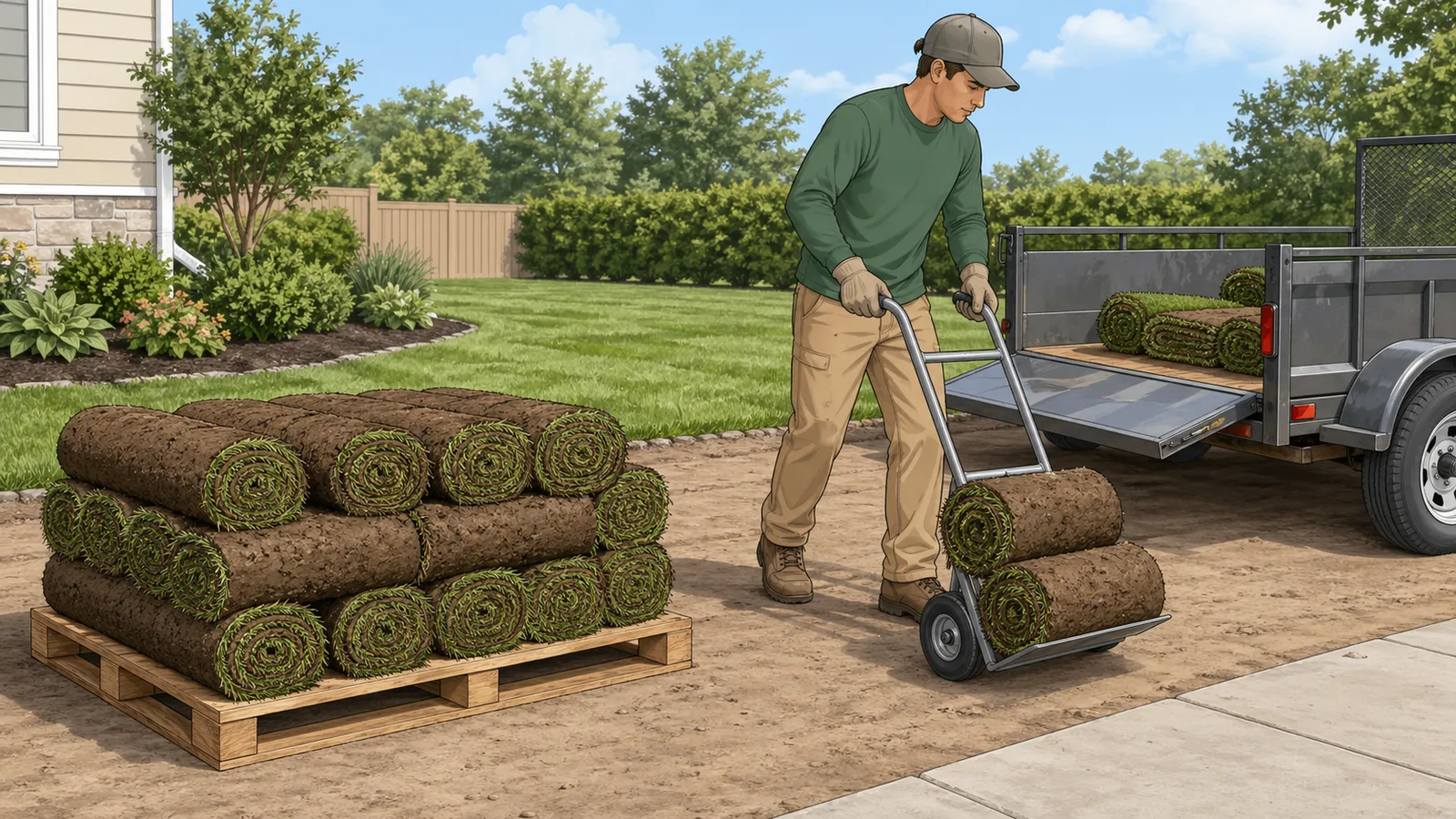
Estimate sod weight, pallet count, roll count, kilograms, tons, waste-adjusted order area, and vehicle payload fit from lawn square footage, pallet coverage.
Last updated
Sod weight, pallet, and payload planner Estimate sod weight from lawn area, waste allowance, sod roll size, supplier pallet coverage, moisture level, and an optional vehicle or trailer payload check.
Quick sod scenarios
Result
3,150 lbs
Estimated sod order weight for 525 sq ft after waste, equal to about 1,428.82 kg or 1.58 short tons.
Order area
525 sq ft
25 sq ft added for waste
Sod pieces or rolls
53
60 lbs each at the selected moisture level
Pallets
2
3,000 lbs per full pallet assumption
Weight per sq ft
6 lbs
Moisture is the main driver of this estimate
Payload check
Add rating
Enter a payload to estimate trips or delivery need
Handling guidance Confirm the supplier pallet weight and your vehicle or trailer payload before collecting a full pallet.
Sod weight calculator for pallets, rolls, transport, and handling
A sod weight calculator estimates the total weight of a sod order from lawn area, piece size, and moisture level. This page also explains the main assumptions behind the sod weight calculator for pallets, rolls, transport, and handling result, highlights the supporting figures shown by the calculator, and helps the reader use the estimate without overstating what a quick online tool can prove.
What makes sod weight change
Sod weight is driven by three things: total area, the size of each piece or roll, and how wet the soil layer is when the sod is cut, stacked, or delivered. Even when the lawn area stays the same, wetter sod or larger pieces can change the handling weight significantly.
That is why the calculator leads with total pounds, piece count, pallet count, and total tons. Those numbers are more useful for transport planning than area alone, especially when you are deciding whether to collect sod yourself or have it delivered by the supplier.
Moisture is the biggest reason a pallet of sod weight estimate can look different from one supplier page to another. A dry slab, an average fresh roll, and a wet pallet can all cover the same square footage while creating very different loading and handling requirements.
Total weight = Lawn area x Weight per sq ft
The weight-per-square-foot assumption changes with the selected moisture level.
Order area = Lawn area x (1 + Waste allowance / 100)
The calculator applies the waste allowance before estimating pieces, pallets, and weight.
Pallets, rolls, and payload limits
Residential sod is commonly sold as individual pieces, rolls, or pallets. A pallet may cover roughly a few hundred square feet, but the real pallet weight depends on the grass type, how much soil stays attached to the roots, and how wet the sod is at delivery.
That means a lawn that looks manageable by area alone can still be too heavy for a small trailer, pickup payload, or manual handling plan. The weight estimate is especially useful if the sod must cross a soft lawn, narrow side access, or a route with steps or ramps.
Competitor pages often answer the headline question of how much a pallet of sod weighs, but they usually stop before the transport decision. This calculator lets you enter the supplier's pallet coverage and an optional vehicle or trailer payload so you can see whether one trip is plausible or whether delivery, multiple loads, or equipment support is safer.
Waste allowance and supplier pallet coverage
Sod orders usually need more than the measured lawn area because pieces are trimmed around curves, walks, planting beds, irrigation heads, and irregular edges. A small rectangular repair may need only a modest waste allowance, while a curved lawn or fragmented layout may need more extra material.
Supplier pallet coverage also changes. Some suppliers describe pallets around 400, 450, 500, 600, or even 700 square feet depending on sod type and roll dimensions. Use the pallet coverage printed on the supplier quote whenever you have it, because that value controls both the estimated pallet count and the assumed weight per full pallet.
The waste-adjusted order area gives you a cleaner number to discuss with the sod farm or landscape supplier. It keeps the sod weight per square foot assumption separate from the ordering allowance so you can adjust each one without mixing up area, roll size, and moisture.
Pallets = ceil(Order area / Supplier pallet coverage)
Uses the supplier-specific pallet coverage rather than assuming every pallet covers the same area.
Sod roll weight and handling checks
The sod roll weight output is meant for the person who has to move the pieces, not just the person ordering the lawn area. A 2 ft by 5 ft roll can be manageable when relatively dry but much harder to carry when freshly cut, heavily watered, or stacked in warm conditions.
The payload check is intentionally conservative. Vehicle payload is not the same as towing capacity, and it has to cover people, fuel, tools, tie-downs, the pallet, and anything else in or on the vehicle. If the calculator shows the sod delivery weight is close to or above the entered rating, treat that as a prompt to confirm the numbers before loading.
How to use the result
Use the total pounds and total tons as a transport-planning check, then look at the pallet count to decide whether delivery is more practical than self-collection. If you are handling pieces by hand, the weight-per-piece output helps you judge whether extra labour or mechanical help will be needed.
Sod should usually be installed promptly after delivery. If a pallet is going to sit in warm weather, the handling plan matters as much as the quantity estimate because heat can build up quickly in stacked turf.
A practical workflow is to enter the measured lawn area, add a waste allowance, adjust pallet coverage to match the supplier, then compare the total sod weight against the payload rating of the vehicle or trailer you plan to use. If the payload result is uncomfortable, ask the supplier about split pallets, delivery placement, or equipment access.
Worked example: checking a full pallet collection
Suppose a lawn repair needs 500 square feet of sod, you add 5 percent waste, the supplier pallet covers 500 square feet, and the sod is in average fresh condition. The calculator uses 525 square feet for ordering, applies the selected weight per square foot, and returns 3,150 pounds for the sod alone.
That result is already above the payload rating of many light-duty vehicles before the wooden pallet, passengers, tools, and tie-downs are counted. In that situation, the useful answer is not simply the number of rolls. It is that the job probably needs delivery, a properly rated trailer, or multiple loads confirmed with the supplier.
What this result does not cover
This calculator does not model the exact soil thickness cut by a sod farm, the weight of the wooden pallet itself, species-specific density differences, or delivery equipment limits set by the supplier. It also does not replace the actual payload rating of your vehicle or trailer.
Use it as a planning tool, then confirm pallet coverage, pallet weight, and handling advice with the sod supplier before collection or delivery.
It also does not decide how much sod you need from a drawing, subtract complex hardscape shapes, or price labour. If you already know the square footage, this page focuses on sod pallet weight, roll count, and safe handling; a full landscape takeoff may still need a separate area measurement step.
Frequently asked questions
How much does a pallet of sod weigh?
A full pallet often covers a few hundred square feet, but the total weight varies with moisture, grass type, soil thickness, and pallet size. Many pallets end up in the rough range of a few thousand pounds rather than a few hundred. That is why the calculator uses area, moisture, and pallet coverage instead of treating every pallet as one fixed weight.
Can a pickup truck carry a pallet of sod?
Sometimes, but not always. You need to compare the expected sod weight plus pallet weight against the vehicle payload rating. Many smaller pickups are not suited to a full wet pallet of sod, and payload must also include passengers, tools, the pallet, fuel, and other cargo.
Why does wet sod weigh so much more?
The soil attached to the roots holds water, and that added moisture changes the total weight quickly. Freshly cut or recently watered sod can be much heavier than drier rolls from the same area. If the supplier says the sod was cut after rain or watered before pickup, use the wet setting or ask for a pallet-specific weight.
How soon should sod be installed after delivery?
As soon as practical. Sod is best laid promptly after delivery because stacked rolls can heat up and dry out, especially in warm weather or direct sun.
How much does one roll of sod weigh?
A roll of sod weight estimate depends on the roll size and moisture level. A common 2 ft by 5 ft roll covers 10 square feet, so at the calculator's average setting it weighs about 60 pounds. A smaller 16 in by 24 in slab weighs much less, but both sizes can become heavier when wet.
How many square feet are on a pallet of sod?
There is no single universal pallet size. Many suppliers use values around 400 to 500 square feet, while some regional sod farms use different pallet layouts. Enter the supplier's quoted pallet coverage when you have it so the pallet count and weight per pallet are aligned with the actual order.
Should I add extra sod for waste?
Yes, most projects should include some waste allowance for trimming, curves, damaged pieces, and edge fitting. A simple rectangular area may need a modest allowance, while irregular layouts, narrow strips, or many obstacles usually justify more.
Does the sod weight calculator include the wooden pallet?
No. The result estimates sod weight only. Add the pallet, packaging, tools, and any other cargo when checking the payload rating for a truck or trailer.
Is sod weight per square foot the same for every grass type?
No. Grass variety, root mat thickness, soil type, harvest thickness, and moisture can all change sod weight per square foot. The calculator's moisture settings are planning assumptions, not supplier-certified weights.
What should I do if the payload check says the order is over the vehicle rating?
Do not treat the calculator as permission to overload the vehicle. Split the order into multiple loads, use a properly rated trailer, request delivery, or ask the supplier to place pallets closer to the work area with suitable equipment.