Use this grass seed calculator to estimate seed quantity, overseeding rate, bag count, leftover seed, and optional cost from lawn size, grass type.
Last updated
Grass seed and overseeding planner Estimate seed needed, bag count, leftover seed, bag coverage, and optional budget from lawn area, grass type, seeding rate, and a realistic order buffer.
Quick lawn sizes
Tall Fescue planning note
Popular cool-season choice for drought tolerance and deeper roots.
Default rate: 8 lb per 1,000 sq ft for a new lawn.
Use the product label as the final authority Grass type, coating, germination, and regional recommendations can change bag coverage. This planner is strongest when you use the label rate and keep a small buffer for overlap, curves, and bare-spot touch-ups.
Enter a realistic lawn-seeding plan Enter a lawn area greater than 0 before calculating grass seed.
Grass seed calculator guide: how much seed, overseeding rate, bag count
A grass seed calculator helps you work out how much grass seed you need for a new lawn, overseeding, or patch repair without guessing from bag marketing alone.
What a grass seed calculator should actually help you decide
The basic math for grass seed is simple, but the buying decision is not. You are usually balancing lawn size, grass species, new-lawn versus overseeding rate, bag size, spare seed for patching, and the exact coverage printed on the product you may actually buy.
A useful grass seed calculator therefore needs to do more than output one weight number. It should help you turn the seeding rate into a realistic order plan by showing bag count, leftover seed, and how much area each bag covers at the chosen rate. That is especially helpful when you are comparing tall fescue, bluegrass, ryegrass, bermuda, zoysia, or a sun-and-shade blend.
How grass seed quantity is calculated
Grass seed is usually planned from an application rate stated in pounds per 1,000 square feet. Once the lawn area is known, the calculator converts that area into the number of 1,000-square-foot units, multiplies by the seeding rate, then adds any order buffer you want to carry for overlap, edges, and touch-up repairs.
The right rate depends on both grass type and project type. New-lawn seeding uses a higher rate because bare soil needs full coverage, while overseeding uses less seed because existing grass is already present. That is why two lawns of the same size can need very different seed orders depending on whether you are starting over or thickening a thin stand.
Seed needed = (Lawn area in sq ft / 1,000) x Seeding rate
This converts lawn area into the base seed weight before any order buffer or bag rounding.
Seed to buy = Seed needed x (1 + Buffer % / 100)
This adds a practical margin for overlap, edge losses, bare spots, and follow-up touch-ups.
Bags needed = Ceiling(Seed to buy / Bag size)
Bag count is rounded up because seed is purchased in whole bags, not exact fractions.
Coverage per bag = (Bag weight / Seeding rate) x 1,000
This shows how much lawn one bag covers at the selected rate rather than relying on generic packaging language.
New lawn versus overseeding is the most important rate choice
Many people search for how much grass seed do I need without first deciding whether the project is a full new lawn or an overseeding job. That distinction matters more than almost any other input because overseeding rates are often about half of new-lawn rates for the same species.
A new lawn from bare soil typically needs more seed because the entire area must establish from scratch. Overseeding is lighter because you are trying to thicken an existing lawn rather than bury it under too much seed. Putting down far more seed than the label recommends can create unnecessary seedling competition instead of a stronger lawn.
Why bag count and leftover seed matter
Competitor calculators often stop at the total seed pounds, but real buyers usually care about the number of bags to put in the cart. A result of 22.4 pounds means something different if the supplier sells 5 lb, 10 lb, or 20 lb bags. The leftover amount also matters because many lawns need a small touch-up pass after germination reveals thin areas.
That is why the bag-coverage view is useful. Instead of only saying you need 22.4 pounds, the calculator can show that three 10 lb bags cover the job with a modest reserve, while five 5 lb bags may cost more and leave less spare seed. That is a more practical shopping answer than a bare weight alone.
How much grass seed do you need per acre
Per-acre planning is common for larger lawns, paddocks, and shared open spaces. One acre equals 43,560 square feet, so even small changes in seeding rate can move the total order by dozens of pounds.
At 3 lb per 1,000 square feet, one acre needs about 130.7 pounds of seed before any buffer. At 6 lb per 1,000 square feet, the same acre needs about 261.4 pounds. This is why a grass seed rate calculator or per-acre seed planner should always keep the chosen rate visible instead of hiding it behind a species dropdown alone.
When to add a buffer and when to trust the label more than the average rate
A 7 to 10 percent buffer is often sensible for edges, curves, spreader overlap, windy conditions, and patch repairs after the first watering cycle. Large rectangular lawns on calm days may need less. Irregular lawns, slopes, patchy soil, and lawns broken up by beds, paths, or trees often need more.
The product label still takes priority over generic planning tables because blends, coating, germination, and purity can change the correct rate. A bluegrass-heavy mix and a tall-fescue-heavy mix can look similar on the shelf but cover different areas. That is why the custom-rate override exists: it lets you keep the calculator workflow while matching the exact bag you intend to buy.
How to measure irregular lawns before using a lawn seed calculator
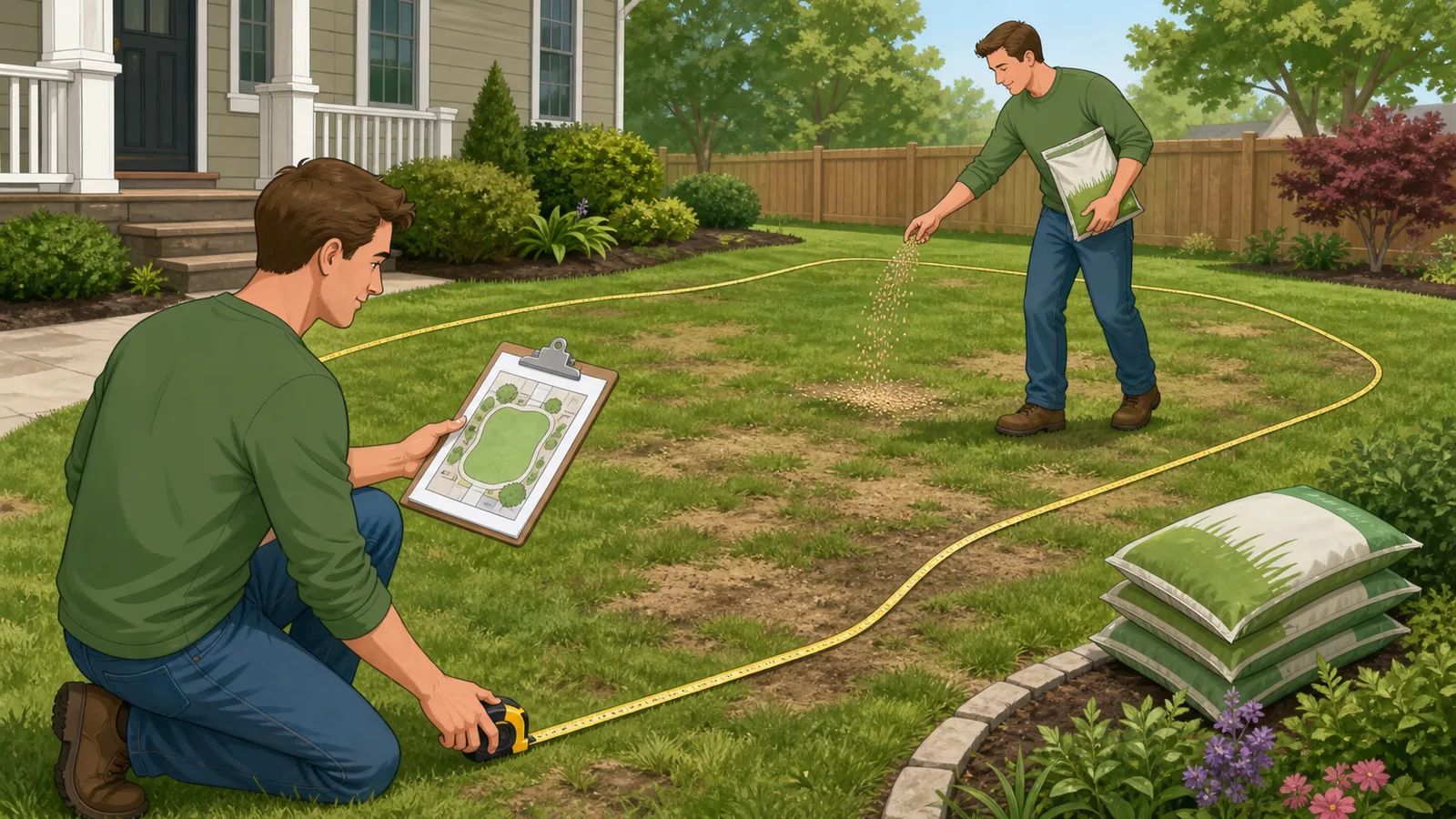
The cleanest approach is to break the lawn into simple sections, calculate each section separately, then add them together. That works better than using the full property dimensions because driveways, patios, beds, tree rings, and the house footprint are not seedable lawn area.
A rough but practical measurement is usually enough. Precision to the last square foot is less important than measuring the actual turf surface instead of the lot boundary. Many ordering mistakes come from measuring the whole plot rather than the part that will really receive seed.
Worked example: 5,000 sq ft tall fescue overseeding plan
Suppose you have a 5,000 square foot lawn that needs tall fescue overseeding at 4 lb per 1,000 square feet. The base seed need is 20 pounds. If you add a 10 percent buffer for overlap and touch-ups, the order target becomes 22 pounds.
If your supplier sells 10 lb bags, you would buy 3 bags for a total of 30 pounds, leaving 8 pounds for thin spots or follow-up repair. If the supplier sells 25 lb bags, a single bag covers the project with less leftover. This is exactly the kind of practical trade-off a grass seed bag calculator should make visible.
Season and germination still matter after the quantity math
The amount of seed is only one part of a successful lawn. Cool-season grasses are usually seeded in late summer to early fall when soil is still warm but air temperatures are easing, while many warm-season grasses are seeded later in spring or early summer once the soil is consistently warm enough.
Seed quantity cannot fix poor timing, weak soil contact, or inconsistent watering. Even a perfectly calculated order can fail if the seed dries out, is spread out of season, or is covered too deeply. Use the calculator for quantity planning, then confirm timing and establishment practice against the label and local extension guidance.
Frequently asked questions
How much grass seed do I need for a new lawn?
Measure the actual lawn area, choose the correct grass type, and use the new-lawn rate rather than the overseeding rate. Bare soil usually needs much more seed than an existing lawn that only needs thickening.
How much grass seed do I need for overseeding?
Overseeding rates are usually lower because existing turf is already present. Many grass types use roughly half the new-lawn rate for overseeding, but the exact product label should still be checked.
How many bags of grass seed do I need for my yard?
That depends on the total seed-to-buy result and the bag size sold by your supplier. The most useful way to plan bags is to divide the buffered seed requirement by the bag size, round up, and review the leftover amount for touch-up work.
How much grass seed do I need per acre?
One acre is 43,560 square feet. At 3 lb per 1,000 square feet you need about 130.7 pounds before any buffer, while 6 lb per 1,000 square feet needs about 261.4 pounds. The chosen rate matters as much as the acreage.
Does seed type change the seeding rate?
Yes. Kentucky bluegrass, tall fescue, ryegrass, bermuda, zoysia, centipede, and mixed bags can all use different rates. The right number depends on both species and whether you are seeding a new lawn or overseeding.
Should I buy extra grass seed?
Usually yes. A small buffer helps with overlap, wind, edge trimming, bare spots, and second-pass repairs after germination. Many projects justify around 7 to 10 percent extra instead of ordering the exact minimum.
Can I put down too much grass seed?
Yes. Too much seed can make seedlings compete for light, water, and nutrients, which can weaken establishment instead of improving it. Heavier is not always better, so follow the label rate rather than assuming more seed guarantees a thicker lawn.
How do I measure an irregular lawn for grass seed?
Break the lawn into simple sections such as rectangles, calculate each section separately, then add the areas together. Subtract patios, beds, driveways, and other non-grass surfaces instead of measuring the whole lot.
What is the best bag size to buy?
The best bag size is the one that covers the project with a sensible amount of leftover seed rather than wasteful overbuying. A larger bag can be cheaper per pound, but a smaller bag may fit a modest repair project better.
Should I use the calculator rate or the bag label rate?
Use the bag label as the final authority. Generic calculators help you plan, but coated seed, custom blends, purity, and germination can all change the exact coverage printed on the product you actually buy.
Does this calculator include fertiliser, topsoil, or straw coverage?
No. This page only estimates grass seed quantity, bag planning, and optional seed budget. Topsoil, compost, starter fertiliser, mulch, straw, and irrigation planning should be handled separately.