

How Much Tile, Grout, and Thinset Do You Need?
Measure the room properly, choose a realistic waste factor, and estimate tile, grout, and thinset so your first tiling job does not stall halfway through.
Before you order a single box of tile
I’ve been laying tile for over twenty years, and the single biggest mistake I see first-timers make isn’t crooked cuts or uneven spacing — it’s running out of materials halfway through the job. Nothing kills momentum like a trip back to the tile shop, only to find out your batch is out of stock and the replacement lot is a slightly different shade.
This guide walks you through the planning side of a tiling project — measuring your space, calculating quantities, and ordering with enough margin that you’re not sweating on install day.
The planning matters because tile jobs fail long before the grout goes in. They fail when the floor is not flat enough for the tile size you picked, when a bathroom wall has not been waterproofed properly, when somebody buys just enough material for the textbook square footage, or when the extra box they need later comes from a different dye lot and does not quite match. Measure twice, cut once is not just a nice phrase in tiling. It is the whole game.
If you are working in a shower, around a bath, or anywhere that sees regular water, treat waterproofing and substrate prep as non-negotiable. This guide helps you plan quantities, but it does not replace the manufacturer instructions for your backer board, membrane, or adhesive system. And if cutting tile means dry cutting indoors or improvising around electrics and plumbing, stop and sort the method properly before you carry on.
How do you measure a room for tile properly?
Before you even look at tile samples, you need to know exactly how many square feet (or square metres) you’re working with. Here’s how to get it right:
- Rectangular rooms are straightforward: length times width.
- L-shaped rooms need to be split into two rectangles. Measure each one separately and add them together.
- Include recesses and alcoves — they need tile too.
- Don’t subtract small obstacles like toilet flanges or pedestal sinks at this stage. You’ll account for waste later.
Use a steel tape measure, not the fabric kind from a sewing kit. Measure in the same units your tile shop uses — mixing metric and imperial is a recipe for expensive mistakes.
If your space is an unusual shape, the Square Footage Calculator can help you break it into sections:
Common square-footage scenarios
Use the result the way pros usually check it
For L-shaped rooms: measure the outer rectangle, subtract the cut-out, then compare the order quantity against the raw floor area before buying material.
For repeated rooms: use the identical sections input when the dimensions genuinely match. Bedrooms that differ by even a small alcove should be measured separately.
For homes and listings: use this as a geometry planner, not as a substitute for ANSI or local listing rules that define what finished square footage counts.
Material order
184.8 ft²
Rectangle area totals 168 ft² before applying 10% waste.
- One section
- 168 ft²
- Measured total
- 168 ft²
- Order with waste
- 184.8 ft²
- Waste amount
- 16.8 ft²
- Square feet
- 168 ft²
- Square metres
- 15.61 m²
- Square yards
- 18.67 yd²
- Perimeter
- 52 ft
Shape check
Use rectangle mode for standard bedrooms, living rooms, garages, lots, and any space with one clear length and width.
Interpretation
Rectangles are the fastest square footage check for rooms, garages, and simple floor plans. This answer shows the measured total with 10% overage available for ordering.
Large-area conversions
0 acres and 0 hectares for site-planning or lot-size comparisons.
| Planning row | Value |
|---|---|
| Measured formula | 12.00 × 14.00 = 168.00 ft² |
| Identical sections | 1 |
| Waste allowance | 10% |
| Flooring order benchmark | 184.8 ft² at 10%, 193.2 ft² at 15% |
Write down your total square footage. You’ll need it for every calculation that follows.
Do not rush this part. If your bathroom floor is 62 square feet and the shower walls add another 84, write those areas down separately before you combine them. That lets you sense-check the tile layout, the trim pieces, and the order quantity later. It also tells you whether one awkward return wall is driving more waste than the rest of the room.
The other habit worth stealing from pros is to round your measurements in a consistent direction and stick with one unit system. If the room is just over 8 feet wide, treat it as over 8 feet when you plan materials, not under. A small amount of caution here is cheaper than a rushed second order when the last row meets the wall.
How many tiles should you order for a tiling job?
Now that you know your area, you can calculate how many tiles to buy. But there’s a catch — you can’t just divide your floor area by the tile area. You need to factor in:
- Waste from cuts: tiles along walls and around obstacles get cut, and offcuts are often too small to reuse. Budget 10% waste for a simple rectangular room, 15% for rooms with lots of cuts.
- Breakage: even experienced tilers crack the occasional tile. A few spares are insurance.
- Future repairs: keep a small box of matching tiles. If one cracks in five years, you’ll thank yourself.
Let’s use the Tile Calculator to work this out. Enter your room dimensions and tile size, and set your waste percentage:
Optional cost display
Switch the currency used for the optional tile-cost output without changing the tile math.
The calculator gives you both the number of individual tiles and the number of cartons to order. Always round up to full cartons — partial cartons aren’t a thing, and returning unopened boxes is usually straightforward.
Here is how I would read the result in practice. A plain rectangular utility room with a straight lay pattern can often live happily at 10% waste. A bathroom with a toilet pan, a vanity, pipe penetrations, and a few fiddly corners is usually a 15% job. Diagonal layouts, herringbone, brick patterns on uneven walls, and large-format tile in a room that is not truly square can push you to 20% without any drama. That is not wasteful buying. That is realistic buying.
This is also the moment to think about cartons, calibre, and shade. Order all your field tile from the same batch if you can, and keep one unopened box for repairs if the budget allows. Five spare tiles sounds generous until one cracks under a dropped radiator valve three years later and the product line has vanished.
How much grout do you need for your tile joints?
Grout fills the joints between tiles, and the amount you need depends on three things: tile size, joint width, and tile thickness. Larger tiles with narrow joints use surprisingly little grout. Small mosaic tiles with wide joints use a lot.
A common mistake is buying one bag and assuming it’ll be enough. Here’s the reality: a 25-pound bag of sanded grout covers roughly 80 to 120 square feet of standard floor tile — but that range varies enormously with joint width.
Use the Grout Calculator to get a proper estimate:
Grout planner
Estimate grout package count, installed grout weight, coverage per package, and cost from tile area, joint geometry, grout type, package size, and imperial or metric measurements.
Display currency
Change the cost display currency without changing the grout calculation.
Quick project presets
Pick a common setup to compare floor, backsplash, shower, and mosaic grout demand quickly.
Joint guidance
A 1/8 in joint sits on the line where either sanded or unsanded grout may work depending on tile finish and manufacturer guidance.
Typical starting point for joints wider than 1/8 in.
Result
1 25 lb package
Rounded purchase quantity for 110 sq ft including 10 sq ft of waste allowance.
- Installed grout weight
- 7.88 lb
- Coverage per package
- 349.09 sq ft
- Base packages
- 1
- Grout volume
- 112.5 cu in
- Waste weight
- 0.72 lb
- Planning density
- 110 lb/ft³
How to use this result
Use the package count as an ordering baseline, then compare it with the exact manufacturer coverage chart for the grout product you plan to buy.
Pro tip: buy sanded grout for joints wider than 3mm (⅛ inch) and unsanded for narrower joints. Using sanded grout in thin joints makes them almost impossible to fill evenly.
What the result really tells you is whether you are in “one bag and a spare” territory or “this layout is going to drink grout” territory. Small-format tile, mosaics, and wider joints always push consumption up because there is simply more joint to fill per square foot. Large-format tile with tight joints usually uses less than first-timers expect.
Check the estimate against the manufacturer coverage chart before you order, especially if you are using textured tile, unusually deep joints, or an epoxy grout system. I would still rather see you finish with half a bag in the garage than run short when the floor is half washed and the joints are still open.
How much thinset do you need under the tiles?
Thinset is the adhesive that bonds tiles to the substrate. The amount depends on your trowel notch size, which depends on your tile size:
- 6mm (¼ inch) square notch: tiles up to 200mm (8 inches)
- 10mm (⅜ inch) square notch: tiles 200–400mm (8–16 inches)
- 12mm (½ inch) square notch: tiles over 400mm (16 inches)
Larger notches lay more mortar per square foot, so big-format tiles use more thinset than you might expect. Let the Thinset Calculator do the maths:
Thinset planner
Estimate thinset mortar bags from direct area or room dimensions, tile size, trowel notch size, installation type, and waste allowance.
Display currency
Switch the cost display currency without changing the thinset maths.
Quick project presets
Known net tile area mode is active.
Project input
Result
Use this as an ordering baseline, then compare the bag count against the actual mortar coverage chart for the product and tile system you are installing.
3 bags
Estimated 50 lb thinset bags required including 10% waste.
- Net tile area
- 120 sq ft
- Coverage per bag
- 68 sq ft
- Base bags
- 2
- Waste bags
- 1
- Recommended waste
- 10 %
- Safer order quantity
- 3 bags
Planning check
How to use this result
This estimate is strongest as an ordering baseline for straightforward tile jobs. The final quantity still depends on the product data sheet, substrate flatness, and whether you need additional back-buttering.
Use the bag count as your ordering baseline, then confirm the bag coverage and trowel recommendation against the product label you are buying. Large-format tile, poor substrate flatness, and back-buttering can all increase real consumption.
If the number feels higher than you expected, do not assume the calculator is wrong. Thinset use jumps fast when the tile gets bigger, the substrate is not perfectly flat, or the job calls for back-buttering to get proper coverage. A neat, flat 80-square-foot splashback is not the same animal as a 120-square-foot floor with 600 x 600 porcelain and a couple of low spots.
This is also where first-timers get caught by systems rather than bags. Modified versus unmodified mortar, membrane requirements, heated-floor systems, exterior work, and wet-area installations all have product-specific rules. Follow the tile and mortar manufacturer instructions exactly, and if you are not confident about coverage or substrate condition, price in an extra bag rather than pretending the trowel will somehow stretch the mix.
What else should go on your tiling order list?
Before you place your order, double-check:
- Tiles: order full cartons, rounded up, with your waste factor included
- Grout: buy one extra bag as insurance — unused bags store well in a dry place
- Thinset: check the shelf life (usually 12 months from manufacture) and buy the type matched to your substrate (modified thinset for plywood-backed cement board, unmodified for uncoupling membranes)
- Spacers: buy a bag that matches your intended grout joint width
- Tile levelling clips (optional but recommended for large-format tiles): budget 3–4 per tile
I would add two more checks before you hand over your card. First, confirm the tile is actually suitable for the space: floor-rated for floors, moisture-appropriate for bathrooms, slip-conscious where bare wet feet are involved. Second, make sure you have the right cutting plan. A wet saw, proper dust control, knee pads, mixing bucket, margin trowel, sponge, and clean water are not glamorous purchases, but they are the bits that stop a Saturday project turning into a swear-filled Sunday night.
What catches first-time tilers out most often?
Even with perfect calculations, real-world tiling has surprises. The substrate might not be perfectly flat. A tile might have a manufacturing defect. Your dog might walk across wet thinset (it’s happened on my jobs more than once).
The buffer in your calculations is there for exactly these moments. If you’ve followed this guide, you’ll have enough material to handle the unexpected — and a few spare tiles in the garage for future repairs.
The other trap is layout. Dry-lay a few rows before you mix anything, especially if you are centring a feature wall, running a brick pattern, or trying to avoid a silly 20 mm sliver along one edge. A five-minute dry layout can save you from discovering at the final row that the room is out of square and your “simple” pattern now looks drunk.
If the project involves waterproofing, significant floor flattening, heated floors, stone tile, or a lot of awkward cuts around niches, drains, or stairs, there is no shame in bringing in a tiler for the tricky part or at least getting a second opinion before you buy materials. DIY is meant to save headaches, not create expensive ones.
Good luck with the project. Measure twice, cut once, and take your time with the first row — it sets the line for everything that follows.
Calculators used in this article
Construction / Flooring
Flooring Calculator
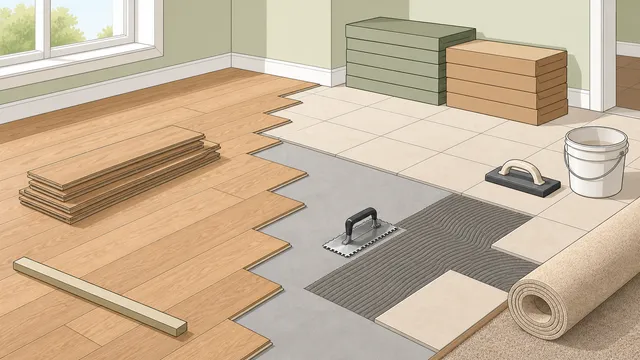
Estimate flooring square footage, net coverage area, planks, tiles, carpet square yards, roll length, box count, grout, thinset, waste.
Construction / Flooring
Flooring Calculator
Estimate flooring square footage, net coverage area, planks, tiles, carpet square yards, roll length, box count, grout, thinset, waste.
Construction / Flooring
Flooring Calculator
Estimate flooring square footage, net coverage area, planks, tiles, carpet square yards, roll length, box count, grout, thinset, waste.
Home & DIY / Measurement / Area
Square Footage Calculator
Calculate square footage for rooms and spaces with rectangle, L-shaped room, circle, triangle, and trapezoid formulas, plus repeated-room totals, custom waste.