

How to Scale a Recipe Up or Down Without Ruining It
Scale recipes with more confidence by adjusting ingredients, converting cups to grams, and checking oven settings before bigger or smaller batches go wrong.
I once tried to triple a banana bread recipe for a school bake sale. In my head, the maths was simple: three times the bananas, three times the flour, three times the sugar, done. What I ended up with was two loaf tins of something that looked like it had been sat on, and one that was somehow still raw in the middle despite forty-five minutes in the oven. My youngest, Rosie, took one look and said, “Mum, that’s not bread. That’s a science experiment.” She wasn’t wrong.
The thing is, scaling a recipe is not just about multiplying numbers. There are ingredients that do not scale neatly, oven temperatures that need adjusting for bigger batches, and conversions to wrestle with when you’re following an American recipe with a British kitchen. After years of feeding a family of five, plus the inevitable extra kids who appear at dinner time, I have learned a few things about getting scaling right, and I have got the bin full of failures to prove it.
If you are trying to work out how to scale a recipe up or down, the good news is that most disasters come from the same few mistakes. People either scale the wrong ingredients too aggressively, switch units halfway through, or forget that pan size and oven behaviour matter just as much as the ingredient list. Once you know where those traps are, the whole thing gets much less intimidating.
Why don’t recipes always scale neatly?
Most home cooks assume that doubling a recipe means doubling every single ingredient. For straightforward things like pasta sauce, chilli, or soup, that often works beautifully. But baking is chemistry, and chemistry is not especially interested in your bake sale deadline.
Leavening agents like baking powder and bicarbonate of soda are the biggest troublemakers. If you double the flour in a cake recipe, you often need less than a full doubling of the leavener. Too much and the cake rises aggressively, then collapses in the middle like a deflated bouncy castle. I learned this the hard way with a Victoria sponge that could have doubled as a frisbee.
Salt and strong flavours are another trap. When you scale up a savoury dish, go gently on the salt at first because you can always add more later. Garlic, chilli, vanilla, and concentrated spices can become far more assertive at larger volumes than your tidy multiplication suggests. A stew or curry can usually be corrected by tasting as you go. A cake batter cannot.
Eggs are where people start muttering at the countertop. Halving a recipe with one egg, or scaling a batch by 1.5, can feel fiddly. In practice, it is manageable if you beat the egg first and measure by weight or by spoonfuls. That matters far more in baking than in a loose savoury dish. One extra egg white or yolk can change structure, moisture, and richness more than you expect.
How do you scale ingredient quantities properly?
Rather than standing in the kitchen doing mental arithmetic with flour on your hands, and inevitably getting it wrong, a recipe scaler does the heavy lifting for you. Pop in your original quantities, tell it how many servings you need, and let it figure out the new amounts.
I use one of these every single week for meal prep. When I’m making my chicken and broccoli pasta bake for four lunches instead of one family dinner, it saves me from the napkin maths that once resulted in a pasta bake the size of a small bathtub.
Scale ingredient quantities with the Recipe Scaler before you start mixing:
Ingredients
Scaled Recipe
Scale factor: ×2 (4 → 8 servings)
Once you have the scaled numbers, pause before you treat every line as gospel. For soups, braises, sauces, and traybakes, proportional scaling is often enough. For cakes, muffins, breads, and biscuits, treat the result as a very good draft rather than a sacred text. Check the eggs, leaveners, salt, and strong flavours before you commit.
This is also where portion planning actually becomes useful. If the original recipe serves 4 and you need 6, doubling it is often the wrong move. A factor of 1.5 may be the sensible answer, and that is exactly the kind of awkward middle-ground batch the scaler handles well. Most real family cooking happens in the land of “a bit more” or “a bit less”, not pristine doubles and triples.
If you are cooking for a party, lunchboxes, or freezer prep, ask yourself one more question after using the calculator: does the finished dish still fit the pot, tin, baking tray, or storage containers you plan to use? Quite a lot of scaling errors are really equipment errors wearing a maths hat.
Why do cups-to-grams conversions go wrong?
Here is a confession: I spent the first three years of my cooking life thinking a cup of flour was just a cup of flour. Whatever fit in the mug. No one told me that American cups are a standardised volume measurement, and that a cup of flour weighs something very different from a cup of sugar, which weighs something very different from a cup of butter.
This becomes a real headache when you’re following recipes from American food blogs, which, let’s be honest, is a lot of them. A cup of all-purpose flour is often treated as roughly 120 to 125 grams, but a cup of brown sugar is much heavier because it packs down. A cup of oats is lighter again. These differences add up fast, especially in baking where precision actually matters.
My eldest, Tom, once made cookies for his football team using a recipe he found online. He measured everything in mugs, which in fairness is what I used to do, and the cookies came out flat as pancakes. “They’re supposed to be chewy,” he protested, while we both stared at what were essentially sweet biscuit frisbees. A proper cups-to-grams conversion would have saved him and probably his teammates’ dental work.
If you’re converting between cups and grams, use the Cups to Grams Converter to avoid density mistakes:
Quick kitchen amounts
Cup system
236.588 ml, used by most US recipes and baking charts.
Ingredient source
Result
125 grams
1 cup of all-purpose flour weighs 125 g using the us cup standard.
- Ounces
- 4.41 oz
- Tablespoons
- 16 tbsp
- Teaspoons
- 48 tsp
- Millilitres
- 236.59 ml
- Density
- 125 g/cup
- Cup system
- US
Kitchen fraction sheet
Quick weights for all-purpose flour using the us cup standard.
1/4 cup
31.25 g
1/3 cup
41.67 g
1/2 cup
62.5 g
3/4 cup
93.75 g
1 cup
125 g
1 1/2 cups
187.5 g
2 cups
250 g
Cup-system comparison
Same ingredient and same cup count, but different recipe cup standards.
US cup
125 g
236.59 ml per cup
Metric cup
132.09 g
250 ml per cup
Australian cup
132.09 g
250 ml per cup
Common ingredient reference
| Ingredient | 1 US cup | 1 US cup |
|---|---|---|
| All-purpose flour | 125 g | 125 g |
| Bread flour | 130 g | 130 g |
| Cake flour | 114 g | 114 g |
| Whole wheat flour | 128 g | 128 g |
| Granulated sugar | 200 g | 200 g |
| Brown sugar (packed) | 220 g | 220 g |
| Powdered sugar | 120 g | 120 g |
| Butter | 227 g | 227 g |
| Milk | 245 g | 245 g |
| Water | 237 g | 237 g |
| Vegetable oil | 218 g | 218 g |
| Honey | 340 g | 340 g |
| Maple syrup | 315 g | 315 g |
| Rice (uncooked) | 185 g | 185 g |
| Rolled oats | 90 g | 90 g |
| Cocoa powder | 86 g | 86 g |
| Cornstarch | 128 g | 128 g |
| Salt (table) | 288 g | 288 g |
| Baking soda | 230 g | 230 g |
| Cream cheese | 232 g | 232 g |
| Sour cream | 230 g | 230 g |
| Yoghurt | 245 g | 245 g |
| Peanut butter | 258 g | 258 g |
| Chocolate chips | 170 g | 170 g |
| Shredded coconut | 85 g | 85 g |
| Almond flour | 96 g | 96 g |
| Walnuts (chopped) | 120 g | 120 g |
| Raisins | 150 g | 150 g |
Why density matters
A cup of flour weighs far less than a cup of honey because their densities are different. Always convert by ingredient, not by a single fixed ratio, for accurate baking and cooking results.
This is where a kitchen scale earns its keep. King Arthur Baking’s ingredient weight chart is a useful reminder that one cup is not one universal weight. Flour, sugar, oats, cocoa, butter, and honey all behave differently, which is why “just convert cups to grams” only works when you know the ingredient.
If you bake often, the best long-term habit is to write your favourite recipes down in grams once you have tested them successfully. It removes one layer of uncertainty forever. For casual cooking, rougher measuring is often fine. For baking, especially if you are scaling up or down, weight is calmer, tidier, and more repeatable.
What happens to oven temperature and cooking time?
When people scale a recipe, they focus on ingredients and forget about the oven entirely. But oven temperature matters, and it can make or break a bigger batch.
As a general rule, when you’re baking a larger quantity in a bigger tin, you often need slightly more time and sometimes a slightly gentler temperature. A deeper mass of batter or dough takes longer to heat through to the centre, and if you keep the original setup unchanged, you can end up with a burnt outside and a raw middle. Sound familiar? That was my triple banana bread disaster.
Then there is the conversion issue. My oven has a dial marked in Celsius, but plenty of recipes online still give temperatures in Fahrenheit. I cannot tell you how many times I have googled “350F in C” while something was already in the oven. It is about 176C, which most people round to 180C. Usually that is fine. Occasionally, for delicate bakes, it genuinely matters.
Fan ovens add another layer of confusion. If a recipe says 200C for a conventional oven, you will often want something closer to 180C in a fan oven because the moving air cooks more efficiently. My mum still ignores this and then acts surprised when her roast potatoes go from golden to charcoal in the blink of an eye.
Convert fan, Celsius, Fahrenheit, and gas-mark settings with the Oven Temperature Converter:
Region and temperature
Region sets the default oven temperature scale from your inferred locale. Use Gas Mark from the input unit list when a recipe gives a UK gas setting.
Common presets
Gas mark reference
| Gas Mark | °F | °C |
|---|---|---|
| 1 | 275 | 135 |
| 2 | 300 | 149 |
| 3 | 325 | 163 |
| 4 | 350 | 177 |
| 5 | 375 | 191 |
| 6 | 400 | 204 |
| 7 | 425 | 218 |
| 8 | 450 | 232 |
| 9 | 475 | 246 |
| 10 | 500 | 260 |
Once you have the converted temperature, think about the tin as well as the number on the oven dial. BBC Good Food’s cake-tin conversion guidance makes this point nicely: shape and depth change the way a bake cooks, even when the total batter amount looks sensible. A shallower traybake behaves differently from a deep loaf tin. A wider pan may bake faster at the edges. Scaling the ingredients correctly does not cancel that out.
That is why the right follow-up question is not just “What temperature?” but also “What am I baking this in, and how deep will it be?” If the scaled recipe looks dramatically deeper or thinner than the original, start checking for doneness earlier and be prepared to adjust.
What is the easiest checklist for scaling a recipe?
After years of trial, error, and feeding questionable baked goods to a very patient family, this is the checklist I use every time I scale a recipe:
First, decide how many servings you actually need. Sounds obvious, but I have lost count of the times I have doubled a recipe when I really only needed one-and-a-half times the quantity. The recipe scaler above handles fractional batches beautifully.
Second, convert your measurements before you start cooking. If the recipe is in cups and your scales are in grams, sort that out before your hands are covered in butter. Future you will be grateful.
Third, look hard at the ingredients that do not always scale cleanly: leaveners, eggs, salt, chilli, garlic, vanilla, and anything intensely concentrated. Those are the lines that deserve human judgment, not blind multiplication.
Fourth, check your pan or dish. Bigger batch does not just mean more mixture. It means different depth, different surface area, and often different baking behaviour.
Fifth, check your oven setting. Bigger batches, fan ovens, and unfamiliar temperature units all affect cooking time and temperature. Do not just set it and forget it.
Sixth, and this is the one I wish someone had told me ten years ago, write everything down. When you successfully scale a recipe, note the adjusted quantities, tin size, oven setting, and cooking time somewhere. I keep a battered notebook in my kitchen drawer that is worth more to me than half the cookbooks on the shelf.
Scaling recipes is one of those skills that seems intimidating until you have the right tools and a bit of practice. And honestly, even when it goes wrong, you usually end up with something edible. Usually. That triple banana bread was the exception, not the rule. Rosie still brings it up at least once a month, which is rude but not inaccurate.
Calculators used in this article
Cooking / Recipe Scaling
Recipe Scaler
Scale any recipe up or down by entering your original and target serving sizes — all ingredient quantities are recalculated proportionally in seconds.
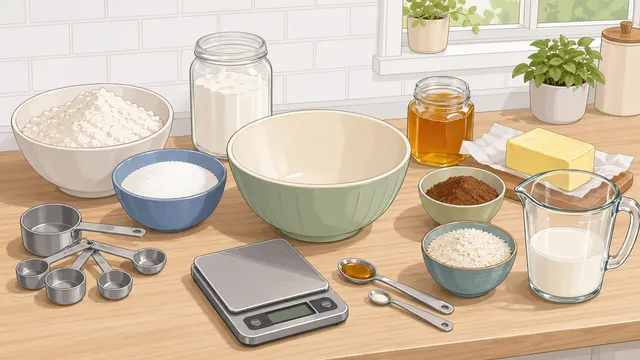
Converters / Cooking & Baking
Ingredient Converter
Convert cooking and baking ingredients between cups, tablespoons, teaspoons, millilitres, grams, ounces, pounds.
Converters / Measurement / Temperature
Temperature Converter
Convert Celsius, Fahrenheit, Kelvin, Rankine, Gas Mark, fan oven settings, weather temperatures, industrial scales.