

How Many Survey Responses Do You Need for Reliable Results?
Work out your survey sample size, confidence interval, and margin of error, then plan for response rates, subgroup reporting, weighting, and bias.
The question that trips everyone up
A few years ago, one of my tutoring students came in with a university assignment: design a survey to find out how students felt about the campus cafeteria. She had written thoughtful questions, tested the wording, even piloted it with flatmates. Then her supervisor asked, “How many responses do you need?” She looked at me and said, with the optimism of someone hoping maths might blink first, “I was hoping you would tell me fifty is enough.”
It is a fair hope. Fifty feels respectable. It fills a spreadsheet. It sounds more serious than “I asked a few people in the corridor”. But sample size is not about whether a number feels grown-up. It is about how much uncertainty you can tolerate, how mixed the opinions are likely to be, and whether you are trying to say something about 300 people, 3,000 people, or 3 million.
That is the part many people miss. Survey design is not only about writing good questions. It is also about deciding how sure you need to be before you act on the answer. Once that clicks, the three ideas that intimidate beginners most, sample size, confidence intervals, and margin of error, start to feel less like separate formulas and more like three ways of looking at the same trade-off.
How many survey responses do you need?
Sample size is simply the number of completed responses you need, not the number of invitations you send, not the number of people who open the link, and not the number who answer the first question before wandering off to make tea. That distinction matters because survey planning often goes wrong at exactly this point.
Three settings do most of the heavy lifting:
- Population size. If you are surveying a school of 500 students, the maths behaves differently than if you are surveying a city of 500,000. Once the population is very large, though, the required sample size starts to level off.
- Desired margin of error. This is the plus-or-minus band around your estimate. A tighter band needs more completed responses.
- Confidence level. Usually 95 percent. Higher confidence means a larger required sample because you are asking the method to miss less often.
There is also a fourth input hiding in plain sight: the expected proportion. If you do not know it yet, the cautious default is 50 percent, because that produces the widest uncertainty and therefore the largest required sample. In other words, it is the safe planning assumption.
For many everyday surveys, the first “aha” moment is discovering that the target is smaller than expected. With a large population, 95 percent confidence, and a 5 percent margin of error, the required sample is usually about 385 completed responses. That does not mean 385 is a magic number for every study. It means 385 is a common result under common assumptions.
Try your own setup with the Sample Size Calculator:
Use this sample size calculator to turn confidence level, margin of error, expected proportion, and response rate into a concrete survey target you can actually field.
Confidence level
Planning notes
Use 50% as the expected proportion when you do not have a prior estimate. That produces the most conservative sample size for proportion-based surveys.
The required sample size is the number of completed responses. If response rate is below 100%, plan for more invitations than completes.
Add completion rate when not every survey start reaches the final question, and use subgroup planning when each segment needs its own stable read instead of sharing one pooled sample.
Add a design effect when weighting, clustering, or complex survey design means your raw completes will behave like a smaller simple-random sample than the headline count suggests.
Result
385 responses
Required completed responses at 95% confidence with ±5% margin of error .
385
Completed responses
385
SRS baseline completes
1,540
Invitations to send
—
Survey starts needed
385
Infinite-pop. baseline
1.96
Critical z-value
50%
Expected proportion
Infinite
Population
SRS
Design effect
Population correction
None
Leave population blank for large audiences where the correction is negligible.
Sample share of population
N/A
For very large populations, sample size depends much more on confidence and margin of error than on total population.
Response-rate plan
25%
At this response rate, plan for about 1,540 invitations to achieve 385 completed responses.
Completion-rate plan
Optional
Use this when your survey has screener exits or drop-off between the first click and the final submit.
Subgroup planning
Optional
If each subgroup needs its own read, size the total sample above the single headline number shown at the top.
Design-effect inflation
Optional
Add design effect when clustering, weighting, or complex sampling means the survey will be less efficient than a simple random sample.
Interpretation
Using 50% keeps the estimate conservative, which is why the classic 95% / ±5% survey setup returns 385 completed responses for a very large population.
This calculator is for proportion-based surveys and polls. A/B tests, mean estimates, clustered samples, and complex weighting schemes need different sample-size or power-analysis methods.
Confidence-level planning
This comparison shows how the required completed responses and invitation volume change as you move between the common confidence levels while keeping the rest of the survey plan fixed.
| Level | Completed responses | SRS baseline | Invitations | Finite correction |
|---|---|---|---|---|
| 80% | 165 | 165 | 660 | — |
| 85% | 208 | 208 | 832 | — |
| 90% | 271 | 271 | 1,084 | — |
| 95% | 385 | 385 | 1,540 | — |
| 99% | 664 | 664 | 2,656 | — |
The highlighted row matches your current selection. Higher confidence levels require more completed responses and, when response rate is below 100%, more invitations.
Margin-of-error planning
Tightening precision is where survey costs usually jump. This table keeps the confidence level fixed and shows how fast the required completes rise as you ask for narrower error bands.
| Margin of error | Completed responses | SRS baseline | Invitations |
|---|---|---|---|
| ±2% | 2,401 | 2,401 | 9,604 |
| ±3% | 1,068 | 1,068 | 4,272 |
| ±4% | 601 | 601 | 2,404 |
| ±5% | 385 | 385 | 1,540 |
| ±7% | 196 | 196 | 784 |
| ±10% | 97 | 97 | 388 |
Moving from ±5% to ±3% usually needs about three times as many completes, which is why quick directional surveys and board-level decision surveys often use different fieldwork budgets.
What should you do with the result? First, read it as the number of completed responses you need, then convert it into a fieldwork plan. If the calculator says you need 370 completes and you expect only a 25 percent response rate, you do not need to invite 370 people. You need to invite about 1,480. That is the kind of quiet arithmetic that saves a project from coming back half-finished.
Second, notice when population size genuinely matters. If you are surveying nearly all 600 members of a professional association, the finite-population adjustment will trim the required sample because each extra response tells you a little more about a small, closed group. If you are surveying a national customer base, population size matters much less than people expect. In that setting, margin of error and confidence level are doing most of the work.
What should you do after the sample size calculator gives you a number?
This is the step that turns a neat classroom exercise into a usable survey plan. A sample size target is only useful if you can actually reach it with the audience, channel, and questionnaire you have.
Start with the invitation maths. Suppose you need 400 completed responses. If your past surveys usually get a 20 percent response rate, you should plan to contact around 2,000 people. If the survey is long, the audience is busy, or the topic is niche, be conservative. It is much easier to stop collecting once you have enough good responses than to invent another 150 people after the deadline.
Then think about subgroups before you launch. If you plan to report the results for first-year students, postgraduates, and staff separately, your full sample size is not the whole story. Each subgroup needs enough people inside it to support the claims you want to make. This is why an overall sample that looks healthy can produce wobbly subgroup charts. Pew, for example, treats very small effective subgroup samples with visible caution because they look more precise on a graph than they really are.
This is also where good survey design becomes more honest. If you only have budget for 250 completed responses, that may still be perfectly useful, but perhaps not for every question you hoped to answer. You might decide to accept a wider margin of error, focus on the full sample instead of subgroup breakdowns, or frame the study as directional rather than definitive. There is no shame in that. The mistake is pretending the data can carry more weight than it can.
What does a 95 percent confidence interval actually mean?
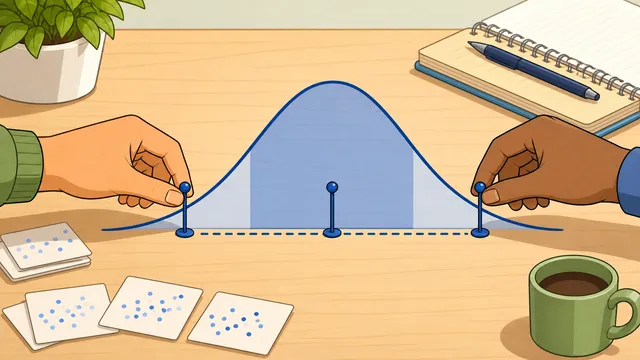
This phrase confuses smart people because ordinary language and statistical language are not having quite the same conversation. A 95 percent confidence interval does not mean there is a 95 percent probability that the true value lies inside the interval you computed from this one sample. It means the method you are using will capture the true value about 95 times out of 100 if you repeated the sampling process over and over.
I often explain it with a tutoring analogy. Imagine you are practising free throws. A good routine does not guarantee every shot goes in. It gives you a repeatable process that works most of the time. A confidence interval is similar: it is a statement about the reliability of the process, not a magical certainty attached to a single result.
In practical terms, a confidence interval gives you a plausible range for the population value. If 52 percent of your sample supports a proposal and the 95 percent confidence interval runs from 47 percent to 57 percent, the sensible reading is not “52 is the truth”. It is “52 is our best estimate, and values in the high forties to high fifties are all reasonably compatible with this sample.”
The width of that interval is driven by the same forces that drive sample size planning. More data narrows it. Greater variability widens it. A near 50-50 split creates the broadest uncertainty, which is why that scenario is used so often in planning formulas.
Test different sample sizes and proportions with the Confidence Interval Calculator:
Use z when population σ is known or n is large; use t when the entered standard deviation is from the sample.
Confidence interval sheet
48.04 to 51.96
95% mean interval. This page uses the standard large-sample z-interval for a mean, which is best when the population standard deviation is known or the sample is large enough for the normal approximation.
48.04
Lower bound
51.96
Upper bound
±1.96
Margin of error
| Confidence interval | (48.04, 51.96) |
| Sample mean | 50 |
| Sample size | 100 |
| Standard error | 1 |
| Interval width | 3.92 |
| Working formula | 50 ± 1.96 × (10 / √100) |
| Critical z-value | 1.96 |
Confidence-level comparison
Holding the same mean, standard deviation, and sample size constant, higher confidence widens the interval.
| Level | Lower | Upper | Margin | Width | Critical value |
|---|---|---|---|---|---|
| 80% | 48.72 | 51.28 | ±1.28 | 2.56 | 1.28 |
| 85% | 48.56 | 51.44 | ±1.44 | 2.88 | 1.44 |
| 90% | 48.36 | 51.64 | ±1.64 | 3.29 | 1.64 |
| 95% | 48.04 | 51.96 | ±1.96 | 3.92 | 1.96 |
| 99% | 47.42 | 52.58 | ±2.58 | 5.15 | 2.58 |
Precision planning
Holding the sample mean and standard deviation fixed, larger samples shrink the margin of error roughly with the square root of n.
| Sample size | Lower | Upper | Margin | Width |
|---|---|---|---|---|
| 100 | 48.04 | 51.96 | ±1.96 | 3.92 |
| 200 | 48.61 | 51.39 | ±1.39 | 2.77 |
| 400 | 49.02 | 50.98 | ±0.98 | 1.96 |
After you use the calculator, pay attention to how quickly the interval changes when you shrink the sample. That is usually the second “aha” moment. Moving from 1,000 responses to 500 does not make the estimate useless, but it does make the range around the estimate visibly wider. The reader now has more wiggle room to reckon with.
Also notice what happens with subgroup analysis. An overall survey may have a neat-looking confidence interval, while a subgroup inside it, say, respondents under 25 or customers in one region, has far fewer observations and therefore a much wider interval. This is one of the easiest ways to over-interpret a chart. The bars or percentages may look clean; the uncertainty underneath is not.
What is margin of error, and when does it help?
Margin of error is the compact, report-friendly version of the confidence interval. If your estimate is 52 percent and the margin of error is plus or minus 3 points, the corresponding interval is 49 percent to 55 percent. It is half the width of that interval, which is why people quote it so often in news stories, dashboards, and research summaries.
The best use of margin of error is as a brake on overconfidence. If two answers are separated by less than the margin of error, you should hesitate before declaring a meaningful lead. A result of 51 percent versus 49 percent with a 4-point margin is not a dramatic finding. It is statistical humility in numeric form.
There are two details worth remembering because competitors explain them and readers often need them. First, the published margin of error is usually the largest one, the version around a 50 percent estimate for the full sample. Second, it normally assumes a probability sample or something close to it. If your survey is an open link shared on social media, a margin of error can sound scientific without doing the job people think it does.
You can estimate your own survey precision with the Margin of Error Calculator:
Use this margin of error calculator to estimate poll or survey precision from sample size, confidence level, and expected proportion, then see how finite-population correction or design-effect inflation changes the interval you report.
Quick assumptions
Use 50% when you do not have a prior estimate. That gives the largest plausible margin of error for a proportion survey at the chosen sample size and confidence level.
Add population size only for closed populations where the sample is a meaningful share of the total. Add design effect only if weighting, clustering, or complex sample design means your raw sample behaves like a smaller effective sample.
Survey precision sheet
±4.99%
95% confidence interval: 45.01% to 54.99%. The result uses the standard simple-random-sample proportion margin-of-error formula.
±4.99%
Margin of error
45.01% – 54.99%
Confidence interval
385
Effective sample size
1.96
Critical z-value
Finite-population effect
Not applied
Leave population blank when the population is very large or unknown. That keeps the estimate slightly conservative.
Design effect
SRS
Under simple random sampling, the effective sample size matches the raw sample size.
Interpretation
50% ± 4.99%
If a poll result is reported at 50%, this setup implies a likely interval from 45.01% to 54.99% under the stated assumptions.
Confidence-level comparison
Holding the same sample settings constant, higher confidence widens the reported interval.
| Level | MOE | Interval | z |
|---|---|---|---|
| 80% | ±3.27% | 46.73% – 53.27% | 1.28 |
| 85% | ±3.67% | 46.33% – 53.67% | 1.44 |
| 90% | ±4.19% | 45.81% – 54.19% | 1.64 |
| 95% (selected) | ±5% | 45.01% – 54.99% | 1.96 |
| 99% | ±6.56% | 43.44% – 56.56% | 2.58 |
Sample-size sensitivity
Margin of error shrinks with the square root of n, which is why doubling the sample does not cut the uncertainty in half.
| Sample size | Effective n | MOE | Interval |
|---|---|---|---|
| 193 | 193 | ±7.05% | 42.95% – 57.05% |
| 385 (current) | 385 | ±5% | 45.01% – 54.99% |
| 770 | 770 | ±3.53% | 46.47% – 53.53% |
| 1,540 | 1,540 | ±2.5% | 47.5% – 52.5% |
Target-margin planning
Use these rows when the real question is how many completed responses you need for a target survey margin of error under the same confidence, proportion, population, and design-effect assumptions.
| Target MOE | Completes needed | Effective n | Achieved MOE | Current sample |
|---|---|---|---|---|
| ±10% | 97 | 97 | ±9.95% | Meets target |
| ±5% | 385 | 385 | ±5% | Meets target |
| ±3% | 1,068 | 1,068 | ±3% | Needs more completes |
| ±2% | 2,401 | 2,401 | ±2% | Needs more completes |
Use the result as a reporting tool, not as a badge of virtue. A margin of error of plus or minus 3 points tells you about random sampling variation. It does not rescue a biased sample, a misleading question, or a low-quality contact list. As Pew and other methodology-focused groups repeatedly point out, sampling fluctuation is only one source of error.
This is also where weighting and effective sample size matter. If a survey needs heavy weighting to resemble the target population, the effective sample can be smaller than the raw number of completes suggests. To a beginner, 1,000 responses sounds precise. To a survey researcher, the next question is often, “How many usable responses do those 1,000 behave like after weighting?”
Why can a survey still be wrong with a tidy margin of error?
Because randomness is not the only thing that can go wrong.
The clean textbook story assumes a simple random sample, good coverage of the target population, clear wording, and honest answers. Real surveys are messier. People ignore invitations. Some groups respond more readily than others. A question that sounds neutral to the writer can feel leading to the reader. Even the order of questions can shift how people answer.
That is why a narrow margin of error should never be read as a blanket guarantee of truth. A survey can report plus or minus 2.5 points and still be badly off if the wrong people responded or if the questionnaire nudged them in one direction. In practice, non-response bias, self-selection, and bad measurement often matter more than the arithmetic beginners are told to fear.
The useful habit is to ask two questions together: “How precise is this estimate?” and “How trustworthy is the sample?” The first is where sample size, confidence intervals, and margin of error help. The second is where fieldwork, recruitment, weighting, and questionnaire design enter the picture.
How do sample size, confidence interval, and margin of error fit together?
These three ideas are really one structure viewed from different angles:
- Choose confidence level and margin of error and you can solve for the sample size you need.
- Collect a fixed sample size and you can estimate the margin of error or confidence interval you ended up with.
- Report a confidence interval and readers can see both the estimate and the uncertainty in one line.
This is why the tools belong together. In planning mode, you start with the sample size calculator because you are deciding how much data to collect. In analysis mode, you often move to the confidence interval or margin of error calculator because you already have the responses and need to describe their precision honestly.
Once you see the triangle, research papers, polls, customer surveys, and internal questionnaires become easier to read. You stop asking “Is 300 a lot?” and start asking better questions: “300 for what population, under what confidence level, with what margin, for which subgroup, and from what kind of sample?”
A practical survey planning checklist
If you want the shortest useful version of this whole article, it is this:
- Define the population you want to represent.
- Decide the confidence level you need, usually 95 percent.
- Choose a margin of error that matches the decision you are making.
- Use 50 percent as the planning proportion if you do not know the expected split.
- Convert required completes into invitations using a realistic response-rate assumption.
- Check whether you need enough responses for subgroups, not just the total sample.
- Remember that margin of error only covers sampling error, not every kind of survey mistake.
That was the point my student eventually reached. She did not just learn that about 350 to 380 responses could be enough for her campus project. She learned why that number depended on the precision she wanted, the population she cared about, and the kind of claim she was planning to make. That is the real mathematical payoff. Not memorising one formula, but learning how to ask the better question before you launch the survey.
Calculators used in this article

Math / Statistics
Sample Size Calculator
Estimate the required completed survey responses for proportion-based surveys from confidence level, margin of error, expected proportion.
Math / Statistics
Confidence Interval Calculator
Calculate confidence intervals for means or proportions from sample statistics and confidence level, with z or t mean intervals, margin of error, Wilson checks.

Math / Statistics
Margin of Error Calculator
Use this margin of error calculator to estimate survey precision from sample size, confidence level, and expected proportion.