Calculate true aquarium volume in litres, US gallons, and UK gallons after glass, bow-front shape, fill level, substrate, decor, and water-change adjustments.
Last updated
Tank worksheet
Estimate true aquarium water volume for dosing, heater sizing, filter selection, and stand-load planning.
The worksheet can start from outside tank dimensions or from the inside water-holding size you already know.
Quick setups
Tank shape
Measurement basis
Units
Water type
Net water volume
47.9 L
Use this net volume for dechlorinator, medication, fertiliser, heater, and water-change planning.
Gross tank size is useful for shopping; net water volume is the number that matters in day-to-day care.
Gross internal volume
70.8 L
Filled before displacement
64.9 L
Net US gallons
12.7
Net UK gallons
10.5
Total displacement
17.0 L
Water weight
47.9 kg
105.6 lb at 1.000 kg/L
Tank dimensions after deductions
Internal length: 30.0 in. Internal width: 12.0 in. Internal height: 12.0 in. Filled water height: 11.0 in.
Planning notes
Net water is 67.7% of gross internal capacity after the chosen fill gap,
substrate depth, and decor displacement. Substrate contributes 11.8 L of that
reduction and decor contributes 5.2 L.
Water-change amounts
Use these net-volume amounts for routine water changes, conditioner dosing, and reef or planted-tank maintenance notes.
Change
Litres
US gal
UK gal
10%
4.8 L
1.3
1.1
20%
9.6 L
2.5
2.1
25%
12.0 L
3.2
2.6
30%
14.4 L
3.8
3.2
50%
24.0 L
6.3
5.3
Use net water volume for care decisions Dose conditioners and medications against the net water result, not the marketing size on the tank label.
For stand or floor-load checks, add glass, substrate, rock, cabinet, and equipment weight on top of the water figure.
Aquarium volume calculator: usable water volume accounting for glass and substrate
The volume printed on an aquarium box refers to the gross tank capacity, not the actual water volume your fish will live in. This page also explains the main assumptions behind the aquarium volume calculator result, highlights the supporting figures shown by the calculator, and helps the reader use the estimate without overstating what a quick online tool can prove.
How aquarium volume is calculated
Starting with external dimensions, the calculator deducts glass thickness from each horizontal axis (two panels on length, two on width) and one panel thickness from the height (the floor panel). This gives internal length, internal width, and internal height.
Substrate depth is then subtracted from internal height to give the water column height. The usable water volume is: Internal Length × Internal Width × Water Column. The result in cubic centimetres is divided by 1,000 to convert to litres.
Real setups usually reduce water volume in more than one way. Many tanks are not filled right to the rim, especially if they have lids, braces, surface agitation, or an aquascape that would splash easily. Hardscape such as rock piles, large wood pieces, and internal backdrops also occupies water space, which is why a practical fish tank gallons calculator should separate gross internal capacity from the net water volume you actually dose and maintain.
This page supports both rectangular aquariums and cylindrical tanks. If you already know the inside water-holding dimensions, you can switch to internal measurements and skip the glass-thickness deduction. If you only know the outside tank size, the calculator handles the panel deduction first and then applies the fill-gap, substrate, and decor adjustments in sequence.
Rectangular gross internal volume = Internal length x Internal width x Internal height
Use the inside dimensions of the tank body after any glass-thickness deduction when starting from outside measurements.
Rectangular net water volume = Internal length x Internal width x (Filled height - Substrate depth) - Decor displacement
This conservative estimate starts from the chosen fill line below the rim, then deducts substrate and any extra occupied volume from rock, wood, or other decor.
Cylindrical volume = pi x (Internal diameter / 2)^2 x Height
The same planning steps apply to cylindrical tanks once the circular footprint area has been calculated.
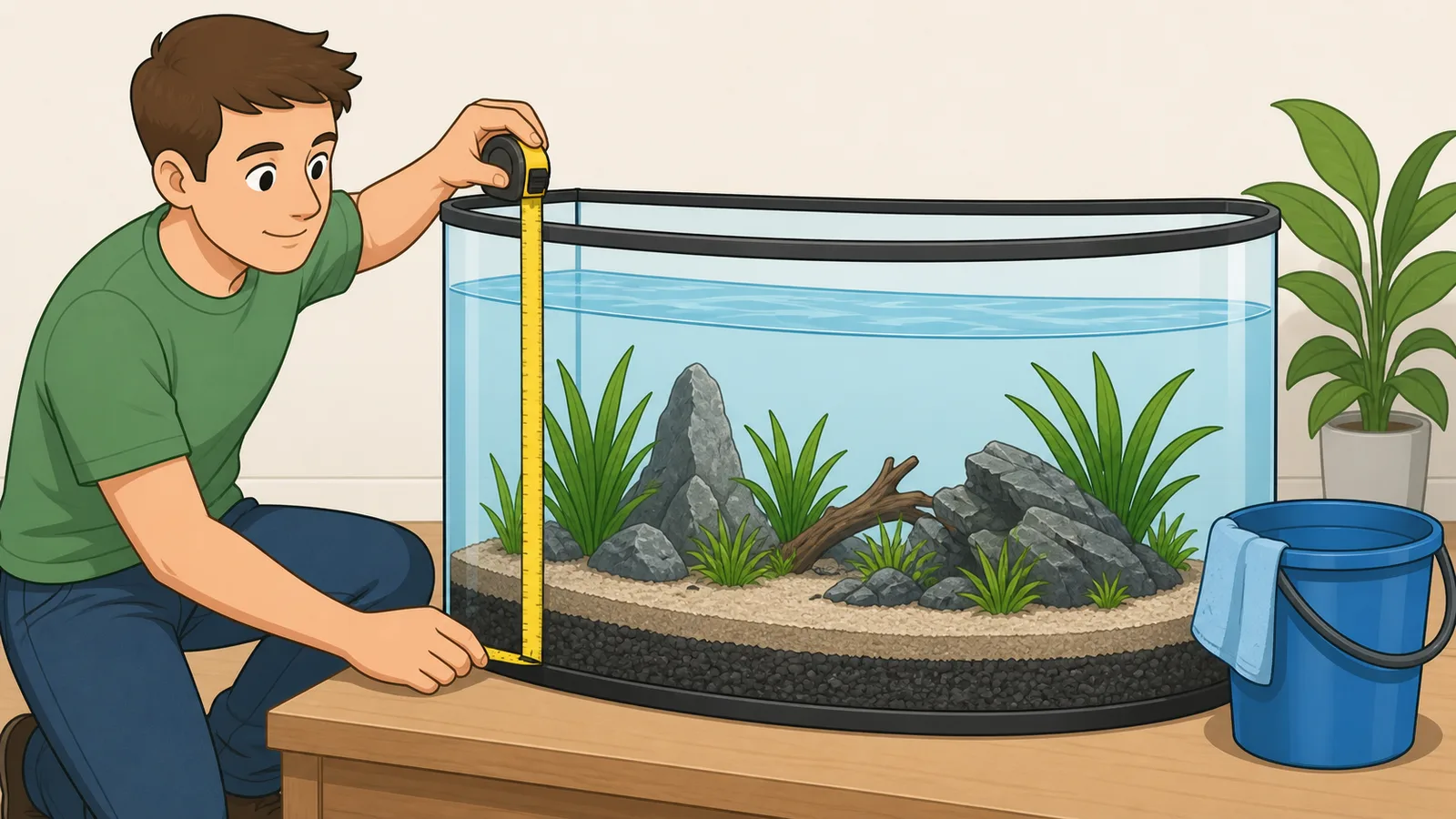
Bow-front footprint = Internal length x straight depth + (pi x internal length x bow depth) / 4
Approximates the curved front as a half-elliptical bulge added to the rectangular back section before height, fill gap, substrate, and decor deductions are applied.
Bow-front tanks, quick setups, and water-change planning
Competitor aquarium volume tools often include bow-front shapes because a curved front panel can add a meaningful amount of capacity compared with the same straight rectangular footprint. This calculator models a bow-front aquarium as a rectangular back section plus a half-elliptical front bulge. Measure bow depth from the flat front line to the deepest point of the curve, not from the back wall to the front tip.
Quick setups help avoid blank-page friction when you are checking a familiar tank size. A 20 gallon long, reef cube, bow-front community tank, or cylindrical column can be loaded first, then adjusted to match the real dimensions, fill gap, substrate depth, and hardscape displacement in front of you. That makes the calculator useful for quick fish tank gallons checks as well as more careful net water volume planning.
The water-change table turns the net water volume into practical maintenance amounts. A 25% water change on the actual water volume is often materially different from 25% of the box size, especially in planted tanks, reef aquariums, and aquascapes with deep substrate or heavy rock. Using the net figure keeps conditioner, salt mix, fertiliser, and medication planning closer to the water your livestock actually occupies.
Use the rectangular setup for standard glass boxes, rimless cubes, and tanks whose front and back panels are straight.
Use the bow-front setup when the front panel curves outward and you can measure the extra curve depth.
Use the cylindrical setup for column tanks, round desktop aquariums, and vertical circular displays.
Use the water-change rows for maintenance buckets, conditioner dosing, and saltwater mixing targets.
Glass thickness and structural safety
Standard glass thickness ranges from 4 mm for small tanks up to 15 mm or more for large display aquariums. The glass thickness should match the tank height and volume — thinner glass in a tall tank creates unacceptable pressure on the seams. Always check the manufacturer’s specification; this calculator is for volume estimation only and does not assess structural safety.
If you measure the inside pane-to-pane distance, do not deduct glass a second time. If you measure the outside of the tank, the panel deduction matters most on smaller aquariums because a few millimetres of glass can remove a noticeable share of usable width and length. The same principle applies to acrylic tanks, even though the panel thickness and joint design differ from framed glass aquariums.
The fill gap below the rim matters for overflow safety and for equipment such as spray bars, hang-on-back filters, and lids. Two tanks with identical gross internal dimensions can end up with different working water volumes if one runs close to the top and the other intentionally leaves more headspace for maintenance access or wave action.
Stocking and filtration implications
Knowing the actual water volume is important for correct filtration sizing, heater wattage, and stocking density. The common guideline of 1 cm of fish per litre of water is a rough heuristic; in practice, bioload, feeding level, and filtration capacity matter more.
Chemical dosing for treatments, dechlorinators, and plant fertilisers must be calculated against water volume, not tank volume. Using the gross tank volume as a basis will result in over-dosing.
Net water volume is also the better starting point for water-change planning. If a tank holds 126 litres of real water and you perform a 25% change, the working target is about 31.5 litres, not 25% of the label size printed on the box. The same logic applies to estimating how much filter media turnover, circulation, and heater output your setup really needs.
Water weight is another practical planning number. Freshwater weighs about 1 kilogram per litre, and saltwater weighs slightly more at normal marine salinity, so even a moderate aquarium can add a substantial load before you include the cabinet, glass, substrate, rock, and equipment. That does not turn this page into a structural engineering tool, but it does help you sanity-check whether a planned setup is in the right range before you load a stand or upper floor.
Use gross internal volume for shopping and label comparison.
Use net water volume for dosing, stocking estimates, and maintenance math.
Use water weight only as one part of the total setup load, not the whole stand or floor calculation.
Fill level, hardscape displacement, and dosing accuracy
A common reason aquariums are overdosed is that the owner uses the nominal tank size instead of the real water volume after aquascaping. Deep substrates, dense planted layouts, and heavy rockwork can remove a meaningful amount of water from a tank, particularly in nano tanks where every litre matters more. This calculator therefore separates the fill-line reduction from the occupied-space reduction so you can model both parts openly instead of hiding them in one guessed number.
The substrate deduction is intentionally conservative because it treats the substrate layer as displaced volume. In reality, porous gravels and aquasoils contain void spaces that still hold some water. That means the true net water volume may be a little higher than the estimate shown here, while solid decor such as dense rock can remove water more directly. The goal is not to pretend perfect precision; it is to give you a transparent planning figure that is safer than dosing against the full packaging volume.
If you are calculating conditioner or medication for a livestock tank, start with the net water result and then adjust further if you know that sump chambers, rear filter compartments, or separate refugium sections add extra water. If you are comparing off-the-shelf aquariums, use the gross and filled values together: the gross number tells you what the manufacturer is roughly selling, while the net number tells you how that setup behaves once it is actually running.
Further reading
NIST — SI Units: Volume — NIST reference for exact litre, millilitre, and cubic-unit relationships used in the aquarium volume conversions.
Why is my aquarium volume lower than the size on the packaging?
Manufacturers typically state the gross tank capacity — the maximum volume if filled to the brim with no glass deduction. Actual water volume is always lower once glass thickness, substrate, and a safe water level below the rim are accounted for. If you also have large rocks, driftwood, or an internal background, the water available to fish and dosing can be lower again.
How much substrate do I need for my aquarium?
A substrate depth of 5–7 cm is typical for many planted tanks, though shallow decorative beds and deep-rooted aquascapes can sit outside that range. Multiply the internal length by the internal width by the desired depth in centimetres to get the bulk substrate volume in cm³, then divide by the material density to estimate purchase weight. Remember that the calculator treats substrate as displaced water volume for a conservative dosing estimate, but porous substrates still contain some water between grains.
Does this calculator work for marine (saltwater) aquariums?
Yes — the geometry is the same regardless of water type, so the litres and gallons are calculated in the same way. The saltwater toggle changes only the approximate water-weight output because marine systems are slightly denser than freshwater systems at normal reef salinity. That helps when you want a more realistic setup-weight estimate for a reef tank or marine fish-only system.
Should I measure the inside or outside of the tank?
Use inside measurements if you can measure the actual pane-to-pane water-holding dimensions easily. Use outside measurements if that is what you have from the tank listing, label, or a tape measure around the exterior. The calculator supports both approaches; the key is not to deduct glass thickness twice.
How do I calculate a bow-front aquarium volume?
Treat the tank as a rectangular back section plus the curved bow-front section. The calculator approximates the bow as a half ellipse, using rectangular footprint plus (π × length × bow depth) / 4 before multiplying by the working water height. Measure bow depth from the flat front line to the deepest point of the curve, then still deduct fill gap, substrate, and decor displacement for net water volume.
How much water do I change for a 25% aquarium water change?
Use 25% of the net water volume, not 25% of the labelled tank size. If the calculator shows 120 litres of net water, a 25% change is 30 litres. If it shows 30 US gallons of net water, a 25% change is 7.5 US gallons. The built-in water-change table calculates common percentages from the adjusted water volume automatically.