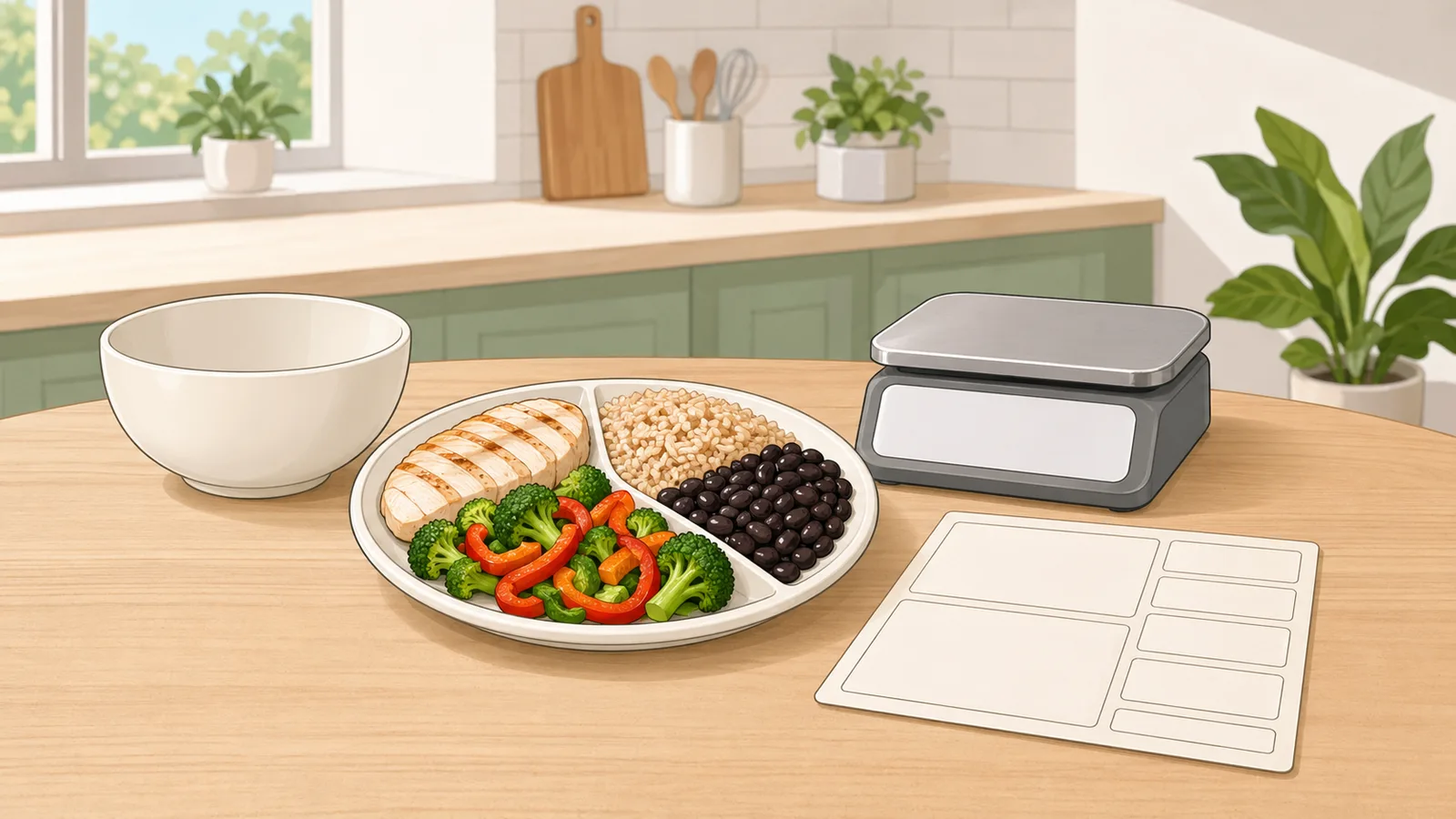
Use a carb counting calculator to scale label carbs by serving size, convert meal totals into carb choices, estimate no-label meals from 15 g carb choices.
Health estimate
Topic review: Maria Santos
Diet & Lifestyle Coach. Assigned as the health topic reviewer for nutrition, macro, calorie, and lifestyle diet calculators.
Scale label carbs by serving size, count carb choices, and watch the running daily total
This carb counting calculator works like a label-first carbohydrate counter. Enter total carbs per serving and the amount you actually ate, then compare each meal or snack with your daily carb budget and a simple carb-choice guide.
Label-first carb counter Food labels usually list total carbohydrate per serving. This page multiplies that by servings eaten, converts the result into 15 g carb choices, and keeps a running remainder so you can see what the day still has room for.
Quick starts
Meals and snacks
No-label carb choice starters
If you do not have a nutrition label, add a starter based on 15 g carb choices, then rename it and adjust servings to match your portion estimate.
Daily carb total
150 g
10 carb choices against a target of 180 g
(12 choices).
Remaining budget
30 g
2 carb choices
Average per entry
37.5 g
83.3% of the daily target logged
Main meals
135 g
3 entries · average 45 g
Largest entry
Dinner
60 g · 40% of the day
How to read the guide columns One carb choice is about 15 g of carbohydrate. With the current guide, main meals are compared with about 45 g and snacks with about 15 g. These are planning references, not a prescription.Use labels when you have them, choices when you do not Packaged foods should start with the Total Carbohydrate line and the serving size. Restaurant foods or homemade meals often need a 15 g carb-choice estimate first, then a portion adjustment after you compare the meal with your usual bowl, cup, plate, or weighed amount.One entry carries a large share of the day Dinner contributes about 40% of the total logged carbs. That is not automatically wrong, but it is a useful prompt if you are trying to spread carbs more evenly across meals.
Meal-by-meal carb sheet
Entry
Carbs / serving
Servings
Total carbs
Choices
Running remainder
Guide check
Breakfast
meal
15 g
2
30 g
2
150 g
15 g below guide
Lunch
meal
15 g
3
45 g
3
105 g
Near guide
Dinner
meal
30 g
2
60 g
4
45 g
15 g above guide
Snack
snack
15 g
1
15 g
1
30 g
Near guide
Daily distribution summary
Group
Entries
Carbs
Carb choices
Average
Main meals
3
135 g
9
45 g
Snacks
1
15 g
1
15 g
Whole day
4
150 g
10
37.5 g
Use total carbohydrate and portion size as a planning aid, not as a substitute for individualized diabetes education, insulin-dosing advice, or clinician-set meal targets.
Carb counting calculator guide: track carbs per meal, daily totals
A carb counting calculator helps you total carbohydrate grams across meals and compare them with a daily target. This page also explains the main assumptions behind the carb counting calculator result, highlights the supporting figures shown by the calculator, and helps the reader use the estimate without overstating what a quick online tool can prove.
Why meal-by-meal carb tracking matters
Carb counting is practical because it turns an abstract daily target into meal-by-meal choices. Instead of only asking how many carbs you ate by the end of the day, it helps you see where those carbs were distributed and whether they fit the plan you were trying to follow.
That is useful for general macro tracking, lower-carb eating, and blood-glucose-aware meal planning. It can also help explain why two days with the same total carbs may feel different depending on where those carbs were concentrated.
That distribution point is one reason a better carb counting calculator should not stop at a single daily total. A practical carbohydrate counter should also show how much one meal contributed, how many carb choices that meal represents, and what remains after breakfast or lunch if you are trying to spread carbs more evenly through the day.
How many carbs per meal is a common starting point?
There is no single per-meal carbohydrate number that fits everyone, which is why better carb-counting pages talk about meal structure rather than one magical target. Some diabetes meal-planning examples use 15-gram carbohydrate servings and then build meals from a certain number of those servings, while athletes and higher-calorie eaters may use much more carbohydrate at once.
The practical lesson is that carbs per meal should match the purpose. Someone using carb counting for glucose awareness, someone aiming for a moderate macro split, and someone fuelling endurance training may all use different meal totals even when each approach is perfectly reasonable in context.
For that reason, this page treats common 45-gram or 60-gram meal patterns as planning guides rather than rules. A carb counting calculator is most useful when it helps you compare your current meal pattern with a reference structure, not when it pretends every user should eat the same number of carb grams at every meal.
Carb counting for diabetes is more specialised than general tracking
This matters because “carb counting” can mean different things to different users. Some people are simply monitoring carbohydrate intake for awareness, while others use carbohydrate totals to support diabetes self-management and, in some cases, match mealtime insulin to food intake.
A general calculator can support awareness, but it cannot replace individual advice about insulin dosing, glucose targets, or carb goals set by a clinician or diabetes educator.
That difference is why the page stays focused on total carbohydrate, carb choices, and meal distribution rather than offering insulin-dose maths. For some users, a carb counting calculator is simply a meal-planning tool. For others, it sits inside a much more individualized diabetes-care process.
The total carbohydrate line on the label is usually the starting point
For many users, carb counting begins with the total carbohydrate line on a nutrition label, then adjusting for serving size and portion eaten. That approach is especially common in standard diabetes education because it keeps the counting method consistent across packaged foods.
Net carbs are discussed heavily in some low-carb communities, but they are not automatically interchangeable with total carbs in diabetes care, food labels, or meal plans. If your clinician or education programme says count total carbohydrate, that instruction should beat general internet shorthand.
This is also why label-first maths matters. If a package lists 24 grams of total carbohydrate per serving and you ate one and a half servings, the practical count is 36 grams, not 24. A carb counter that ignores portion scaling can understate the real meal total even when the label itself is accurate.
How to count carbs when there is no nutrition label
No-label meals are where carb counting gets more practical than mathematical. Diabetes education resources often teach people to estimate from food groups, measuring cups, food scales, restaurant nutrition pages, and familiar 15-gram carb choices rather than pretending every meal arrives with a perfect label.
That is why the calculator now includes no-label carb choice starters. A single 15-gram choice can represent a small fruit, a starch portion, or a milk/yogurt portion in many exchange-style lists, while a 45-gram meal can be built from three 15-gram choices. The starter is only a first estimate; the useful step is renaming the entry and adjusting the servings until it matches the portion actually eaten.
This also explains why homemade and restaurant meals need more caution than packaged foods. Cooked versus uncooked portions, sauces, mixed dishes, and shared plates can all change the final carbohydrate count. When the count affects medication decisions, use the calculator to organize the arithmetic but rely on your diabetes care plan, food database, or educator-led method for the actual estimate.
MiniMed — Carbohydrate counting — Describes nutrition labels, measuring tools, hand estimates, apps, and 15-gram serving methods for carb counting.
Why carb choices still help when labels already list grams
A carb choice is usually about 15 grams of carbohydrate. That may sound old-fashioned when labels already show grams, but the choice system is still useful because it gives a quick visual shortcut. A 45-gram lunch is about 3 carb choices. A 60-gram dinner is about 4. That makes meal comparisons easier than staring at a long list of gram totals all day.
This page keeps both views visible for that reason. The gram total is what you log from a label or estimate from a food list. The carb-choice view is what helps many users judge whether one meal or snack was light, moderate, or heavy compared with the structure they were aiming for.
Why running totals are more useful than an end-of-day surprise
Many carb counters only tell you the final number. A stronger carb counting calculator should also show what remains after each meal. If breakfast and lunch already used most of the day’s carb budget, that changes how useful the dinner number is.
Running totals matter because food decisions happen before the day is over. Knowing that lunch leaves 90 grams for the rest of the day is more actionable than only finding out at night that you went over. That is especially true when meals are irregular, snacks are easy to underestimate, or portion size drift is the real issue rather than food choice alone.
What this page does not measure
A carb-counting calculator usually totals grams, but it does not automatically judge food quality, glycaemic response, or gastrointestinal tolerance. Fibre, food processing, meal composition, and medication use can all influence how a meal behaves in real life.
That is why this page works best as a tracking aid. It gives structure, but it does not turn carbohydrate management into a complete care plan.
It also does not replace food databases, brand-specific label checks, or individualized education for insulin users. If carb counting is being used to guide medication decisions, the calculator should support that plan, not define it.
Frequently asked questions
How many carbs should I eat per meal?
There is no universal per-meal target. Some meal plans use carbohydrate servings of about 15 grams each and then assign a certain number of servings per meal, while other users plan around sport, appetite, or a broader macro target. The right meal total depends on why you are counting in the first place.
Is carb counting only for people with diabetes?
No. People also use it for lower-carb diets, sports nutrition, and general macro tracking. But diabetes-related carb counting can be more medically important because it may interact with medication and glucose management.
Should I count total carbs or net carbs?
That depends on why you are tracking. Many general carb-counting and diabetes-label approaches focus on total carbohydrate. Net carbs are more common in some low-carb communities, but they are not interchangeable in every context.
Can this page replace diabetes education?
No. If carbohydrate counting is being used to support insulin dosing or glucose management, a calculator like this should be treated as a helper tool, not as a substitute for professional diabetes education.
What should I do if I only eat part of a labelled serving?
Multiply the total carbohydrate on the label by the fraction you actually ate. For example, if one serving has 30 grams of carbohydrate and you ate half a serving, count 15 grams. If you ate one and a half servings, count 45 grams. That keeps the total aligned with the portion you actually consumed.
What is a carb choice?
A carb choice is a planning shortcut based on about 15 grams of carbohydrate. So a 45-gram meal is about 3 carb choices and a 60-gram meal is about 4. Some diabetes education materials still use carb choices because they make meal comparisons faster than reading raw grams alone.
Why does the calculator ask for carbs per serving and servings eaten instead of only total grams?
Because food labels usually list carbohydrates per serving, while real eating often involves half a serving, one and a half servings, or a larger portion than the label default. Multiplying carbs per serving by servings eaten is often the most reliable label-first way to avoid understating the meal total.
Can I use a carb counting calculator to dose insulin?
Not by itself. Carb counting may be part of insulin dosing, but insulin-to-carb ratios, correction factors, glucose targets, and mixed-meal effects are individualized. Use this page as a tracking and planning tool, not as a substitute for clinician-set dosing instructions.
How can I count carbs without a nutrition label?
Start with the best trustworthy estimate available: a food database, restaurant nutrition information, a diabetes food list, a weighed ingredient total, or a 15-gram carb choice reference. Then adjust for the portion you actually ate. The calculator's no-label starters are designed for this situation because they let you add 15 g, 30 g, 45 g, or 60 g estimates quickly and then rename or resize the entry.
Why does protein or fat matter if the calculator only counts carbohydrates?
Carbohydrate has the most direct role in the arithmetic on this page, but protein, fat, fibre, food processing, and meal timing can affect fullness and glucose response. That is why the result should be read as a carbohydrate-counting aid rather than a full prediction of what a meal will do in your body.