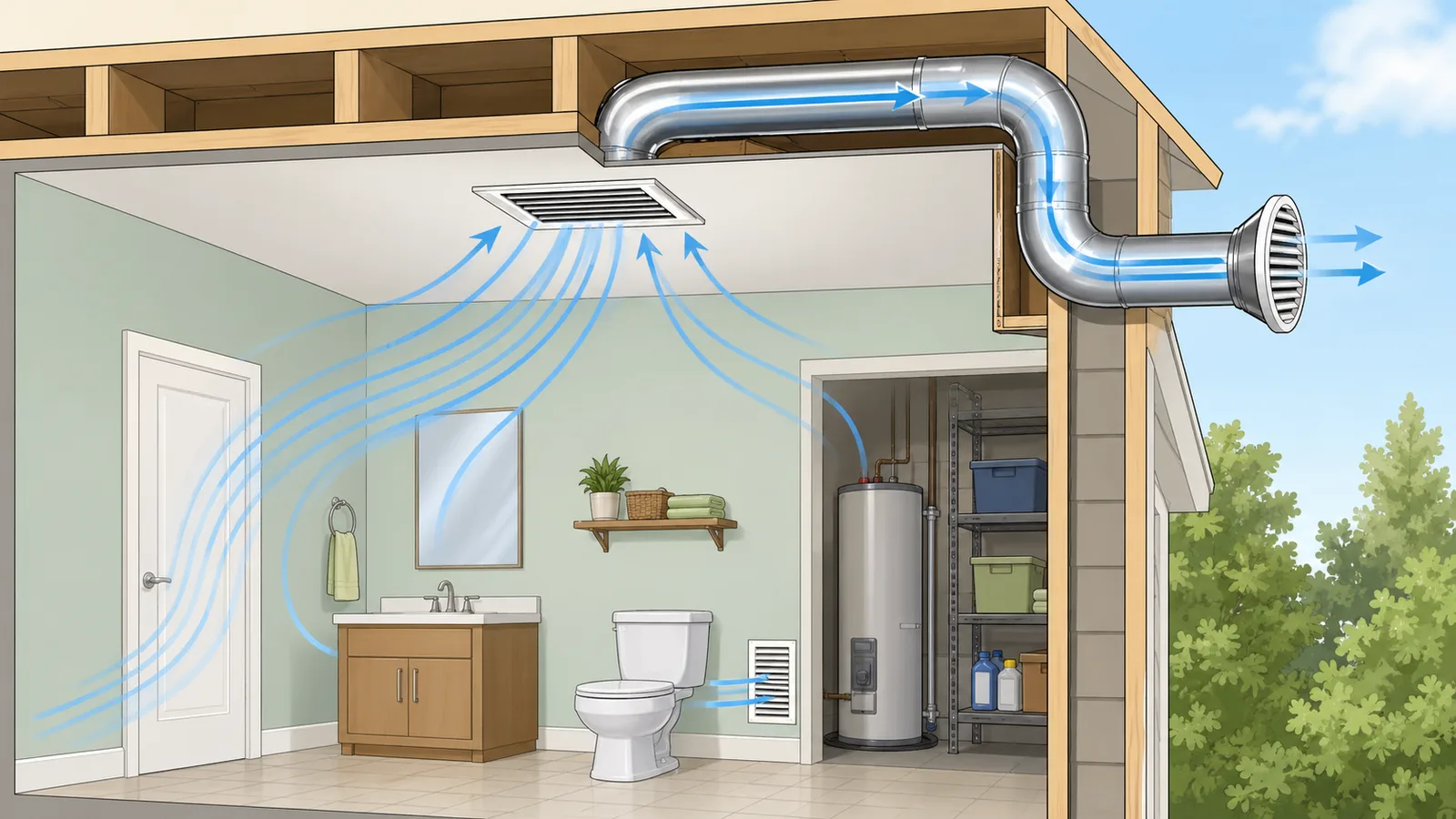
Calculate cubic feet per minute airflow for HVAC ducts, exhaust fans, or ventilation from room volume and ACH, then compare practical fan sizes.
Last updated
CFM calculator Estimate cubic feet per minute airflow from room volume and air changes per hour, then compare the result with optional round-duct velocity. This page is built for cfm calculator, cubic feet per minute calculator, hvac cfm calculator, fan cfm calculator, and calculate cfm for room intent, while keeping compressed-air and engine CFM conversions off the page.
Common ventilation scenarios
How to use this estimate
Best for: room ventilation screening, bathroom fan checks, kitchen and garage airflow planning, and round-duct velocity comparisons.
ACH first: room CFM is based on how often you want the room air replaced each hour.
Duct note: optional duct diameter does not change the CFM target; it shows whether that airflow looks calm or aggressive in the selected duct size.
Result
Estimated airflow requirement
320 CFM
That is about 0.8 CFM per square foot for this 400 sq ft room.
Planning fan size
320 CFM
Room volume
3,200 cu ft
ACH
6
Duct velocity
916.73 fpm
Velocity band
High velocity
Duct area
0.35 sq ft
Room airflow basis
The calculator uses room volume × ACH ÷ 60, so larger rooms and higher ventilation targets both raise the CFM requirement.
Duct comparison
The optional round-duct velocity shows whether the selected duct diameter looks calm, typical, or aggressive for the target airflow.
Interpretation
The current airflow is pushing a relatively high duct velocity, so noise and friction can climb unless the duct is enlarged.
Sizing checks to review
Selected duct diameter produces a high screening velocity; compare the duct size planner before choosing a fan or duct.
Common fan size
Planning status
50 CFM
Below target
80 CFM
Below target
100 CFM
Below target
110 CFM
Below target
150 CFM
Below target
200 CFM
Below target
250 CFM
Below target
300 CFM
Below target
320 CFM
Smallest practical match
400 CFM
Extra capacity
500 CFM
Extra capacity
600 CFM
Extra capacity
Duct sizing target
Required round duct
Suggested common duct
Quiet / low velocity (400 fpm)
12.11"
14" duct, about 299.34 fpm
Typical branch target (700 fpm)
9.16"
10" duct, about 586.71 fpm
Upper screening limit (900 fpm)
8.07"
10" duct, about 586.71 fpm
Round duct size
Velocity at current CFM
4" duct
3,666.93 fpm
6" duct
1,629.75 fpm
8" duct
916.73 fpm
10" duct
586.71 fpm
Sizing equation used
CFM = room volume × ACH ÷ 60
3200 × 6 ÷ 60 = 320 CFM
No extra room-type minimum is applied beyond the ACH calculation.
A CFM calculator estimates cubic feet per minute airflow from room volume and air changes per hour, then compares that airflow with optional round-duct velocity. This page is built for cfm calculator, cubic feet per minute calculator, hvac cfm calculator, fan cfm calculator, and calculate cfm for room intent, while keeping compressed-air and engine CFM conversions off the page.
What a CFM calculator actually solves
CFM means cubic feet per minute, which is simply airflow volume over time. On an HVAC page, people usually mean one of two related tasks. First, they want to know how much airflow a room needs. Second, they want to know whether that airflow makes sense in a certain duct size. Those are related questions, but they are not the same calculation.
That is why this page separates room airflow from duct velocity. The room side starts with room volume and air changes per hour. The duct side takes the resulting airflow and compares it with the cross-sectional area of a round duct. A good CFM calculator should make both sides visible so users do not confuse room demand with duct performance.
CFM = Room volume × ACH ÷ 60
Converts air changes per hour into cubic feet per minute airflow for a room.
Velocity (fpm) = CFM ÷ Duct area
Shows how fast the air moves through a chosen round duct size at the calculated airflow.
How ACH and room size turn into CFM
The first half of a room CFM calculation is room volume. Multiply length by width by ceiling height to get cubic feet. The second half is the ventilation target, usually expressed as air changes per hour. If a room has 960 cubic feet of air and you want 4 air changes per hour, the airflow is 960 × 4 ÷ 60 = 64 CFM.
That is why search phrases like calculate cfm for room, air change rate calculator, and cfm for room size point to the same core math. The room volume determines how much air is available to exchange, and ACH determines how aggressively you want to replace it.
Bathroom, kitchen, bedroom, and garage ventilation examples
Bathrooms often use higher spot ventilation than bedrooms because moisture control matters more than quiet background airflow. Kitchens often need stronger ventilation than bedrooms or garages because cooking creates heat, grease, and odor loads. Garages and utility spaces usually sit between those two extremes when you are only screening general ventilation.
These examples are why users search for bathroom exhaust fan calculator, bath fan CFM calculator, and calculate CFM exhaust fan. A small bathroom may already be near or above the common 50 CFM fan baseline once you convert the room volume through a realistic ACH target, while a larger kitchen can need much more airflow than its floor area alone would suggest.
Bathroom example: 8 × 10 × 8 ft at 8 ACH produces about 85 CFM
Kitchen example: 12 × 15 × 8 ft at 15 ACH produces about 360 CFM
Garage example: 20 × 20 × 9 ft at 6 ACH produces about 360 CFM
What duct velocity means after you know the CFM
Once you know the target airflow, duct size becomes a velocity question. The same 320 CFM can move calmly through a larger duct or very aggressively through a smaller duct. High velocity can increase noise and friction, while very low velocity can be less effective for some systems. That is why duct chart queries such as cfm chart for duct, duct size cfm calculator, and cfm duct chart are really asking how airflow and duct area interact.
This page does not replace a full duct design chart, but it does show whether the selected duct diameter looks calm, typical, or aggressive. That is often enough to decide whether an 8-inch duct is reasonable, whether a 6-inch duct is too small for the airflow target, or whether the fan selection and duct selection feel aligned.
Fan-size and duct-size decisions after the raw CFM
The raw CFM number is not always the number you should shop from. A bathroom calculation can produce a small airflow in a compact room, but a practical bathroom exhaust fan calculator should still respect the common 50 CFM baseline and round upward to a real fan size. That is why the calculator now separates calculated CFM from planning fan size.
The duct-size planner answers the next question users usually have after an HVAC CFM calculator result: what round duct size keeps velocity reasonable? Instead of making you copy the airflow into a separate cfm to duct size calculator, the page compares the same planning fan size against quiet, typical branch, and upper screening velocity targets.
Calculated CFM: the room-volume and ACH airflow result
Planning fan size: the rounded practical fan target after bathroom baseline checks
Duct sizing target: the round duct diameter needed for selected velocity bands
How many CFM do I need for a bathroom fan or exhaust fan?
A bathroom fan is one of the most common CFM questions because many people want a quick rule and a room-size cross-check. The familiar 50 CFM minimum is still a useful benchmark, but larger bathrooms or bathrooms with more demanding moisture loads often justify higher airflow. That is why a bathroom fan calculator should be able to compare room-volume math with the common minimums instead of choosing only one method.
The same logic applies to general exhaust fan sizing. If you already know the room volume and the desired air-change target, the calculator can give you a planning airflow. You can then round up to a practical fan size and check whether the connected duct diameter looks realistic.
What this CFM page does not cover
CFM can show up in many unrelated search clusters: compressed air, carburetors, SCFM to CFM conversion, and engine airflow. Those are not the same problem. This page is intentionally focused on room ventilation and simple round-duct velocity checks for HVAC and exhaust planning.
It also does not replace a full ductulator, static-pressure calculation, or code-specific whole-house ventilation design. Use this page to screen room airflow and fan size, then move to duct friction, equivalent length, or code-specific ventilation design if the job requires that level of detail.
When to use this estimate and what to do next
Use this page when you need a quick CFM target for a room, bathroom fan, kitchen exhaust concept, or simple HVAC ventilation check. It is especially useful when you want the room airflow and a first-pass duct-velocity sense in one place instead of bouncing between a room-volume calculator and a duct chart.
If the airflow target is high, the duct velocity looks aggressive, or the project is tied to code, noise limits, or longer duct runs, the next step is a fuller duct design and fan selection process. That is where static pressure, fitting losses, and manufacturer fan curves start to matter more than a room-volume screen.
Find the room volume in cubic feet, then multiply it by the desired air changes per hour and divide by 60. For example, a 960-cubic-foot room at 4 ACH needs 64 CFM. That is the core room-ventilation formula behind most HVAC CFM calculators.
What is the CFM formula?
For room ventilation, the formula is CFM = room volume × ACH ÷ 60. For duct velocity, the relationship is velocity = CFM ÷ duct area. Those formulas answer different questions, which is why this page shows both separately.
Is CFM the same as ACH?
No. ACH is air changes per hour, which is a ventilation target. CFM is cubic feet per minute, which is the airflow needed to hit that target in a specific room volume. ACH sets the goal, and CFM is the resulting airflow number.
How many CFM does a bathroom fan need?
A common baseline is 50 CFM, but larger bathrooms or stronger moisture loads can justify more. A room-volume-and-ACH calculation is useful because it shows whether the bathroom is near that baseline or meaningfully above it.
How many CFM do I need for a kitchen or garage?
Kitchens often need higher airflow because cooking adds heat, moisture, and odor load. Garages usually need more moderate ventilation unless a specific process is driving the airflow target. That is why the calculator uses different preset ACH assumptions for different room types.
What is the difference between room CFM and duct CFM?
The target CFM is the room airflow requirement. Duct CFM does not change that target. Instead, duct size determines how fast that same airflow moves through the duct. The room tells you how much air you need; the duct tells you whether the airflow path looks reasonable.
How do you calculate duct velocity from CFM and duct size?
First find the duct cross-sectional area, then divide the CFM by that area. If the duct is smaller, the same CFM produces higher velocity. That is why duct size charts and duct CFM calculators are really velocity checks built on top of the airflow target.
What duct diameter is reasonable for a given airflow?
There is not one perfect answer, but lower velocities usually mean quieter and less restrictive airflow, while very high velocities can signal more noise and pressure loss. This page helps by comparing the same CFM across several common round-duct diameters.
Can I use this as a bathroom exhaust fan calculator?
Yes. That is one of the best fits for this page. Use the bathroom preset or a custom ACH target, then compare the result with common fan sizes and optional duct velocity.
Why can the planning fan size be higher than the calculated CFM?
The calculated CFM is the room-volume and ACH result. The planning fan size rounds that result to a practical fan target and, for bathrooms, checks the common 50 CFM baseline. That prevents a small bathroom from producing a technically correct but underpowered fan recommendation.
How do I use CFM to choose a round duct size?
Use the duct size planner after the airflow result. It estimates the round duct diameter needed to keep the planning fan size near quiet, typical branch, or upper screening velocity targets. A final duct design still needs static pressure, fittings, equivalent length, and manufacturer fan data.
When should I use a duct chart instead of this calculator?
Use this calculator when you need the airflow target and a first-pass duct-velocity check together. Move to a fuller duct chart or ductulator when the job depends on fitting losses, static pressure, longer duct runs, or a final equipment selection tied to fan curves.