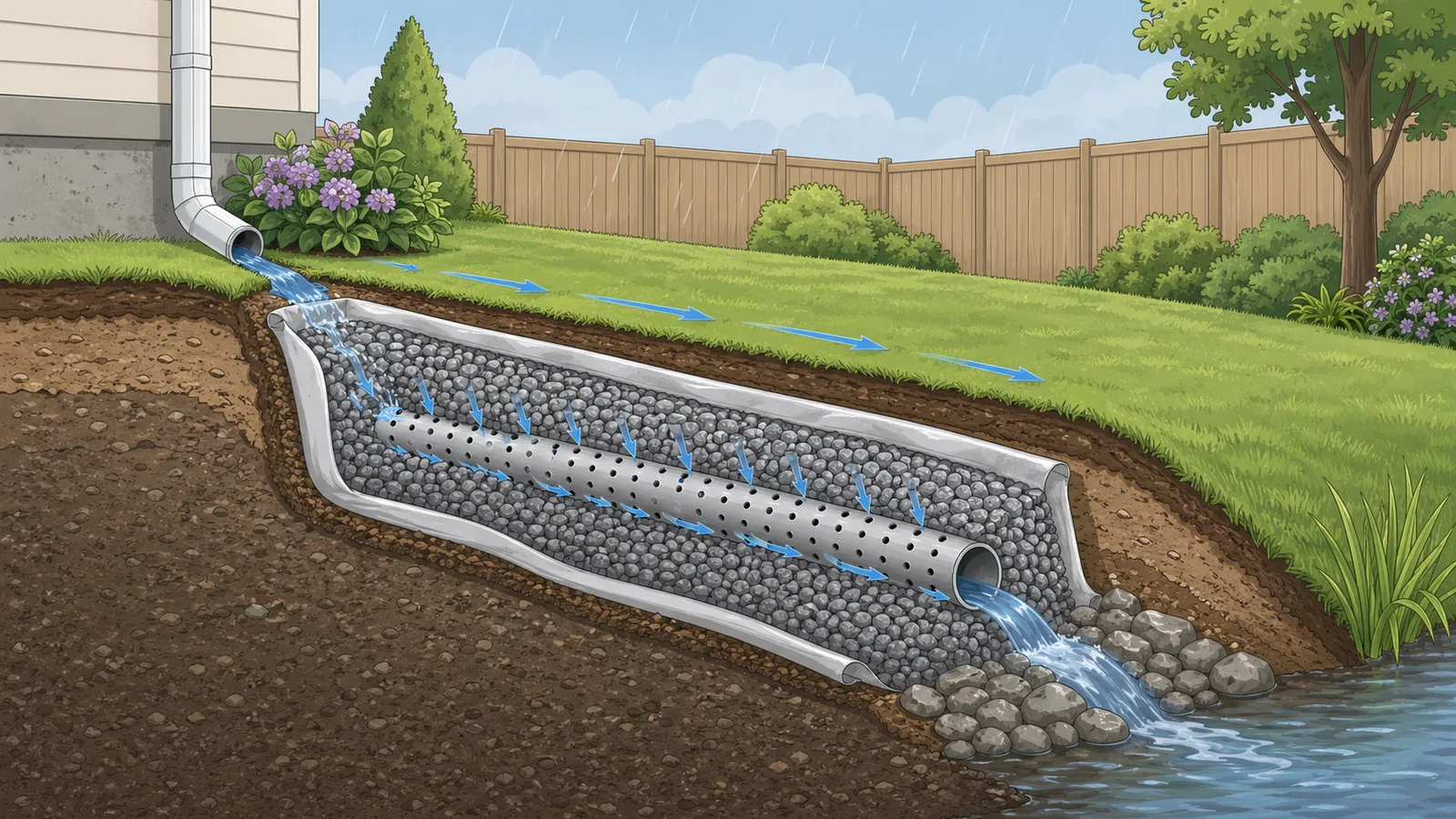
Estimate French drain gravel fill, bulk gravel weight, bag count, material cost, perforated pipe, filter fabric, excavation volume, cleanout access.
Last updated
French drain trench planner Estimate gravel fill, perforated pipe, filter fabric, excavation volume, and total slope drop from trench geometry, pipe size, and drainage run.
Quick French drain scenarios
Common perforated pipe sizes
Gravel order quantity
5.76 yd³
Excavation volume is
5.56
yd³, with
1
ft
of fall across the full run at
1% slope.
Perforated pipe
110 ft
11 sections
Filter fabric
550
ft²
Excavation volume
5.56
yd³
Total fall
1 ft
Bulk gravel weight
8.06
tons
311 small bags at the default bag volume.
Access points
3
Planning check at about every 50 ft on a straight run.
Material cost estimate
756.56
Includes entered gravel, pipe, and fabric unit costs only. It excludes excavation, fittings, outlets, delivery, labour, permits, and site restoration.
Drainage area context
This run serves about 10 ft² of drainage area per ft of trench.
Slope checkpoints for the same run
0.5% slope
0.5 ft
Total drop over the full trench length.
1% slope
1 ft
Total drop over the full trench length.
2% slope
2 ft
Total drop over the full trench length.
How to use this result
The gravel figure assumes the trench is filled with free-draining aggregate around the perforated pipe, with the pipe displacement removed from the material total.
Use the fall, cleanout spacing, bag count, and material-cost figures to compare trench layouts before ordering. Final pipe type, outlet detail, frost depth, and geotextile specification still need to be checked against the actual site design.
French drain gravel, pipe, fabric, and trench-fall planning
A French drain calculator turns trench geometry into a practical material list before you start digging. It estimates excavation volume, gravel fill, perforated pipe length, filter-fabric coverage, and total fall from the selected slope so you can compare the trench concept with the space available on site.
What this French drain calculator is estimating
A practical French drain estimate is more than just trench length. The material total depends on trench width, trench depth, perforated pipe diameter, the amount of filter fabric needed to wrap the aggregate, and the fall required to move water toward the outlet.
This calculator treats the trench as a simple rectangular excavation with a round perforated pipe. It subtracts the pipe displacement from the gravel fill so the aggregate total is closer to the material you actually need to order.
Core trench and gravel formulas
The excavation volume starts with trench length multiplied by trench width and trench depth. Gravel volume then removes the pipe cylinder from that trench volume before any waste allowance is added for trimming, spillage, and practical ordering.
Filter fabric coverage is estimated from trench width plus both trench walls plus the selected overlap. That gives you a rough wrap width multiplied by trench length, which is more useful for early roll planning than area alone.
Bulk gravel, bag count, and material cost planning
Many French drain gravel calculators stop at cubic yards or cubic metres, but ordering often happens in bulk weight, small bags, or a line-item material budget. This calculator therefore keeps the trench volume result and adds a density-based gravel weight, a small-bag planning count, and optional unit-cost inputs for gravel, perforated pipe, and filter fabric.
The density field is intentionally editable because washed drainage stone, pea gravel, crushed aggregate, and supplier-specific products can have different bulk weights. Use the default only as a planning placeholder, then replace it with the supplier's stated tons per cubic yard or tonnes per cubic metre before ordering.
Why slope matters
A French drain only works if the trench falls consistently toward its discharge point. The calculator converts the selected slope percentage into total fall over the entered trench length so you can see the drop you need to maintain in the field.
For example, a 100 ft run at 1 percent slope needs 1 ft of fall from start to finish. That is simple to say, but it is easy to miss once the trench starts turning, crossing grades, or tying into an outlet at a constrained elevation.
Outlet, cleanout, and access planning
A material list is only useful if the drain can still be built and maintained. The access-point estimate gives a simple straight-run reminder to think about cleanouts or inspection access at both ends and at practical intervals along longer runs.
That does not replace a site design. A drain with bends, silt-prone soil, tree roots, buried utilities, low outlet elevation, or multiple collection points may need more access points, solid pipe at the discharge section, catch basins, or a different layout altogether.
French drain calculator versus a generic gravel calculator
A generic gravel calculator can estimate trench fill, but it usually does not know that a French drain contains a perforated pipe, filter fabric, slope fall, overlap allowance, and an outlet path. Those details change the materials and the practical questions you need to answer before digging.
Use this page when the project is specifically a French drain or curtain drain. Use a plain gravel calculator only when you are filling a rectangular excavation without pipe displacement, wrapped fabric, or drainage-slope constraints.
Worked example
A 100 ft trench that is 12 inches wide and 18 inches deep with 4 inch perforated pipe needs about 5.56 cubic yards of excavation. After pipe displacement and a 10 percent material allowance, the gravel order is about 5.76 cubic yards, with about 110 ft of pipe and roughly 550 sq ft of filter fabric.
With an editable planning density of 1.4 tons per cubic yard, the same gravel quantity is about 8.06 tons, or roughly 311 small 0.5 cubic foot bags if bulk delivery is not practical. Entering supplier prices for gravel, pipe, and fabric turns the same material estimate into a first-pass DIY budget before fittings, delivery, excavation, and restoration are added.
That same run at 1 percent slope needs 1 ft of fall from inlet to outlet. If the available site grades cannot deliver that fall cleanly, the trench layout or outlet point should be rechecked before excavation starts.
Frequently asked questions
How much gravel goes in a French drain?
That depends on trench length, width, depth, pipe size, and whether you add a waste allowance. This calculator estimates gravel by taking the trench volume and subtracting the displaced pipe volume before adding any ordering allowance.
What slope should a French drain have?
Many installers aim for at least about 1 percent fall, though the exact target depends on the pipe type, outlet conditions, and the site layout. The key is consistent downhill fall toward the discharge point rather than isolated low spots.
Why does a French drain need filter fabric?
Filter fabric helps separate the free-draining aggregate from surrounding soil so the stone and perforated pipe do not clog as quickly with fines. The exact fabric specification should still match the soil and drainage design.
Does this calculator size the whole drainage system?
No. It is a trench and material planner. Outlet design, water loading, local code, soil conditions, and final pipe selection still need site-specific review.
How many tons of gravel do I need for a French drain?
Tonnage depends on the calculated gravel volume and the bulk density of the stone you plan to buy. The calculator multiplies the gravel volume by the entered density so you can compare cubic yards, cubic metres, tons, tonnes, and small-bag counts without losing the underlying trench-volume calculation.
Can I use bagged gravel instead of bulk gravel?
Yes for small drains, but bagged gravel becomes awkward and expensive on long runs. The bag count is included as a planning reality check: if the result is hundreds of bags, bulk delivery or a revised layout may be more practical.
Does the cost estimate include labour?
No. The optional cost fields estimate only the entered gravel, pipe, and filter-fabric materials. Excavation, hauled spoil, fittings, catch basins, solid outlet pipe, delivery, permits, landscaping repair, and labour should be priced separately.
Where should a French drain discharge?
A French drain needs a legal and practical outlet that is lower than the collection run. That may be daylight to a safe discharge point, a dry well, a storm system where permitted, or another approved drainage feature. Do not send water toward a neighbour, foundation, septic area, or unstable slope without checking local rules and site conditions.
How often should a long French drain have cleanout access?
There is no single universal spacing for every residential drain, but long straight runs are easier to maintain when both ends and periodic access points are planned before backfilling. The calculator shows a simple interval-based access count so you can decide whether the layout needs cleanouts, inspection risers, or a different route.
Is a French drain the right fix for surface water?
Sometimes, but not always. French drains are better at intercepting subsurface water and moving collected water through stone and perforated pipe. If the issue is roof runoff, sheet flow, a low patio, or standing surface water, grading, swales, catch basins, downspout extensions, or a surface-drain system may be more appropriate.