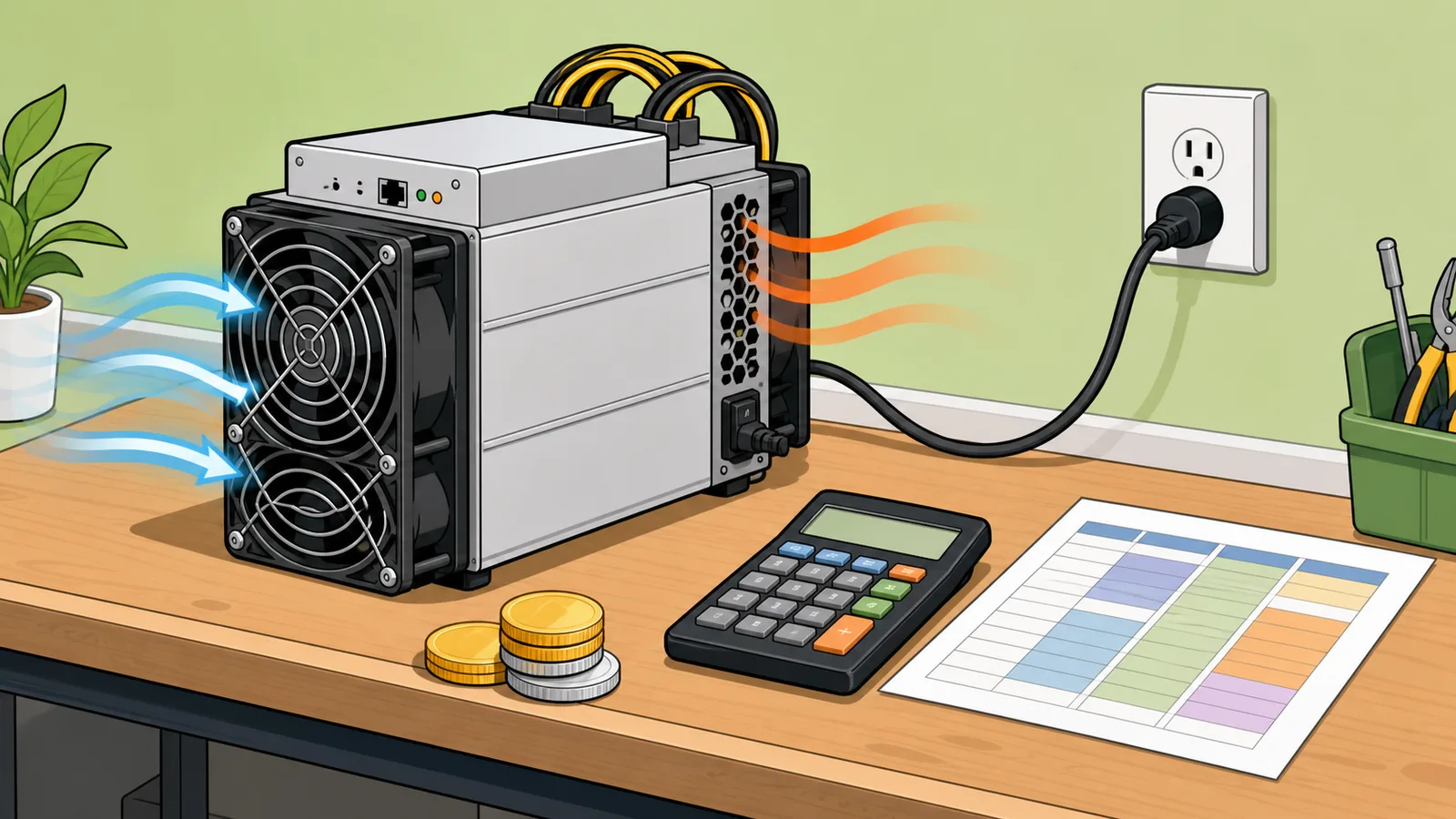
Estimate crypto mining profit from hashrate, difficulty or network hashrate, coin price, power draw, electricity rate, pool fees, overhead, uptime.
Last updated
Model crypto mining revenue, power cost, and payback before buying hardware This crypto mining profitability calculator estimates expected coins mined, revenue, electricity cost, recurring overhead, and net operating profit from your own hashrate, network assumptions, coin price, pool fee, and uptime inputs. It is educational only and does not predict future profitability.
Quick examples
Choose a preset to compare a baseline ASIC, a high-power-cost scenario, or Bitcoin-family difficulty input.
Display currency
Set the currency before entering coin price, power cost, hardware cost, and recurring overhead. The calculator does not fetch live exchange rates or live coin prices.
Result
$0.19/day
Expected daily operating result from 196 TH/s of effective hashrate against an estimated network rate of 700 EH/s.
Current assumptions produce a positive operating result Gross revenue of $8.19 per day is offset by
$0.16 of pool fees and
$6.59 of electricity cost, plus
$1.25 of recurring overhead.
Coins mined per day
0.000126
Network share
0%
Gross revenue per day
$8.19
Power use per day
82.32 kWh
Miner efficiency
17.5 J/TH
Operating cost per coin
$63,487.30
Period
Coins mined
Gross revenue
Pool fees
Electricity
Overhead
Net profit
Daily
0.000126
$8.19
$0.16
$6.59
$1.25
$0.19
Monthly
0.0038325
$249.11
$4.98
$200.31
$38.02
$5.80
Yearly
0.04599
$2,989.35
$59.79
$2,403.74
$456.25
$69.57
Operating break-even price
$63,456.43 per coin
Below this coin price, the entered setup no longer covers pool fees and electricity on an operating basis.
Hardware payback
23,609.65 days
Roughly 776.21 months or 64.68 years if assumptions stay unchanged.
Electricity-rate headroom
$0.08 per kWh
Above this electricity rate, revenue after pool fees and recurring overhead no longer covers power cost.
Important limitations
This educational mining profit calculator does not fetch live network difficulty, block reward changes, halving schedules, downtime events, repair cost, taxes, or slippage between quoted and realized payouts. Mining economics can change quickly and materially.
The displayed monthly figures use an average month length of 30.42 days so that monthly and yearly projections stay internally consistent.
Crypto mining profitability calculator for revenue, electricity cost, net profit, and
A crypto mining profitability calculator estimates how much coin a mining setup may earn and whether that expected revenue is likely to cover pool fees, electricity cost, and hardware spend under a stated set of assumptions. That makes it a planning tool, not a forecast: mining profit can change quickly when network difficulty, block reward, uptime, or market price changes.
What this crypto mining profitability calculator estimates
This mining profit calculator models expected coin output from your miner hashrate, the network hashrate or difficulty assumption you supply, the block reward, and average block time. It then converts expected coin output into estimated revenue using your entered coin price and subtracts pool fees, electricity cost, and optional recurring overhead to show daily, monthly, and yearly operating profit.
That scope matches the practical question most miners ask before turning on a rig or buying new hardware: if current conditions stayed roughly the same, would this setup cover its variable operating cost and how long might it take to recover the hardware purchase?
Core mining profitability formulas
Expected mining output starts with your effective hashrate after uptime is applied. That effective hashrate is divided by the network hashrate to estimate your share of all proof-of-work being performed. Expected blocks per day are based on 86,400 seconds divided by the average block time, and expected coin output multiplies that block frequency by your network share and the block reward.
Once expected coins per period are known, the calculator multiplies by the entered coin price to estimate gross revenue. Pool fees are taken as a percentage of gross revenue, electricity cost comes from power draw and the local electricity rate per kilowatt-hour, recurring overhead is entered as a daily cost, and net mining profit is gross revenue minus those cost buckets.
Effective miner hashrate = Miner hashrate x Uptime
Reduces stated hardware speed when the machine is not expected to run 100% of the time.
Expected coins per day = (Effective miner hashrate / Network hashrate) x (86,400 / Block time) x Block reward
Estimates average daily coin production from your share of network work and the protocol's reward schedule.
Net profit per day = Gross revenue - Pool fees - Electricity cost
Shows operating mining profitability before taxes, hosting charges, and hardware depreciation.
Net profit per day = Gross revenue - Pool fees - Electricity cost - Extra daily overhead
Extends the operating-profit view when hosting, cooling, internet, or maintenance reserves are entered.
Why ASIC efficiency and overhead change the mining ROI picture
Mining profitability is not only a hashrate question. Two miners can produce similar expected revenue while using very different power. That is why the calculator reports miner efficiency in joules per terahash when the entered hashrate can be expressed as TH/s. Lower J/TH generally means less power cost for the same SHA-256-style hashrate.
Recurring overhead also matters. Hosted miners may have management fees, rack charges, repair reserves, internet costs, or cooling charges that are not captured by watts alone. Home miners may still need extra ventilation or circuit work. Entering a daily overhead allowance makes the payback estimate less optimistic than a revenue-minus-electricity calculation.
Network hashrate mode versus difficulty mode
The cleanest input is direct network hashrate because it avoids any hidden conversion assumptions. If you already know the current network hash rate for the coin and algorithm you mine, enter that directly and the calculator will compare your rig against the network on a like-for-like basis.
Difficulty mode exists for Bitcoin-family proof-of-work networks where users often know current difficulty but not network hashes per second. In that mode, the calculator estimates network hashrate from difficulty using the common Bitcoin-style relationship difficulty x 2^32 divided by block time. That is useful, but it is not universal across all crypto networks and algorithms, so direct network hashrate is the safer choice whenever available.
Worked example: daily BTC-style mining economics
Suppose a miner contributes 200 TH/s, the network runs at roughly 700 EH/s, the block reward is 3.125 coins, average block time is 600 seconds, the market price is 65,000, the rig draws 3,500 watts, the electricity rate is 0.08 per kWh, the pool fee is 2%, and uptime is 98%. The calculator first reduces miner speed for uptime, then estimates the expected share of daily blocks and the resulting coin output.
From there, gross daily revenue is translated into a daily operating result after pool fees, electricity, and any entered overhead. If the daily result is positive, the hardware payback output converts that operating surplus into an approximate recovery period for the entered hardware cost. If the daily result is negative, payback is not shown because the setup is not covering its own operating cost under the entered assumptions.
How to use the break-even outputs
The break-even coin price answers the question: how far could the market price fall before this setup stops covering pool fees, electricity, and entered overhead? It is an operating break-even only. It does not mean the hardware purchase is recovered, and it does not include tax or financing.
The break-even electricity rate is the matching power-cost threshold. If overhead already consumes revenue after pool fees, there may be no positive electricity rate that makes the setup break even. In that case the calculator withholds the rate instead of presenting a misleading negative number.
What this mining ROI estimate does not cover
This calculator does not fetch live coin prices, live network difficulty, halving schedules, transaction-fee income, repair cost, taxes, financing cost, or resale value. It now gives hosting, cooling, and maintenance a manual daily-overhead input, but those values still depend on the user's own assumptions and records.
It also should not be treated as investment advice or a prediction of future crypto mining profitability. Proof-of-work mining economics are highly sensitive to price volatility, difficulty adjustments, reward changes, and downtime. Small input changes can produce very large result changes.
Further reading
Bitcoin Developer Guide — Mining — Primary technical overview of block creation, pooled mining, and the role of target thresholds in Bitcoin-style mining.
FINRA — Crypto Assets — High-trust investor guidance on crypto-asset volatility, liquidity, and investor-protection limitations.
Frequently asked questions
How does this crypto mining profitability calculator differ from a simple mining revenue calculator?
A revenue-only tool stops at expected coins mined and gross revenue. This calculator also subtracts pool fees, electricity cost, and optional daily overhead, then estimates hardware payback when daily operating profit is positive.
Can I use this as a bitcoin mining profitability calculator?
Yes, as long as you enter Bitcoin-style inputs such as current network hashrate or difficulty, the block reward, average block time, your power draw, and your electricity rate. Difficulty mode is specifically intended for Bitcoin-family proof-of-work assumptions.
Why does electricity cost matter so much in mining profit?
Power is one of the main recurring operating costs in proof-of-work mining. Two miners with identical hashrate can have very different net profit if their wattage, uptime, or electricity rate differs materially.
What does the break-even coin price mean?
It is the entered coin price at which expected daily revenue after pool fees exactly covers daily electricity cost and any entered overhead. Below that level, the setup no longer breaks even on operating cost under the current assumptions.
Why is hardware payback missing in some scenarios?
Payback only appears when hardware cost is greater than zero and the estimated daily operating result is positive. If net profit is zero or negative, there is no finite payback period under those assumptions.
What is J/TH and why does it matter for ASIC mining profitability?
J/TH means joules per terahash. It measures how much electrical energy a miner uses to produce one terahash of work. A lower J/TH figure is more efficient, which can materially improve mining profit when electricity is one of the largest recurring costs.
Should I include hosting, cooling, or maintenance as extra daily overhead?
Yes, if those costs apply to your setup. Electricity is only one operating cost. Hosted mining, ventilation, repairs, internet, downtime support, and replacement parts can all reduce net mining ROI, so the extra overhead field gives those costs a place in the model.
Why do mining profitability calculators disagree with each other?
They often use different market prices, network difficulty snapshots, payout methods, pool assumptions, transaction-fee assumptions, hardware presets, and exchange-rate timing. A manual calculator is useful because it makes each assumption visible, but it still depends entirely on the numbers you enter.
What is operating cost per coin?
Operating cost per coin divides the daily operating costs by expected coins mined per day. It helps compare the entered setup with the entered coin price. If cost per coin is near or above the coin price, the scenario has little or no operating margin before hardware recovery.
Can this calculator tell me which ASIC miner to buy?
No. It can compare a stated hashrate, power draw, hardware cost, and overhead assumption, but it does not know hardware reliability, delivery risk, warranty terms, resale value, noise, heat, hosting availability, or future network conditions.