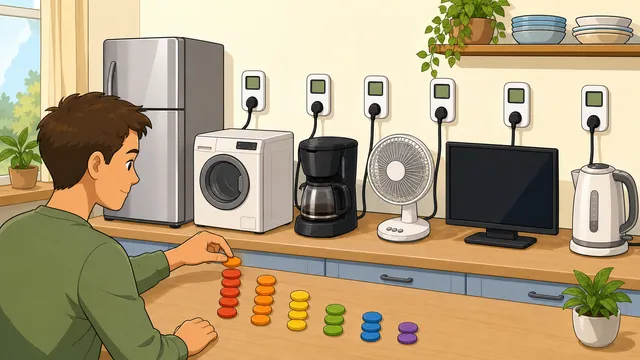
Estimate appliance electricity cost from watts, use time, duty cycle, kWh rate, billing days, and annual use days.
Last updated
Electricity cost calculator Estimate appliance electricity cost from watts, daily use, duty cycle, electricity rate, and the number of days you actually run the device.
Display currency
Set the tariff currency before entering the electricity rate. This changes labels and formatting, not the energy calculation.
Appliance presets
Wattage and duty cycle
Use rated wattage for simple loads. For cycling appliances such as fridges or dehumidifiers, set duty cycle to the share of the entered hours when the appliance is actively drawing near that wattage.
Result
$5.40/mo
Estimated monthly electricity cost for a 1,500 W appliance running 1 effective hour per day at $0.12/kWh.
Daily cost
$0.18
Annual cost
$65.70
kWh per day
1.5
kWh per month
45
kWh per year
547.5
Cost per active hour
$0.18
How to use this result
Use the monthly cost as a baseline estimate for budgeting and the annual cost for replacement decisions. The annual projection uses 365 active days, so seasonal appliances can be estimated without pretending they run all year.
Common appliance examples
These examples reuse your rate, billing days, and annual-use days so you can compare typical loads on the same tariff.
An electricity cost calculator converts appliance wattage, daily usage hours, duty cycle, days used, and the utility rate per kilowatt-hour into an estimated daily, monthly, and annual running cost so you can compare appliances and plan your electricity budget.
What this electricity cost calculator estimates
This calculator takes the power draw of an appliance in watts, the number of hours you run it each day, your electricity rate per kilowatt-hour, the number of billing days per month, the number of days used per year, and an optional duty-cycle percentage to produce a running-cost estimate at daily, monthly, and annual horizons.
It also reports energy consumption in kilowatt-hours at each interval so you can compare devices by energy draw rather than just cost. The appliance presets make common electricity cost checks faster, while the manual inputs keep the estimate tied to your own device label, usage pattern, and tariff.
Core electricity cost formulas
The calculation converts watts to kilowatts, multiplies by effective hours of use to get daily energy consumption, then multiplies by the electricity rate to arrive at cost. Effective hours are the entered hours multiplied by duty cycle, so a cycling appliance can be modelled without pretending it draws full power every minute.
Effective hours per day = Hours per day x Duty cycle
Adjusts the entered runtime for appliances that cycle on and off during the usage window.
kWh per day = Watts x Effective hours per day / 1,000
Converts watt-hours of daily usage into kilowatt-hours.
Daily cost = kWh per day x Electricity rate
Multiplies daily energy consumption by the price per kilowatt-hour.
Monthly cost = kWh per day x Days per month x Electricity rate
Extends the daily cost across the billing period.
Annual cost = kWh per day x Days used per year x Electricity rate
Projects the daily cost across the selected number of active days in a year.
How to use the cost result
Use the monthly cost as a budgeting baseline. For example, a 1,000-watt appliance running 5 effective hours a day at a rate of 0.12 per kWh costs roughly 18 per month and 219 per year in the same tariff currency when used every day of the year. Comparing two appliances with different wattages at your own rate shows which one is cheaper to run over time.
The annual figure is especially useful when deciding whether to replace an older, less efficient appliance with a newer model, because the energy savings can offset the purchase price over the life of the device.
When duty cycle matters
Some appliances draw close to their rated wattage whenever they are on. Space heaters, kettles during a boil, many lights, and simple resistive loads are good examples, so a 100% duty cycle is often a reasonable first pass.
Other appliances cycle. A fridge, freezer, dehumidifier, air conditioner, or thermostat-controlled heater may be plugged in for many hours but actively draw high power for only part of that time. In those cases, enter the full usage window in hours and use duty cycle to approximate the active share, or use measured average wattage from a plug-in energy monitor when you have it.
Electricity cost versus electricity bill
This page estimates usage-based appliance running cost: kilowatt-hours multiplied by the price per kilowatt-hour. That is the right scope when you want to know what one device costs to run or compare two devices under the same tariff.
A full electricity bill can include standing charges, fixed service fees, taxes, tiered rates, time-of-use rates, demand charges, credits, and other utility-specific line items. Use the electricity bill calculator when those bill extras matter; use this electricity cost calculator when the question is the direct appliance energy charge.
What this result does not cover
This calculator assumes a flat electricity rate and does not model tiered pricing, time-of-use rates, demand charges, or seasonal rate changes. It also does not account for standby power draw when the appliance is off but plugged in unless you enter that standby load as its own scenario.
For a full electricity bill estimate, you would need to add up the costs of all appliances and include any fixed service charges from your utility provider.
Frequently asked questions
How do I find the wattage of my appliance?
Check the label on the appliance or its manual. The wattage is usually listed near the power cord or on a sticker on the back or bottom of the device. You can also look up the model number online.
What is a typical electricity rate?
Rates vary widely by country, utility, tariff type, and time of use. The most reliable number to enter is the price per kilowatt-hour shown on your own electricity bill or tariff sheet.
Does this include standby power?
No. This calculator only estimates the cost while the appliance is actively running at its rated wattage. Standby or phantom power draw is typically much lower and would need to be calculated separately.
What is duty cycle in an electricity cost calculator?
Duty cycle is the share of the entered usage window when the appliance is actively drawing near the wattage you entered. A 1,500 W heater running steadily for 4 hours uses a 100% duty cycle, while a cycling fridge might be plugged in all day but actively run for a smaller share of that time.
How do I calculate the cost to run an appliance for one hour?
Divide the wattage by 1,000 to convert it to kilowatts, then multiply by the electricity rate per kWh. For example, a 1,500 W appliance is 1.5 kW, so at 0.12 per kWh it costs about 0.18 in the selected tariff currency for one active hour.
Why enter days used per year?
Not every appliance runs all year. A space heater, pool pump, holiday lighting setup, or dehumidifier may be seasonal, so the annual cost should use the number of days it actually runs rather than automatically assuming 365 days.
Is this the same as an energy cost calculator?
It overlaps, but the intent is narrower. This electricity cost calculator is a fast single-appliance running-cost tool. A broader energy cost worksheet may also include quantity, billing-period comparisons, or multi-device planning.
Why does the annual cost use 365 days instead of 12 months?
The annual figure uses the days-used-per-year value you enter, while the monthly figure uses the billing days you specify. The two projections are calculated independently so a seasonal appliance does not have to be treated as if it runs every month.
Guides
Featured in articles
Step-by-step guides that use this calculator to solve real problems.