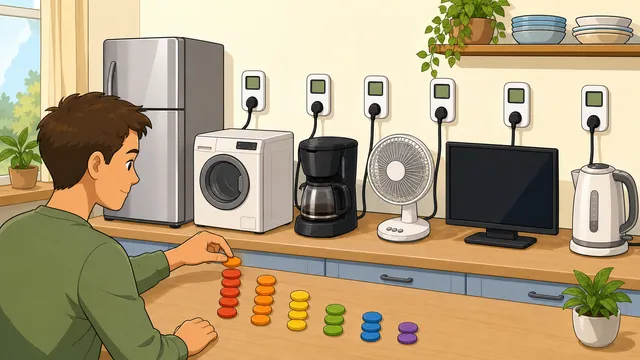
Estimate appliance energy cost from watts, quantity, daily runtime, duty cycle, billing days, and electricity price per kWh.
Last updated
Estimate appliance running cost across billing, monthly, and annual views Enter device wattage, quantity, daily runtime, billing-period length, and your electricity tariff to estimate
total energy use and operating cost at multiple time horizons.
Appliance presets
Display currency
Set the display currency before entering the rate. The currency selector changes formatting, not the kWh calculation.
Enter appliance load, runtime, and tariff Add wattage, quantity, hours per day, duty cycle, billing days, and price per kWh to estimate energy use and cost.
Energy cost calculator: estimate appliance running cost by wattage, duty cycle, tariff
An energy cost calculator turns appliance wattage, quantity, runtime, duty cycle, billing-period length, and electricity price per kWh into a bill estimate you can actually use. This page shows energy use and operating cost across daily, billing-period, monthly, and annual views so you can compare multiple devices under the same tariff.
What this energy cost calculator covers
This page estimates the cost of running one or more identical electrical devices from six inputs: wattage per device, number of devices, hours used per day, duty cycle, billing-period length in days, and electricity price per kilowatt-hour.
The result sheet keeps the entered billing period at the center while also showing daily, monthly, and annual projections. That makes it useful for one appliance, a group of identical appliances, a seasonal load, a short project, or a bill-period check where the exact number of billed days matters.
This page is intentionally a broader energy cost worksheet. The electricity cost calculator is the faster single-appliance running-cost tool; this energy cost calculator is better when quantity, duty cycle, and a custom billing horizon are central to the question.
Energy use starts with connected load, runtime, and duty cycle
The total connected load is the wattage of one device multiplied by the number of identical devices. Multiplying that load by effective daily runtime gives daily watt-hours, which the calculator converts into kilowatt-hours by dividing by 1,000.
Duty cycle adjusts runtime for devices that cycle or run at full draw only part of the time. A 500 W dehumidifier entered for 8 hours at a 60% duty cycle is treated as 4.8 effective full-power hours per day, not 8 full-power hours.
Once daily energy use is known, the billing-period, monthly, and annual views are time projections. Applying the tariff to each kWh value converts energy use into operating cost.
Connected load (W) = Device watts x Quantity
Total instantaneous load for the identical devices entered in the worksheet.
Effective hours/day = Hours/day x Duty cycle
Adjusts the daily runtime for cycling or part-load equipment.
kWh/day = Connected load x Effective hours/day / 1,000
Daily energy use converts watt-hours into kilowatt-hours, which is the unit used on electricity bills.
Cost = kWh x Electricity price per kWh
Every cost view on the page comes from multiplying projected kWh by the entered electricity price.
Worked energy cost examples
Suppose you run two 1,000 W heaters for 8 hours a day over a 30-day billing period at 0.15 per kWh. The connected load is 2,000 W, daily use is 16 kWh, and billing-period use is 480 kWh.
At that tariff, the billing-period operating cost is 72.00 in the selected currency. The same daily pattern projects to about 58.44 per average month and 876.00 per year, which is why the calculator shows multiple horizons instead of only one total.
A cycling appliance changes the result. A 180 W fridge running 24 hours at a 35% duty cycle uses 1.512 kWh per day. At 0.20 per kWh over 30 days, that is 45.36 kWh and 9.07 in usage cost. The full-day runtime is real, but the duty cycle stops the estimate from pretending the compressor draws full power every minute.
How to choose the electricity rate
Use the price per kWh from your own utility bill or tariff sheet when you have it. Many bills list separate delivery, supply, tax, credit, and fixed-charge lines, so the cleanest planning rate is usually the energy charge or an effective per-kWh rate you calculate from the bill.
If you only need a rough comparison, use a representative local rate and keep the same rate for every appliance scenario. The absolute cost may not match the final bill, but the comparison between devices will still show which load dominates under the same assumptions.
For time-of-use tariffs, run separate scenarios for peak and off-peak periods instead of blending everything into one line. A device used mostly off-peak can cost less than the same kWh used during peak hours.
Rated watts versus measured watts
Rated wattage is a useful starting point, but measured watts are better when a cost-sensitive decision depends on the answer. A plug-in energy monitor, smart plug, inverter readout, or utility submeter can show actual draw under your real operating conditions.
Nameplate wattage may describe maximum draw rather than long-run average draw. That matters for fridges, freezers, air conditioners, dehumidifiers, pumps, computers, and thermostat-controlled heaters. Use duty cycle when the entered wattage is an active-draw estimate rather than a daily average.
If you already have measured average watts across the whole operating period, enter that wattage and leave duty cycle at 100%. Do not reduce the result twice.
Reading the billing, monthly, and annual results
The billing-period result answers the practical bill question: what does this appliance schedule add over the number of days you enter? That is useful because real utility bills are often 28, 29, 30, 31, or more days rather than a perfect calendar month.
The monthly average uses 365 / 12 days, which is a useful budgeting horizon but not always the same as your current bill. The annual projection uses 365 days and is best for always-on loads, appliance replacement decisions, and long-term energy budgeting.
The per-device billing cost divides the total billing-period cost by quantity. That helps when you are comparing a group of identical devices, such as several heaters, monitors, lamps, chargers, or pumps.
What this calculator does not model
This calculator assumes representative wattage, the duty cycle you enter, a flat tariff, and the same hours of use every day. It does not model standby power unless entered as a separate scenario, startup surges, time-of-use pricing, demand charges, seasonal schedules, taxes, credits, or separate supply fees on the bill.
Use it as a planning and educational worksheet. If your tariff structure or load profile is more complex, confirm the estimate against measured usage data and the full utility bill design.
For whole-home reconciliation, remember that this page estimates one device group at a time. A full bill includes every load in the home or building plus any non-usage charges.
Multiply watts by quantity and effective hours of use, divide by 1,000 to get kWh, then multiply kWh by the electricity price per kWh. This calculator also scales that daily result into billing-period, monthly, and annual cost views.
What is the energy cost formula?
The core formula is cost = kWh x rate per kWh. For appliance estimates, kWh = watts x quantity x hours per day x duty cycle x days / 1,000.
Why does the calculator ask for billing-period days?
Because real electricity bills do not always cover exactly one calendar month. Entering the actual billing length gives a more useful bill estimate while the worksheet still shows monthly and annual views for comparison.
What does duty cycle mean for energy cost?
Duty cycle is the share of the entered runtime when the appliance effectively draws the wattage you entered. A 500 W appliance entered for 8 hours at 60% duty cycle is costed as 4.8 effective full-power hours.
What if my appliance does not run at the same wattage all the time?
Use measured average wattage if you know it, or use the duty-cycle field for a practical estimate. This is especially important for fridges, dehumidifiers, air conditioners, pumps, and thermostat-controlled equipment.
Does this include standing charges or fixed service fees?
No. The calculator estimates usage-based electricity cost only. Fixed charges, taxes, delivery fees, demand charges, and credits must be added separately if they apply to your utility bill.
Why show monthly and annual projections if I enter a billing period?
Because the billing-period total answers the near-term bill question, while monthly and annual views help with budgeting and appliance-comparison decisions over longer horizons.
Should I use the appliance label wattage or a plug-in meter?
Use a plug-in meter or smart plug with energy monitoring when accuracy matters. Label wattage is fine for a first estimate, but it may show maximum or rated draw rather than the real average draw over time.
Can I use this for time-of-use electricity rates?
Use separate scenarios for peak and off-peak usage. The calculator applies one flat rate at a time, so a blended rate can hide the difference between expensive and cheaper hours.
Is this the same as an electricity cost calculator?
It overlaps, but the emphasis is broader. This energy cost calculator supports quantity, duty cycle, and custom billing-period views for a device group. The electricity cost calculator is a faster single-appliance running-cost page.