Convert any finite decimal to a percentage, move the decimal point two places, choose rounding precision, see the fraction form.
Last updated
Percentage Basics
Turn a decimal into a percentage with the working shown
Use this decimal to percent calculator to convert a finite decimal into percent form, see the decimal point move two places, and check the equivalent fraction. It handles values below 1, decimals above 1, negative decimals, and small rate-style inputs such as 0.001.
Quick examples
Pick a common decimal-to-percentage conversion, then edit the input if your value is different.
Decimal to percent formula Percent means per hundred, so the conversion is the same value written per 100: multiply the decimal by 100, or move the decimal point two places to the right.
Result
75%
0.75 converts to 75% by multiplying by 100.
0.75 × 100 = 75%
Original decimal
0.75
Percentage
75%
Decimal point move
75
Fraction equivalent
3/4
Step-by-step work
Start with the decimal 0.75.
Move the decimal point two places to the right: 0.75 becomes 75.
Multiply by 100 to convert from decimal form to percent form: 0.75 × 100 = 75%.
The same decimal also simplifies to the fraction 3/4.
Common decimal to percent conversions
Use these checkpoints to sanity-check proportions, grades, rates, probabilities, and percentages above 100%.
Decimal
Percent
Interpretation
0.01
1%
One hundredth written as one percent.
0.125
12.5%
A common eighth used in fractions and measurements.
0.5
50%
Half of the reference amount.
0.75
75%
Three quarters of the reference amount.
1
100%
One whole reference amount.
1.25
125%
More than one whole, so the percent is above 100%.
The percentage is a different notation for the same ratio. Values between 0 and 1 become percentages between 0% and 100%, values above 1 become percentages above 100%, and negative values stay negative.
Decimal to percent calculator: convert decimals into percentages
A decimal to percent calculator multiplies any finite decimal by 100 to express it as a percentage. It also shows the simplified fraction form and the working step, making it useful for finance, grades, statistics, and everyday maths. If you need the reverse direction, use the percent to decimal calculator.
The conversion formula
To convert a decimal to a percentage, multiply the value by 100. This moves the decimal point two places to the right. For example, 0.75 becomes 75% and 4.5 becomes 450%. The word percent means per hundred, so the conversion is really a change in notation, not a change in value.
The calculator also shows the simplified fraction form of the decimal. That is helpful when you want to see the same number as a percentage, a decimal, and a fraction without doing the simplification by hand.
Percentage = Decimal × 100
Multiply the decimal by 100 to express it as a percentage.
Decimal = Percentage ÷ 100
The reverse conversion, which is handled by the percent to decimal calculator.
Worked examples
A decimal of 0.75 becomes 75%, which is the same as three quarters. A decimal of 1.2 becomes 120%, meaning the value is one and one-fifth of the reference amount. A negative decimal such as -0.125 becomes -12.5%, which can represent a decline, loss, or negative adjustment depending on the context.
Decimals greater than 1 are still valid inputs. They simply produce percentages greater than 100%. That is common when you are describing growth, overage, or values that are larger than the original baseline.
0.25 = 25%
0.75 = 75%
1.2 = 120%
-0.125 = -12.5%
Where decimal-to-percent appears
Finance uses decimal notation inside formulas but percentage notation in plain language. A 6.5% interest rate is entered as 0.065 in many calculations, while the final result is often reported back as a percentage. Statistics works the same way: a proportion between 0 and 1 can be converted into a percentage when you want a more readable comparison.
Teachers and students also use decimal-to-percent conversions when checking grades, test scores, and probability values. In all of those cases, the same rule applies: multiply by 100 to convert the decimal into a percentage.
Decimal point movement and rounding
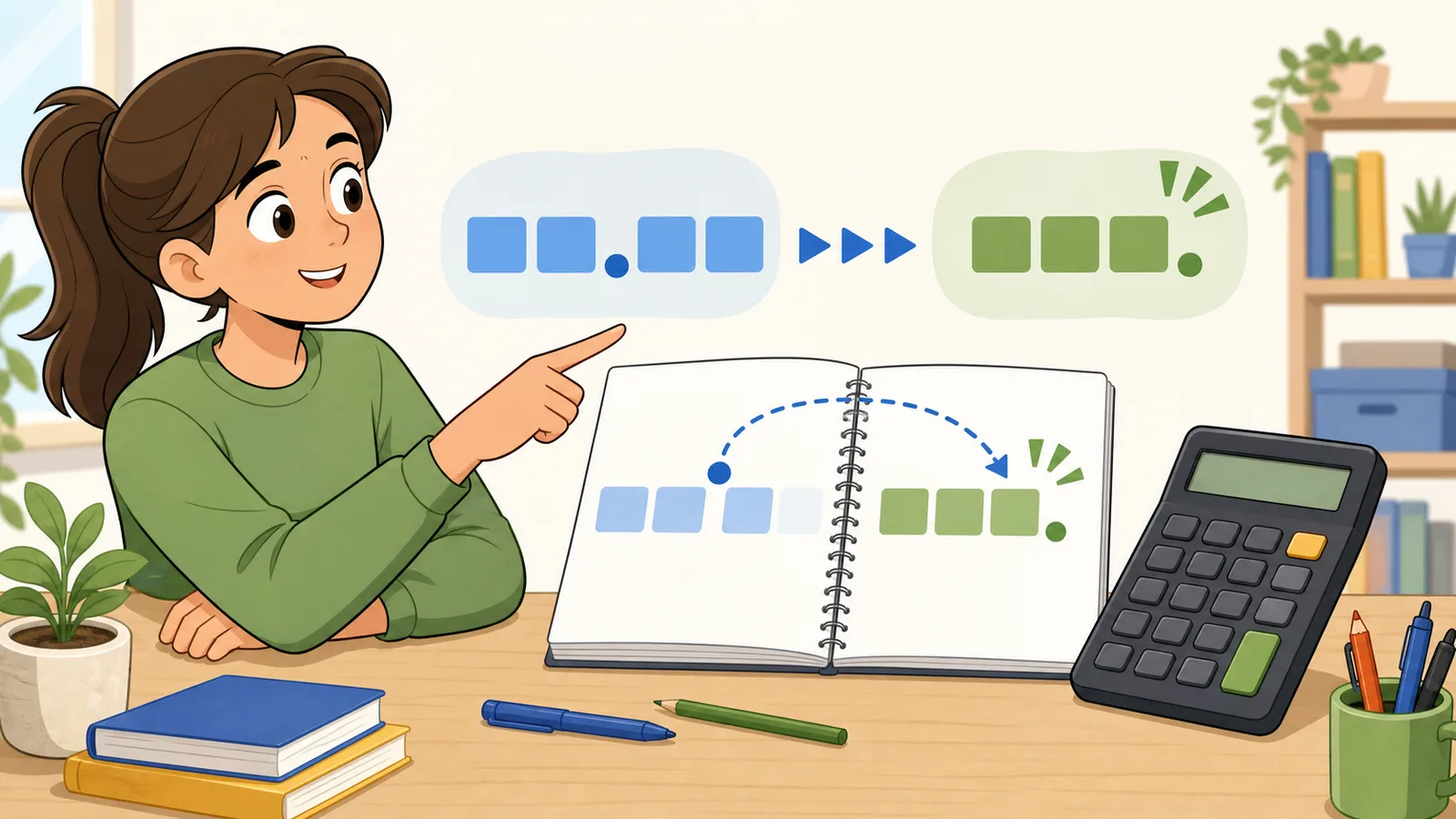
Competitor pages often explain the same conversion in two equivalent ways: multiply by 100, or move the decimal point two places to the right. Both descriptions mean the same thing. The calculator shows the multiplication equation and the shifted decimal-point value so you can check the answer visually instead of relying on a bare final percentage.
Rounding only changes the displayed percentage, not the underlying conversion rule. For example, 0.123456 is exactly 12.3456% before rounding. If a report, gradebook, dashboard, or worksheet only allows two decimal places, the rounded display becomes 12.35%. Keeping the rounding control visible helps you decide how much precision is appropriate for the context.
0.001 = 0.1%, which is useful for small rates and probabilities.
0.01 = 1%, a common benchmark for one hundredth.
0.5 = 50%, meaning half of the reference amount.
1 = 100%, meaning one full reference amount.
1.25 = 125%, meaning one and one quarter of the reference amount.
Using the conversion chart
Search results for decimal-to-percent tools commonly include a conversion chart because many users want to check familiar values quickly. The chart in the calculator is not a separate formula; it is a set of benchmark conversions that all follow Decimal × 100. Use it to sanity-check common proportions before or after entering your own decimal.
A chart is especially useful when the decimal represents a score, probability, completion rate, survey share, investment return, or change from a baseline. Seeing 0.75 beside 75% and 1.25 beside 125% reinforces the difference between values below one whole and values above one whole.
Decimals above 1 and negative values
A decimal greater than 1 becomes a percentage above 100%. For example, 1.2 is 120% and 2.5 is 250%. That does not mean the value is incorrect; it simply means the amount is more than one full unit of the reference value.
Negative decimals convert the same way, with the minus sign preserved. A result such as -0.3 becomes -30%. That is useful for reporting decreases, negative rates, and deficits in a consistent percentage format.
Fraction form and the reverse relation
Because a decimal is a number expressed in tenths, hundredths, thousandths, and so on, many decimals can also be written as exact fractions. For example, 0.75 is 75/100, which simplifies to 3/4. Showing that fraction form can make the answer easier to compare with other values.
The reverse conversion is simple: divide the percentage by 100. That is why the sister percent to decimal calculator is the right tool when you already have a percentage and need the decimal version instead.
Frequently asked questions
How do I convert 0.75 to a percentage?
Multiply 0.75 by 100 to get 75%. The page uses this rule as a quick reference, but the surrounding assumptions and units still matter when you interpret the result.
Can percentages be over 100%?
Yes. A decimal greater than 1 converts to a percentage above 100%. For example, 1.2 becomes 120%.
What about negative decimals?
Negative decimals convert the same way. For example, -0.125 becomes -12.5%.
Why multiply by 100?
Percent literally means per hundred, so multiplying by 100 changes a decimal ratio into a percentage format.
How is this different from percent to decimal?
Decimal to percent multiplies by 100, while percent to decimal divides by 100. They are reverse conversions.
Do repeating decimals convert exactly?
Repeating decimals are best handled with a separate symbolic method. This page is designed for finite decimal inputs, which convert exactly when multiplied by 100.
What is 0.001 as a percent?
0.001 is 0.1%. Moving the decimal point two places to the right changes 0.001 into 0.1, then the percent sign is added. This kind of small decimal often appears in rates, probabilities, and statistical outputs.
Can I choose how many decimal places the percent uses?
Yes. The calculator includes a rounding control for the displayed percentage. The underlying conversion is still decimal multiplied by 100, but the display can be rounded to match a worksheet, report, dashboard, gradebook, or presentation.
Why does 1.25 become 125%?
Percent means per hundred, so 1 whole is 100%. A decimal of 1.25 is one and one quarter of the reference amount, so multiplying by 100 gives 125%.
Is a decimal to percent calculator the same as a percentage calculator?
It is a narrower tool. A decimal to percent calculator converts one decimal number into percent notation. A general percentage calculator may also solve questions such as percentage change, percentage of a number, discount, markup, or what percent one number is of another.