Calculate dice probability for exact, at least, at most, and between sums with d6, d20, custom dice, distribution rows, and repeat-roll odds.
Last updated
Dice probability planner
Find exact, cumulative, and range odds for dice rolls
Choose a common roll or enter custom dice notation. The calculator counts the full distribution, highlights the target sums, and turns the result into percentage, decimal probability, one-in odds, and repeat-attempt odds.
Dice probability calculator for d6, d20, and custom dice Use exact sum, at least, at most, or between modes for tabletop games, board games, classroom probability, and any fair polyhedral dice with the same number of sides.
Quick examples
Presets cover common search intents first, then every value remains editable.
Dice setup
The current roll is 2d6. Values are capped to keep the exact distribution usable in the browser.
Question type
P(total = target)
Probability
16.67%
Rolling 2d6, the chance of getting exactly 7 is 16.67%, from 6 favorable outcomes out of 36.
Decimal probability
0.17
Favorable outcomes
6
One-in odds
1 in 6
Repeat chance
16.67%
How to read this dice probability result Repeat-roll odds match the single-roll probability because only one attempt is selected. The most likely sum for 2d6 is 7.
Total outcomes
36
Mean total
7
Standard deviation
2.42
Distribution table
Highlighted rows are included in the selected query. Large distributions show the target area, extremes, and most likely sums.
Sum
Ways
Exact %
At most
At least
2
1
2.78%
2.78%
100%
3
2
5.56%
8.33%
97.22%
4
3
8.33%
16.67%
91.67%
5
4
11.11%
27.78%
83.33%
6
5
13.89%
41.67%
72.22%
7
6
16.67%
58.33%
58.33%
8
5
13.89%
72.22%
41.67%
9
4
11.11%
83.33%
27.78%
10
3
8.33%
91.67%
16.67%
11
2
5.56%
97.22%
8.33%
12
1
2.78%
100%
2.78%
Assumptions
All dice are treated as fair, independent, and identical. If a game uses loaded dice, advantage/disadvantage rules, keep-highest dice pools, exploding dice, rerolls, or non-identical dice, use this as a baseline rather than the final game-rule answer.
Dice probability calculator: exact, at least, at most, and range odds
A dice probability calculator should answer more than one exact-sum question. This page calculates the chance of rolling a specific total, at least a target, at most a target, or an inclusive range with fair d6, d20, and custom polyhedral dice. It also shows the full distribution table, one-in odds, repeat-roll odds, and the most likely totals so you can interpret the result instead of only copying a percentage.
What this dice probability calculator is for
Use this calculator when you need the probability of a dice roll total from identical fair dice. It covers classroom probability examples, board-game odds, tabletop role-playing checks, and custom dice pools where every die has the same number of sides.
The most common question is an exact sum, such as the probability of rolling 7 on 2d6. Many real game questions are cumulative instead: at least 10 on 2d6, at most 4 on 2d6, or between 9 and 12 on 3d6. Those modes are included because leading dice odds tools and tabletop users often need the whole target area, not only one row of the distribution.
The calculator assumes the dice are fair, independent, and identical. That is the standard baseline for dice probability. If your game uses advantage, disadvantage, rerolls, exploding dice, keep-highest dice pools, or weighted dice, the result is still useful as a reference point but does not model every rule layer.
How dice probability is calculated
For one fair die with S sides, each face has probability 1/S. For N identical dice, the total number of equally likely ordered outcomes is S^N. With 2d6, there are 6 x 6 = 36 ordered outcomes. With 3d6, there are 6^3 = 216 ordered outcomes.
The hard part is counting how many ordered outcomes produce each sum. The calculator uses dynamic programming to build the distribution one die at a time. After the distribution is built, exact probability is one row, at-least probability is the upper tail, at-most probability is the lower tail, and between probability is the sum of every row inside the inclusive range.
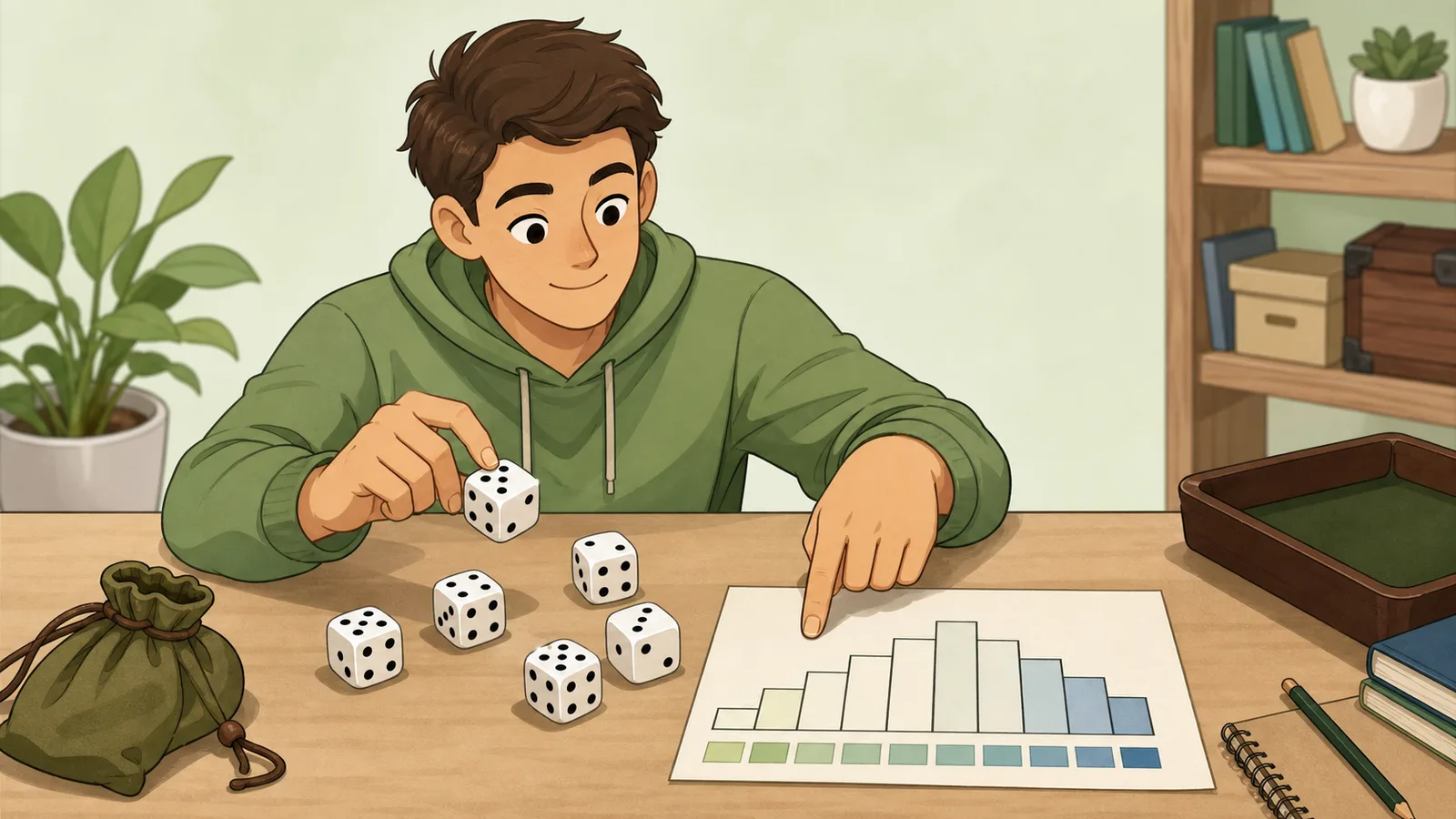
This is why middle totals are more likely than extreme totals. A total of 7 on 2d6 can happen in six ordered ways, while 2 and 12 each happen in only one ordered way. For more dice, the distribution becomes more bell-shaped because many combinations cluster around the mean.
Total outcomes = S^N
S is sides per die and N is the number of dice.
P(exact sum) = ways to roll that sum / total outcomes
Used for exact target-sum questions. This is the specific relationship the calculator applies when building the result.
P(at least k) = sum of ways for k through max / total outcomes
Upper-tail probability for target-number checks.
P(between a and b) = sum of ways from a through b / total outcomes
Inclusive range probability. This is the specific relationship the calculator applies when building the result.
Worked examples: 2d6, 3d6, and d20
For 2d6, the most likely total is 7. The six ordered combinations are 1+6, 2+5, 3+4, 4+3, 5+2, and 6+1, so P(7) = 6/36 = 16.67%. The chance of at least 10 on 2d6 is also 6/36 because the qualifying totals are 10, 11, and 12, with 3, 2, and 1 ordered ways respectively.
For 3d6, totals near 10 and 11 are most likely. A range question such as 9 through 12 includes several high-probability middle rows, so it is much more common than a single exact target. This is why 3d6 game systems feel less swingy than a single d20 even when the possible totals cover a broad range.
For a single d20, every face has the same probability: 1/20 or 5%. A natural 20 is not more or less likely than any other single face. Repeat attempts change the question. Seeing at least one natural 20 in three independent d20 rolls is 1 - (19/20)^3, not simply 3 x 5% once probabilities start to overlap.
Exact vs at least vs at most vs between
Exact mode answers a narrow question: what is P(total = k)? Use it when a game or homework problem asks for one specific sum. At-least mode answers P(total >= k), which is common in target-number games where meeting or beating a difficulty number succeeds.
At-most mode answers P(total <= k). It is useful for failure checks, low-roll risks, and questions such as the chance of rolling 4 or lower on 2d6. Between mode answers P(a <= total <= b), which is useful for acceptable ranges, middle-band outcomes, and classroom probability intervals.
The distribution table shows exact, at-most, and at-least values together so you can compare the point probability with the cumulative probability. This prevents a common mistake: treating the probability of exactly 10 as if it were the probability of 10 or higher.
Repeat-roll odds
Many users do not roll once. They ask how likely an outcome is across several attempts: at least one critical hit in three rolls, at least one high 2d6 total over a few turns, or at least one success in a short sequence. The repeat-attempt panel answers that by using the complement rule.
If the single-roll probability is p and you roll independently A times, the chance of never seeing the target is (1 - p)^A. The chance of seeing it at least once is therefore 1 - (1 - p)^A. This is more accurate than multiplying p by A, especially when the event is not extremely rare or the number of attempts grows.
P(at least once in A attempts) = 1 - (1 - p)^A
p is the probability from the selected exact, at-least, at-most, or between query.
When this calculator is not enough
This calculator models identical fair dice and sums. It does not model non-identical dice such as 1d8 + 1d6, keep-highest mechanics, roll-and-drop systems, exploding dice, dice pools that count successes instead of sums, or advantage/disadvantage rules. Those mechanics need a different distribution model.
It also does not replace a general probability calculator or probability distribution calculator. Use the general probability calculator for event rules, complements, unions, intersections, conditional probability, combinations, and permutations. Use a probability distribution calculator for binomial, Poisson, normal, or uniform model questions that are not literally dice sums.
The probability is 6 out of 36, or 16.67%. The total 7 can be made by six ordered combinations: 1+6, 2+5, 3+4, 4+3, 5+2, and 6+1.
What is the probability of rolling at least 10 on 2d6?
The probability is 6 out of 36, or 16.67%. The qualifying totals are 10, 11, and 12. They have 3, 2, and 1 ordered ways respectively.
What is the most likely sum on 3d6?
The most likely sums on 3d6 are 10 and 11. They sit near the mean of 10.5 and each has more combinations than the extreme totals.
Why are middle dice totals more likely?
Middle totals can be formed by many different ordered combinations. Extreme totals usually require every die to land very low or very high, so they have fewer combinations.
Does a d20 have a bell-shaped distribution?
A single d20 does not. Every face from 1 to 20 is equally likely. Bell-shaped sum distributions appear when you add multiple dice together, such as 2d6 or 3d6.
How do repeat-roll odds work?
Repeat-roll odds use the complement rule. If one roll has probability p, the chance of seeing that outcome at least once in A independent attempts is 1 - (1 - p)^A.
Can this calculator handle custom dice like d4, d8, d10, d12, and d20?
Yes. Enter the number of sides per die. The calculator works for fair identical dice with 2 to 100 sides, including common polyhedral dice used in tabletop games.
Can this calculator handle advantage, disadvantage, exploding dice, or keep-highest rolls?
No. Those mechanics change the sample space. This calculator handles sums of identical fair dice. Use it as a baseline when comparing house rules, but do not treat it as a full dice-engine simulator.