Does this calculator account for drug accumulation with repeated dosing?
No — this calculator models a single dose only. With regular dosing, drug levels accumulate until a steady state is reached, typically after about 4–5 half-lives. A full pharmacokinetic model is needed for multi-dose scenarios.
Can I use this to decide when it is safe to take another medication?
No. Drug interactions depend on mechanism, enzyme pathways, therapeutic window, organ function, and clinical context — not just residual concentration. Always consult a pharmacist or prescriber before making dosing or combination decisions.
How many half-lives until a drug is mostly gone?
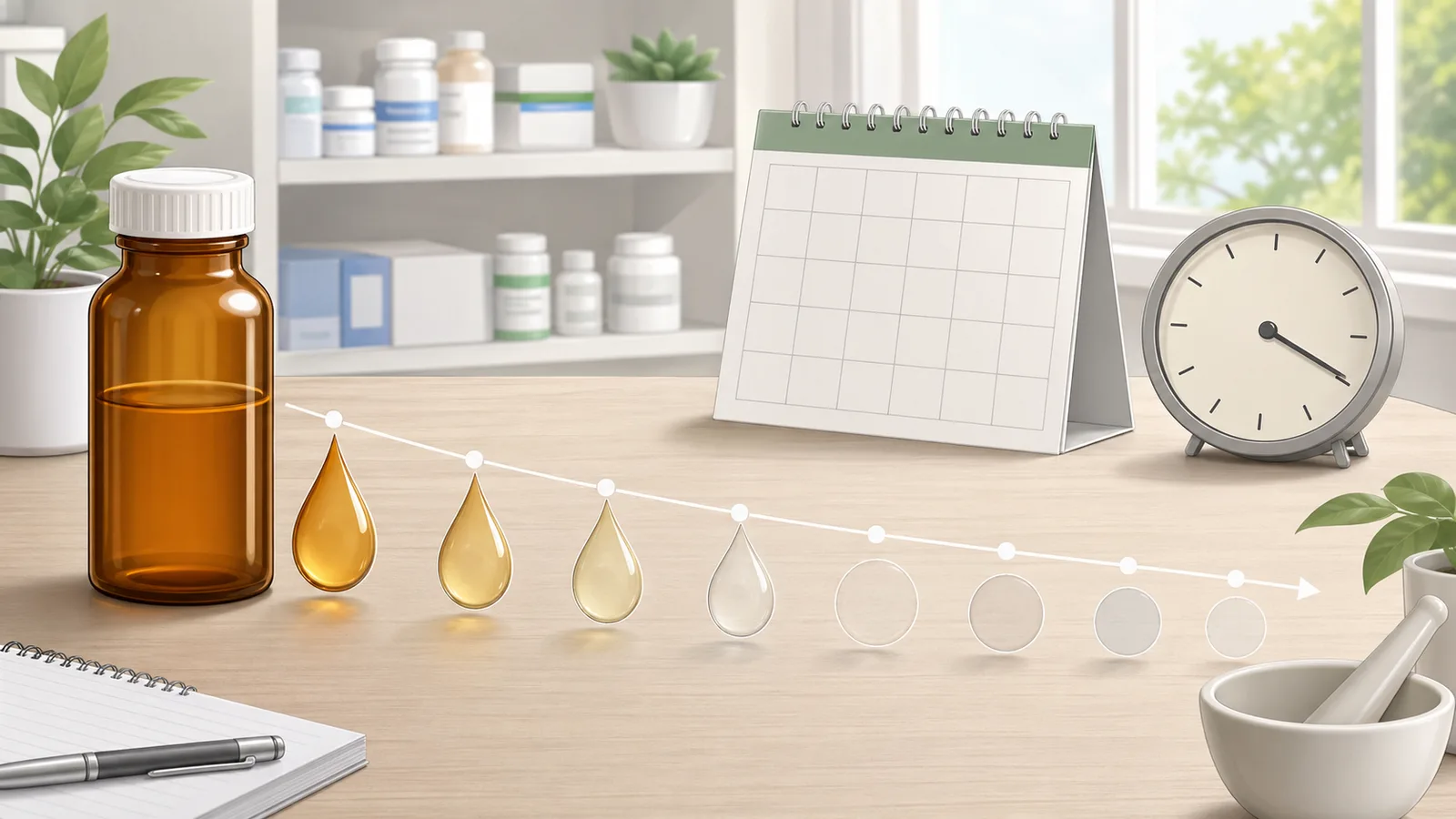
A common rule of thumb is about five half-lives for near-complete washout. That leaves roughly 3% of the original amount, although the exact clinical significance depends on the medicine, the formulation, and the person taking it.
Can kidney or liver disease change half-life?
Yes. Reduced renal or hepatic function can slow elimination and extend half-life, which is why the same medication may stay in the body longer in someone with organ impairment or a significant drug interaction.
How do you calculate how much of a drug remains after a certain time?
For a first-order model, multiply the starting amount by 0.5 raised to the power of elapsed time divided by half-life. In other words, each half-life cuts the remaining amount in half. This page applies that relationship to estimate the remaining amount after any chosen interval.
Does 5 half-lives mean the drug is completely out of the body?
No. Five half-lives is a practical rule of thumb for near-complete elimination, not literal zero. About 3% of the original amount still remains under the simple model, and the clinical significance of that remainder depends on the medicine, the formulation, and patient factors.
Why do some sources say 5 half-lives and others say about 6.6 half-lives?
They are describing different thresholds. About five half-lives leaves roughly 3% remaining, while about 6.6 half-lives gets closer to 99% eliminated. Both are useful rules of thumb, but neither one replaces drug-specific guidance or clinical judgement.
How long does it take to reach 95% drug elimination?
In a first-order model, 95% eliminated means 5% remains. That takes about 4.32 half-lives, so a drug with a 10-hour half-life would reach the 95% eliminated checkpoint at about 43.2 hours. The calculator lets you change the target percentage so you can compare 90%, 95%, 97%, 99%, or another educational washout point.
Why does the calculator let me enter minutes, hours, or days?
Medication half-lives can be reported in different units. A short-acting drug may be described in minutes or hours, while a long-acting drug may be easier to think about in days. The calculator converts the selected units internally so the half-life and elapsed-time inputs stay consistent.
What is the difference between half-life and duration of action?
Half-life describes how quickly the amount in the body declines. Duration of action describes how long the medicine continues to produce a meaningful clinical effect. A drug can have a short clinical effect but still remain measurable in the body, or it can continue to matter clinically after the bulk has been eliminated.
Why can the same drug have different half-lives in different people?
Clearance depends on kidney function, liver function, age, body composition, formulation, genetic differences in metabolism, and interacting medicines. That is why the same drug can stay in the body for very different lengths of time in different people.
Can I use this for buprenorphine, Adderall XR, Eliquis, or Zoloft?
Only with caution and only as a general educational model. Specific-drug half-life values vary by formulation and patient context. Extended-release products, active metabolites, renal function, hepatic function, and interacting drugs can all change the correct half-life to use, so product guidance and clinician or pharmacist advice matter more than a generic calculator when a real decision depends on the answer.
Why is this only a first-order elimination estimate?
Because many medicines approximately follow first-order elimination over normal therapeutic ranges, where the same fraction is removed over time. Some drugs do not behave that way in every circumstance, especially at high concentrations or under unusual physiologic conditions, so this page should be treated as a simplified teaching model.
What is the difference between half-life and clearance?
Half-life is the time it takes for the amount or concentration of a drug to fall by 50%. Clearance is the volume of plasma the body removes of that drug per unit time. They are connected, but they are not the same measurement, and a calculator that only uses half-life does not fully describe the clearance process.
What is the difference between elimination and excretion?
Elimination is the broader process of reducing a drug’s presence in the body, which usually includes both metabolism and excretion. Excretion is the physical removal of the drug or its metabolites, while metabolism is the chemical conversion step that often happens before excretion. A medicine can be eliminated even if the parent compound is no longer the main active form.
How many half-lives does it take to reach steady state?
For many first-order drugs, steady state is reached after about 4 to 5 half-lives. That is a rule of thumb rather than a universal law, because loading doses, changing dose intervals, active metabolites, and non-linear kinetics can move the timing earlier or later.
Can extended-release or modified-release products change the answer?
Yes. Extended-release and modified-release formulations change how quickly the drug enters the body, and that can change the concentration curve you are trying to interpret. The half-life value may still describe elimination, but the timing of peaks, troughs, and apparent wear-off can differ from an immediate-release product.
Can a drug still be detectable after five half-lives?
Yes. Five half-lives is a useful washout estimate, but it does not guarantee a negative test or zero detectability. Test sensitivity, assay cutoff, dose size, repeated use, tissue storage, and metabolites can all keep a substance detectable longer than the simple rule of thumb suggests.