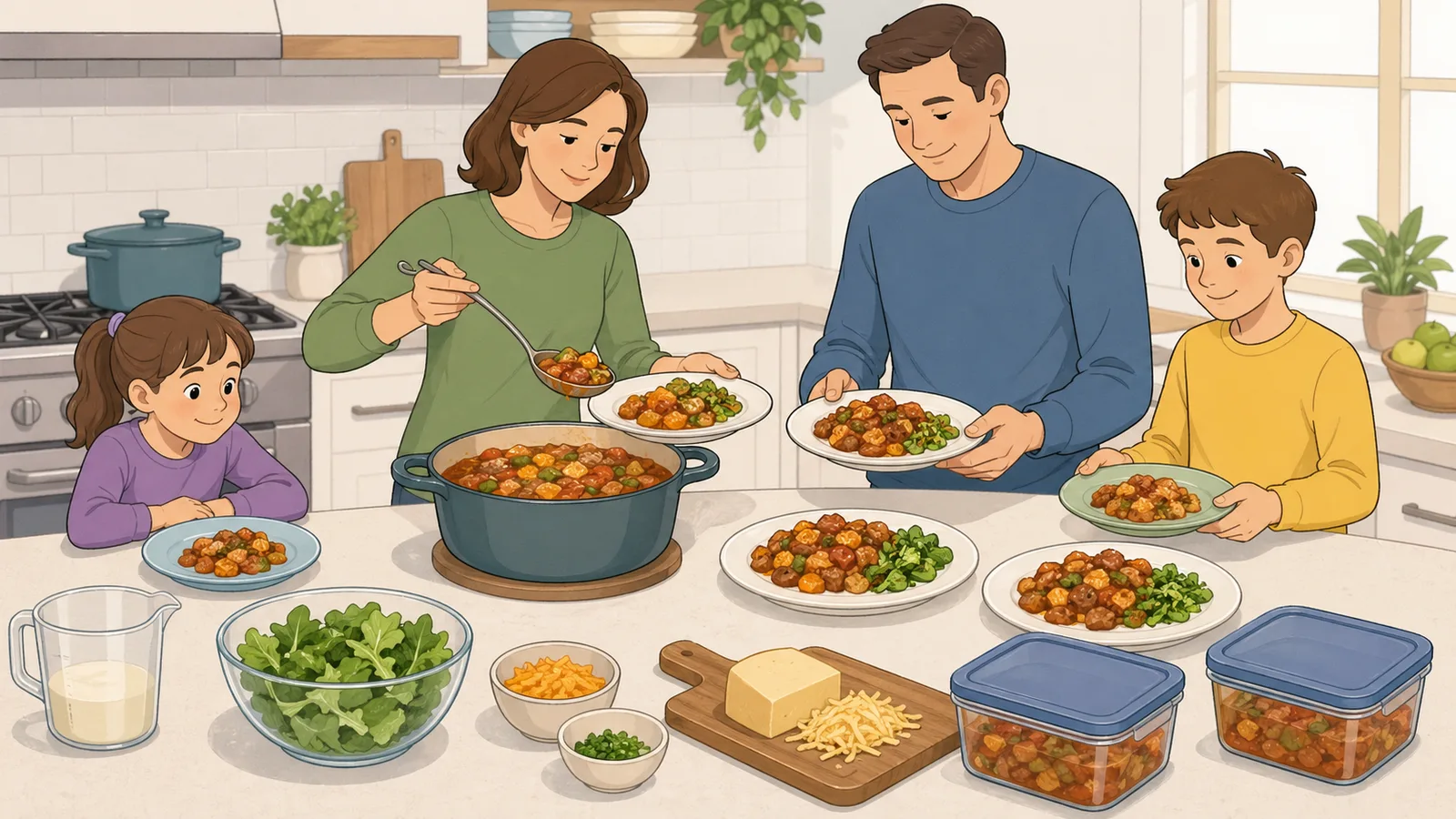
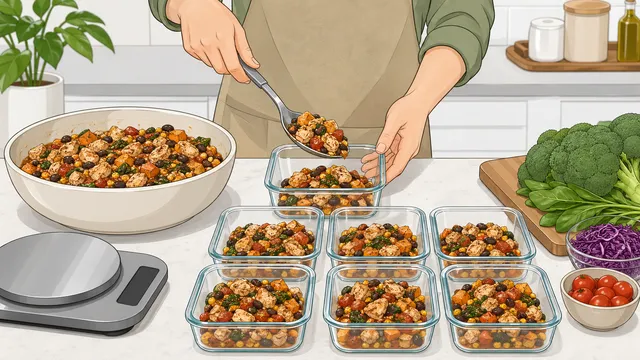
Use this family scaling calculator to scale recipes for adults, children, appetite, and leftovers, with a direct ingredient sheet and family-serving estimate.
Health estimate
Topic review: Maria Santos
Diet & Lifestyle Coach. Assigned as the health topic reviewer for nutrition, macro, calorie, and lifestyle diet calculators.
Family scaling calculator Use this family scaling calculator to scale a recipe for family size by adults, children, appetite, and leftovers, then convert the result into a recipe scaling plan and a leftover servings estimate.
Example households
Recipe ingredients
Add ingredient quantities if you want the calculator to scale the shopping and cooking amounts, not just the target servings.
Family scaling result
5.2 target servings
This family meal portion calculator estimates 3.2 servings for the household and adds 2 leftover servings, so the recipe scales by x1.3.
Adult-equivalent servings
3.2
Scale factor
x1.3
Leftover servings
2
Extra meal coverage
0.63
Adult vs child split
Adults contribute 2 servings and children contribute 1.2 servings using a 60% child-share rule.
Appetite adjustment
Household appetite is set to 100%, which lets you scale by appetite rather than headcount alone.
Leftover read
A leftover plan of 2 servings covers about 0.63 extra family meals at the same household serving pattern.
Scaled ingredient sheet
Ingredient
Scaled quantity
Unit
Rice
2.6
cups
Chicken
650
g
Broccoli
390
g
Scaling note Most family meal portion plans scale linearly, but baking recipes, strong spices, salt, and some sauces may need judgement instead of exact multiplication when you scale far up or down.
Family scaling calculator: scale recipes for adults, children, and leftovers
Use this family scaling calculator to scale a recipe for family size by adults, children, appetite, and leftovers. It is useful when you want a recipe scaling calculator that does more than multiply by headcount and instead helps answer how much food a household really needs.
How family recipe scaling works
A family scaling calculator starts with the recipe's original serving count and then converts the household into adult-equivalent servings. That matters because two adults and two children do not always eat like four full adult portions, especially when the meal is for younger children or the plan intentionally includes leftovers.
This is why searches like family scaling calculator, scale recipe for family size, and recipe scaler for adults and children point to a slightly different task than a generic recipe multiplier. The job is not only to multiply ingredients, but also to make a realistic portion assumption for the household.
Adults, children, and appetite are different inputs
Adults are usually treated as full servings, while children are often estimated as a percentage of an adult portion. A common planning shortcut is to count each child as roughly one-half to three-quarters of an adult serving depending on age, appetite, and the type of meal.
Appetite can also change the answer. A family meal portion calculator is more useful when it can scale by appetite, not just by headcount, because a light lunch, a training-day dinner, and a buffet-style family meal do not all require the same portion size even with the same number of people.
Required family servings = (adults + children x child share) x appetite factor
Converts the household into adult-equivalent servings before planning leftovers.
Total planned servings = required family servings + desired leftover servings
Adds extra portions for tomorrow's lunch, meal prep, or deliberate leftovers.
Scale factor = total planned servings / base recipe servings
Applies the family portion plan to the original recipe yield.
How much food for 2 adults and 2 children
There is no single correct answer because the age of the children and the meal itself matter, but a practical planning approach is to convert the family into adult-equivalent servings. For example, 2 adults and 2 children at 60% child servings equals 3.2 servings before you add any leftovers.
If the base recipe serves 4 and you want 2 leftover servings for lunches, the total plan becomes 5.2 servings. That means the recipe should be scaled by 5.2 / 4, or 1.3 times the original ingredient list.
Why leftovers change the scale factor
A leftover servings calculator is useful because households often cook once and eat twice. If you want tomorrow's lunch, freezer portions, or a buffer for hungrier eaters, those servings need to be added before scaling the recipe.
Leftovers also change shopping behaviour. A recipe quantity calculator for family use is stronger when it tells you not only the immediate dinner target, but also how many future servings the batch is meant to cover.
When recipe scaling stops being perfectly linear
Most family meals scale linearly for core ingredients, especially proteins, grains, vegetables, sauces, and one-pot dishes. But spices, salt, chilies, and some baking ingredients may need more judgement because doubling the recipe does not always mean you should exactly double every flavouring or leavening input.
That is why a family recipe portion planner should be treated as a measurement and shopping aid first. Once the scale factor is known, cooks should still taste and adjust where the recipe itself is sensitive.
How to use this with shopping and meal prep
This type of planner is helpful before both one-time dinners and recurring meal prep. For a one-time dinner, you can set leftovers to zero and target only the family meal. For meal prep, you can increase the leftover setting so the batch intentionally covers later lunches or reheated dinners.
That makes the page relevant for queries like meal prep portion calculator and shopping list quantity planning. The scaled ingredient sheet shows what to buy or prep for the batch you actually want, not just for the original recipe yield.
A standard recipe scaling calculator usually asks for original servings and desired servings. That is enough when you already know the exact target yield, but family meals often start with a fuzzier question: how much food should this household actually cook tonight?
This page answers that household planning step first. It converts adults and children into adult-equivalent servings, adjusts for appetite, adds leftover servings, and only then applies the recipe scale factor. That makes it more useful for family dinner planning than a simple double-or-half recipe multiplier.
What this planner does not cover
This calculator does not estimate calories, nutrient adequacy, allergy substitutions, or medically prescribed meal portions. It also does not determine infant feeding, texture-modified diets, or therapeutic meal plans where standard family portion shortcuts are inappropriate.
Use it as a household meal-planning aid rather than a clinical nutrition tool. For medically significant diets, allergy management, or very young children, the underlying portion assumptions should come from a qualified source rather than a generic family scaling rule.
Frequently asked questions
How do you scale a recipe for family size?
Start with the recipe's original serving count, convert the household into adult-equivalent servings, add any desired leftovers, and divide that target by the base recipe servings to get the scale factor.
How much food do 2 adults and 2 children need?
A practical estimate is to count adults as full servings and children as a partial share, often around 50% to 75% of an adult serving. The exact answer depends on age, appetite, and the type of meal.
Should children count as full servings?
Not always. Younger children often eat less than adults, which is why a child-serving percentage is a useful planning shortcut. Older children or teens may be closer to full adult servings.
How do leftovers affect family meal planning?
Leftovers should be added as extra servings before scaling the recipe. That way the scale factor reflects both tonight's meal and the extra portions you want for lunches, meal prep, or freezer storage.
Can you scale meals by appetite, not just headcount?
Yes. Appetite adjustment helps when a meal is meant to be lighter or heavier than average. It is a practical way to avoid undercooking or overcooking when household appetite is not typical.
When does recipe scaling stop being linear?
Core ingredients usually scale linearly, but spices, salt, chilies, and many baking ingredients often need judgement. Large upscales or downscales are where exact multiplication becomes less reliable.
Do spices and baking ingredients scale the same way?
Not always. Spices and salt may taste too strong if scaled mechanically, and baking ingredients can change texture or rise. Use the scale factor as a starting point, then adjust where the recipe is sensitive.
How do you estimate total servings after scaling?
Total planned servings equal the household's required servings plus any target leftovers. That total is what the scaled batch is meant to produce.
Is this better for meal prep or one-time dinners?
It works for both. Set leftovers to zero for a one-time family dinner, or add leftover servings when you want the same batch to cover future meals.
Can a family scaling calculator help with shopping lists?
Yes. Once the scale factor is known, the ingredient sheet tells you how much of each item the larger or smaller batch needs, which makes shopping and prep planning easier.
Is this the same as a recipe multiplier calculator?
No. A recipe multiplier calculator usually multiplies ingredients from original servings to target servings. This calculator first estimates the target servings from adults, children, appetite, and leftovers, then uses that target to scale the recipe.