Convert approximate hardness between HRC, HRB, HBW, HV, and Shore D-style references with steel-table interpolation, presets, and range warnings.
Last updated
Hardness conversion reference Compare Rockwell C, Rockwell B, Brinell, Vickers, and Shore D-style hardness readings using a steel-table interpolation model with visible range warnings.
Reference presets
Approximation warning
The HRC, HRB, HBW, and HV values are interpolated from a practical carbon/alloy steel reference table. Material family, heat treatment, test load, and the exact ASTM E140 table range can still shift the real equivalent value.
Selected source scale: Rockwell C. Best for hardened steels and hard tool steels.
Enter a hardness value Provide a starting hardness value and scale to compare approximate equivalents.
Hardness converter: approximate HRC, HRB, HBW, HV, and Shore D crosswalk
A hardness converter is useful when a material specification, heat-treatment note, or inspection report is expressed on a different hardness scale from the one you need. This page gives a practical approximation across common Rockwell, Brinell, Vickers, and Shore D labels while making the limitations explicit.
Why hardness conversion is never exact
Hardness scales are built from different indentation methods, penetrators, loads, and response curves. Rockwell B, Rockwell C, Brinell, Vickers, and Shore D are not simple decimal reskins of one another.
That is why published conversion standards rely on empirical hardness conversion tables rather than one universal formula. A converter can still be useful for planning and rough comparison, but it should never hide the fact that the real relationship depends on method, range, and material family.
The calculator now uses a steel-table interpolation approach for the HRC, HRB, HBW, and HV relationship instead of a single straight-line formula. That makes common searches such as HRC to Brinell, Brinell to Rockwell, and Vickers to Rockwell easier to compare while still keeping the approximation warning visible.
When an approximate crosswalk is helpful
Approximate conversion is helpful when you are reading mixed documents, sanity-checking a supplier note, or trying to understand where one reported value sits relative to another scale used in the same field.
It is not the right tool for certifying a part, accepting material against a contract, or replacing the exact ASTM table for a specific alloy and range. Those tasks need the formal standard and the measured method context, not just a quick equivalent number.
A hardness conversion calculator is most useful when the question is interpretive: whether a 40 HRC note is in the same general region as a 371 HBW value, whether an HV value belongs in a hardened-steel range, or whether a Rockwell B reading is too soft to discuss as Rockwell C.
approximate target scale = fitted relation from a common reference scale
Shows that the page uses an approximate fitted comparison rather than an exact universal law.
Rockwell C, Rockwell B, Brinell, and Vickers are used for different jobs
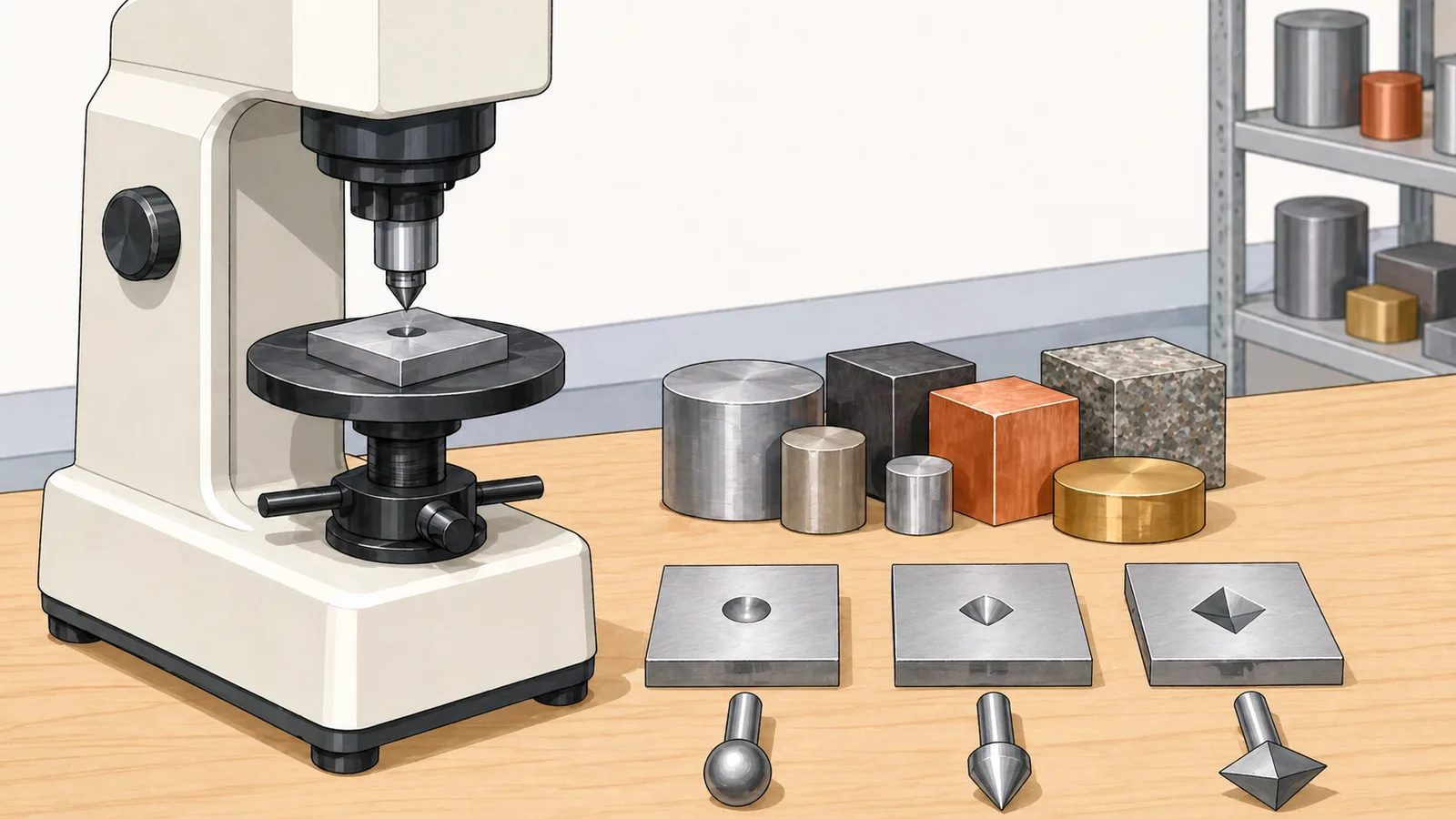
Rockwell C hardness is common for hardened steels because the diamond cone and heavier load suit hard surfaces. Rockwell B hardness is normally the softer-scale choice for lower-hardness metals, brass, bronze, and softer steel checks.
Brinell hardness uses a larger ball impression, so it is often easier to relate to castings, forgings, and stock where a bigger indentation is acceptable. Vickers hardness uses a diamond pyramid and is widely used when the indent needs to be small or when a lab wants one scale that can span a broad hardness range.
The converter keeps these scale choices visible because the best equivalent number is not always the best inspection method. If a drawing says HRC, measure HRC where possible. If a mill certificate reports HBW, convert only to understand the approximate neighborhood.
40 HRC ≈ 371 HBW ≈ 392 HV
Typical steel-table crosswalk values for a common hardened-steel reference point.
50 HRC ≈ 481 HBW ≈ 513 HV
Shows why the relationship becomes steeper at higher hardness and should not be treated as a simple linear conversion.
How to read the warning band
The highlighted range note exists because cross-scale fits become less reliable as you move away from the core overlapping range. A number can still be converted mathematically outside that band, but the practical confidence drops.
Treat the result as an informed estimate first and a specification value never. If a purchase decision, certification step, or process release depends on the hardness number, return to the standard method and official conversion table.
The source-scale range warning matters most when a Rockwell B value is below the HRC overlap, when a very high HRC value produces a Brinell number outside the recommended Brinell test range, or when a Shore D reading is being compared with metal hardness scales for rough context rather than acceptance.
Why Shore D is shown with extra caution
Shore D is a durometer scale used mainly for harder plastics and elastomers, while Rockwell, Brinell, and Vickers are indentation hardness methods used heavily in metals and engineering materials.
Some quick hardness converter pages put Shore D beside HRC, HRB, HB, and HV because users often need a broad material-hardness reference. This page includes it only as an illustrative comparison and flags it as weaker than the steel-table relationship between Rockwell, Brinell, and Vickers.
If a material decision depends on polymer hardness, use the actual Shore D measurement and the polymer specification. Do not accept or reject a metal part from a Shore D-style equivalent.
How this page differs from a plain hardness conversion chart
A printed hardness conversion chart is useful when you already know which row and material family to use. The calculator adds presets, source-scale checks, range notes, and a grouped result table so the user can see both the equivalent numbers and the confidence problem at the same time.
That is especially useful on mobile or during supplier review, where the practical question is often not just "what is the equivalent hardness?" but "is this equivalent inside the range where the comparison makes sense?"
The result should help a real user decide the next step: compare the approximate region, choose the correct test scale for a drawing, or escalate to the exact standard table when the number is critical.
Frequently asked questions
Why does the page call the result approximate?
Because hardness scales are method-dependent and do not convert by one exact universal formula. The result is useful for comparison, but formal acceptance work still needs the official standard table and the exact material context.
Can I convert any metal hardness value with full confidence?
No. Confidence depends on the scale, the material, and whether the value sits inside the range where published cross-scale comparisons are considered reliable.
How do I convert HRC to Brinell hardness?
Use a hardness conversion table or a calculator that interpolates table values. For a common steel-table reference, 40 HRC is about 371 HBW and 50 HRC is about 481 HBW, but the relationship is not a single exact formula.
How do I convert Brinell to Rockwell C?
Start with the Brinell value, map it through the relevant steel or material-specific conversion table, and read the approximate Rockwell C equivalent only if the value lies in the HRC overlap. Softer Brinell values may be better discussed as Rockwell B rather than Rockwell C.
What is the difference between Rockwell B and Rockwell C?
Rockwell B uses a ball indenter and is better suited to softer metals. Rockwell C uses a diamond cone and is intended for harder materials such as hardened steels. The scales overlap only partly, so a low HRB value may not have a meaningful HRC equivalent.
Is Vickers hardness easier to compare than Rockwell?
Vickers can span a broad range with the same diamond-pyramid geometry, which makes it useful in labs and microhardness work. It still needs method context, load details, and material awareness before it becomes a specification-grade value.
Why include Shore D with Rockwell and Vickers scales?
Because many practical reference sheets compare polymer and harder-material readings side by side. The page keeps Shore D available for broad comparison, but it is not an ASTM E140 metal conversion and the warning matters even more there.
Should I use this page for inspection signoff?
No. Use it for planning, reading, and rough comparison only. Inspection signoff should follow the specified hardness method and the governing conversion or acceptance standard.
Why can a high HRC value produce a Brinell warning?
Very hard values can exceed the recommended Brinell testing range even when a table prints an approximate equivalent. The warning tells you the number may be informative but should not be treated as a clean Brinell acceptance value.
Can I use the steel hardness conversion for aluminum or stainless steel?
Use caution. ASTM conversion relationships vary by material family, and the steel-table relationship should not be reused blindly for aluminum, copper alloys, austenitic stainless steel, or other non-steel materials.