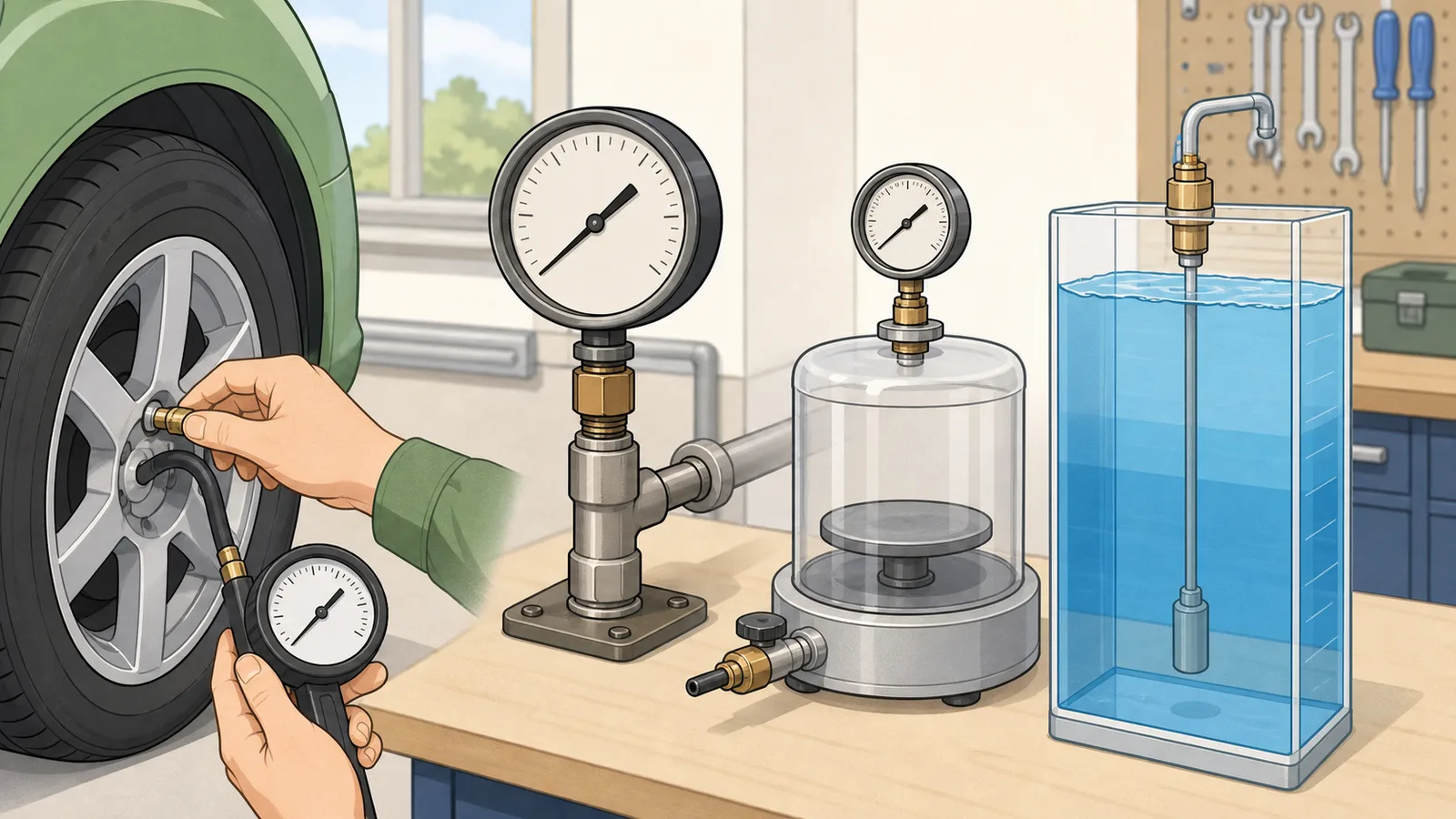
Convert pressure units across psi, bar, kPa, Pa, atm, torr, mmHg, inHg, microns, kgf/cm², and contextual tyre, vacuum, and water-depth pressure workflows.
Last updated
Pressure converterConvert pressure units for engineering, weather, tyres, vacuum service, lab readings, and water-depth reference work without mixing gauge and absolute-pressure assumptions.
Context
Common conversion intents
General pressure reference
This page converts the unit first, then shows context-specific interpretation. Tyre gauge readings stay gauge-based, vacuum readings are interpreted as absolute pressure, and water-depth results show both absolute and gauge pressure.
Result
101.325 kPa
1 atm equals 101.325 kPa, 1.0133 bar, 14.6959 psi, and 760 Torr.
Pressure converter: psi, bar, kPa, vacuum, tyre, and water-depth pressure explained
A pressure converter shows the same reading in the units used across engineering, weather, automotive, laboratory, vacuum, and water-depth contexts. Enter pascals, kilopascals, megapascals, bar, millibar, psi, atmospheres, millimetres of mercury, inches of mercury, torr, microns, or kgf/cm², then switch context for tyre placard comparison, vacuum interpretation, or depth pressure.
How pressure conversion works
Each supported unit is converted into pascals first, because the pascal is the SI unit for pressure. Once the reading has been expressed in pascals, the calculator divides by each unit factor to show the matching value in kPa, MPa, bar, mbar, psi, atmospheres, mercury-column units, torr, microns, and kgf/cm².
This conversion step does not silently change the pressure reference. A gauge reading remains gauge pressure after conversion; an absolute reading remains absolute pressure. The context panels explain how to interpret tyre, vacuum, and water-depth readings without mixing those reference zeros.
1 Pa = 1 N/m²
The pascal is one newton of force applied over one square metre.
1 bar = 100,000 Pa
Bar is a metric pressure unit commonly used in weather, tyre, and industrial work.
1 atm = 101,325 Pa
Standard atmosphere is a fixed reference pressure close to average sea-level air pressure.
Common pressure units and where they appear
Pascals, kilopascals, and megapascals are common in SI-based technical documents. Kilopascals are convenient for everyday readings such as weather maps and tyre placards, while megapascals keep large hydraulic or materials values readable. Bar and millibar remain common in meteorology, process engineering, and equipment specifications.
Psi is widely used in the United States for tyres, compressors, and mechanical systems. Millimetres of mercury and torr appear in laboratory, medical, and vacuum settings. Inches of mercury are still familiar in aviation, barometric reporting, and some vacuum-gauge references. Microns are millitorr, so they are especially useful for deep vacuum readings that would otherwise be small Torr decimals.
Absolute, gauge, and atmospheric reference
Pressure numbers can look similar while meaning different things depending on the reference zero. Absolute pressure is measured against a vacuum. Gauge pressure is measured relative to the surrounding atmosphere. Standard atmospheric pressure is defined as 101,325 Pa, which is also 1.01325 bar, 14.6959 psi, and 760 mmHg.
That distinction matters because 0 psi gauge is not zero absolute pressure. If you are comparing a tyre-pressure reading, a weather pressure chart, a vacuum specification, and a water-depth calculation, always check whether the source is absolute, gauge, or differential pressure before interpreting the converted values.
Tyre pressure: placard target, cold inflation, psi, bar, and kPa
Tyre pressure conversion is usually a unit problem plus a target-comparison problem. Pumps, TPMS displays, and manuals may use psi, bar, kPa, or kgf/cm², but the correct routine target comes from the vehicle placard or owner’s manual. That is why the tyre context lets you enter the gauge reading and an optional cold placard target, then reports the difference in psi, kPa, bar, and percent from target.
Many passenger cars start around 32 to 35 psi when cold, so that range is useful as orientation. It is not a universal recommendation. Vehicle weight distribution, tyre size, load, speed rating, axle position, and manufacturer guidance can all move the correct pressure outside that band.
Cold inflation matters because tyre pressure rises as the tyre warms during driving. A hot reading can be higher than the placard target without meaning the tyre should be deflated immediately. Use the converter to translate the units, then compare the reading with the correct cold value for the specific vehicle.
Difference = gauge reading − placard target
A negative value means the reading is below the target entered.
Percent from target = difference ÷ placard target × 100
This normalises the pressure gap when the target is high or low.
Vacuum pressure: torr, microns, psia, inHg, and percent vacuum
A stronger vacuum means a lower absolute pressure, not a higher one. That is why vacuum work often looks numerically inverted compared with everyday pressure work: the better the evacuation, the fewer pascals, torr, or microns remain in the system.
The vacuum context treats the entered pressure as absolute pressure when it is at or below one standard atmosphere. It then shows torr, microns, psia, inches of mercury absolute, percent of full vacuum on a standard-atmosphere baseline, and a standard-atmosphere inHg vacuum-gauge shorthand.
Percent of full vacuum is not a separate physical quantity. It is a way of describing how much of one atmosphere has been removed, so the atmospheric reference must be stated. This page uses one standard atmosphere for the percentage baseline and explicitly flags that local weather and altitude can change field-gauge interpretation.
1 micron = 0.001 Torr
Deep-vacuum service work often writes millitorr as microns so evacuation targets remain easy to read.
% full vacuum = (1 − Pabs / Patm) × 100
Reference relationship used here to express the same absolute reading as a percentage of one standard atmosphere removed.
inHg vacuum gauge ≈ 29.9213 − inHg absolute
Standard-atmosphere shorthand only; real field gauges depend on local atmospheric pressure.
Water depth pressure: fresh water, salt water, absolute pressure, and gauge pressure
Water pressure rises because every additional metre or foot adds more fluid weight above the point you are measuring. The water-depth context applies hydrostatic pressure from the water column and then adds one atmosphere at the surface to report absolute pressure in bar, atm, psi, and kPa.
Fresh water and salt water are close but not identical. Salt water is denser, so the same depth produces slightly higher pressure. The calculator keeps that density assumption visible rather than hiding it in the background.
Absolute pressure includes the atmosphere at the surface. Gauge pressure removes that atmosphere and keeps only the water-column contribution. The distinction is important when comparing dive references, aquarium pressure checks, tank work, and hydraulic examples.
Pabs = Patm + ρgh
Absolute pressure equals atmospheric pressure plus hydrostatic pressure from the water column.
Pgauge = ρgh
Gauge pressure at depth excludes the atmosphere and keeps only the water-column contribution.
Worked examples and quick checks
A tyre placard example: 32 psi is about 220.63 kPa, 2.206 bar, and 2.25 kgf/cm². If the placard target is 35 psi, the gauge reading is 3 psi below target, or roughly 20.7 kPa below target.
A vacuum example: 500 microns is 0.5 Torr, about 66.66 Pa absolute, about 0.6666 mbar, and roughly 99.93% full vacuum on the standard-atmosphere reference used here.
A water-depth example: 10 metres in salt water is close to 2 atmospheres absolute because the water column adds about one atmosphere on top of the surface atmosphere. Fresh-water and salt-water rows differ slightly because the density assumption is different.
Tyre sidewall pressure is usually not the everyday placard target.
Frequently asked questions
What is normal atmospheric pressure in common units?
Standard atmospheric pressure is 101,325 Pa, which equals 101.325 kPa, 1.01325 bar, 14.6959 psi, 760 mmHg, and 29.9213 inHg. Actual local weather pressure can be higher or lower than that reference value.
Are mmHg and torr the same?
They are extremely close and are treated as equal in many practical contexts. Historically they come from related but slightly different definitions, but for everyday conversion work the difference is negligible.
Is bar an SI unit?
No. The SI unit of pressure is the pascal. Bar is a widely used metric unit outside the SI, and it converts exactly to 100,000 pascals.
How do I convert tyre pressure from bar to psi?
Enter the pressure, choose bar, and read the psi result. As a common example, 2.2 bar is about 31.9 psi. Use that converted number to compare with the vehicle placard, not with the sidewall maximum.
Should tyre pressure be checked hot or cold?
Vehicle placard pressures are normally cold inflation pressures. A hot tyre reading is expected to be higher after driving, so it should not usually be deflated down to the cold target immediately after use.
Is micron the same as millitorr?
Yes for practical vacuum conversion work. One micron equals one thousandth of a torr, so 1,000 microns equals 1 Torr and 500 microns equals 0.5 Torr.
What does percent of full vacuum mean?
On this page it means the fraction of one standard atmosphere removed from the system. It is derived from absolute pressure, so local atmospheric pressure can change how a field gauge should be interpreted.
How much pressure is there at 10 metres underwater?
In salt water it is close to 2 atmospheres absolute: roughly one atmosphere from the air plus about one more from the water column. The exact result depends on water density and the surface-pressure assumption.
What is the difference between absolute and gauge pressure at depth?
Absolute pressure includes the atmosphere at the surface. Gauge pressure removes that atmosphere and keeps only the pressure added by the water column.