Convert energy units including joules, calories, kilocalories, watt-hours, kilowatt-hours, megawatt-hours, BTU, therms, electronvolts, foot-pounds, and ergs.
Last updated
Energy converter Convert the same amount of energy across scientific, electrical, food, and heating units, from joules and kilowatt-hours to calories, BTU, therms, and megawatt-hours.
Common presets
Choose a common energy conversion or enter your own amount.
Power × time helper
If you know watts and hours, calculate the energy first, then send that result into the converter as kilowatt-hours.
Energy versus power
Energy measures total work or heat transferred. Power measures the rate at which that energy is used. A 1 kWh battery stores energy, while a 1 kW appliance describes how fast it consumes that energy.
Quick checkpoints
1 kcal = 4,184 J. 1 kWh = 3,600,000 J. 1 BTU ≈ 1,055.06 J. 1 therm = 100,000 BTU. Food labels often write “Calories” but mean kilocalories.
Enter a value Provide an energy amount to compare food, electrical, heating, or scientific units side by side.
Energy converter: joules, calories, BTU, therms, and kilowatt-hours explained
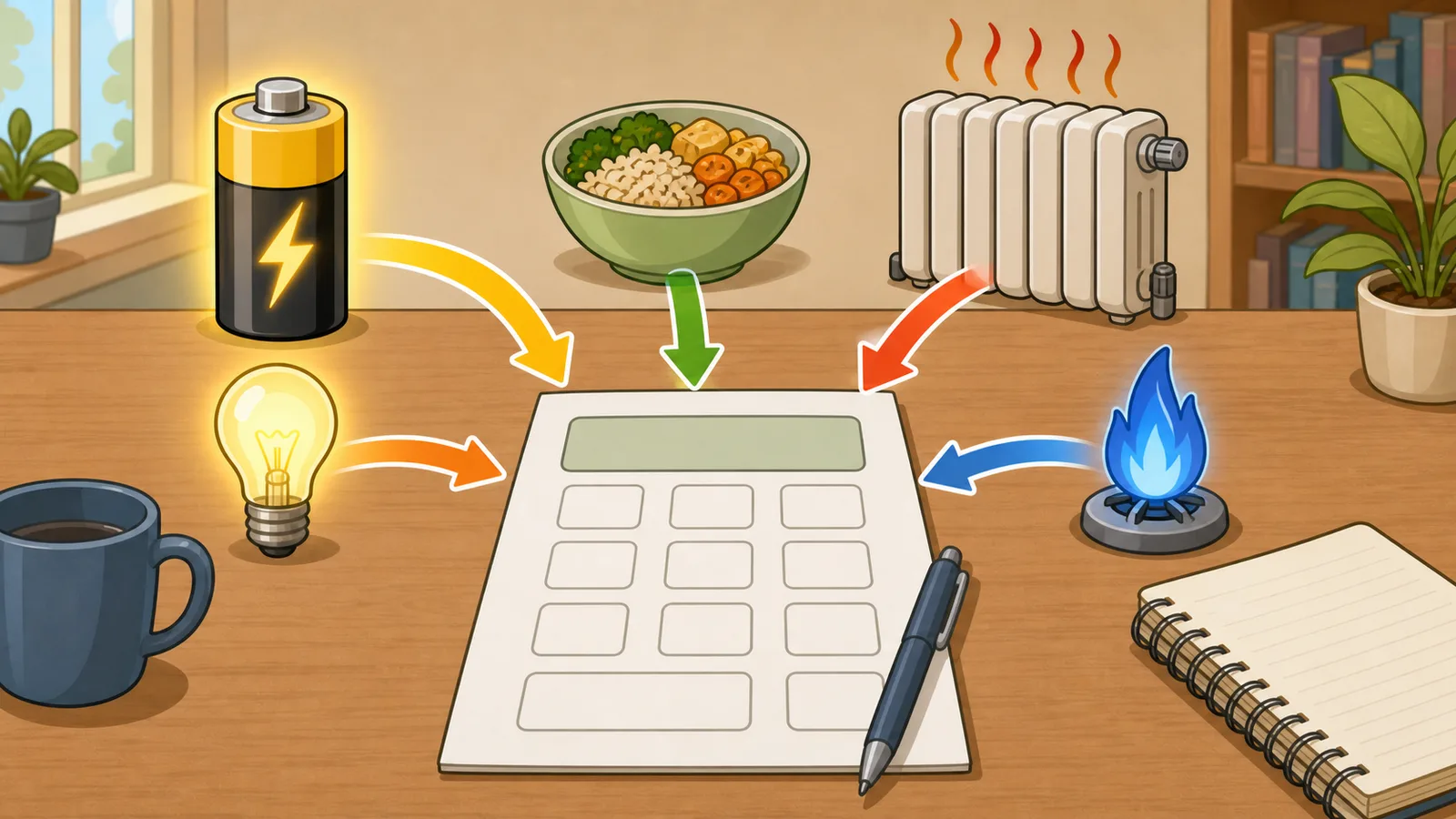
An energy converter translates the same quantity of stored or transferred energy into whichever unit fits the job. That may mean joules for physics, kilowatt-hours and megawatt-hours for electricity, kilocalories for food, BTU and therms for heating, or foot-pounds, ergs, and electronvolts for specialist contexts. Enter a value in any supported unit, use the watts-times-hours helper when needed, and compare the full set instantly.
How energy conversion works
Every unit in the converter is tied back to a common base unit: the joule. Once the input has been converted into joules, the calculator divides that same total by each unit factor to show all equivalent values. This keeps the logic consistent whether you start with kilowatt-hours, kilocalories, BTU, therms, megawatt-hours, or a very small scientific unit such as the electronvolt.
The most important thing to remember is that energy measures a total amount. A battery, a meal, a gas bill, an HVAC rating, and a physics experiment can all be described in different units, but they are still measuring the same underlying concept: how much work, heat, or stored capacity is available.
J = kcal × 4,184
One food kilocalorie equals 4,184 joules.
J = kWh × 3,600,000
One kilowatt-hour equals 3.6 million joules.
J = BTU × 1,055.06
A British thermal unit is approximately 1,055.06 joules.
1 therm = 100,000 BTU
A therm is a larger heating and natural-gas energy unit.
When each energy unit is useful
Joules, kilojoules, megajoules, and gigajoules are common in science, engineering, and technical specifications. Kilowatt-hours are the familiar household electricity unit because they are large enough to describe appliance use and utility billing without huge numbers. Megawatt-hours are more useful for grid, generator, and large battery contexts.
Calories can be confusing because the small calorie and the food Calorie are not the same thing in everyday writing. Nutrition labels generally use “Calories” with a capital C, but that actually means kilocalories. This converter keeps both calorie units explicit so you can see the exact scale being used.
BTU and therms are heating-oriented units. BTU are common in appliance and HVAC specifications, while therms appear in some natural-gas billing contexts. Showing both alongside joules and kilowatt-hours makes it easier to compare heat, electricity, and fuel-energy figures without opening a separate BTU converter.
Using watts and hours to get energy first
Many real questions start with power and time rather than a ready-made energy value. A 100 W device running for 10 hours uses 1,000 Wh, which is 1 kWh. The power × time helper calculates that energy first and then sends it into the converter as kilowatt-hours.
This matters because power and energy are easy to mix up. Watts describe the rate of energy use, while watt-hours and kilowatt-hours describe the total amount used over time. The helper keeps that distinction visible before the unit conversion starts.
Practical interpretation tips
If you are comparing equipment ratings, match the unit to the source document before converting. Electricity bills usually quote kWh, food packaging uses kcal, boiler or air-conditioning literature may use BTU, and gas bills may use therms or local equivalents. Converting everything to joules can help you compare like for like, but the original unit is often the most readable for the user.
For very large or very small values the converter switches to compact scientific notation so the number remains readable. That is especially useful for electronvolts, ergs, and other units that would otherwise display an impractical number of leading or trailing zeros.
Further reading
BIPM — SI base units — Official reference for the SI framework that underpins joules, watts, and the rest of the energy-conversion chain.
The context comparison rows translate your result into familiar reference buckets: food Calories, electricity-bill kWh, HVAC BTU, and therms. These are not claiming that every unit is used in every country or bill format; they are quick interpretation anchors for the same physical amount of energy.
For example, entering 1 kWh shows the same energy as about 860 food kilocalories, about 3,412 BTU, and a small fraction of a therm. That makes the result more useful than a bare unit table because it links the conversion to how people encounter energy in everyday documents.
Scope and limitations
This page converts energy units only. It does not estimate electricity cost, appliance runtime, combustion efficiency, heating-system performance, battery voltage, or greenhouse-gas emissions. Those questions need additional assumptions beyond the unit conversion.
The factors are fixed reference conversion factors. Real bills, fuel invoices, equipment labels, and country-specific standards can use rounded values, local billing definitions, or gross/net heat content conventions, so always match the unit definition in the source document when money, compliance, or engineering margins matter.
Compare with related calculators
Use this energy converter when you already know an energy amount or can derive one from watts and hours. Use a battery, electricity-cost, or power calculator when voltage, current, runtime, tariff, or device-rating assumptions are part of the real question.
For mechanical work problems, a mechanical energy converter may be more focused because it emphasises joules, newton-metres, foot-pounds, and related work units without food, heat, and electricity units in the same table.
An energy converter changes the same amount of energy from one unit into another, such as joules to kilowatt-hours, kilocalories to joules, BTU to kWh, or therms to BTU.
What is the difference between energy and power?
Energy is a total amount, while power is the rate at which energy is used or delivered. A battery may store 60 kWh of energy, but a charger may deliver that energy at 7 kW of power.
How do I convert watts and hours to kWh?
Multiply watts by hours to get watt-hours, then divide by 1,000 to get kilowatt-hours. For example, 100 W for 10 hours is 1,000 Wh, or 1 kWh.
Why do food labels use Calories instead of joules?
Food labels often use Calories because the numbers are easier for consumers to interpret than joules. In nutrition, 1 Calorie with a capital C means 1 kilocalorie, which equals 4,184 joules.
How many joules are in 1 kilowatt-hour?
One kilowatt-hour equals 3,600,000 joules. That comes from 1,000 watts sustained for 3,600 seconds, and a watt is defined as one joule per second.
How many BTU are in a therm?
One therm is defined here as 100,000 BTU. The calculator also converts that therm to joules, kilowatt-hours, and the other supported energy units.
Why is BTU still used for heating equipment?
BTU remains common in heating and cooling because it has long been used in HVAC sizing and fuel-heating discussions. The unit is older, but it still describes the same physical quantity of energy and can be converted directly to joules or kilowatt-hours.
When should I use MWh instead of kWh?
Use MWh for large electrical-energy quantities such as grid generation, commercial storage, or utility-scale reporting. One MWh equals 1,000 kWh.
Can this converter calculate energy cost?
No. It converts energy units only. To estimate cost, you need a price per kWh, therm, or fuel unit and should use an energy cost calculator or your tariff details.
Are these conversion factors country-specific?
Most physics unit factors are universal, but billing conventions and rounded display values can vary. This page is a universal reference converter, so check the exact unit definition on bills or regulated documents when precision matters.