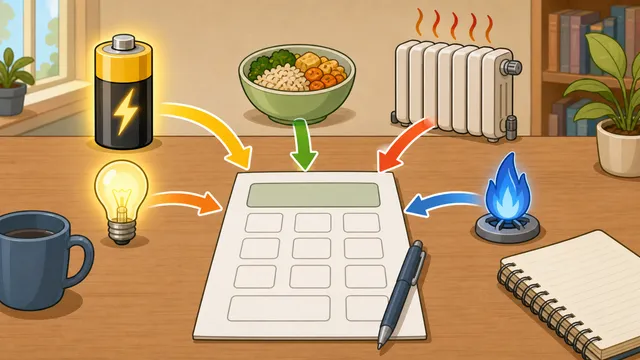
Convert power units including watts, kilowatts, horsepower, BTU per hour, tons of refrigeration, calories per second, and foot-pounds per second.
Last updated
Power converter Compare electrical, mechanical, and heating power ratings in one place, from watts and kilowatts to horsepower and BTU per hour.
Common presets
When to use each family
Watts and kilowatts are standard for appliances and electrical systems. Horsepower remains common for engines and motors. BTU per hour and tons of refrigeration are widely used for heating and air-conditioning equipment.
Quick checkpoints
1 hp ≈ 745.7 W. 1 kW ≈ 1.341 hp. 1 BTU/h ≈ 0.2931 W. 1 refrigeration ton = 12,000 BTU/h ≈ 3.517 kW.
Enter a value Provide an appliance, motor, or heating output to compare it across watts, horsepower, and BTU per hour.
Power converter: watts, kilowatts, horsepower, and BTU per hour explained
A power converter compares how quickly energy is being used, produced, or transferred. This page also explains the main assumptions behind the power converter result, highlights the supporting figures shown by the calculator, and helps the reader use the estimate without overstating what a quick online tool can prove.
How power conversion works
All supported units are converted through watts, the coherent SI derived unit for power. Once the input value is translated into watts, the converter divides by each unit factor to produce equivalent ratings in kilowatts, horsepower, BTU per hour, refrigeration tons, and the remaining unit families.
Power describes rate, not total quantity. A 2 kW heater and a 2 kW kettle may have the same power rating, but the total energy each uses depends on how long they run. That is why power is often paired with an energy unit such as kWh on utility bills.
W = hp × 745.6999
Mechanical horsepower converted to watts.
kW = W ÷ 1,000
Kilowatts are simply watts scaled by 1,000.
W = BTU/h × 0.293071
Heating and cooling output converted into watts.
1 refrigeration ton = 12,000 BTU/h ≈ 3.51685 kW
Common HVAC cooling-capacity conversion.
Which power units appear in real life
Watts and kilowatts dominate appliance labels, electrical design, and utility discussions. Horsepower is still widely used for engines, pumps, compressors, and workshop equipment because it gives an intuitive sense of mechanical output. BTU per hour remains common in air-conditioning and heating product literature, especially for room units and domestic HVAC systems. Refrigeration tons are another HVAC shorthand: one ton of refrigeration is conventionally 12,000 BTU per hour.
The less familiar units in the converter are still useful in technical work. Foot-pounds per second appears in mechanical calculations, while calories per second and kilocalories per hour can appear in thermal and metabolic discussions.
How to interpret a converted rating
Use the unit that best matches the source you are comparing against. If you are buying an electric heater, watts or kilowatts are usually clearest. If you are matching a motor to a legacy specification, horsepower may be the better working unit. If you are comparing air-conditioning outputs, BTU per hour may align better with the manufacturer literature.
Do not confuse a power rating with actual running cost. Cost depends on both power and time. A 3 kW heater running for two hours uses 6 kWh of energy, while a 60 W bulb running for the same time uses only 0.12 kWh. The calculator therefore includes a simple one-hour, eight-hour, and 24-hour energy-use table so a converted power rating can be interpreted in kWh terms.
Power vs energy: why kW and kWh are not interchangeable
A watt, kilowatt, horsepower, or BTU per hour rating is a rate. A kilowatt-hour is an accumulated amount of energy. The distinction is important for bills, batteries, generators, and equipment sizing because a large power rating used briefly can consume less energy than a small rating used continuously.
To estimate energy from a power rating, multiply kilowatts by hours of operation. For example, 1.5 kW running for 8 hours uses 12 kWh. That energy estimate is separate from the unit conversion itself, but it is often the next practical question after converting watts, horsepower, or BTU per hour.
When not to use this converter
This page converts power units that already describe the same physical quantity. It does not calculate electrical power from volts, amps, resistance, phase, or power factor. Use the electrical power converter for watts, volts, amps, ohms, kW, VA, kVA, and horsepower relationships that depend on circuit assumptions.
It also does not calculate total energy, fuel use, motor efficiency, coefficient of performance, or actual HVAC capacity from room size. Use the converted rating as a common unit baseline, then apply the appropriate engineering, electrical, or thermal model for the equipment question.
ASHRAE — SI Guide — HVAC-oriented SI guidance useful for interpreting heating and cooling capacity units.
Frequently asked questions
How many watts are in 1 horsepower?
One mechanical horsepower is approximately 745.7 watts. Metric horsepower is slightly smaller at about 735.5 watts, so it is worth checking which definition the source uses.
What is the difference between kW and kWh?
kW is power, meaning the rate of energy use. kWh is energy, meaning how much energy was used over time. A 2 kW appliance running for 3 hours uses 6 kWh.
Why is BTU per hour used for air conditioners?
BTU per hour has been the traditional HVAC sizing unit in the United States. It expresses how much heat the equipment can remove or add per hour, which makes it useful for comparing cooling and heating capacity.
How many BTU per hour are in one ton of refrigeration?
One refrigeration ton equals 12,000 BTU per hour, which is about 3.51685 kW. This is a cooling-capacity convention, not a mass measurement.
Can I compare motor and heater ratings directly?
Yes, once they are converted into the same unit. A power converter makes the rate directly comparable, even though the equipment may serve very different purposes.
Can this convert watts, volts, and amps?
No. Watts, volts, and amps require electrical circuit assumptions such as DC versus AC, phase, and power factor. This page converts power units after the power rating is already known.
Why does the calculator show kWh estimates?
The kWh rows are not extra unit conversions; they show what the converted power would consume if it ran continuously for common time spans. Multiply kW by hours to estimate energy use.