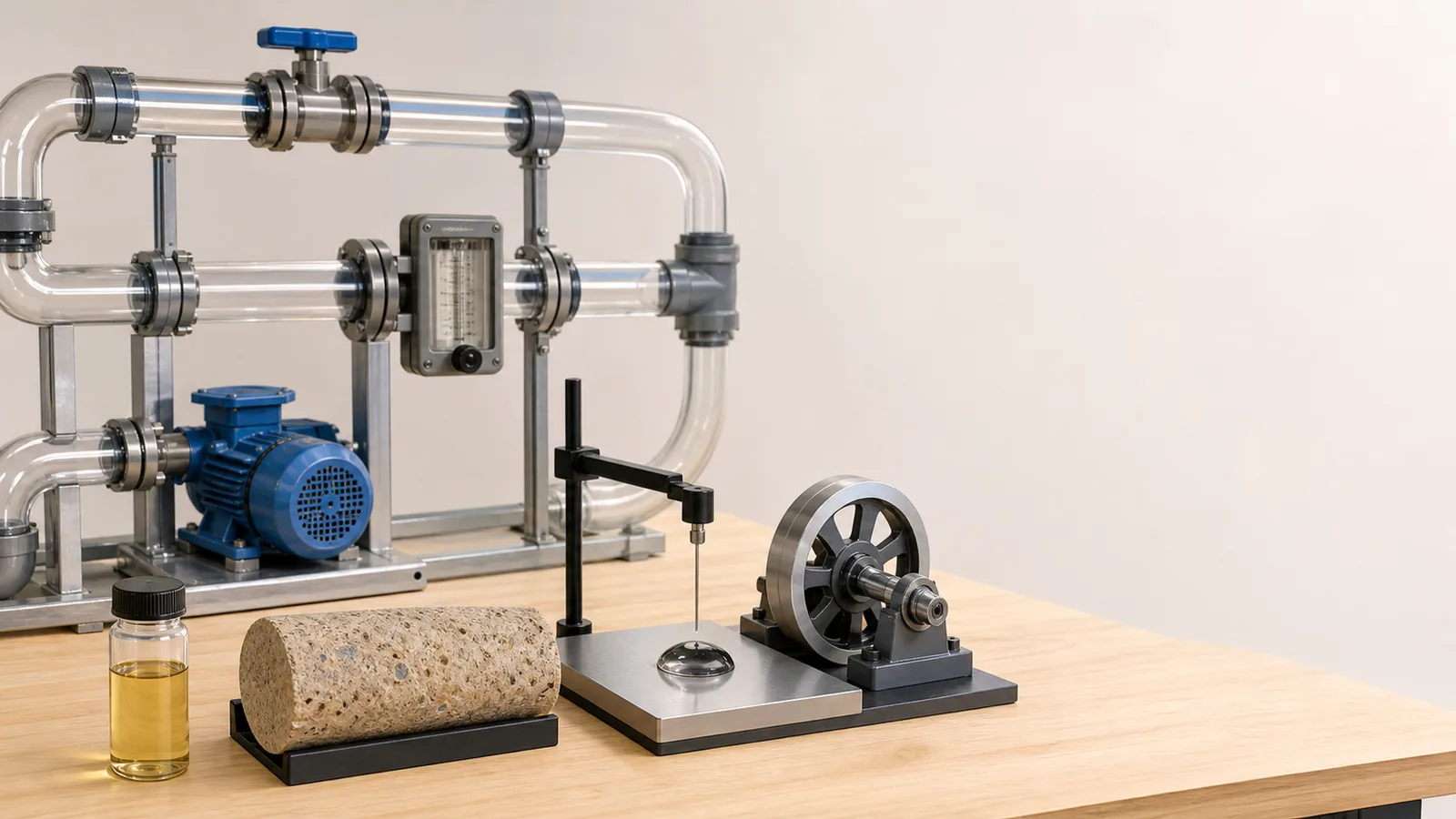
Convert engineering units across viscosity, flow rate, mass flux, permeability, surface tension, specific volume.
Last updated
Engineering units
Choose the engineering property first
Convert fluid and mechanical property units without flattening different physical dimensions into one generic picker.
Viscosity, flow rate, flux, permeability, surface tension, specific volume, and inertia each keep their own panel,
examples, warnings, and result labels.
No false direct conversions Use this as an engineering units converter, not a property solver. Dynamic viscosity needs density before it can be
related to kinematic viscosity; mass, volume, and molar flow need density or molar mass; permeability, surface
tension, specific volume, and moment of inertia answer different questions.
Optional viscosity density bridge
Convert between cP and cSt only when density is known. This keeps the dynamic and kinematic viscosity panels separate while covering the common oil, water, and process-fluid lookup task.
Density bridge result
1 cSt
1 cP at 1,000 kg/m3 is 1 cSt.
Active property
Dynamic viscosity
Convert shear-resistance units such as Pa*s, mPa*s, cP, P, and mass-based imperial viscosity units.
Convert dynamic viscosity between SI, CGS, and explicit mass-based US customary units used in process sheets,
laboratory notes, and equipment references.
Common presets
Interpretation
Dynamic viscosity depends on temperature, pressure, and composition. This page translates the stated value only
and keeps pound-mass notation explicit so it is not confused with force-based units.
Enter values Provide a non-negative dynamic-viscosity value to compare the supported SI, CGS, and imperial mass-based units.
Engineering quantity comparison
Family
Panels
Answers
Keep separate because
Viscosity
Dynamic viscosity, kinematic viscosity
Fluid resistance to shear, with or without density already folded into the unit
Dynamic viscosity cannot become kinematic viscosity without density.
Flow rate
Mass flow, volume flow, molar flow
Throughput by mass, volume, or amount of substance per unit time
Mass, volume, and molar rates need density or molar mass before they can be related.
Flux
Mass flux density
Mass throughput divided by area
Flux is not total flow unless the active area is known.
Permeability
Intrinsic porous-media permeability
How readily a porous medium transmits fluid through its pore structure
Intrinsic permeability is not hydraulic conductivity, air permeability, or magnetic permeability.
Surface tension
Surface or interfacial tension
Force per length along a liquid interface
Surface tension is not viscosity even though both are fluid properties.
Specific volume
Volume per mass
Reciprocal-density style thermodynamic property
Specific volume is not ordinary volume unless mass is known.
Inertia
Mass moment of inertia
Rotational mass distribution for rigid-body and machinery calculations
Moment of inertia is not area moment of inertia or torque.
What moved into this engineering converter
The former specialist pages still matter as search intents: dynamic viscosity converter, kinematic viscosity converter,
mass flow converter, volume flow rate converter, molar flow converter, mass flux converter, permeability converter,
surface tension converter, specific volume converter, and moment of inertia converter. They now resolve into one
canonical engineering units converter with the same jobs separated by property family.
This consolidation keeps the useful long-tail examples while reducing duplicate thin pages. It does not merge density,
pressure, torque, force, power, or thermal-property pages into this suite because those have their own broader workflows.
Engineering units converter: viscosity, flow rate, permeability, surface tension
An engineering units converter is useful only when the physical property stays visible. This page also explains the main assumptions behind the engineering units converter result, highlights the supporting figures shown by the calculator, and helps the reader use the estimate without overstating what a quick online tool can prove.
Why engineering property units must be separated
Engineering handbooks and process notes often mix fluid properties, flow rates, fluxes, porous-media properties, surface-interface values, thermodynamic properties, and rotating machinery data. A direct unit conversion should stay inside one physical quantity. A dynamic viscosity value in cP is not a kinematic viscosity value in cSt unless density is supplied. A mass flow rate in kg/s is not a volume flow rate in L/min unless density is supplied. A molar flow rate cannot become a mass flow rate without molar mass.
The calculator therefore starts with a property-family choice. It converts dynamic viscosity, kinematic viscosity, mass flow rate, volume flow rate, molar flow rate, mass flux density, permeability, surface tension, specific volume, and moment of inertia in separate panels. It does not infer density, molar mass, active area, pore-fluid assumptions, temperature, pressure, geometry, or rigid-body shape factors unless those inputs belong to the same unit family.
Viscosity conversions: Pa*s, cP, St, and cSt
Dynamic viscosity measures resistance to shear and is commonly reported in Pa*s, mPa*s, cP, P, kg/(m*s), lbm/(ft*s), lbm/(ft*h), or slug/(ft*s). The dynamic viscosity panel keeps pound-mass notation explicit so users do not accidentally treat mass-based and force-based viscosity units as the same thing.
Kinematic viscosity is dynamic viscosity divided by density. It is reported as area per time, commonly m2/s, mm2/s, St, cSt, ft2/s, or in2/s. The kinematic viscosity panel handles those units directly, and the optional density bridge relates cP and cSt only when a density value is supplied.
1 Pa*s = 1000 cP
Links coherent SI dynamic viscosity to the common centipoise laboratory scale.
1 St = 1 cm2/s; 1 cSt = 1 mm2/s
Shows the common CGS-to-SI relationships for kinematic viscosity.
nu = mu / rho
Shows why density is required before dynamic and kinematic viscosity can be related.
Using the optional cP to cSt density bridge
Some oil, water, and process-fluid references ask for a quick cP to cSt converter or cSt to cP converter. That is not a pure unit conversion, because density has to connect dynamic viscosity and kinematic viscosity. The bridge on this page therefore asks for density in kg/m3 and leaves the main dynamic-viscosity and kinematic-viscosity panels separated.
With density entered, the relationship is straightforward: cSt equals cP divided by density in g/cm3, and cP equals cSt multiplied by density in g/cm3. A density of 1000 kg/m3 is 1 g/cm3, so 1 cP corresponds to 1 cSt only for a fluid close to that density.
cSt = cP / density(g/cm3)
Dynamic to kinematic viscosity bridge when density is supplied.
cP = cSt * density(g/cm3)
Kinematic to dynamic viscosity bridge when density is supplied.
Flow rate conversions: mass, volume, and molar throughput
Mass flow rate states how much mass passes a boundary per unit time. Use the mass flow panel for kg/s, kg/min, kg/h, g/s, t/h, lb/s, lb/h, and short ton/h values from process sheets, material balances, or feed-rate notes.
Volume flow rate states how much volume passes per unit time. Use the volume flow panel for m3/s, m3/h, L/s, L/min, L/h, mL/s, US gpm, imperial gpm, ft3/s, ft3/min, and barrels per day. US and UK gallons remain separate because the unit names are easy to confuse.
Molar flow rate states amount of substance per unit time. Use the molar flow panel for mol/s, mol/min, mol/h, mol/day, kmol/s, kmol/min, kmol/h, kmol/day, mmol/s, mmol/min, mmol/h, and lb-mol forms.
mass flow = density * volume flow
Shows why density is needed before mass and volume flow can be converted as physical quantities.
mass flow = molar flow * molar mass
Shows why molar mass is needed before molar and mass flow can be related.
Flux, permeability, and surface tension conversions
Mass flux density is mass flow divided by area. Units such as kg/(m2*s), kg/(m2*h), g/(cm2*s), g/(m2*s), lb/(ft2*s), lb/(ft2*h), and kg/(ft2*h) belong together because they are all mass-throughput-per-area values.
Intrinsic permeability is a porous-media property. This suite keeps m2, mm2, um2, nm2, darcy, millidarcy, microdarcy, nanodarcy, cm2, in2, and ft2 in a permeability panel that is explicitly limited to porous-media intrinsic permeability, not hydraulic conductivity, gas-permeability test frameworks, or magnetic permeability.
Surface tension and interfacial tension are force per length. The surface tension panel converts N/m, mN/m, uN/m, dyn/cm, gf/cm, lbf/ft, and lbf/in without mixing them with viscosity or permeability.
mass flux = mass flow / area
Shows why active area is needed before total mass flow and mass flux can be related.
1 D = 9.869233e-13 m2
Links darcy notation to the SI area form used for intrinsic permeability.
1 dyn/cm = 0.001 N/m
Common conversion between CGS and SI surface tension notation.
Specific volume and moment of inertia conversions
Specific volume is volume per unit mass and is often used in thermodynamics, gas tables, and steam property work. The specific volume panel handles m3/kg, L/kg, cm3/g, mL/g, ft3/lb, in3/lb, and gal/lb. It is related to density by reciprocal logic, but it is not ordinary volume unless mass is known.
Moment of inertia in this page means mass moment of inertia for rotational mechanics. It converts kg*m2, g*cm2, lb*ft2, lb*in2, slug*ft2, and oz*in2. It does not convert area moment of inertia, which belongs to beam and section-property work.
specific volume = 1 / density
Shows the reciprocal-density relationship when compatible units are used.
I = sum(m * r2)
Shows mass moment of inertia as mass weighted by squared distance from the rotation axis.
What this consolidation keeps and what stays separate
The old specialist pages overlapped because they all handled fluid or mechanical property unit translation. Combining them into one engineering units converter makes the physical boundaries clearer while keeping each long-tail query represented in panel names, examples, formulas, FAQ coverage, result labels, and redirect anchors.
Pressure, force, torque, power, density, temperature, thermal-property, and electrical converters remain separate pages. They answer broader workflows or different physical quantities and should not be folded into this suite without a future pass that keeps their equations and search intent isolated.
Frequently asked questions
Can I convert dynamic viscosity directly to kinematic viscosity?
Not with a pure unit converter. Dynamic viscosity and kinematic viscosity are related by density, so the engineering units converter keeps them in separate panels and uses the optional density bridge only when a density value is supplied.
How do I convert cP to cSt with density?
Enter the dynamic viscosity in cP and the fluid density in kg/m3 in the optional density bridge. The bridge converts density to g/cm3, then calculates cSt = cP / density(g/cm3). Reverse the direction to convert cSt back to cP.
Is cP the same as mPa*s?
Yes. One centipoise equals one millipascal-second. The dynamic viscosity panel shows both because laboratory and process references often use cP while SI-first references use mPa*s.
Is cSt the same as mm2/s?
Yes. One centistokes equals one square millimetre per second. The kinematic viscosity panel includes both labels for lubrication charts and engineering tables.
Can mass flow rate convert to volume flow rate?
Only if density is known. The mass flow and volume flow panels convert units within their own families, but they do not infer density or fluid state.
Can molar flow rate convert to mass flow rate?
Only with molar mass. A molar flow in mol/s or kmol/h is amount-of-substance throughput; a mass flow in kg/s or lb/h needs molecular weight before the quantities can be related.
Is mass flux density the same as mass flow rate?
No. Mass flux density is mass flow per area. You need the active area before converting a total mass flow into a mass flux or the other way around.
Does this permeability panel convert hydraulic conductivity?
No. It converts intrinsic permeability of porous media. Hydraulic conductivity depends on the fluid as well as the medium, so it needs additional assumptions.
Is surface tension a viscosity unit?
No. Surface tension is force per length along an interface, while viscosity describes resistance to shear or momentum diffusion. They stay in separate panels.
Is specific volume just volume?
No. Specific volume is volume per unit mass. It can be related to density, but it is not the same as ordinary volume unless the mass is known.
Does moment of inertia here mean area moment of inertia?
No. This page converts mass moment of inertia for rotational mechanics. Area moment of inertia for beams and sections is a different property.
Why did Calcipedia combine these engineering converters?
The previous pages served closely related unit-reference tasks. Combining them into one engineering units converter preserves the specialist keyword coverage while reducing thin overlap and making the property boundaries clearer on one page.
Related
More from nearby categories
These related calculators come from the same leaf category, nearby sibling categories, or the same top-level topic.