Convert density units between kg/m³, g/cm³, g/mL, kg/L, g/L, lb/ft³, lb/US gal, lb/UK gal, oz/in³, and slug/ft³.
Last updated
Density converter Convert material density between kg/m³, g/cm³, g/mL, kg/L, g/L, lb/ft³, lb/US gal, lb/UK gal, oz/in³, and slug/ft³ for chemistry, materials, and process work.
Common presets
Temperature can change density
Liquids and gases often shift density with temperature and pressure. Use this converter to translate a stated density value, not to predict a new density from changing conditions.
Mass per volume only
This page converts density units only. It does not calculate buoyancy, concentration, mass from volume, or volume from mass.
Result
1 g/cm³
1,000 kg/m³ equals 1 g/cm³. It is also 1,000 kg/m³, 1 g/cm³, and 62.428 lb/ft³.
Kilograms per cubic metre
1,000 kg/m³
Grams per cubic centimetre
1 g/cm³
Pounds per cubic foot
62.428 lb/ft³
Pounds per US gallon
8.3454 lb/US gal
Popular density conversions
Pair
Source scale
Converted scale
Why it matters
kg/m³ to g/cm³
1,000 kg/m³
1 g/cm³
Common engineering-to-lab density conversion.
g/cm³ to lb/ft³
1 g/cm³
62.428 lb/ft³
Useful for material tables and construction references.
g/mL to kg/L
1 g/mL
1 kg/L
Equivalent metric liquid-density expressions.
lb/US gal to lb/UK gal
8.3454 lb/US gal
10.0224 lb/UK gal
Keeps gallon systems separate before comparing product data.
Metric units
Kilogram per cubic metre
1,000 kg/m³
Gram per cubic centimetre
1 g/cm³
Gram per millilitre
1 g/mL
Kilogram per litre
1 kg/L
Gram per litre
1,000 g/L
Milligram per litre
1,000,000 mg/L
Metric tonne per cubic metre
1 t/m³
Imperial units
Pound per cubic foot
62.428 lb/ft³
Pound per cubic inch
0.0361 lb/in³
Pound per US gallon
8.3454 lb/US gal
Pound per UK gallon
10.0224 lb/UK gal
Ounce per cubic inch
0.578 oz/in³
Reference units
Slug per cubic foot
1.9403 slug/ft³
Material reference checks
Material
kg/m³
g/cm³
lb/ft³
Use as a check
Fresh water near maximum density
1,000
1
62.428
Handy check for 1 g/cm³, 1 g/mL, and 1 kg/L equivalence.
Density converter: kg/m³, g/cm³, lb/ft³, lb/gal, and engineering density units explained
A density converter rewrites the same material density in the unit your laboratory note, engineering table, process sheet, or product data expects. Materials references move between SI and imperial forms frequently, so direct translation helps prevent avoidable reporting errors.
What density measures
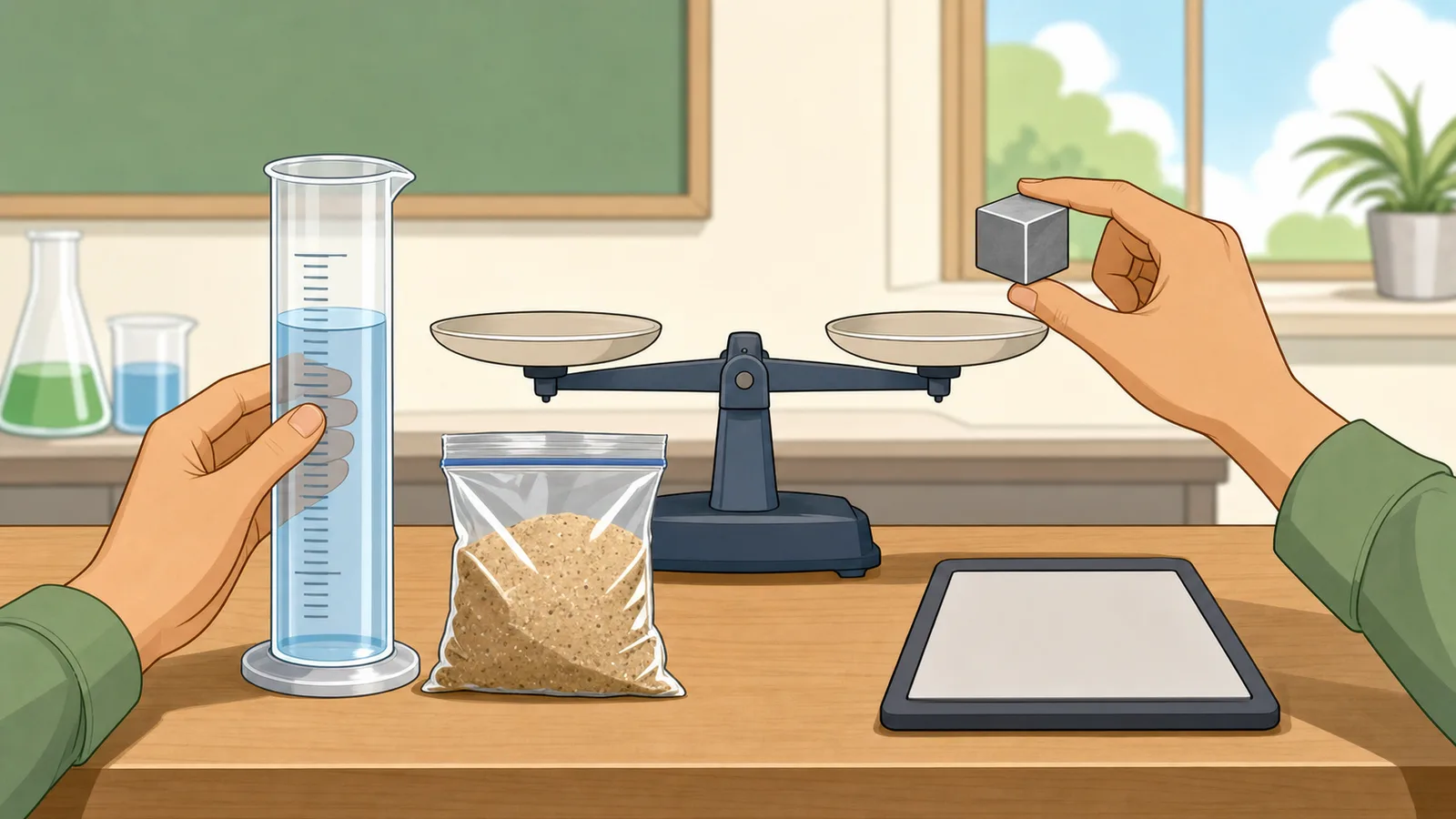
Density is mass per unit volume. It tells you how much matter is packed into a given space, which is why it is useful in chemistry, materials science, fluid handling, and quality control.
The quantity does not change when you rewrite it from kg/m³ to g/cm³ or lb/ft³. Only the reporting scale changes.
ρ = m / V
Defines density as mass divided by volume.
1 g/cm³ = 1,000 kg/m³
Links a common laboratory density unit to the SI base form.
1 kg/L = 1 g/mL
Shows the equivalence between common metric liquid-density expressions.
Why conditions matter
Density is not always a fixed constant. Temperature, pressure, salinity, and composition can all change the value, especially for liquids and gases.
That means a converter should only translate the density you already have. It cannot predict how a material density changes when the conditions change.
Density and specific gravity are related, not identical
Specific gravity compares a material density with a reference density, often water. Density itself still needs units such as kg/m³ or lb/ft³.
Use this page to move between density units directly. If a datasheet gives specific gravity instead, convert that reference relationship separately before treating it as a density figure.
NIST — SI Units — NIST reference for SI units and metric prefixes used in density-unit relationships.
Direct density conversions and the all-units sheet
Many density conversion searches are pair-specific: kg/m³ to g/cm³, g/cm³ to lb/ft³, g/mL to kg/L, or lb/US gal to lb/UK gal. The direct target selector now answers that narrow question first, while the full sheet keeps neighbouring metric, imperial, and reference engineering units visible for sanity checks.
The safest workflow is to keep the original density value, choose the source unit from the document you are reading, and then select the unit required by the destination table, drawing, lab note, or process sheet. Swapping the units converts the current result back into the input field, which helps check whether the conversion is reversible before copying the answer.
Use kg/m³ for SI engineering, fluid mechanics, and many physics formulas.
Use g/cm³, g/mL, or kg/L for laboratory and material-density tables where the same water-scale relationship is useful.
Use lb/ft³, lb/in³, lb/US gal, or lb/UK gal only when the destination specification clearly uses an imperial or customary volume basis.
Use slug/ft³ when a mechanics reference is written in slug-based imperial mass units rather than pound-mass units.
Reference material checks help catch unit mistakes
A good density unit converter should make obvious mistakes easy to see. Water near its maximum density is a useful rough check because 1 g/cm³, 1 g/mL, 1 kg/L, and 1,000 kg/m³ all describe the same scale. If a water-like liquid appears as 0.001 kg/m³ or 1,000 g/cm³, the cubic-length conversion has probably been inverted.
Air, aluminium, and steel provide three additional scale checks. Air is close to the 1 kg/m³ range at standard conditions, aluminium is around 2.7 g/cm³, and many steels are near 7.85 g/cm³. The exact value depends on conditions and composition, but the reference table is useful for spotting decimal-place and gallon-system errors before the result is used downstream.
Common density conversion formulas
The converter uses kg/m³ as the shared base unit. Metric relationships are especially compact: 1 g/cm³ = 1 g/mL = 1 kg/L = 1 t/m³ = 1,000 kg/m³. Also, 1 g/L = 1 kg/m³ and 1 mg/L = 0.001 kg/m³.
Imperial relationships need more care because both mass and volume units change. One lb/ft³ is about 16.018 kg/m³, while one lb/in³ is about 27,680 kg/m³ because a cubic inch is much smaller than a cubic foot. Pounds per gallon also needs the gallon label: one pound per US gallon is not the same density as one pound per UK gallon.
kg/m³ = g/cm³ × 1,000
Direct metric density conversion used for laboratory-to-SI reporting.
lb/ft³ = kg/m³ ÷ 16.018463
Common engineering conversion from SI density into pounds per cubic foot.
g/L = kg/m³
Mass and volume prefix changes cancel, so the numeric value is identical.
lb/US gal ≠ lb/UK gal
The gallon volume differs by system, so the same pound-per-gallon number does not describe the same density.
Frequently asked questions
What is the difference between density and specific gravity?
Density is mass per unit volume and always has units. Specific gravity is a unitless ratio that compares a density with a reference material, often water.
Why does water density change with temperature?
Temperature changes how closely molecules pack together, which changes mass per unit volume. That is why a stated density value should be tied to the conditions when it matters.
Is 1 g/mL the same as 1 kg/L?
Yes. Those two metric expressions are equivalent because a millilitre and a cubic centimetre match, and a kilogram is 1,000 grams.
Can I use this page to calculate mass from volume?
Not by itself. This converter translates density units only. You would still need a separate mass, volume, or buoyancy calculation once the density is in the units you want.
How do I convert kg/m³ to g/cm³?
Divide kg/m³ by 1,000. For example, 1,000 kg/m³ equals 1 g/cm³. The factor comes from converting kilograms to grams and cubic metres to cubic centimetres at the same time.
How do I convert g/cm³ to lb/ft³?
First convert g/cm³ to kg/m³ by multiplying by 1,000, then divide by about 16.018463 to get lb/ft³. One g/cm³ is about 62.428 lb/ft³, which is why water is often shown near 62.4 lb/ft³ in engineering tables.
Is g/L the same number as kg/m³?
Yes. One gram per litre has the same numeric value as one kilogram per cubic metre. This equivalence is useful when moving between chemistry, water-quality, and SI engineering references.
Why are lb/US gal and lb/UK gal different?
They use different gallon volumes. A UK imperial gallon is larger than a US liquid gallon, so one pound spread over a UK gallon is a lower density than one pound spread over a US gallon. Keep the gallon system attached whenever comparing product sheets.
Can a density converter replace a specific gravity calculator?
No. A density converter keeps units attached and translates mass per volume. Specific gravity is a unitless ratio against a reference density, often water, so it requires an extra reference step before it can be treated as a density value.