

Kitchen Measurement Conversions: Cups, Grams, Tablespoons, and More
Stop guessing and start measuring properly — with tools to convert between cups, grams, tablespoons, and every other unit your recipes throw at you.
Last Tuesday I was halfway through a peanut butter cookie recipe from an American food blog when I hit the line “3/4 cup peanut butter.” I stood there holding a measuring jug, a tablespoon, and a look of mild panic. Is that the same as a UK cup? How many tablespoons is three-quarters of a cup? Should I just weigh it instead? By the time I’d finished googling, the butter I’d been softening on the counter had turned into a puddle and my youngest was eating chocolate chips straight from the bag.
If this sounds familiar, you’re not alone. Kitchen measurement conversions trip up everyone — from people following their first recipe to home bakers who’ve been at it for years. The problem isn’t that the maths is hard. It’s that different countries use different systems, volume and weight aren’t the same thing, and recipes cheerfully mix units like it’s no big deal. This guide will sort out the confusion once and for all, with converters you can use right here whenever a recipe throws something unexpected at you.
Why Kitchen Measurements Are So Confusing
The root of the problem is that cooking uses two completely different systems of measurement, and most recipes don’t bother telling you which one they’re using.
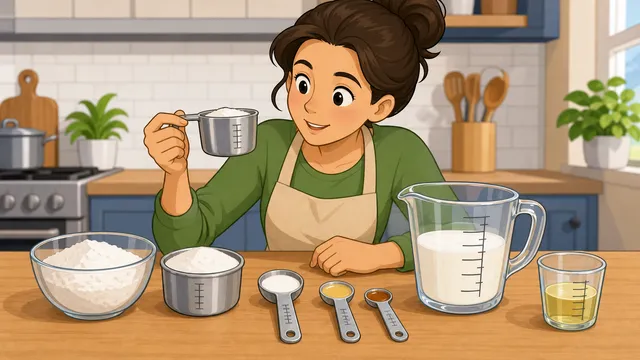
Volume measurements — cups, tablespoons, teaspoons, fluid ounces — tell you how much space an ingredient takes up. These are the standard in American and Canadian kitchens. One US cup is 240 millilitres. One tablespoon is 15 millilitres. There are 16 tablespoons in a cup and 3 teaspoons in a tablespoon. Simple enough on paper.
Weight measurements — grams, ounces, kilograms — tell you how heavy an ingredient is. This is standard in the UK, Europe, Australia, and most professional kitchens worldwide. Weight is more precise because it doesn’t depend on how you scoop or pack an ingredient.
The headache starts when you try to convert between the two. A cup of flour and a cup of sugar take up the same amount of space, but flour weighs about 125 grams while sugar weighs about 200 grams. Cocoa powder, oats, butter, honey — every ingredient has a different density, which means every ingredient has a different grams-to-cups conversion. There’s no single number that works for everything.
Then there are the regional differences within volume measurements themselves. A US cup is 240 ml, but an Australian cup is 250 ml, and a Japanese cup is 200 ml. US tablespoons are 15 ml, but Australian tablespoons are 20 ml. If you’ve ever wondered why an Australian recipe produced something slightly off, that missing 5 ml per tablespoon across an entire recipe can absolutely be the culprit.
Converting Between Cups, Tablespoons, Teaspoons, and Millilitres
Before we get into the grams question, let’s sort out the volume conversions that come up constantly in everyday cooking. These are the ones I use most often — when a recipe says “half a cup” and I want to know how many tablespoons that is (eight, by the way), or when I’m converting an American recipe’s “fluid ounces” into something my metric measuring jug can handle.
Here are the relationships worth committing to memory:
- 1 cup = 16 tablespoons = 48 teaspoons = 240 ml
- 1 tablespoon = 3 teaspoons = 15 ml
- 1/4 cup = 4 tablespoons
- 1/3 cup = 5 tablespoons + 1 teaspoon
- 1/2 cup = 8 tablespoons
- 3/4 cup = 12 tablespoons
But honestly, I don’t expect anyone to memorise all of that. I certainly haven’t — and I cook every single day. That’s why I keep a converter handy.
Use the Cooking Volume Converter to switch between cups, tablespoons, teaspoons, fluid ounces, and millilitres:
Recipe volume
Convert cooking volume measurements
Compare millilitres with US cups, spoons, fluid ounces, metric kitchen measures, UK-imperial fluid ounces, and the larger Australian tablespoon used in some recipes.
Result
This is particularly useful when you’re halving or doubling a recipe and the fractions get awkward. Trying to figure out what half of 3/4 cup is while your onions are browning is not a fun time. (It’s 6 tablespoons, or 90 ml, in case you’re wondering right now.)
Converting Grams to Cups (and Why the Ingredient Matters)
This is where things get properly tricky, and where I see the most mistakes — including plenty of my own. When a British recipe says “200g plain flour” and you want to use your American measuring cups, you need to know that 200 grams of flour is about 1 and 3/5 cups. But 200 grams of sugar? That’s only 1 cup. Same weight, very different volume.
Here are some common ingredient conversions that come up constantly:
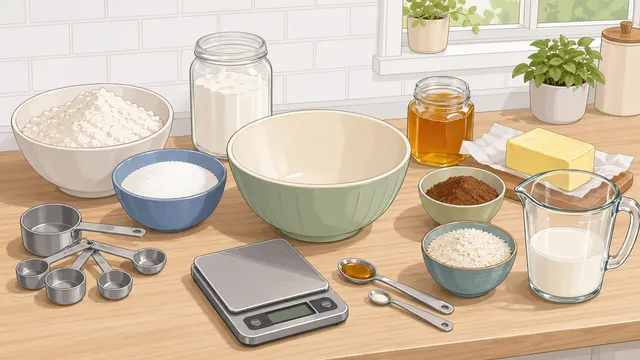
- Plain/all-purpose flour: 1 cup = roughly 125g
- Granulated sugar: 1 cup = roughly 200g
- Brown sugar (packed): 1 cup = roughly 220g
- Butter: 1 cup = roughly 227g (that’s two standard sticks in the US)
- Rolled oats: 1 cup = roughly 90g
- Cocoa powder: 1 cup = roughly 85g
- Honey or golden syrup: 1 cup = roughly 340g
The differences are enormous. A cup of honey weighs four times as much as a cup of cocoa powder. This is exactly why professional bakers weigh everything — and why converting between grams and cups without accounting for the specific ingredient leads to baking disasters.
My friend Sarah (lovely woman, terrible at measuring) once substituted “a cup” of cocoa powder by weight when the recipe meant by volume. Her brownies came out so dense and bitter they could have been used as doorstops. We still call them the Doorstop Brownies. She’s since invested in a kitchen scale, which I fully support — but when you’re following a recipe that mixes units, a converter is what you actually need.
Use the Grams to Cups Converter to get ingredient-specific conversions:
Ingredient source
Use the preset list when you need a fast kitchen estimate for flour, sugar, butter, honey, oats, and other common ingredients. Switch to custom density when your recipe or product label gives a grams-per-cup value.
Result
0.8 cups
100 g of all-purpose flour equals 0.8 cups using the stored density assumption for that ingredient.
- Tablespoons
- 12.8 tbsp
- Teaspoons
- 38.4 tsp
- Ounces
- 3.53 oz
- Millilitres
- 189.27 ml
- 1 cup weighs
- 125 g
- 1/2 cup weighs
- 62.5 g
- Density
- 0.53 g/ml
Selected ingredient quick reference
100 g
0.8 cups
100 g
200 g
1.6 cups
200 g
250 g
2 cups
250 g
1/4 cup
0.25 cups
31.25 g
1/2 cup
0.5 cups
62.5 g
1 cup
1 cups
125 g
These quick checks cover the search-heavy kitchen cases people look up most often, especially 100 g, 200 g, and 250 g conversions for flour, sugar, butter, and similar staples.
Common ingredient reference
| Ingredient | 1 cup | 100 g |
|---|---|---|
| All-purpose flour | 125 g | 0.8 cups |
| Bread flour | 130 g | 0.77 cups |
| Cake flour | 114 g | 0.88 cups |
| Whole wheat flour | 128 g | 0.78 cups |
| Granulated sugar | 200 g | 0.5 cups |
| Brown sugar (packed) | 220 g | 0.45 cups |
| Powdered sugar | 120 g | 0.83 cups |
| Butter | 227 g | 0.44 cups |
| Milk | 245 g | 0.41 cups |
| Water | 237 g | 0.42 cups |
| Vegetable oil | 218 g | 0.46 cups |
| Honey | 340 g | 0.29 cups |
| Maple syrup | 315 g | 0.32 cups |
| Rice (uncooked) | 185 g | 0.54 cups |
| Rolled oats | 90 g | 1.11 cups |
| Cocoa powder | 86 g | 1.16 cups |
| Cornstarch | 128 g | 0.78 cups |
| Salt (table) | 288 g | 0.35 cups |
| Baking soda | 230 g | 0.43 cups |
| Cream cheese | 232 g | 0.43 cups |
| Sour cream | 230 g | 0.43 cups |
| Yoghurt | 245 g | 0.41 cups |
| Peanut butter | 258 g | 0.39 cups |
| Chocolate chips | 170 g | 0.59 cups |
| Shredded coconut | 85 g | 1.18 cups |
| Almond flour | 96 g | 1.04 cups |
| Walnuts (chopped) | 120 g | 0.83 cups |
| Raisins | 150 g | 0.67 cups |
Why density matters
A cup of flour weighs far less than a cup of honey because their densities are different. Always convert by ingredient, not by a single fixed ratio, for accurate baking and cooking results.
The result also assumes a standard US cup. Metric and Australian cups are slightly larger, so recipes written for those systems can produce a different cup count even when the gram weight stays the same.
Pick your ingredient from the list, enter the gram weight, and you’ll get the equivalent in cups. This takes the guesswork out of converting European and British recipes for American measuring tools — or vice versa.
When You Need Tablespoons Instead of Cups
Not every ingredient comes in cup-sized quantities. Spices, leavening agents, oils, vanilla extract, small quantities of flour for thickening a sauce — these all tend to be measured in tablespoons or teaspoons. And when a recipe gives you a gram weight for a small quantity, converting to tablespoons is often more practical than converting to cups.
This matters more than you’d think. If a recipe calls for 15 grams of baking powder, you need to know that’s about 1 tablespoon — not eyeball it and hope for the best. Too much baking powder and your cake tastes metallic and bitter. Too little and it doesn’t rise. Small measurements, big consequences.
The same applies to things like cocoa powder in a hot chocolate recipe (30 grams is about 3.5 tablespoons), chia seeds for overnight oats (10 grams is about 1.5 tablespoons), or cornflour for thickening gravy (8 grams is about 1 tablespoon).
Use the Grams to Tablespoons Converter for these smaller quantities:
Quick gram checks
Tablespoon convention
Ingredient source
Use the preset ingredient list for fast kitchen estimates, especially for flour, sugar, butter, honey, and spices. Switch the tablespoon convention if the recipe source is American, metric / UK, or Australian before trusting the spoon count.
Result
1 tablespoon
15 g of water equals 1 metric / uk tablespoon.
- Equivalent teaspoons
- 3 tsp
- Millilitres
- 15 ml
- Ounces
- 0.53 oz
- Density basis
- 15 g/tbsp (metric)
- 1 teaspoon weighs
- 5 g
- Density
- 1 g/ml
Nearest kitchen measure
1 tbsp
Rounded to quarter-spoon steps so the result is easier to measure in a home kitchen.
Best use
Spoon-based conversion is practical for small additions, toppings, spice blends, and quick recipe adaptation when the source gives grams but your workflow is volume-based.
When to keep grams
For baking, sticky ingredients, or any result above about 4 tablespoons, weighing remains the safer choice for repeatability because packing and spoon levelling can shift the final amount.
Recipe scaling workflow
| Scenario | Weight | Tablespoons | Teaspoons | Workflow note |
|---|---|---|---|---|
| Half batch | 7.5 g | 0.5 tbsp | 1.5 tsp | Useful when you are testing or downsizing a recipe. |
| Current batch | 15 g | 1 tbsp | 3 tsp | The exact conversion for the weight you entered. |
| Double batch | 30 g | 2 tbsp | 6 tsp | A quick scaling check before mixing a larger bowl. |
| Triple batch | 45 g | 3 tbsp | 9 tsp | Helpful when multiplying fillings, sauces, or spice mixes. |
This is most useful when the current conversion becomes part of a larger kitchen task, such as halving a frosting, doubling a spice blend, or scaling a sauce without recalculating every spoon value from scratch.
Selected ingredient quick reference
20 g
1.33 tbsp
4 tsp
30 g
2 tbsp
6 tsp
50 g
3.33 tbsp
10 tsp
100 g
6.67 tbsp
20 tsp
200 g
13.33 tbsp
40 tsp
250 g
16.67 tbsp
50 tsp
These quick checks cover the common kitchen lookups people search for most often, especially 20 g, 30 g, 50 g, and 100 g conversions for flour, sugar, butter, and honey.
Reverse spoon checks
1 teaspoon
5 g
Quick reverse check for small baking additions and spice measures.
1 tablespoon
15 g
Fast answer when the real question is how many grams are in a tablespoon.
2 tablespoons
30 g
Useful for butter, honey, and sauce checks before scaling a batch.
3 tablespoons
45 g
Larger spoon checkpoint when a recipe is drifting beyond a single tablespoon.
If you are really asking “a tablespoon is how many grams?”, start with the 1 tablespoon row here, then use the larger spoon rows as a quick reverse check before you switch back to full recipe scaling.
Kitchen interpretation
Water is being converted with the metric / uk tablespoon assumption of 15 g per tbsp (metric). If your recipe says packed, heaped, sifted, or loosely spooned, the real tablespoon count can move even when the gram weight stays fixed.
Use the teaspoon and millilitre equivalents as a reverse check when the tablespoon figure feels awkward. That is often the fastest way to decide whether a small baking addition should stay as grams, switch to teaspoons, or be rounded to the nearest practical spoon measure.
Common ingredient reference
| Ingredient | 1 tbsp (metric) | 15 g |
|---|---|---|
| Water | 15 g | 1 tbsp |
| Salt | 18 g | 0.83 tbsp |
| Sugar (granulated) | 12.6 g | 1.19 tbsp |
| Baking powder | 13.8 g | 1.09 tbsp |
| Baking soda | 13.8 g | 1.09 tbsp |
| Flour (all-purpose) | 7.8 g | 1.92 tbsp |
| Butter | 14.1 g | 1.06 tbsp |
| Vanilla extract | 12.6 g | 1.19 tbsp |
| Cinnamon | 7.8 g | 1.92 tbsp |
| Cocoa powder | 7.5 g | 2 tbsp |
| Honey | 21 g | 0.71 tbsp |
| Olive oil | 13.5 g | 1.11 tbsp |
| Yeast (active dry) | 9.3 g | 1.61 tbsp |
Regional tablespoon note
US tablespoons are about 14.79 ml, modern metric / UK tablespoons are 15 ml, and Australian tablespoons are 20 ml. Switch conventions before converting if your recipe source uses a different kitchen standard.
Density still matters more than spoon size. One tablespoon of flour is much lighter than one tablespoon of honey or butter, so choose the ingredient first and then check the regional spoon assumption.
When are cups good enough, and when do you really need grams?
This is the question that would have saved me several truly average banana breads in my twenties. The honest answer is that cups are usually perfectly fine for quick savoury cooking, soups, stews, pasta sauces, and the sort of dinner where nobody is judging the exact structure of the crumb. If your chilli gets a touch more onion or your soup gets a touch less stock, life goes on.
Baking is different. Cakes, biscuits, bread dough, pastry, macarons, brownies that are meant to be fudgy rather than cakey — these care about precision. Flour, sugar, butter, cocoa, and raising agents all play structural roles, and small measurement errors stack up quickly. That is why bakers get evangelical about scales. They are not trying to be difficult. They are trying to stop your sponge from turning into a sad little brick.
So my practical rule is this: if texture matters, weigh it. If chemistry matters, weigh it. If the recipe is from a different country and already looks slightly unfamiliar, definitely weigh it. Cups are convenient. Grams are dependable. Knowing when to switch from one to the other is half the battle.
Tips for Getting Measurements Right Every Time
After years of cooking for a household that includes three children with strong opinions about whether dinner is “right” or “weird,” I’ve picked up a few habits that save a lot of grief:
Invest in a digital kitchen scale. Yes, even if you’re mostly a cups-and-tablespoons person. Scales cost less than a bag of decent coffee and they last for years. Whenever you have the option, weighing ingredients in grams is more accurate than measuring by volume — especially for baking. It’s faster too, because you can weigh directly into the bowl without dirtying six different measuring cups.
Level your dry measurements. When you scoop flour or sugar into a measuring cup, scrape a straight edge (a knife or the back of a spatula) across the top to level it off. A heaped cup of flour can contain 30 to 40 grams more than a levelled one. Over an entire recipe, that’s enough extra flour to make your cake dry and heavy.
Don’t measure sticky ingredients in dry cups. Honey, treacle, golden syrup, peanut butter — these all cling to dry measuring cups and you lose a chunk of the ingredient to the cup itself. If you must use volume, spray the inside of the cup with a tiny bit of oil first and the sticky stuff slides right out. Or better yet, weigh it.
Know your spoon sizes. A “tablespoon” in a recipe means a proper measuring tablespoon (15 ml), not whatever spoon you eat cereal with. Similarly, a “teaspoon” is 5 ml — your actual teaspoons at home are probably bigger or smaller. This catches people out with baking powder, salt, and spices where precision matters.
Keep a conversion cheat sheet on your fridge. I’ve got a little card stuck to my fridge with the conversions I use most often: cups to grams for flour and sugar, tablespoons per cup, and oven temperature conversions. For everything else, I use the tools above. It sounds old-fashioned, but when your hands are covered in dough, tapping a phone screen isn’t ideal — and a laminated card doesn’t mind getting flour on it.
Stop Guessing, Start Converting
Kitchen measurement confusion is one of those problems that’s genuinely easy to solve once you have the right tools. You don’t need to memorise every conversion — you just need to know that cups and grams aren’t interchangeable, that every ingredient converts differently, and that a quick check before you start cooking is worth more than a failed recipe and a wasted evening.
The converters above will handle the maths for you. Bookmark this page, stick it in your recipe folder, or just remember it’s here next time a recipe asks for something in units you don’t recognise. Your cookies, cakes, and weeknight dinners will thank you — and you’ll never have to stand in the kitchen googling “how many tablespoons in 3/4 cup” with butter melting on the counter again.
Calculators used in this article
Converters / Measurement / Volume & Capacity
Cooking Volume Converter
Convert cooking volumes between cups, tablespoons, teaspoons, fluid ounces, and millilitres, with US, metric, UK-imperial.
Converters / Cooking & Baking
Ingredient Converter
Convert cooking and baking ingredients between cups, tablespoons, teaspoons, millilitres, grams, ounces, pounds.
Converters / Cooking & Baking
Ingredient Converter
Convert cooking and baking ingredients between cups, tablespoons, teaspoons, millilitres, grams, ounces, pounds.