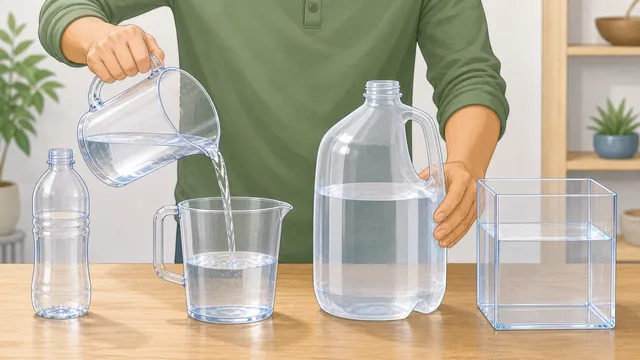
Convert cooking volumes between cups, tablespoons, teaspoons, fluid ounces, and millilitres, with US, metric, UK-imperial.
Last updated
Recipe volume
Convert cooking volume measurements
Compare millilitres with US cups, spoons, fluid ounces, metric kitchen measures, UK-imperial fluid ounces, and the larger Australian tablespoon used in some recipes.
Quick kitchen amounts
Recipe note US and metric cooking measures are not identical. A US tablespoon is about 14.79 ml, while the modern metric tablespoon used in many UK and Commonwealth recipes is 15 ml. US and UK fluid ounces also differ.
Result
Enter a cooking volume Provide a non-negative recipe volume above to compare millilitres, cups, spoons, and fluid ounces.
Cooking volume converter: US cups, metric spoons, fluid ounces, and millilitres explained
A cooking volume converter helps when a recipe keeps the ingredient amount fixed but the measuring system changes. Modern recipes can mix millilitres with US cups and spoons, metric cups, UK-imperial fluid ounces, and Australian tablespoons. A dedicated converter keeps those systems visible side by side so a cup, tablespoon, teaspoon, or fluid-ounce label is not treated as universal when the recipe context matters.
Why recipe volume units are easy to mix up
Cooking measures often reuse the same names across different systems even when the actual volume is not identical. A tablespoon in a US recipe is not exactly the same as the modern metric tablespoon used in many UK and Commonwealth recipes, an Australian tablespoon is larger again, and a US fluid ounce is not the same as an imperial fluid ounce.
That is why a cooking-volume converter needs to be explicit about which family each unit belongs to. The safe workflow is not to assume that every spoon, cup, or fluid-ounce label means the same thing, but to keep the US, metric-first, UK-imperial, and Australian relationships visible together.
The unit relationships used here
The live tool converts everything through millilitres. For US measures it uses the customary relationships published by NIST: 1 US teaspoon is about 4.9289 ml, 1 US tablespoon is about 14.7868 ml, 1 US fluid ounce is about 29.5735 ml, and 1 US cup is about 236.588 ml.
On the metric-first side, the converter uses the common modern kitchen standards of 5 ml for a metric teaspoon, 15 ml for a metric tablespoon, 250 ml for a metric cup, and 28.4130625 ml for an imperial fluid ounce. It also shows the 20 ml Australian tablespoon separately because it is a common recipe trap. That keeps modern recipe notation explicit without implying a single universal "UK cup" or universal tablespoon.
1 US tbsp ≈ 14.7868 ml
US customary tablespoon relationship used in many North American recipes.
1 metric tbsp = 15 ml
Modern metric tablespoon relationship commonly used in UK and Commonwealth kitchen notation.
1 US fl oz ≈ 29.5735 ml; 1 imperial fl oz = 28.4130625 ml
Shows why fluid-ounce labels need system context in recipe work.
1 Australian tbsp = 20 ml
Australian tablespoon convention included because it is larger than both US and common metric tablespoons.
How to use the converter safely in recipe planning
If a recipe source is clearly American, start from the US measure shown in the recipe and use the metric outputs for weighing or measuring with metric jugs and spoons. If a recipe is UK-based or metric-first, use the metric spoon or cup option instead of assuming the US relationship.
This matters most for baking, syrups, extracts, and other small-volume ingredients where repeated spoon differences can noticeably change the result. The tool is most useful as a notation translator, not as a substitute for a recipe author’s own system labels.
Common recipe equivalents to check first
Many people arrive with a quick kitchen question such as 1 cup to ml, 1 tablespoon to ml, 1 teaspoon to ml, cups to tablespoons, or fluid ounces to millilitres. The converter now includes quick-start buttons and a common-equivalents table so those everyday recipe amounts are visible without forcing you to rebuild the conversion from scratch.
The most important comparison is often not the final number alone but the system note beside it. One US cup is about 236.6 ml, one metric cup is 250 ml, one US tablespoon is about 14.79 ml, one metric tablespoon is 15 ml, and one Australian tablespoon is 20 ml. Seeing those together helps you decide whether a difference is harmless for soup or important for baking.
What this converter does not do
This is a volume-to-volume converter, not a density-aware ingredient converter. It can tell you how many millilitres, cups, tablespoons, teaspoons, or fluid ounces represent the same volume, but it cannot tell you how many grams of flour, sugar, butter, honey, or cocoa that volume weighs.
For precision baking, a kitchen scale and ingredient-specific density table is usually better than volume conversion. For everyday cooking, sauces, drinks, syrups, and recipe notation checks, volume conversion is still useful because the original recipe may be written only in cups and spoons.
Frequently asked questions
Is a US tablespoon the same as a metric tablespoon?
No. A US tablespoon is about 14.79 ml, while a modern metric tablespoon is 15 ml. The difference is small, but it can add up in baking or in recipes with repeated spoon measures.
Is there one standard UK cup?
No single modern legal "UK cup" standard dominates the way the US cup does. Metric-first recipes often use a 250 ml metric cup, while older imperial-style references may use different conventions. This tool labels the metric cup explicitly rather than implying a universal UK cup.
Why do US and UK fluid ounces differ?
They come from different historical customary systems. A US fluid ounce is about 29.57 ml, while an imperial fluid ounce is about 28.41 ml, so the same label does not always mean the same volume.
Should I convert recipe volume or weigh ingredients instead?
For the highest accuracy, especially in baking, weighing ingredients is usually better because density differs from ingredient to ingredient. Volume conversion is still useful when the recipe itself is written in cups, spoons, or fluid ounces.
How many millilitres are in an Australian tablespoon?
An Australian tablespoon is commonly treated as 20 ml. That is larger than a US tablespoon at about 14.79 ml and a modern metric tablespoon at 15 ml, so Australian recipe labels should not be silently converted as US tablespoons.
How many millilitres are in one US cup?
One US customary cup is about 236.588 ml. That is slightly smaller than the common 250 ml metric cup, which is why cup-to-ml conversions should keep the cup basis visible.
Can this converter change cups to grams?
No. Cups to grams depends on ingredient density and measuring method. This cooking volume converter only converts volume units such as cups, tablespoons, teaspoons, fluid ounces, and millilitres.
Which unit should I choose if the recipe just says tablespoon?
Use the source recipe context. American recipes usually mean US tablespoons, many metric-first recipes mean 15 ml tablespoons, and Australian recipes may mean 20 ml tablespoons. If the recipe author gives millilitres, use that explicit value.
Guides
Featured in articles
Step-by-step guides that use this calculator to solve real problems.