Use this cubic feet calculator and cubic dimension converter to calculate cubic feet, cubic inches, cubic metres, cubic yards, litres.
Last updated
Volume & capacity
Convert cubic feet, cubic metres, cubic inches, litres, and gallons
Use one page for cubic feet calculator, cubic inches calculator, cubic metres from dimensions, and square-feet-to-cubic-feet depth checks without splitting the workflow across separate tools.
Common cubic jobs
Exact anchor relationships One cubic centimetre equals exactly one millilitre, one litre equals exactly 1,000 cubic centimetres, and one cubic metre equals exactly 1,000 litres.
Use this when the volume is already known
Best for tank labels, specification sheets, tote capacities, and supplier documentation where the source is already stated in litres, gallons, or another finished cubic unit.
Result
Enter a cubic volume Provide a non-negative number to compare cubic units with litre and gallon equivalents.
Cubic dimension converter: cubic metres, litres, and gallons explained
A cubic dimension converter helps when one three-dimensional volume needs to be read as both structural space and liquid capacity. It also works as a cubic feet calculator, cubic inches calculator, cubic metres calculator, and square-feet-to-cubic-feet depth checker on one page for packaging, tanks, bins, storage boxes, rooms, and product specifications.
Why cubic units and liquid capacity belong together
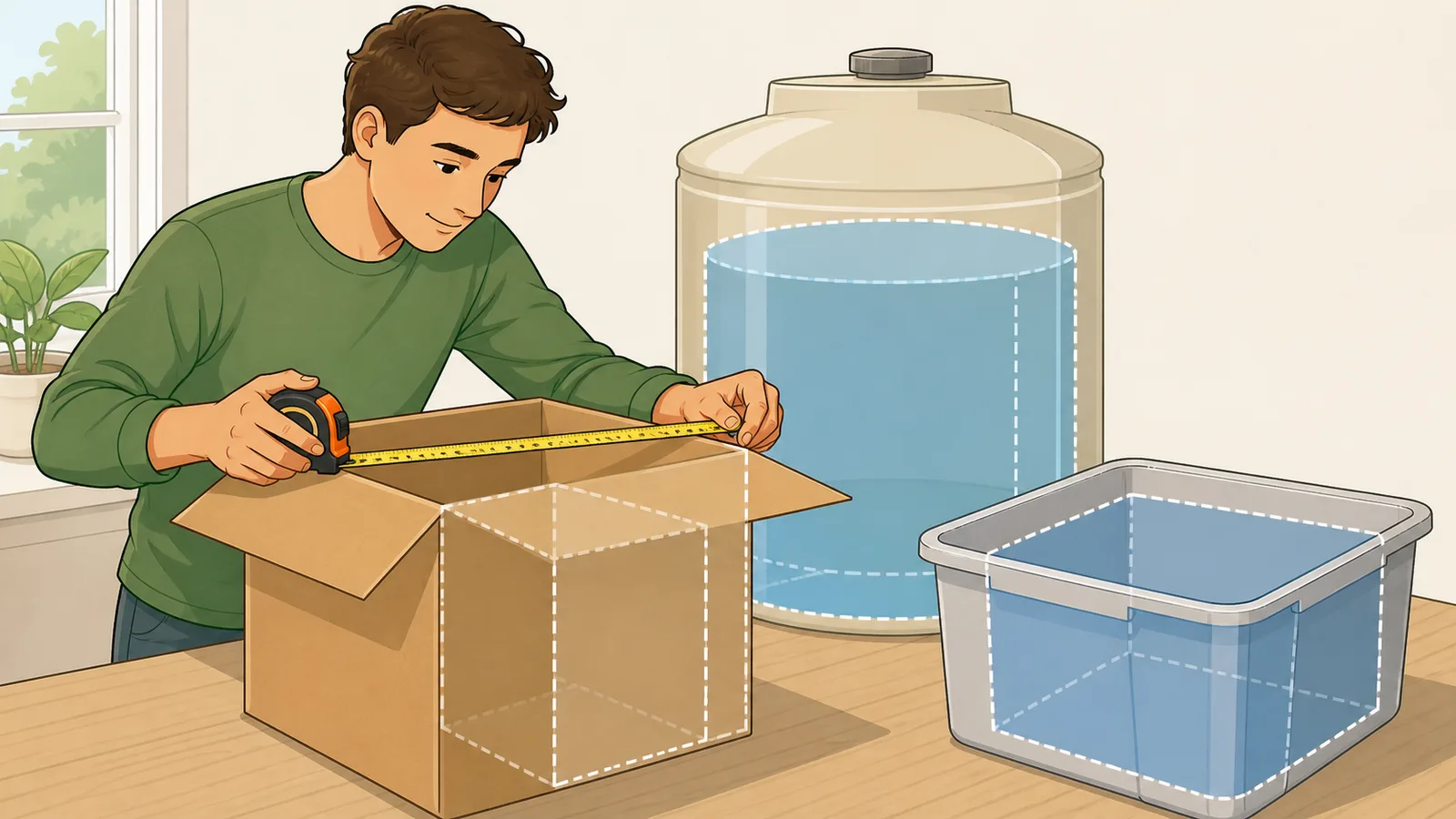
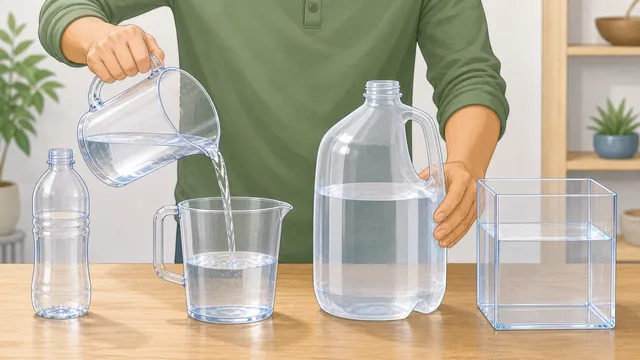
Cubic units describe space. Litres and gallons describe capacity. In practice those are often the same question from two different angles: how much space does a box or tank occupy, and how much material can it hold?
That is why this tool keeps cubic centimetres, cubic metres, cubic inches, cubic feet, cubic yards, litres, millilitres, and both US and UK gallons in one place. The goal is to let dimensional planning and capacity planning share the same base volume instead of forcing you to convert in separate steps.
The exact metric anchors behind the conversion
The cleanest relationships are metric. One cubic centimetre equals exactly one millilitre. One litre equals exactly 1,000 cubic centimetres, and one cubic metre equals exactly 1,000 litres. That means a 1 m × 1 m × 1 m cube always corresponds to 1,000 litres of capacity.
The customary units then connect back through the same base. A US gallon equals exactly 3.785411784 litres, while an imperial gallon equals exactly 4.54609 litres. Cubic feet and cubic yards are derived from exact foot-based length definitions, so they can be compared directly with litre and gallon outputs once the base volume is fixed.
1 cm³ = 1 mL
Exact metric bridge between geometric and liquid volume.
1 L = 1,000 cm³; 1 m³ = 1,000 L
Core metric capacity relationships used throughout the converter.
1 US gal = 3.785411784 L; 1 imperial gal = 4.54609 L
Exact gallon relationships used to distinguish US and UK capacity labels.
Where this is most useful in practice
For tanks and containers, the litre and gallon outputs are often the easiest way to communicate fill capacity. For timber crates, storage boxes, ventilation spaces, and dimensional product listings, cubic feet or cubic metres may be more familiar. A converter that keeps both views aligned helps prevent the same container being described as if it had multiple capacities.
It is also useful for cross-market product reading. A spec sheet may list cubic inches or cubic feet, while another source lists litres or gallons. This tool keeps the comparison explicit, including the difference between US and UK gallons, which should never be treated as interchangeable.
For boxes, drawers, fridges, totes, and tanks, interior dimensions are usually the right input when you need usable capacity. Exterior dimensions matter more for fit, freight envelope, or whether something will physically pass through a door or onto a shelf, so it helps to decide that before treating the result as a real fill capacity.
Calculate cubic feet, cubic inches, or cubic metres from dimensions
The master now supports a direct length × width × height workflow for rectangular spaces, boxes, packages, bins, rooms, and storage volumes. Enter the dimensions in millimetres, centimetres, metres, inches, feet, or yards, then choose cubic feet, cubic inches, cubic metres, cubic yards, litres, millilitres, or gallons as the headline result.
This preserves the old cubic feet calculator, cubic inches calculator, and cubic meters calculator jobs on one page while keeping the unit conversion sheet visible. The same input can answer "how many cubic feet is this box?", "how many cubic inches is this package?", or "how many cubic metres is this room?" without maintaining separate permutation pages.
Rectangular volume = length × width × height
Used for boxes, rooms, crates, bins, and other rectangular volumes.
Cylinder and area-depth workflows
Cubic feet searches often involve cylindrical tanks, posts, tubes, and round containers. The cylinder workflow uses diameter and height, then converts the result into the same cubic, litre, and gallon result sheet.
Square-feet-to-cubic-feet searches need one extra dimension: depth or thickness. The area × depth workflow converts a known footprint such as 120 ft² at 3 inches deep into cubic feet, cubic yards, cubic metres, litres, and gallons. It is intentionally a dimensional converter; material-specific ordering, density, bag count, supplier rounding, and compaction still belong on dedicated material calculators.
Cylinder volume = π × (diameter ÷ 2)² × height
Used for round tanks, tubes, posts, and cylindrical containers.
Volume = area × depth
Used for square feet to cubic feet and simple square-feet-to-cubic-yards dimensional conversion.
Frequently asked questions
Is one cubic centimetre the same as one millilitre?
Yes. They are exactly equal. That is one of the core metric relationships linking geometric volume and liquid capacity.
How many litres are in one cubic metre?
Exactly 1,000 litres. A cubic metre is the volume of a 1 m × 1 m × 1 m cube, and each cubic metre contains 1,000 litres by definition.
Why does the tool show both US and UK gallons?
Because they are different units. A US gallon is 3.785411784 L, while an imperial gallon is 4.54609 L, so treating them as interchangeable can produce meaningful errors.
When should I use cubic feet instead of litres?
Use cubic feet when the surrounding workflow is dimension-led, such as rooming, packaging, or structural product descriptions. Use litres when the capacity itself is the main concern, such as tanks, fluids, and fill volume.
Can this calculate cubic feet from length, width, and height?
Yes. Use the length × width × height mode, enter dimensions in feet, inches, metres, centimetres, millimetres, or yards, and choose cubic feet as the headline unit. The result sheet also shows cubic yards, cubic metres, litres, and gallons.
How do I convert square feet to cubic feet?
Use area × depth mode. Enter the footprint in square feet, enter the depth or thickness, and choose cubic feet as the headline result. The formula is volume = area × depth, with depth converted into feet before multiplying.
Does this replace a cubic yards material calculator?
No. It can convert dimensions into cubic yards, but it does not replace material-specific ordering tools that include density, waste allowance, bag size, compaction, truck loads, or supplier rounding.
Should I use inside or outside dimensions for boxes or tanks?
Use inside dimensions when you want usable storage or fill capacity. Use outside dimensions when the job is about fit, transport clearance, or external footprint. Mixing the two is one of the easiest ways to overstate how much a container can really hold.