

How to Solve Triangles: Pythagoras, Angles, and Missing Sides
Learn when to use the Pythagorean theorem, right-triangle trigonometry, or general triangle rules to find missing sides and angles.
Triangles are everywhere — once you start looking
Here’s something I tell every student on the first day of geometry: triangles are the most important shape you will ever learn. That sounds dramatic, but think about it. Bridges, roof trusses, phone screen measurements, even the way GPS pinpoints your location — all of it relies on triangle math. The good news? You don’t need to be a math genius to understand how triangles work. You just need the right starting point.
If triangles have ever felt confusing or abstract, this guide is going to change that. We’ll walk through the big ideas step by step, and you can test every concept with interactive calculators along the way. Ready? Let’s do this.
When should you use the Pythagorean theorem?
If you remember only one formula from math class, it’s probably this one: a² + b² = c². That’s the Pythagorean theorem, and it applies to every right triangle — any triangle that has one 90-degree angle.
Here’s what it actually means in plain language: if you know the lengths of two sides of a right triangle, you can always find the third. The two shorter sides are called legs (a and b), and the longest side — the one opposite the right angle — is the hypotenuse (c).
Let’s say you’re hanging a shelf and you want it to be perfectly level. You measure 3 feet along the wall and 4 feet up from the floor. How long is the diagonal brace you need? Plug in the numbers: 3² + 4² = 9 + 16 = 25. The square root of 25 is 5. Your brace needs to be 5 feet long. That’s the theorem at work in about ten seconds.
Try this: use the Pythagorean Theorem Calculator below. Enter any two sides and watch it solve for the third. Start with the classic 3-4-5 triangle to confirm the math, then experiment with your own numbers. There’s no wrong answer here — just play around with it.
Side-only right-triangle checks
Solve or verify a side set from the Pythagorean theorem
Keep this workflow focused on side lengths: solve the missing side when two are known, or test whether all three sides satisfy a² + b² = c².
Right-triangle reminder
The theorem only applies to right triangles. In solve modes, the hypotenuse must be longer than the known leg. In check mode, the calculator treats the largest entered side as the hypotenuse candidate before comparing the squares.
Nice work if you tried a few combinations. You just proved a theorem that’s been useful for over 2,500 years. That’s a win worth celebrating.
The result is most useful when you also ask yourself whether the triangle is really a right triangle in the first place. If the problem does not include a 90-degree angle, or if the diagram only looks like one by accident, stop before you force the theorem where it does not belong. That one habit alone saves students a surprising number of marks.
How do you solve a right triangle when you know an angle?
The Pythagorean theorem handles side lengths, but what if you need to find an angle? Or what if you know one side and one angle and need to figure out the rest? That’s where trigonometry enters the picture — and before you tense up, I promise it’s more approachable than it sounds.
Right triangle trigonometry boils down to three ratios, each connecting an angle to a pair of sides:
- Sine (sin) = opposite side / hypotenuse
- Cosine (cos) = adjacent side / hypotenuse
- Tangent (tan) = opposite side / adjacent side
A classic memory trick is SOH-CAH-TOA — Sine is Opposite over Hypotenuse, Cosine is Adjacent over Hypotenuse, Tangent is Opposite over Adjacent. Say it a few times and it sticks.
Here’s a practical example. Imagine you’re standing 50 feet from a tree and you measure the angle from your eye level up to the top of the tree at 35 degrees. Using tangent: tan(35°) = tree height / 50. Multiply both sides by 50, and you get roughly 35 feet. You just measured a tree without climbing it.
Try this: the Triangle Calculator right-triangle workflow below lets you enter any combination of sides and angles. Give it just two known values and it will solve the entire triangle for you — all three sides and all three angles. Enter that tree example (adjacent side = 50, angle = 35) and see if you get the same result.
Triangle geometry workflows
Choose the triangle problem first
Use one triangle calculator for SSS, SAS, AAS/ASA, SSA, right triangles, hypotenuse, isosceles triangles, equilateral triangles, special right triangles, triangle area, perimeter, height, and angle of elevation or depression. Anchored workflows preserve the long-tail searches while keeping one canonical triangle geometry page.
Active workflow
General triangle solver
Solve SSS, SAS, AAS/ASA, and SSA triangle cases with sides, angles, area, perimeter, altitudes, inradius, and circumradius.
SSS: sides a, b, and c are known.
Result
6 area units
Solved triangle. This is a scalene triangle with a right angle pattern.
- Side a
- 3
- Side b
- 4
- Side c
- 5
- Angle A
- 36.87°
- Angle B
- 53.13°
- Angle C
- 90°
- Perimeter
- 12
- Inradius
- 1
- Circumradius
- 2.5
| Derived value | Result | How to use it |
|---|---|---|
| Semiperimeter | 6 | Used by Heron’s formula and inradius checks. |
| Altitudes to a / b / c | 4 / 3 / 2.4 | Useful when you need a height for area, layout, or cross-section work. |
| Medians to a / b / c | 4.27 / 3.61 / 2.5 | Each median runs from a vertex to the midpoint of the opposite side, a common worksheet and construction check. |
| Incircle / circumcircle area | 3.14 / 19.63 | Turns the inradius and circumradius into the areas of the inscribed and circumscribed circles. |
| Normalized ratio a : b : c | 1 : 1.333 : 1.667 | Shows the shape independent of scale, which helps spot 3-4-5 or special-angle families. |
| Formula path | Heron | Confirms whether the solve path came from Heron, the law of cosines, or the law of sines. |
Triangle workflow comparison
General triangle solver
Answers: missing sides, angles, area, perimeter, altitudes, radii, and type
Use when: You know SSS, SAS, AAS/ASA, or SSA inputs and need the full triangle.
Formula: Heron, law of cosines, law of sines
Right triangle and hypotenuse
Answers: legs, hypotenuse, acute angles, area, and perimeter
Use when: One angle is 90 degrees, or the query is specifically a hypotenuse calculator.
Formula: a^2 + b^2 = c^2, sin, cos, tan
Triangle type calculators
Answers: equilateral or isosceles area, height, perimeter, angles, and radii
Use when: The triangle has equal sides and a narrower subtype shortcut is faster than the general solver.
Formula: fixed symmetry relationships
Measurement helpers
Answers: area, perimeter, height, elevation angle, depression angle, distance, or height
Use when: The question asks for one practical measurement rather than a full triangle solve.
Formula: 1/2 bh, Heron, tangent ratios
| Workflow | Answers | Use when | Formula |
|---|---|---|---|
| General triangle solver | missing sides, angles, area, perimeter, altitudes, radii, and type | You know SSS, SAS, AAS/ASA, or SSA inputs and need the full triangle. | Heron, law of cosines, law of sines |
| Right triangle and hypotenuse | legs, hypotenuse, acute angles, area, and perimeter | One angle is 90 degrees, or the query is specifically a hypotenuse calculator. | a^2 + b^2 = c^2, sin, cos, tan |
| Triangle type calculators | equilateral or isosceles area, height, perimeter, angles, and radii | The triangle has equal sides and a narrower subtype shortcut is faster than the general solver. | fixed symmetry relationships |
| Measurement helpers | area, perimeter, height, elevation angle, depression angle, distance, or height | The question asks for one practical measurement rather than a full triangle solve. | 1/2 bh, Heron, tangent ratios |
What moved into this triangle calculator
The former specialist pages still represent useful long-tail intents: right triangle calculator, hypotenuse calculator, isosceles triangle calculator, equilateral triangle calculator, special right triangle calculator, triangle area calculator, triangle perimeter calculator, triangle height calculator, angle of elevation calculator, and angle of depression calculator. They now resolve to anchored workflows on this canonical triangle calculator instead of competing as separate thin geometry pages.
The law of sines, law of cosines, Heron's formula, and Pythagorean theorem pages remain linked as advanced reference calculators for now. The master solver uses those formulas directly, but the separate references carry deeper theorem-specific explanations that are not being removed in this phase.
If you got it right, give yourself some credit. You just did trigonometry, and the world didn’t end. That’s real progress.
This is also where it helps to separate two jobs in your head. The Pythagorean theorem is brilliant for side-side-side work inside a right triangle. Trigonometric ratios are what you use when the angle itself becomes part of the story. Same shape, different question.
What about triangles that aren’t right triangles?
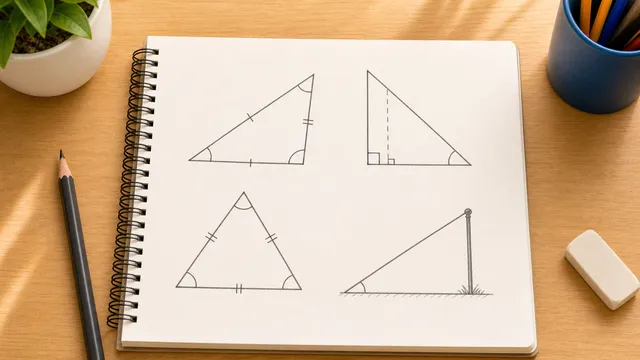
Most triangles in the real world don’t have a neat 90-degree angle. A plot of land, the frame of a bicycle, the shape of a sail — these are usually oblique triangles, meaning none of their angles is exactly 90 degrees. So how do you solve those?
Two powerful formulas cover almost every situation:
The Law of Sines states that the ratio of any side to the sine of its opposite angle is constant across the triangle: a/sin(A) = b/sin(B) = c/sin(C). This is especially handy when you know two angles and one side, or two sides and an angle opposite one of them.
The Law of Cosines generalizes the Pythagorean theorem to all triangles: c² = a² + b² - 2ab·cos(C). When angle C is 90 degrees, cos(90°) is zero and the formula simplifies right back to a² + b² = c². Think of the Law of Cosines as the Pythagorean theorem’s older sibling — it handles the same job but works for every triangle, not just right ones.
Let’s say you’re surveying a triangular lot and you’ve measured two sides at 120 feet and 85 feet, with the included angle at 72 degrees. The Law of Cosines gives you the third side, and from there the Law of Sines fills in the remaining angles.
Try this: the Triangle Calculator below handles any triangle — right or oblique. Enter the measurements you have (sides, angles, or a mix) and let it work out the rest. Try the lot example above and see if the results make sense to you.
Triangle geometry workflows
Choose the triangle problem first
Use one triangle calculator for SSS, SAS, AAS/ASA, SSA, right triangles, hypotenuse, isosceles triangles, equilateral triangles, special right triangles, triangle area, perimeter, height, and angle of elevation or depression. Anchored workflows preserve the long-tail searches while keeping one canonical triangle geometry page.
Active workflow
General triangle solver
Solve SSS, SAS, AAS/ASA, and SSA triangle cases with sides, angles, area, perimeter, altitudes, inradius, and circumradius.
SSS: sides a, b, and c are known.
Result
6 area units
Solved triangle. This is a scalene triangle with a right angle pattern.
- Side a
- 3
- Side b
- 4
- Side c
- 5
- Angle A
- 36.87°
- Angle B
- 53.13°
- Angle C
- 90°
- Perimeter
- 12
- Inradius
- 1
- Circumradius
- 2.5
| Derived value | Result | How to use it |
|---|---|---|
| Semiperimeter | 6 | Used by Heron’s formula and inradius checks. |
| Altitudes to a / b / c | 4 / 3 / 2.4 | Useful when you need a height for area, layout, or cross-section work. |
| Medians to a / b / c | 4.27 / 3.61 / 2.5 | Each median runs from a vertex to the midpoint of the opposite side, a common worksheet and construction check. |
| Incircle / circumcircle area | 3.14 / 19.63 | Turns the inradius and circumradius into the areas of the inscribed and circumscribed circles. |
| Normalized ratio a : b : c | 1 : 1.333 : 1.667 | Shows the shape independent of scale, which helps spot 3-4-5 or special-angle families. |
| Formula path | Heron | Confirms whether the solve path came from Heron, the law of cosines, or the law of sines. |
Triangle workflow comparison
General triangle solver
Answers: missing sides, angles, area, perimeter, altitudes, radii, and type
Use when: You know SSS, SAS, AAS/ASA, or SSA inputs and need the full triangle.
Formula: Heron, law of cosines, law of sines
Right triangle and hypotenuse
Answers: legs, hypotenuse, acute angles, area, and perimeter
Use when: One angle is 90 degrees, or the query is specifically a hypotenuse calculator.
Formula: a^2 + b^2 = c^2, sin, cos, tan
Triangle type calculators
Answers: equilateral or isosceles area, height, perimeter, angles, and radii
Use when: The triangle has equal sides and a narrower subtype shortcut is faster than the general solver.
Formula: fixed symmetry relationships
Measurement helpers
Answers: area, perimeter, height, elevation angle, depression angle, distance, or height
Use when: The question asks for one practical measurement rather than a full triangle solve.
Formula: 1/2 bh, Heron, tangent ratios
| Workflow | Answers | Use when | Formula |
|---|---|---|---|
| General triangle solver | missing sides, angles, area, perimeter, altitudes, radii, and type | You know SSS, SAS, AAS/ASA, or SSA inputs and need the full triangle. | Heron, law of cosines, law of sines |
| Right triangle and hypotenuse | legs, hypotenuse, acute angles, area, and perimeter | One angle is 90 degrees, or the query is specifically a hypotenuse calculator. | a^2 + b^2 = c^2, sin, cos, tan |
| Triangle type calculators | equilateral or isosceles area, height, perimeter, angles, and radii | The triangle has equal sides and a narrower subtype shortcut is faster than the general solver. | fixed symmetry relationships |
| Measurement helpers | area, perimeter, height, elevation angle, depression angle, distance, or height | The question asks for one practical measurement rather than a full triangle solve. | 1/2 bh, Heron, tangent ratios |
What moved into this triangle calculator
The former specialist pages still represent useful long-tail intents: right triangle calculator, hypotenuse calculator, isosceles triangle calculator, equilateral triangle calculator, special right triangle calculator, triangle area calculator, triangle perimeter calculator, triangle height calculator, angle of elevation calculator, and angle of depression calculator. They now resolve to anchored workflows on this canonical triangle calculator instead of competing as separate thin geometry pages.
The law of sines, law of cosines, Heron's formula, and Pythagorean theorem pages remain linked as advanced reference calculators for now. The master solver uses those formulas directly, but the separate references carry deeper theorem-specific explanations that are not being removed in this phase.
The real win here is not memorising two more laws. It is recognising that triangle problems become easier once you classify them first. Right triangle or not? Enough information to fix one unique triangle or not? Included angle or opposite angle? Those questions matter more than whether the symbols look intimidating.
Which triangle calculator should you use first?
With three calculators at your fingertips, you might wonder which one to reach for. Here’s a simple decision guide:
- You have a right triangle and know two sides — use the Pythagorean Theorem Calculator. It’s the fastest path to that missing side.
- You have a right triangle and know a side and an angle (or want to find angles) — use the Triangle Calculator right-triangle workflow. It handles both sides and angles in one go.
- Your triangle isn’t a right triangle, or you’re not sure — use the Triangle Calculator. It applies the Law of Sines and Law of Cosines automatically, so you don’t have to choose.
If you want a quick classroom version, use this order:
- Check whether there is a right angle.
- If yes, decide whether you know two sides or a side-plus-angle.
- If not, switch to the general triangle tool and identify which measurements you actually have.
- Sanity-check the result. Angles in any triangle should add up to 180°, and the longest side should sit opposite the largest angle.
Real-world triangle problems you can solve today
Triangles aren’t just textbook exercises. Here are a few situations where this knowledge pays off immediately:
- Home improvement: Calculating the slope of a roof, the length of a diagonal brace, or whether a doorframe is truly square.
- Navigation: Figuring out the straight-line distance between two points when you can only measure along two legs of a path.
- Art and design: Setting proportions, determining perspective angles, or spacing objects evenly in a circular layout (which breaks down into triangles).
- Outdoor activities: Estimating the height of a cliff, the width of a river, or the distance across a lake using angles measured from shore.
If you are learning this for school, these examples matter because they stop the topic from feeling like a bag of unrelated formulas. If you are learning it for practical work, they matter because they show what the measurements mean. A side length is not just a side length. It might be a ladder, a span, a brace, or a line of sight.
You’ve got this
If you made it through this guide and tried even one of the calculators, you’ve already moved past the point where triangles are intimidating. Every expert started exactly where you are — with a formula, a few practice problems, and the willingness to try. Keep experimenting, keep plugging in numbers, and trust that the patterns will click. Triangles aren’t a mystery. They’re a toolkit. And now it’s yours.
And if one method still feels fuzzy, that is normal. The goal is not to memorise every rule at once. It is to know the first question to ask. Right triangle or not? Missing side or missing angle? Once you can answer that calmly, the rest gets dramatically easier.
Calculators used in this article
Math / Geometry / Triangles
Pythagorean Theorem Calculator
Solve for a missing hypotenuse or leg, or check whether three sides form a right triangle with this Pythagorean theorem calculator.
Math / Geometry / Triangles
Triangle Calculator
Use the triangle calculator to solve general triangles, right triangles, hypotenuse, isosceles and equilateral triangles, special right triangles, area.
Math / Geometry / Triangles
Triangle Calculator
Use the triangle calculator to solve general triangles, right triangles, hypotenuse, isosceles and equilateral triangles, special right triangles, area.