General triangle solver
Answers: missing sides, angles, area, perimeter, altitudes, radii, and type
Use when: You know SSS, SAS, AAS/ASA, or SSA inputs and need the full triangle.
Formula: Heron, law of cosines, law of sines
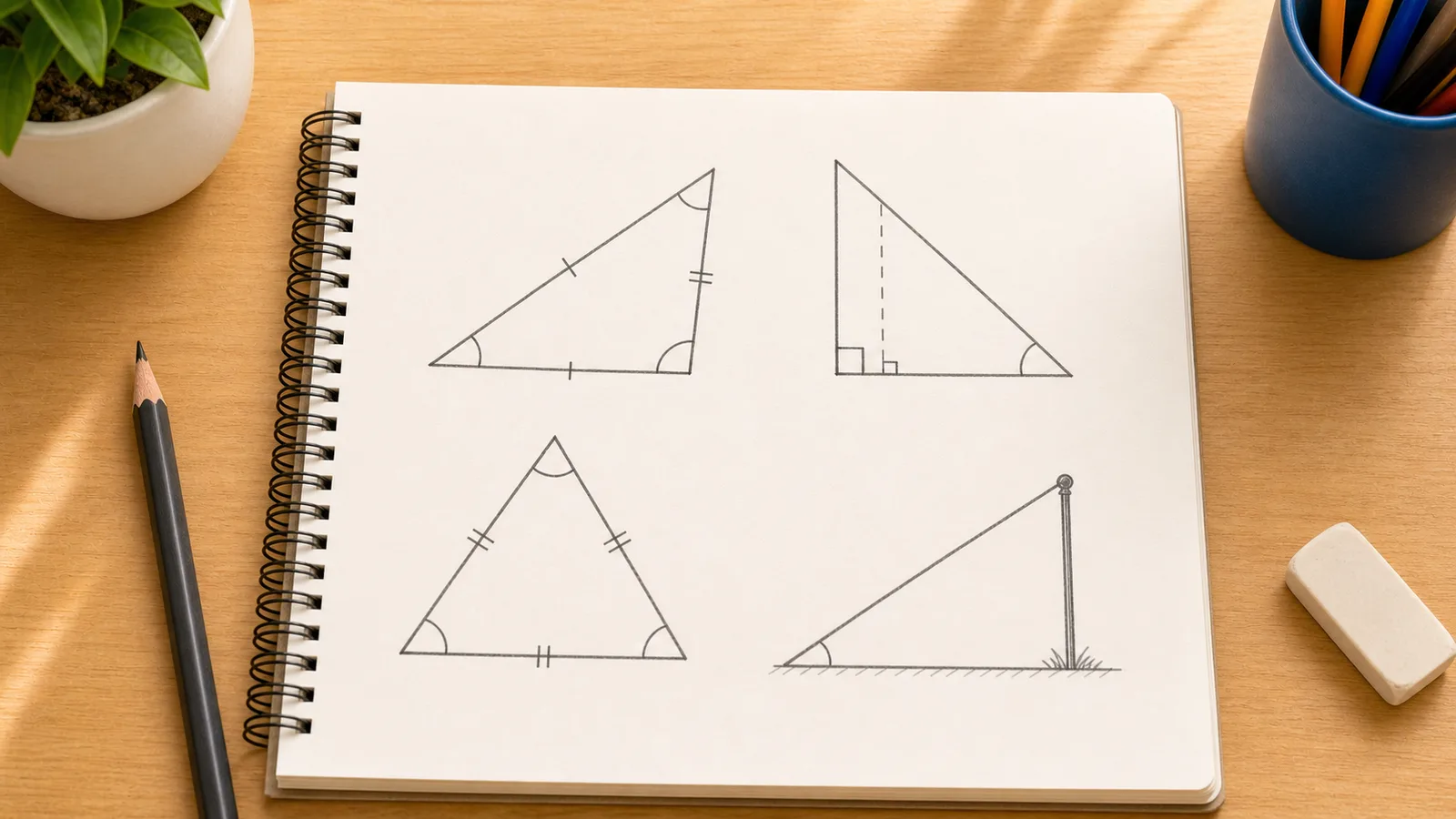
Use the triangle calculator to solve general triangles, right triangles, hypotenuse, isosceles and equilateral triangles, special right triangles, area.
Last updated
Triangle geometry workflows
Use one triangle calculator for SSS, SAS, AAS/ASA, SSA, right triangles, hypotenuse, isosceles triangles, equilateral triangles, special right triangles, triangle area, perimeter, height, and angle of elevation or depression. Anchored workflows preserve the long-tail searches while keeping one canonical triangle geometry page.
Active workflow
Solve SSS, SAS, AAS/ASA, and SSA triangle cases with sides, angles, area, perimeter, altitudes, inradius, and circumradius.
SSS: sides a, b, and c are known.
Result
Solved triangle. This is a scalene triangle with a right angle pattern.
| Derived value | Result | How to use it |
|---|---|---|
| Semiperimeter | 6 | Used by Heron’s formula and inradius checks. |
| Altitudes to a / b / c | 4 / 3 / 2.4 | Useful when you need a height for area, layout, or cross-section work. |
| Medians to a / b / c | 4.27 / 3.61 / 2.5 | Each median runs from a vertex to the midpoint of the opposite side, a common worksheet and construction check. |
| Incircle / circumcircle area | 3.14 / 19.63 | Turns the inradius and circumradius into the areas of the inscribed and circumscribed circles. |
| Normalized ratio a : b : c | 1 : 1.333 : 1.667 | Shows the shape independent of scale, which helps spot 3-4-5 or special-angle families. |
| Formula path | Heron | Confirms whether the solve path came from Heron, the law of cosines, or the law of sines. |
General triangle solver
Answers: missing sides, angles, area, perimeter, altitudes, radii, and type
Use when: You know SSS, SAS, AAS/ASA, or SSA inputs and need the full triangle.
Formula: Heron, law of cosines, law of sines
Right triangle and hypotenuse
Answers: legs, hypotenuse, acute angles, area, and perimeter
Use when: One angle is 90 degrees, or the query is specifically a hypotenuse calculator.
Formula: a^2 + b^2 = c^2, sin, cos, tan
Triangle type calculators
Answers: equilateral or isosceles area, height, perimeter, angles, and radii
Use when: The triangle has equal sides and a narrower subtype shortcut is faster than the general solver.
Formula: fixed symmetry relationships
Measurement helpers
Answers: area, perimeter, height, elevation angle, depression angle, distance, or height
Use when: The question asks for one practical measurement rather than a full triangle solve.
Formula: 1/2 bh, Heron, tangent ratios
| Workflow | Answers | Use when | Formula |
|---|---|---|---|
| General triangle solver | missing sides, angles, area, perimeter, altitudes, radii, and type | You know SSS, SAS, AAS/ASA, or SSA inputs and need the full triangle. | Heron, law of cosines, law of sines |
| Right triangle and hypotenuse | legs, hypotenuse, acute angles, area, and perimeter | One angle is 90 degrees, or the query is specifically a hypotenuse calculator. | a^2 + b^2 = c^2, sin, cos, tan |
| Triangle type calculators | equilateral or isosceles area, height, perimeter, angles, and radii | The triangle has equal sides and a narrower subtype shortcut is faster than the general solver. | fixed symmetry relationships |
| Measurement helpers | area, perimeter, height, elevation angle, depression angle, distance, or height | The question asks for one practical measurement rather than a full triangle solve. | 1/2 bh, Heron, tangent ratios |
The former specialist pages still represent useful long-tail intents: right triangle calculator, hypotenuse calculator, isosceles triangle calculator, equilateral triangle calculator, special right triangle calculator, triangle area calculator, triangle perimeter calculator, triangle height calculator, angle of elevation calculator, and angle of depression calculator. They now resolve to anchored workflows on this canonical triangle calculator instead of competing as separate thin geometry pages.
The law of sines, law of cosines, Heron's formula, and Pythagorean theorem pages remain linked as advanced reference calculators for now. The master solver uses those formulas directly, but the separate references carry deeper theorem-specific explanations that are not being removed in this phase.
Triangle Geometry
A triangle calculator helps you solve the triangle problem you actually have: a full SSS, SAS, AAS/ASA, or SSA triangle solve; a right triangle or hypotenuse problem; an isosceles or equilateral triangle; a 30-60-90 or 45-45-90 special right triangle; or a practical triangle area, perimeter, height, angle of elevation, or angle of depression calculation.
Three lengths form a valid triangle only if they satisfy the triangle inequality. In plain terms, each pair of sides must add to more than the third side. If that rule fails, the lengths cannot close into a triangle at all, which is why a triangle side calculator checks validity before attempting to find area or angles.
Once the side lengths do form a valid triangle, several useful properties follow immediately. The perimeter is the sum of the three sides, the interior angles must add to 180 degrees, and the shape can be classified by side equality and by whether any angle is right, obtuse, or acute.
The triangle inequality is not just a textbook rule — it has practical consequences. In construction, if you cut three pieces of wood or pipe and they fail the triangle inequality, they physically cannot form a closed frame. Checking validity first saves time and materials.
This calculator supports the common triangle-solving patterns rather than only one formula path. For three-side input (SSS), Heron’s formula finds the area directly from the side lengths and the law of cosines finds each angle from the side-length relationships. For SAS, the law of cosines finds the missing side first. For two-angle-and-side or SSA inputs, the law of sines completes the missing sides and angles when the information defines a valid triangle.
Heron’s formula is particularly useful because it does not require knowing a height. The traditional area formula (½ × base × height) requires you to first calculate or measure the perpendicular height, which is not always straightforward. Heron’s formula bypasses that step entirely by working from the semiperimeter s = (a + b + c) / 2.
Perimeter = a + b + c
The perimeter is the total boundary length of the triangle and also determines the semiperimeter used in Heron’s formula.
Area = √(s(s - a)(s - b)(s - c)), where s = (a + b + c) / 2
Heron’s formula gives the area of a triangle directly from its three side lengths without first finding a height.
cos(A) = (b² + c² - a²) / (2bc)
The law of cosines converts the three side lengths into one angle; the same pattern is then used for the other two angles.
Triangles are often classified in two parallel ways. By sides, a triangle may be equilateral, isosceles, or scalene. By angles, it may be acute, right, or obtuse. These labels describe different aspects of the same figure, so one triangle can be both isosceles and acute, or scalene and right, for example.
That is why a triangle angle calculator or triangle side calculator often reports both side classification and angle classification. The labels help interpret the geometry rather than just listing raw numbers, especially when you want to check whether a set of sides forms a right triangle or whether the triangle is symmetric in some way.
Right triangle questions are common enough to deserve their own workflow inside the master calculator. Use the right triangle panel when you know two sides, or one side plus one acute angle. It returns the missing leg or hypotenuse, the two acute angles, area, and perimeter without forcing you through the broader non-right triangle solver.
If the only question is “what is the hypotenuse?”, use the hypotenuse panel. It keeps the Pythagorean theorem calculation direct: c = √(a² + b²). For special right triangles, the 30-60-90 and 45-45-90 panels use fixed ratios, which is faster and less error-prone than entering the same information into a general solver.
Right triangle: a² + b² = c²
The Pythagorean theorem finds the hypotenuse c or checks whether three sides form a right triangle.
30-60-90 ratio: short : long : hypotenuse = 1 : √3 : 2
One known side determines all sides in a 30-60-90 triangle.
45-45-90 ratio: leg : leg : hypotenuse = 1 : 1 : √2
One leg or the hypotenuse determines the whole isosceles right triangle.
The master page also includes shape-specific panels for isosceles and equilateral triangles. These are not separate indexable calculators anymore, but their intent is preserved. The isosceles workflow is useful when two sides are equal and you know the base or apex angle. The equilateral workflow is useful when every side and every angle is equal.
For an equilateral triangle, many values determine the entire shape: side length, area, perimeter, height, inradius, or circumradius. Keeping those options in a dedicated panel preserves the exact equilateral triangle calculator intent while avoiding a duplicate standalone page competing with the broader triangle calculator.
Equilateral area = (√3 / 4) × side²
The equilateral area formula follows from splitting the triangle into two 30-60-90 triangles.
Isosceles height = √(equal side² − (base / 2)²)
The altitude bisects the base and creates two congruent right triangles.
Some searches are measurement-first rather than triangle-first. The triangle area workflow handles base-times-height and Heron’s formula. The perimeter workflow adds and validates three sides. The height workflow works backward from area and base, or from two sides and the included angle.
Angle of elevation and angle of depression are applied right-triangle workflows. They connect vertical height, horizontal distance, and viewing angle with the tangent ratio. Both now live in the triangle calculator because they are triangle problems with applied labels, not separate calculation domains.
Area = 1/2 × base × height
Use this when the perpendicular height is known.
Height = 2 × area / base
Rearrange the area formula to recover a missing altitude.
tan(angle) = height / distance
Elevation and depression workflows use the same right-triangle tangent relationship.
A three-side triangle calculator is useful because many practical measurements are taken as lengths rather than as side-and-angle combinations. Surveying, construction layouts, and design sketches often start with side distances, and from those the full triangle can be reconstructed using standard geometry.
For everyday use, the most valuable outputs are usually the area, the perimeter, and the three angles. Together they show whether the triangle is valid, how large it is, and what kind of shape it represents.
SSS is one of five classical congruence conditions for triangles (SSS, SAS, ASA, AAS, and the ambiguous SSA). This calculator now covers SSS, SAS, one-side-and-two-angle cases, and SSA ambiguous-case checks in separate modes, so the input labels stay clear and the result explains which formula path was used.
Further reading
Competitor triangle calculator pages often expose many input boxes at once, which can make the first step harder than the maths. This calculator separates the common known-value patterns into modes: SSS for three side lengths, SAS for two sides and their included angle, AAS/ASA-style solving for one known side and two known angles, and SSA when two sides plus a non-included angle may create the ambiguous case.
Use SSS when you measured all three sides. Use SAS when you know two sides and the angle between them; the law of cosines finds the missing side before the rest of the triangle is calculated. Use the two-angle-and-side mode when you know a side paired with one angle and another angle; the third angle follows from the 180-degree angle sum and the law of sines scales the missing sides.
Use the SSA mode carefully. Side-side-angle information is not always enough to define a unique triangle. Depending on the numbers, there may be no triangle, one triangle, or two possible triangles. A good triangle solver should surface that ambiguity instead of silently choosing one answer.
SAS: c² = a² + b² − 2ab cos(C)
Two sides and their included angle determine the missing third side with the law of cosines.
AAS/ASA: a / sin(A) = b / sin(B) = c / sin(C)
Once the third angle is known, the law of sines determines the remaining sides from one side-angle pair.
SSA: sin(B) = b sin(A) / a
If this ratio is valid, B may have an acute and an obtuse solution, which is why SSA can be ambiguous.
The result is more useful when it goes beyond area and perimeter. Altitudes give the perpendicular height to each side, so you can switch from a side-only solve back to base-and-height thinking. The inradius gives the radius of the circle that fits inside the triangle, while the circumradius gives the radius of the circle through all three vertices.
These derived values are common on stronger triangle calculator pages because they turn the result into a geometry worksheet rather than a bare answer. They also help catch mistakes. For example, every valid triangle has positive altitudes and radii, and a right triangle's circumradius is half its hypotenuse.
The calculator now also reports the three medians, plus the areas of the incircle and circumcircle. A median runs from a vertex to the midpoint of the opposite side, which makes it useful for centroid problems, geometry worksheets, and physical layout checks where midpoint lines matter. The circle areas turn the inradius and circumradius into easier-to-compare quantities.
The normalized side ratio is another interpretation aid. It scales the sides against the shortest side, making it easier to see whether the triangle is close to a familiar family such as 3-4-5, 5-12-13, or a special-angle pattern.
Altitude to side a = 2 × Area / a
Each altitude follows from rearranging the triangle area formula.
Inradius = Area / s
The inradius uses the area and semiperimeter of the solved triangle.
Circumradius = abc / (4 × Area)
The circumradius is calculated after all three sides and the area are known.
Median to side a = 1/2 × √(2b² + 2c² − a²)
The same median formula pattern is used for sides b and c.
Incircle area = πr² and circumcircle area = πR²
After the inradius r and circumradius R are known, the corresponding circle areas follow directly.
Triangle calculations appear frequently outside the classroom. In construction, triangles are used to check that corners are square — a 3-4-5 triangle laid out with a tape measure confirms a right angle without needing a large square or laser. Roof trusses, gable ends, and A-frame structures are all designed around triangle geometry.
In surveying and navigation, triangulation uses known side lengths or angles to determine distances and positions. Architects and engineers use triangle solvers when designing trusses, bracing, and structural frames where load-bearing capacity depends on precise angle and length relationships.
Even in everyday tasks like cutting fabric, laying tile diagonals, or planning a garden bed with angled edges, knowing the area and angles of a triangle helps you estimate materials, check fits, and avoid costly measurement errors.
A 3-4-5 triangle is one of the most common geometry examples because it forms a right triangle. The perimeter is 3 + 4 + 5 = 12, and the area is (3 × 4) / 2 = 6 square units because the shorter sides act as perpendicular legs.
Using Heron’s formula: s = 12 / 2 = 6, then Area = √(6 × 3 × 2 × 1) = √36 = 6 square units — matching the base-times-height shortcut. For the angles, the law of cosines gives cos(A) = (16 + 25 − 9) / (2 × 4 × 5) = 32/40 = 0.8, so angle A ≈ 36.87°. Similarly, angle B ≈ 53.13°, and angle C = 180 − 36.87 − 53.13 = 90°, confirming the right angle.
The calculator reaches the same result from side-side-side input by validating the triangle first, then using Heron’s formula for area and the law of cosines for the angles. That makes it useful both as a triangle solver and as a quick check on manual homework or construction layout calculations.
This calculator now solves the most common deterministic triangle input patterns: SSS, SAS, and one-side-plus-two-angle cases, and it explicitly reports the SSA ambiguous case when two valid triangles exist. It does not solve from area-plus-side, coordinates, medians, angle bisectors, or every possible derived-property combination.
Very flat triangles (where one side is close to the sum of the other two) or very narrow triangles (where two sides are nearly equal and the third is very small) can produce results that are mathematically correct but sensitive to small input changes. In physical applications, measurement uncertainty of even a few millimetres can noticeably shift the calculated angles in near-degenerate cases.
Area is returned in abstract square units. If you enter side lengths in centimetres, the area is in square centimetres; if you enter metres, the area is in square metres. The calculator does not convert between unit systems, so you must interpret the result consistently with your input units.
Frequently asked questions
Use the triangle inequality. Each pair of sides must add to more than the third side. For example, 3, 4, and 5 form a valid triangle because 3 + 4 > 5, 3 + 5 > 4, and 4 + 5 > 3. If any one of those checks fails, the lengths cannot form a closed triangle. The calculator checks this automatically before attempting to solve.
A triangle is uniquely defined by SSS (three sides), SAS (two sides and the included angle), ASA (two angles and the included side), or AAS (two angles and a non-included side). SSA (two sides and a non-included angle) can produce zero, one, or two valid triangles — the ambiguous case. This calculator solves SSS, SAS, one-side-and-two-angle cases, and surfaces both valid SSA solutions when the ambiguous case occurs.
The law of cosines (c² = a² + b² − 2ab cos C) generalises the Pythagorean theorem to any triangle. It is used when you know three sides (to find angles) or two sides and the included angle (to find the third side). For right-angled triangles (C = 90°), the 2ab cos C term becomes zero and the formula simplifies to the Pythagorean theorem. This calculator uses it to derive all three interior angles from the three side lengths.
The base-times-height formula (Area = ½ × base × height) requires you to know or calculate the perpendicular height of the triangle, which is not always easy to measure directly. Heron’s formula (Area = √(s(s−a)(s−b)(s−c))) calculates the area from the three side lengths alone, without needing a height measurement. Both give the same result, but Heron’s formula is more practical when you only have side measurements.
Yes. A right triangle is simply a triangle where one angle equals 90 degrees. Enter the three side lengths (including the hypotenuse) and the calculator will compute the area, perimeter, and all three angles. It will also classify the triangle as having a right angle type. For the classic 3-4-5 right triangle, the calculator returns an area of 6 square units and confirms the 90-degree angle.
The law of cosines is mathematically exact, but very flat triangles (where one side is nearly equal to the sum of the other two) are sensitive to small input changes. A difference of 0.1 in a side length can shift the calculated angles by several degrees in near-degenerate triangles. For physical measurements, this means the accuracy of your angle results depends directly on the precision of your side measurements.
The calculator works with abstract units. If you enter side lengths in metres, the area is in square metres and the perimeter is in metres. If you enter centimetres, the results are in square centimetres and centimetres. Angles are always in degrees regardless of the input unit. The calculator does not convert between unit systems — your input and output units are always consistent.
Common Pythagorean triples (side sets that form right triangles with whole-number sides) include 3-4-5, 5-12-13, 8-15-17, 7-24-25, and 20-21-29. Any multiple of these also works — for example, 6-8-10 is double the 3-4-5 triple. Enter any of these into the calculator and it will confirm the right angle classification and compute the exact area.
Yes. Choose the two sides plus included angle mode, enter side a, side b, and angle C, and the calculator uses the law of cosines to find side c. It then solves the remaining angles, area, perimeter, altitudes, inradius, and circumradius.
Yes. Choose the two angles plus side mode, enter side a, angle A, and angle B, and the calculator finds angle C by subtracting from 180 degrees. It then uses the law of sines to find the remaining side lengths.
SSA means two sides and a non-included angle are known. Unlike SSS, SAS, ASA, or AAS, that information can sometimes describe two different triangles. The calculator checks this law-of-sines case and shows two solution controls when both an acute and an obtuse angle solution are valid.
Those values make the result more useful as a geometry worksheet. The inradius is the radius of the inscribed circle tangent to all three sides, and the circumradius is the radius of the circle passing through the three vertices. They are also helpful consistency checks after the triangle is solved.
A triangle median is a segment from one vertex to the midpoint of the opposite side. Every triangle has three medians, and they meet at the centroid. The calculator reports all three median lengths after the triangle is solved, which is useful for geometry homework, centroid checks, and layout problems involving midpoint lines.
Yes. Open the hypotenuse workflow, enter the two perpendicular legs, and the calculator uses the Pythagorean theorem c = √(a² + b²). If you also need acute angles, area, and perimeter, use the right triangle workflow instead.
Yes. The special right triangle workflow includes both 30-60-90 and 45-45-90 panels. Enter one known side and the calculator applies the fixed side ratios 1:√3:2 or 1:1:√2 to recover the missing sides, area, and perimeter.
If you know area and base, use Height = 2 × Area / Base. If you know two sides and the included angle, the height can be derived from the sine relationship used by the height workflow. The general solver also reports altitudes once the full triangle is known.
An equilateral triangle is a special case where all three sides are equal and all three angles are 60 degrees. The equilateral workflow is faster because one value such as side, area, perimeter, height, inradius, or circumradius determines the whole triangle.
Angle of elevation is measured upward from a horizontal line of sight. Angle of depression is measured downward from a horizontal line of sight. In the calculator, both use the same right-triangle tangent relationship between height, horizontal distance, and angle.
Guides
Step-by-step guides that use this calculator to solve real problems.
Also in Triangles
Related
These related calculators come from the same leaf category, nearby sibling categories, or the same top-level topic.
Solve a triangle using the law of cosines — find a missing side from two sides and the included angle, or find an angle from three sides.
Solve a triangle using the law of sines — find missing sides or angles from a known side-angle pair and one additional measurement.
Solve for a missing hypotenuse or leg, or check whether three sides form a right triangle with this Pythagorean theorem calculator.
Find triangle area from 3 sides using Heron's formula, then review the semi-perimeter, perimeter, inradius, circumradius, and altitude measures.