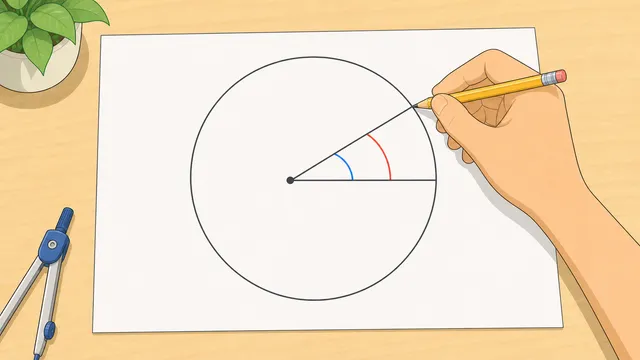
The half-angle calculator applies the half-angle formulas to compute sin(θ/2), cos(θ/2), and tan(θ/2) from an input angle in degrees or radians.
The half-angle formulas
The half-angle identities are: sin(θ/2) = ±sqrt((1 - cos θ) / 2), cos(θ/2) = ±sqrt((1 + cos θ) / 2), and tan(θ/2) = sin(θ) / (1 + cos(θ)) = (1 - cos(θ)) / sin(θ).
The sign of sin(θ/2) and cos(θ/2) depends on the quadrant in which θ/2 falls. The calculator determines the correct sign automatically based on the input angle.
Applications
Half-angle identities are used in calculus to reduce powers of trig functions for integration, in geometry to find exact values of non-standard angles (e.g. sin 15° from sin 30°), and in physics for Fresnel equations in optics.
Worked example and interpretation
A worked example helps translate the half-angle identities for sin, cos, and tan maths into a realistic scenario so the user can compare the headline result with a concrete set of inputs.
That matters because a result is easier to trust when the page shows how the same logic behaves in a practical case instead of leaving the formula abstract.
Because the square root can be positive or negative depending on the quadrant of θ/2. For example, if θ/2 is in the second quadrant, cosine is negative.
How can I check the half-angle identities for sin, cos, and tan result manually?
The safest manual check is to follow the same formula or rule one step at a time and compare that working with the calculator output. That catches sign errors, bracket mistakes, and input-order mixups without requiring any extra method beyond the underlying maths itself.