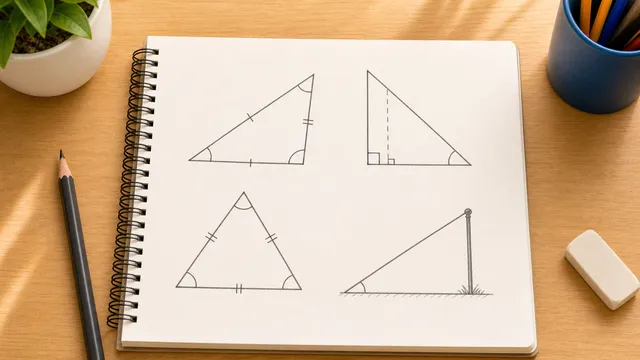
Find triangle area from 3 sides using Heron's formula, then review the semi-perimeter, perimeter, inradius, circumradius, and altitude measures.
Last updated
Find the area of a triangle from its three side lengths using Heron's
formula. This is useful when you know all three sides but do not know a
height or any interior angles.
The calculator also checks the triangle inequality first, then reports
the semi-perimeter, perimeter, inradius, circumradius, and altitudes
derived from the same side lengths.
Quick presets
Formula steps
First find the semi-perimeter: s = (a + b + c) / 2.
Then substitute it into A = √(s(s − a)(s − b)(s − c)) to get the area.
Triangle area
6
For sides 3, 4,
and 5, the semi-perimeter is
6 and the triangle area is
6.
12
Perimeter
6
Semi-perimeter
1
Inradius
2.5
Circumradius
Altitude to side a
4
Altitude to side b
3
Altitude to side c
2.4
Heron's formula working s = (3 + 4 +
5) / 2 = 6 A = √(6(6
− 3)(6 −
4)(6 −
5) = 6
Heron's formula calculator: find triangle area from 3 sides with worked steps
The Heron's formula calculator finds the area of a triangle from 3 sides when you know the side lengths but not a height or angle. It checks that the sides really form a triangle, calculates the semi-perimeter, and then applies Heron's formula to return the area and related triangle measures.
How Heron's formula works
Heron's formula calculates triangle area from the three sides a, b, and c. First compute the semi-perimeter s = (a + b + c) / 2, then the area is sqrt(s * (s-a) * (s-b) * (s-c)).
The formula is attributed to Hero of Alexandria (first century AD) and works for any valid triangle, including obtuse and scalene triangles where the height is not obvious.
That makes it especially useful when the usual area formula, one-half times base times height, is awkward because the height is not given directly. If all you have are the three edges, Heron's formula is often the fastest route to the area.
s = (a + b + c) / 2
Semi-perimeter. This is the specific relationship the calculator applies when building the result.
A = sqrt(s(s-a)(s-b)(s-c))
Area from the semi-perimeter and three sides.
The triangle inequality
Three lengths form a valid triangle only if each side is less than the sum of the other two: a < b + c, b < a + c, and c < a + b. If any condition fails, no triangle exists and the formula produces an imaginary result.
The calculator checks this condition before computing and reports an error if the sides cannot form a triangle.
Worked examples
The classic 3-4-5 triangle has semi-perimeter s = (3 + 4 + 5) / 2 = 6. Substituting into Heron's formula gives A = sqrt(6 × 3 × 2 × 1) = sqrt(36) = 6 square units.
For an equilateral triangle with sides 6, the semi-perimeter is 9 and the area becomes sqrt(9 × 3 × 3 × 3) = sqrt(243) ≈ 15.59 square units. This is the same area you would get from the equilateral-triangle formula, which makes it a good cross-check.
How to interpret the extra triangle measures
Once the area is known, the same side lengths can also produce the perimeter, inradius, circumradius, and altitudes to each side. Those values help when you are moving between triangle-area work, circle geometry, and height-based triangle problems.
Heron's formula is still only a side-length method. It does not replace full triangle solving when you need missing angles or side-angle-side relationships, so use the law of cosines or law of sines tools when the problem gives mixed side and angle data instead.
Frequently asked questions
When should I use Heron's formula instead of base-times-height?
Use Heron's formula when you know all three side lengths but not the height. It avoids the need to construct or compute an altitude first, which is especially useful for scalene or obtuse triangles where the height is not obvious from the diagram.
Does Heron's formula work for right triangles?
Yes. For a right triangle with legs a and b and hypotenuse c, Heron's formula gives the same area as (1/2) × a × b. The right-triangle formula is usually quicker when the perpendicular sides are known, but Heron's formula is still correct when you only have the three side lengths.
What is the semi-perimeter?
It is half the perimeter: s = (a + b + c) / 2. Heron's formula is written in terms of the semi-perimeter because it creates a compact way to combine the three side lengths in one area expression, and the same value also appears in other triangle identities.
What if the sides almost form a triangle but not quite?
Then the triangle inequality fails and the area is not physically meaningful. In practice, this usually means one side is too long compared with the other two, or the numbers were rounded from an earlier measurement. Recheck the side lengths before using the result in any geometry or construction workflow.