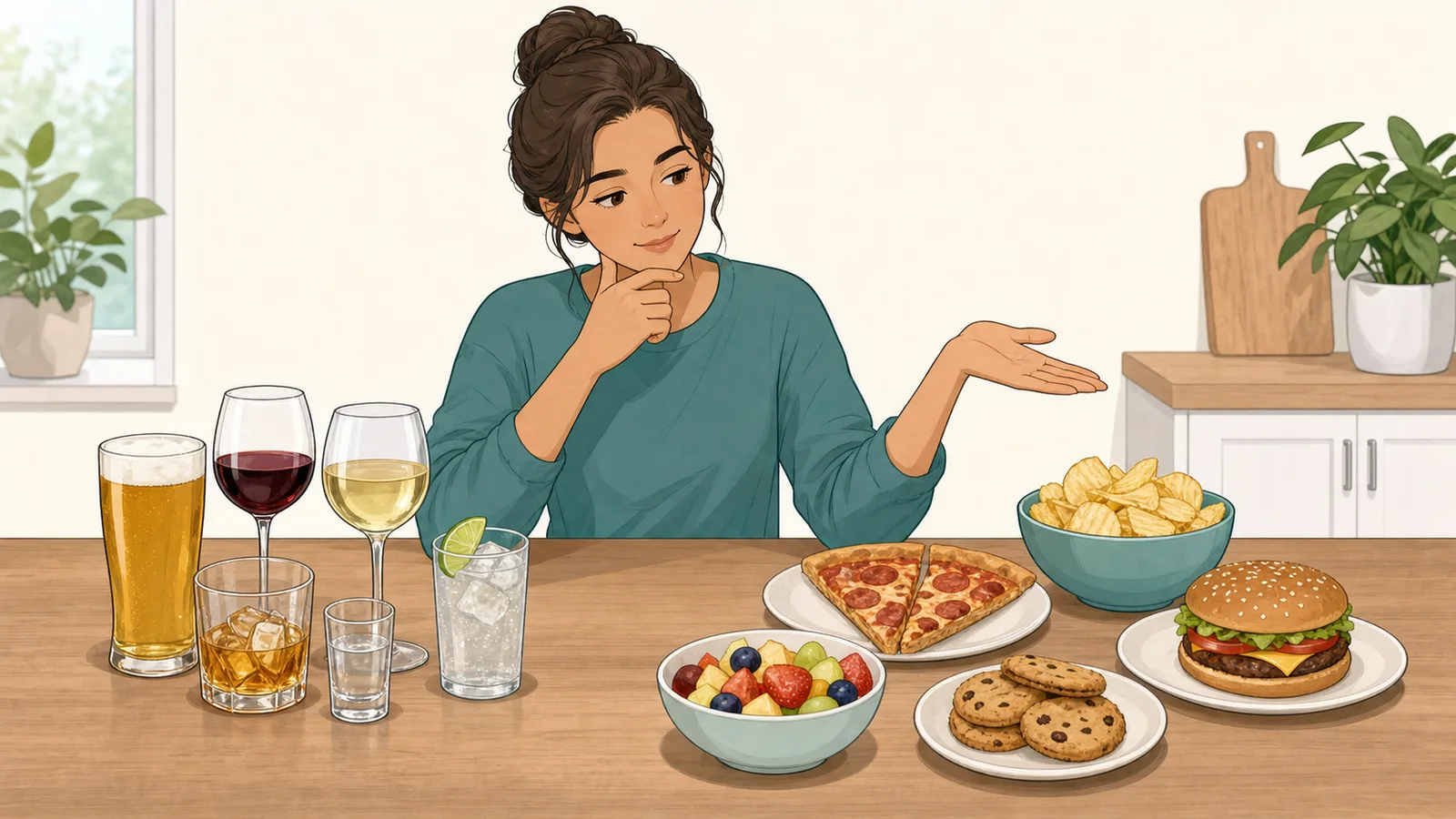
Build a real drink session on-page or paste in a calorie total directly, then translate the result into familiar foods so beer, wine, spirits, and cocktail calories feel easier to picture.
Start with the method that matches what you know Use the session builder when you know the drinks but not the calorie total. Use direct calories when you already have the total from a label, tracking app, or another alcohol calorie calculator.
Input method
Habit context
Set how often this session happens and what daily calorie budget you want the comparison to sit against.
Quick add common drinks
The food-equivalent result updates from the session total below, so you do not need a separate alcohol calorie estimate first.
Drink 1
Name the drink so the comparison reads like the real session.
Drink 2
Name the drink so the comparison reads like the real session.
Result
380 kcal
That is roughly what the same calorie load looks like when translated into common snack and takeaway foods.
2
Drinks in session
74.2%
From alcohol
19%
Of daily budget
190
Average kcal per drink
Session context
One session like this each week would add 380 kcal across the week, or about 1647 kcal across an average month.
A moderate session that can fit into a plan more easily when you count it before the evening instead of after it.
The biggest single contributor in this session is Pint of lager at about 239 kcal.
Context
These 380 calories from alcohol are comparable to the figures above. Alcohol is not inherently "worse" than food calories — the comparison is simply to give a concrete sense of scale, since alcohol calories are often overlooked when tracking intake.
Alcohol food equivalent calculator: drink calories compared with common foods
Alcohol calories often feel abstract until they are compared with familiar foods. This page also explains the main assumptions behind the alcohol food equivalent calculator result, highlights the supporting figures shown by the calculator, and helps the reader use the estimate without overstating what a quick online tool can prove.
Why alcohol calories are easy to miss
Alcohol contributes energy at about 7 kcal per gram, which is why drinks can add up surprisingly quickly even before mixers or sugar-heavy cocktail ingredients are counted. Those calories are also easy to overlook because many people think in units, glasses, pints, or rounds rather than in calories.
That is why rival pages often rank for overlapping phrases such as calories in alcohol, wine calories, beer calories, and alcohol and weight gain. Users are usually trying to translate drinks into something more concrete than a number on a label, especially when the drinking happened socially and was never logged like a meal.
Why food equivalents are memorable
Telling someone that a drinking session contained 500 or 700 kcal is accurate, but it may still not land. Converting the same total into familiar foods makes the comparison more tangible because most people can visualise slices of pizza, croissants, bagels, biscuits, or bowls of rice more easily than a raw calorie figure.
Used properly, that comparison is neutral. It does not mean alcohol and food are nutritionally equivalent, and it does not claim one is morally better than the other. It is simply a communication tool that turns an abstract energy total into a more intuitive mental picture.
What changes the calorie total of a drink
Drink calories are driven by several things at once: alcohol strength, serving size, and whatever else is in the glass. A pint of stronger beer, a large pour of wine, or a double spirit with a sugary mixer can move the total up quickly even when the drink looks ordinary.
This is also why the same category label can hide very different calorie totals. A spirit with diet mixer is not the same as a creamy cocktail. A small glass of wine is not the same as a large restaurant pour. If you are trying to estimate alcohol calories accurately, ABV and volume matter more than the drink name alone.
That is why this calculator now works in two directions. If you already know the calorie total, you can compare it directly with food. If you only know the drinks, the session builder estimates the alcohol and mixer calories first, then turns the combined total into a food equivalent and weekly habit context.
Use the comparison as awareness, not as a guilt tool
The most helpful use of a food-equivalent calculator is to make weekly patterns more visible. Someone may decide that the calories are worth it, decide to drink less often, switch to lower-calorie options, or simply stop forgetting to count a habit that had been invisible in food logs.
What the page should not do is imply that one night out must be 'paid for' with compensation eating. The better question is whether the alcohol calories fit the pattern you want overall. A food equivalent is there to improve awareness, not to encourage punishment or food guilt.
Worked example: 500 alcohol calories from a night out
A 500 kcal session is a useful middle-ground example because it is large enough to matter but not so extreme that it feels unrealistic. At that level, the comparison lands at about 2.2 Mars bars, 3.8 small bags of crisps, or 2 slices of pepperoni pizza. That framing makes the energy load easier to picture than a raw calorie total on its own.
The point is not that a night out is literally the same as those foods. The value is in scale. Once the comparison becomes concrete, it is easier to decide whether the alcohol calories fit your wider weekly intake or whether a smaller pour, fewer drinks, or a different mixer would bring the total back into a range that feels more intentional.
Frequently asked questions
Do alcohol calories count the same way as food calories?
They still count toward energy balance, but alcohol is metabolised differently from carbohydrate, fat, or protein. The body prioritises clearing ethanol, which can temporarily displace the oxidation of other fuels. That does not mean alcohol calories "do not count". It means they enter the system through a different metabolic route while still adding energy overall.
Why can two drinks with similar alcohol units have different calories?
Because alcohol is only part of the total. Serving size, residual sugar, syrups, juices, cream liqueurs, and mixers can all raise calories significantly. Two drinks may carry similar units of alcohol while having very different calorie totals once the non-alcohol ingredients are included.
Should I subtract alcohol calories when tracking macros?
No — alcohol calories should be added, not subtracted. Some tracking approaches assign alcohol calories to carbohydrate or fat macros as a simplification; neither is technically accurate. The clearest approach is to track alcohol as its own category. Most calorie tracking apps have an alcohol entry function. For precision tracking, calculating actual calories using ABV and volume (as this calculator does) is more accurate than relying on standard drink labels.
Are food equivalents saying alcohol is bad?
No. They are there to make the calorie scale easier to visualise. A food equivalent is an awareness tool, not a morality score. If the comparison helps you choose smaller pours, lower-calorie mixers, or fewer drinks, that is a practical benefit, but the main purpose is understanding rather than judgement.
Why can a food equivalent still be useful if alcohol and food are not nutritionally the same?
Because the comparison is about energy scale, not nutrient quality. Alcohol and food affect appetite, micronutrient intake, satiety, and metabolism differently, but translating a drink total into familiar foods can still make the calorie load easier to understand at a glance.
Should I enter drink calories directly or build the session on the page?
Use direct calories when you already have a reliable total from a label, tracking app, or another calculator. Use the session builder when you know the drink types, ABV, pour sizes, quantities, or mixer carbs but do not yet know the calorie total. Both routes end at the same food-equivalent comparison.